
And of course, large urban areas are easier to provide services to and develop employment in. Hull is well connected to a number of cities - Stranraer not so much...Rural settlements whose raison d'etre has gone and reasonably sized cities are rather different, though. The idea of depopulating Hull deliberately would just be a contribution to the housing crisis and is just like the Liverpool vendetta* noted above. It's an OK enough place, it just needs more jobs, which can be done easily enough for places like that by moving civil service functions in.
* Right wingers, most notably Thatcher, always had it in for Liverpool due to the strength of its trade union movement.

-
Our new ticketing site is now live! Using either this or the original site (both powered by TrainSplit) helps support the running of the forum with every ticket purchase! Find out more and ask any questions/give us feedback in this thread!
You are using an out of date browser. It may not display this or other websites correctly.
You should upgrade or use an alternative browser.
You should upgrade or use an alternative browser.
Voluntary or potentially compulsory depopulations in the UK?
- Thread starter Bletchleyite
- Start date
Sponsor Post - registered members do not see these adverts; click here to register, or click here to log in
R
RailUK Forums

Baxenden Bank
Established Member
- Joined
- 23 Oct 2013
- Messages
- 4,770
Kielder village is a recent British example. It was built to serve the surrounding forestry. That industry changed to a owner/contractor model rather than employer/employee based model so it ceased to have a purpose as a forestry settlement. It had, at one point, a very generous 'per head' regeneration budget to try and diversify the economy rather than 'shut up and ship out' the population.
Similar examples would include Kinlochleven (former aluminium smelter), the estates at Corpach near Fort William built to serve the former pulp / paper mill and plenty of rural towns where a key large employer has closed down. People don't move out because they have roots in an area. Many of them may be at / approaching retirement so there is no need to move but you get problems associated with an ageing population.
Similar examples would include Kinlochleven (former aluminium smelter), the estates at Corpach near Fort William built to serve the former pulp / paper mill and plenty of rural towns where a key large employer has closed down. People don't move out because they have roots in an area. Many of them may be at / approaching retirement so there is no need to move but you get problems associated with an ageing population.
Last edited:

HSTEd
Veteran Member
- Joined
- 14 Jul 2011
- Messages
- 20,409
I agree that housebuilders are acting in their own Interest to sustain artificially high profit margins, but I view the planning system as their primary weapon to achieve this.The planning system has not (generally) created a housing shortage. Housebuilders have created a housing shortage, it is in their interest to do so as a shortage leads to higher prices at much the same build cost, kerching.
The only reason they can retain a stranglehold on the supply of housing is because they have used their legal muscle and resources to obtain a bulk of the land on which planning permission has been granted.
If it was possible for someone to buy a slice of agricultural land and then order a prefab or manufactured house from IKEA (other catalogues are available), then the conventional housebuilders would be forced to build or die.
But this is at risk of derailing the thread.
Bletchleyite
Veteran Member
Kielder village is a recent British example. It was built to serve the surrounding forestry. That industry changed to a owner/contractor model rather than employer/employee based model so it ceased to have a purpose as a forestry settlement. It had, at one point, a very generous 'per head' regeneration budget to try and diversify the economy rather than 'shut up and ship out' the population.
Kielder village still seems to exist, though.
== Doublepost prevention - post automatically merged: ==
A relatively modern example would be Cassiar in Canada. A town built to serve an asbestos mine. The mine closed, the town closed, the houses got bought and trucked out.
That of course is a unique thing about North America - houses are in effect large static caravans and can be jacked up, shoved onto the back of a large lorry and relocated as desired. You can't do that with a traditional British brick house in an economic manner.
Will "just moving jobs in" deliver that, though? If you move a load of civil service (i.e. white collar) jobs in from elsewhere, how is that going to generate the work for long term unemployed in the place where those jobs are coming to? Not in theory (we can all cite multiplier effects), but in hard reality. And does that then actually help the people who are losing out because of long term economic problems.Rural settlements whose raison d'etre has gone and reasonably sized cities are rather different, though. The idea of depopulating Hull deliberately would just be a contribution to the housing crisis and is just like the Liverpool vendetta* noted above. It's an OK enough place, it just needs more jobs, which can be done easily enough for places like that by moving civil service functions in.
* Right wingers, most notably Thatcher, always had it in for Liverpool due to the strength of its trade union movement.
There is a shortfall of supply in many places, and surpluses in other places are frequently irrelevant. I grew up in Southfields, where Edwardian housing was threatened with demolition ~50 years ago; prices are now ridiculous. What changed was demand, where those houses came to be in demand, and drove a price spiral.The planning system has not (generally) created a housing shortage. Housebuilders have created a housing shortage, it is in their interest to do so as a shortage leads to higher prices at much the same build cost, kerching.
Also higher prices, supported by an over-excited / under-cautious financial services industry lending at ever increasing loan ratios and salary multiples have created an affordability problem. In some, perhaps many, parts of the country there remains a healthy supply of properties to buy. Affordability is the issue not supply.
There are numerous places where there is a measurable surplus of empty properties (for example the referred to part abandoned pit villages) where the asking price simply doesn't follow market demand/supply rules where properties should reduce to reflect the lack of demand.
Relating to this thread, relocating the population of Fairbourne to Stoke-on-Trent, nay problem, it would merely soak up a few of our 5,000 or so long-term voids!
At a national level, the availability of property is heavily constrained and the number of empty properties is well below comparable European countries* - which further reinforces lack of mobility.
* - before someone says "social housing", it's also worth note that the proportion of social housing in the UK is well above European norms.
Bletchleyite
Veteran Member
Will "just moving jobs in" deliver that, though? If you move a load of civil service (i.e. white collar) jobs in from elsewhere, how is that going to generate the work for long term unemployed in the place where those jobs are coming to? Not in theory (we can all cite multiplier effects), but in hard reality.
The fact that if you relocate jobs from London to Hull, most people won't move, and will instead switch to other jobs in London where they're more plentiful.
That's making a big assumption about the jobs being transferable, and the impact of the changes being positive. I'm not convinced that past precedents for that kind of implanted growth are as successful - in your home patch in the NW, my experience was that Merseyside regeneration relied heavily on organic growth, rather than transplants from elsewhere - and if that transplant model did work, why is Skem still struggling?The fact that if you relocate jobs from London to Hull, most people won't move, and will instead switch to other jobs in London where they're more plentiful.
Bletchleyite
Veteran Member
if that transplant model did work, why is Skem still struggling?
The problem with Skem is that it worked on the basis that people would live, work and play within the confines of one small town. This model proved an abject failure - simply because a job isn't just a job, people need one that fits their skillset etc. That has also been the problem with other small new towns like Peterlee. Yes, you could ship in civil service jobs (and the Co-op Bank did provide a range of clerical type jobs until recently) but that doesn't really provide enough of a range in a small town. There is work, but unless you have specific skills relating to the industry there it's going to be minimum wage.
Hull is a medium sized city and just by contrast needs a bit of a boost.
Kirkby (as 1960s overspill a bit like Bletchley) probably gives you an idea of how you might regenerate Skem a bit, but fundamentally what it needs is trains to Liverpool, even if that's just done by extending Merseyrail to Wigan and running a shuttle bus to an upgraded Upholland. Yes, it's 11 minutes' drive to Maghull North, but not everyone owns a car and people prefer to live directly on the railway so people won't choose it.
Also, housing estate wise, it's a bit of a dump with poor quality housing, so you'd have to do some heavy redevelopment to make it desirable.
The biggest mistake with Skem was not building it a few miles south straddling the railway. I don't think Milton Keynes would have worked as well if that was 10 miles south with no rail connection - its economic strength comes mostly from easy access to London. Kirkby isn't *lovely*, but it's seen a lot of investment and the railway means it has access to the much wider employment available in Liverpool even if you lack a car.
As you highlight, local specifics are key. Which is why the example of Hull, which was in my early 1990s geography syllabus and is still suffering many of the same issues, needs much more thought - including over the economic incentives to stay or leave.

But are those larger number of empty properties in comparable European countries not in part a sign that they also have areas where no one wants to be (Italian or French villages, swathes of estates in blighted East German towns etc)At a national level, the availability of property is heavily constrained and the number of empty properties is well below comparable European countries* - which further reinforces lack of mobility.
* - before someone says "social housing", it's also worth note that the proportion of social housing in the UK is well above European norms.
I honestly don't know how that spare capacity is distributed. But the suggestion, which I regard as credible, is that a reason for high British house prices is that supply is severely constrained compared to demand because there isn't capacity within the housing market. Where there is surplus capacity (Stoke's been mentioned, there have been similar very cheap house sales in Tyneside), some housing is almost impossible to even give away - which reinforces the argument that it is the supply where people want to live that matters.But are those larger number of empty properties in comparable European countries not in part a sign that they also have areas where no one wants to be (Italian or French villages, swathes of estates in blighted East German towns etc)
Baxenden Bank
Established Member
- Joined
- 23 Oct 2013
- Messages
- 4,770
The response always seems to be on the supply side (build more) rather than the demand side. If there is an overall net deficit across the country, then more houses need to be built, otherwise affect demand instead. Encourage relocation of businesses away from over-heating parts of the country. The people will follow the jobs or retrain people in the area being relocated to. Why pay £800,000 for a semi in Surrey when you can pay £400,000 for the best detached in Stoke!I honestly don't know how that spare capacity is distributed. But the suggestion, which I regard as credible, is that a reason for high British house prices is that supply is severely constrained compared to demand because there isn't capacity within the housing market. Where there is surplus capacity (Stoke's been mentioned, there have been similar very cheap house sales in Tyneside), some housing is almost impossible to even give away - which reinforces the argument that it is the supply where people want to live that matters.
And yes, @Bletchleyite we can poke your eyes out with a rusty nail for you, all included in the relocation package! Seriously Stoke-on-Trent conurbation is something of a dump and getting worse by the hour. But within a handful of miles there are beautiful areas. I'm trapped here. All donations gratefully received.
Bletchleyite
Veteran Member
I honestly don't know how that spare capacity is distributed. But the suggestion, which I regard as credible, is that a reason for high British house prices is that supply is severely constrained compared to demand because there isn't capacity within the housing market. Where there is surplus capacity (Stoke's been mentioned, there have been similar very cheap house sales in Tyneside), some housing is almost impossible to even give away - which reinforces the argument that it is the supply where people want to live that matters.
It is yes. But the main reason people want to live in the South East is that that's where much of the work is. I don't think people actually like the vast swathe of nondescript, overpriced commuter towns circling London.
There also seems to be more of a culture of moving there, meaning that settlements can exhibit noticeably wider population swings than we really get in this country. Consider places like Cairo, Illinois - the history there is particularly stark and bleak, with population falling from 15,000 in the early 20th century to about a tenth of that now. Since 1950, the population has consistently declined by about 20% per decade. Gary (a satellite town of Chicago) and Detroit have also lost populations steadily since that time. Cairo is probably closest to the Stranraer example - it's an obvious location for a port (being where two major rivers meet) but flooding, racial tensions, and a decline in river trade all have caused the place to decline - there's still a town there (just about) but no-one would choose to live there.That of course is a unique thing about North America - houses are in effect large static caravans and can be jacked up, shoved onto the back of a large lorry and relocated as desired. You can't do that with a traditional British brick house in an economic manner.
As a rough comparison, typical US cities (such as Milwaukee, Pittsburgh, or Baltimore) seem to have about 15% of their population moving each year. Here, the figures are generally a bit lower (typically 10% other than in areas with a lot of students).
Bletchleyite
Veteran Member
And yes, @Bletchleyite we can poke your eyes out with a rusty nail for you, all included in the relocation package! Seriously Stoke-on-Trent conurbation is something of a dump and getting worse by the hour. But within a handful of miles there are beautiful areas. I'm trapped here. All donations gratefully received.
To be fair most towns have good and bad bits. Blackpool for example has a very bad name and is one of the cheapest towns in the north west to live in. However that does mean you can get some bargains, and to the north really solid semis are avaiable very cheap in quite nice, leafy areas, provided you don't mind your town centre being an absolute dive.
Some do, some don't. And many move out when the opportunity arises (as I did).It is yes. But the main reason people want to live in the South East is that that's where much of the work is. I don't think people actually like the vast swathe of nondescript, overpriced commuter towns circling London.
But there's a difference between a general rebalancing of work so that people aren't so inclined to move to the south east, and dealing with specific issues in "left behind" places. Those who've been "left behind" are frequently the least able to change up or move in pursuit of something else, which reinforces the deprivation when the economy declines - see Detroit for a really bad example
HSTEd
Veteran Member
- Joined
- 14 Jul 2011
- Messages
- 20,409
Governments have been trying to move jobs around by fiat for decades and so far it hasn't really worked.The response always seems to be on the supply side (build more) rather than the demand side. If there is an overall net deficit across the country, then more houses need to be built, otherwise affect demand instead. Encourage relocation of businesses away from over-heating parts of the country. The people will follow the jobs or retrain people in the area being relocated to. Why pay £800,000 for a semi in Surrey when you can pay £400,000 for the best detached in Stoke!
And yes, @Bletchleyite we can poke your eyes out with a rusty nail for you, all included in the relocation package! Seriously Stoke-on-Trent conurbation is something of a dump and getting worse by the hour. But within a handful of miles there are beautiful areas. I'm trapped here. All donations gratefully received.
The cheap houses are in places that have lost their economic raison d'etre and we can't easily recreate it.
We don't need hundreds of thousands of people working in coal mines or millions working in the fields.
It appears that a lot of the service and other such jobs of our age work well in large urban agglomerations where complex economic website can easily come into existence.
Cities create economic activity through agglomeration, you can't just dismantle London and forcibly redistribute it's economic activity, or even a portion of it, without serious consequences.
In any case, Shelter put the deficit of housing units as several million, whilst the number of long term empty properties is in the low hundreds of thousands.
EDIT:
To illustrate my point, if we create an extreme thought experiment that had some new technology that made housing cheap provide anywhere we wished, but otherwise kept everything the same, what would happen?
Currently only about half a million people are involved in things like onshore mining and agriculture, and fishing is increasingly done with long distance vessels.
I think urbanisation would probably climb to something like 99% and London would end up with a large majority of the population.
Bletchleyite
Veteran Member
It appears that a lot of the service and other such jobs of our age work well in large urban agglomerations where complex economic website can easily come into existence.
We have several large urban agglomerations of course, not just London. We have the Bristol area, the West Midlands, the North West, west Yorkshire and Tyne and Wear.

Egg Centric
Established Member
I think this is one of those things where on a utilitarian/technocratic basis there are strong arguments that some settlements should just be abandoned. I often wonder about some of the former pit villages in County Durham the likes of Horden or Blackhall Colliery (nominative determinism?). Once the mines shuttered in the late 80s and early 90s what was realistically the point of these settlements anymore? They either didn't exist prior to the mines or were little more than hamlets with a couple of cottages before the mines. Why bother pouring resources into settlements with no purpose? They seem to just now be misery factories to a great degree. We spend vast sums of money on enabling people to live in unremitting poverty for several generations in a row at this point. Wouldn't it be better spent on moving people to places where there is more opportunity?
But, life and humans in general aren't very good at being utilitarian/technocratic. Perhaps its just me but the thought of Horden colliery closing in 1987 and then in 1988 we load the 8,000 odd residents onto buses and ship them around the country to towns and cities feels wrong, feels like something a Fascistic or Stalinist regime would do. The forced displacement of people is something which has a nearly unremittingly dark and grim history. Both here at home but also abroad. Even when done with good intentions it seems to wind up causing tremendous damage. Equally the idea of just saying that you can continue to live in Horden but we're not going to be providing you with any financial support, no benefits, nada unless you move hardly feels equitable either.
Somewhere like Horden can effectively survive in the modern era because we have a welfare state even though the settlements themselves are now exist after their purpose for being created (or expanded) has gone. 100 years ago if Horden colliery had shuttered, the people living in Horden would have depopulated the village themselves because they'd have to find another way of supporting themselves. But is that really a good thing? The sort of poverty we had a 100 years ago makes poverty of today look like a life of luxury. I'm not convinced going back to that is sensible for anyone.
I often wonder about them too. The big issue I see is that ironically people do move from them so they get worse every generation as those remaining become more and more desperate and incapable (that sounds a bit eugenic but I'm not sure how else to phrase it).
The only solution really is to bring them jobs but that doesn't seem a great use of resources, honestly - why would any employer want to recruit from somewhere that's gone as downhill as Horden? Who can you recruit? So you either end up handing over piles of subsidies to employers who will sod off the moment you stop doing this, or you do something more or less the same in the public sector, just as wastefully.
I don't see anything other than bad options really and maybe in that context the whole category D thing wasn't so terrible.
Baxenden Bank
Established Member
- Joined
- 23 Oct 2013
- Messages
- 4,770
Remploy type employment, that is the old version which was sheltered workshops for the disabled, or similar activities dealing with rehabilitation of people having had a severe illness, an accident or military casualties. Or NACRO for ex-offenders. Strong, structured 'pathways to employment' rather than lifelong benefit dependency or just bunging a zero-hours employer some cash to employ people.I often wonder about them too. The big issue I see is that ironically people do move from them so they get worse every generation as those remaining become more and more desperate and incapable (that sounds a bit eugenic but I'm not sure how else to phrase it).
The only solution really is to bring them jobs but that doesn't seem a great use of resources, honestly - why would any employer want to recruit from somewhere that's gone as downhill as Horden? Who can you recruit? So you either end up handing over piles of subsidies to employers who will sod off the moment you stop doing this, or you do something more or less the same in the public sector, just as wastefully.
I don't see anything other than bad options really and maybe in that context the whole category D thing wasn't so terrible.
Egg Centric
Established Member
Remploy type employment, that is the old version which was sheltered workshops for the disabled, or similar activities dealing with rehabilitation of people having had a severe illness, an accident or military casualties. Or NACRO for ex-offenders. Strong, structured 'pathways to employment' rather than lifelong benefit dependency or just bunging a zero-hours employer some cash to employ people.
That's less demeaning than being on the dole but not a great way to run a self respecting community is it?
It's almost like an "open prison" version of a workhouse.
One crazy "blue sky" idea I just had that can probably be torn to pieces in minutes - eventually I've no doubt we'll legalise drugs, starting with cannabis (which is - whisper it cause almost no one has noticed this - already de facto legal if you're middle class and get the right private GP). Perhaps we could start off by only licensing the first dispensaries or whatever in places like that. Would play to many of the inhabitants strengths and get a pile of cash flowing in.

GusB
Established Member
To begin with, I have to say that I really don't agree with the mentality that country folk should give up and move to the city because it costs so much more to provide people with services. There are some industries (agriculture for a start) that are rural by nature and can't easily be moved. You also have to consider the various supporting businesses; while they may not create an "economic powerhouse" in the same vein as big cities like London, they're still very necessary to their local economies.
Secondly, isn't it incredibly wasteful to abandon a settlement when there is a national shortage of housing? The traditional infrastructure (water/sewerage/electricity etc.) is already there but provision of "new" infrastructure (such as broadband internet) takes much longer and this holds people back. You don't have to live in London to have a successful internet business, but you do need to have a connection that's a bit better than dial-up.

Secondly, isn't it incredibly wasteful to abandon a settlement when there is a national shortage of housing? The traditional infrastructure (water/sewerage/electricity etc.) is already there but provision of "new" infrastructure (such as broadband internet) takes much longer and this holds people back. You don't have to live in London to have a successful internet business, but you do need to have a connection that's a bit better than dial-up.
This is more purple haze than blue sky, methinksOne crazy "blue sky" idea I just had that can probably be torn to pieces in minutes - eventually I've no doubt we'll legalise drugs, starting with cannabis
HSTEd
Veteran Member
- Joined
- 14 Jul 2011
- Messages
- 20,409
Well agriculture doesn't seem to employ that many people now. The last time I saw stats it was something like a half million, overwhelmingly composed of farmers and their spouses.To begin with, I have to say that I really don't agree with the mentality that country folk should give up and move to the city because it costs so much more to provide people with services. There are some industries (agriculture for a start) that are rural by nature and can't easily be moved. You also have to consider the various supporting businesses; while they may not create an "economic powerhouse" in the same vein as big cities like London, they're still very necessary to their local economies.
You'd probably get a few tens do thousands of other people maintaining things like power, water and transport systems, but the population of rural and semi rural areas servicing systems that cannot be evacuated would probably be well under a million.
It might be a great deal less than that if very unproductive farming areas were allowed to go fallow (for example a lot of sheep farms in the hills produce very little per hectare).
To some extent I agree that abandoning the housing is a bs idea. But I believe solving the housing crisis nationally would probably lead to these areas depopulating naturally over time.Secondly, isn't it incredibly wasteful to abandon a settlement when there is a national shortage of housing? The traditional infrastructure (water/sewerage/electricity etc.) is already there but provision of "new" infrastructure (such as broadband internet) takes much longer and this holds people back. You don't have to live in London to have a successful internet business, but you do need to have a connection that's a bit better than dial-up.
It would be important fo government to ensure this occurs in an orderly fashion to avoid areas being stuck with no working age people and elderly/sick left with no facilities and no way to afford to leave.
When I saw the title of the discussion, Stanford is where I thought of first. It has a railway link in that, during the days of National Service, lots of troops trained there arriving and departing by troop train at Brandon.Imber is famous because of the buses but STANTA (STANford Training Area) has no fewer than six evacuated and depopulated villages.
Stanford, Buckenham Tofts, Langford, Sturston, Tottington, and West Tofts.
They're discussing which towns might need to be compulsorily purchased, and replaced with reservoirs. Rivers drying up in the summer, and flooding in the winter, means we need more storage, and there's very little empty land in the UK.
One of the reasons that we have built so few reservoirs in recent years is that it became increasingly difficult to find rivers where dams could be built without flooding villages.
This became a political issue in Wales a long time ago. The Llyn Celyn dam, which flooded the village of Capel Celyn, and part of the Bala-Ffestiniog railway, is often cited as one of the key events in the development of Plaid Cymru.
A bit more recently Rutland Water involved demolishing then flooding the villages of Nether Hambleton and Middle Hambleton, parts of which were revealed this year as water levels dropped in the drought:
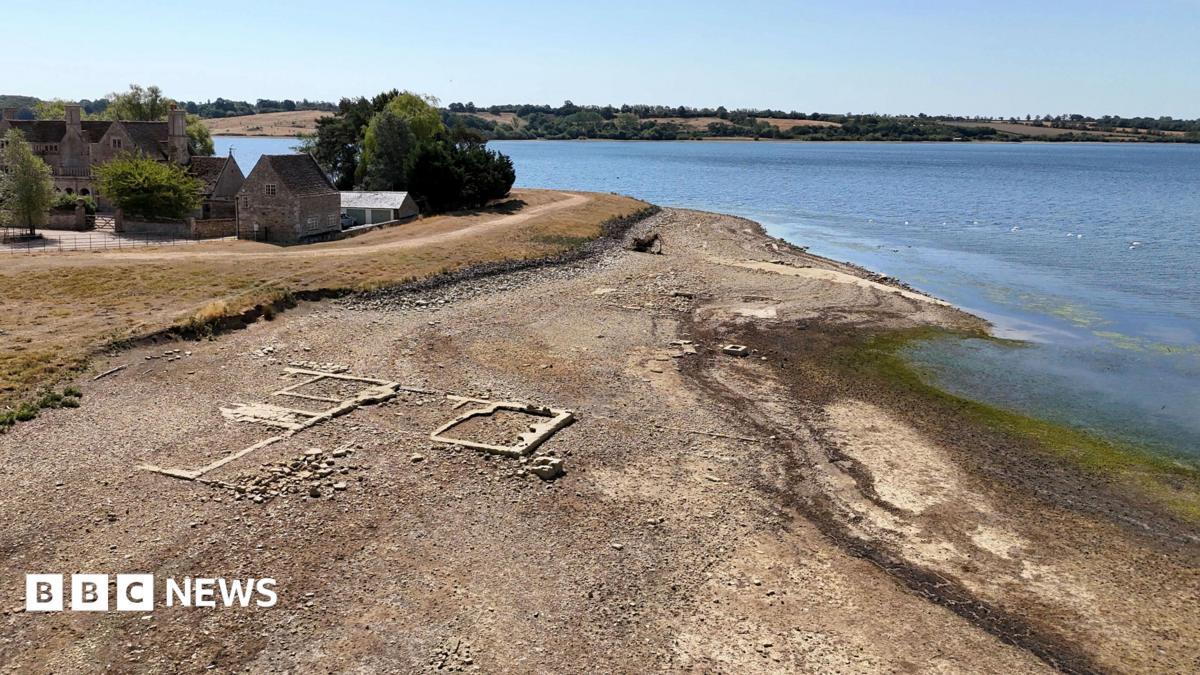
Lost village revealed as drought lowers Rutland Water reservoir levels
Low levels uncover the remains of the buildings, which were once part of the village of Nether Hambleton.
 www.bbc.co.uk
The remains of a lost village that was demolished and flooded to create a reservoir have been revealed as the country continues to face drought conditions.
Low water levels at the Rutland Water reservoir have uncovered buildings, which were once part of the village of Nether Hambleton.
Residents, along with other small villages including Middle Hambleton, were relocated to other areas before the buildings were demolished and the area flooded in the 1970s to create the reservoir.
They're discussing the price point of defences. How many houses are worth building a sea wall?
Properties being demolished before they fall into the sea is already happening in Norfolk and Suffolk:

Fourteen clifftop homes in Hemsby are facing 'imminent collapse'
Hemsby residents are told their homes should not be occupied due to a risk of further cliff falls.
www.bbc.co.uk
Residents of more than a dozen clifftop properties have been told to get out immediately because their homes are at risk of "imminent" collapse.
Glenda Dennington, 80, and her husband are among those who have been told by Great Yarmouth Borough Council to leave their homes in Hemsby, Norfolk, after recent bad weather caused more than 10m (32ft) of the cliff to fall away.

Six more Thorpeness homes face demolition as cliff crumbles
The council says erosion has reached "critical safety levels" in a holiday village.
www.bbc.co.uk
Six more homes on a crumbling clifftop are being demolished after erosion reached "critical safety levels".
East Suffolk Council said demolition work has had to begin to take down a block of five apartments and a detached home in Thorpeness.
The homes on Tinkers End are off North End Avenue where five other properties have been removed since 2022.
This is already happening with river flooding too, see this story from Chesterfield:There will be streets in villages all over the country where these five houses will be protected, because it's financially viable, but those five on the other side of street won't be.

Plans to demolish all homes on flood-hit Chesterfield street approved
It comes after Maureen Gilbert, 83, died when her Tapton Terrace home was flooded in October 2023.
www.bbc.co.uk
Plans for a council to purchase and demolish homes on a street where a woman drowned when water filled her home have been given the green light.
Maureen Gilbert died after her house in Tapton Terrace, Chesterfield, Derbyshire, flooded in October 2023 when the nearby River Rother burst its banks.
Chesterfield Borough Council voted unanimously at a meeting on Wednesday to approve the flood risk management project for the street, which has suffered flooding problems since at least 2007.
The council said it would take "a lead role" in delivering the project in partnership with the Environment Agency, which seeks to remove the risk to life by demolishing the properties.