This whole discussion is based on a false premise - that the stretch between Basingstoke and Reading Oxford Road Junction is the limiting factor in track capacity for traffic between the south coast and off the Newbury route on the one hand and London, the Midlands and the North on the other. This has not been proven - no specific bottlenecks have been identified and no attempt to compare how much additional income could be generated by the proposed changes and what the cost for some of these proposals might be. At a time when the Government is paying 6% interest on 30 year borrowings these become very important considerations. Without some grounding in reality such a discussion is not speculation, it is day dreaming.
A valid question to ask, so what rail use in the area.
For just passengers it's:
2tph Newbury
2tph Basingstoke
1tph Plymouth/Cornwall
1tph XC Bournemouth
1tph Exeter semi fast/ former XC Southampton
That's 7tph in each direction before you consider freight and the junctions.
As such it's not too unreasonable to assume that here is a significant constraint.
At Basingstoke, as has been pointed out, the flat junction is more constrained by the Stoppers from Waterloo occupying platform 1 for a significant portion of the hour and them crossing than probably most other movements.
Actually the Stoppers to Waterloo at Basingstoke are fairly easy to deal with (turn them back at a new station at Oakley or at Andover - the latter would create a good overlap between stations either side of Basingstoke and could allow the speeding up of the Yeovil services).
Certainly it wouldn't be the only place where more capacity was needed to improve freight capacity (and there's a need for that from Southampton, even National Highways suggest that rail capacity is better than getting to do anything with the M3 beyond junction 9 rebuild currently underway).
Up to Basingstoke freight could be routed via Andover to give a few extra paths.
If there's more needed at Basingstoke, add a freight loop West of the station to allow P4 to be bi direction and add a grade separated flyover to the down (southern side tracks) as the first phase.
If there's more capacity needed then create the extra lines behind (North) of P5.
Passenger enhancements would ideally be 6tph for local services and 2tph for long distance services made up of:
2.5tph Newbury locals
2.5tph Basingstoke
1tph Newbury/Southampton to Paddington (either 1tph which splits joins or 0.5tph to each)
1tph Exeter semi fast (may need to only run to Reading 0.5tph due to path constraints)
1tph Plymouth/Cornwall
The Basingstoke services are very busy at peak times and can be well loaded even fairly late into the evening, so extra frequency on that corridor would be useful.
This is connecting 2 significant urban areas where there's significant road congestion and when the rail strikes were happening road congestion got significant worse.
As such better connectivity and frequencies would likely generate significant economic benefits.
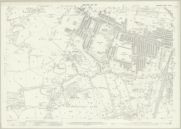
The aqua line goes very close to, if not through people's gardens. The cutting is deep at points and the trees attenuate the noise from the railway, but there is housing that's extremely close to the boundary - along Western Elms Avenue, Josephine Court and Kenilworth Avenue (which is actually a private road).
The most space is at the point where the old branch line splits off - the alignment for that is still fairly intact and could be built over (there's one house in the way, by the underbridge on Southcote Lane).
I don't think you could build the flyover on the side suggested and the level of earth moving required would be extremely disruptive & destabilising.
In any case, it would require demolishing Reading West, the station that's just been rebuilt, and replacing the bridge over Oxford Road.
If you look at the images of Bath Road Bridge previously linked up thread, the central portal is like 70 brick courses to the start of the arch when full electrification clearance needs 64 brick courses, that doesn't sound much until you remember that there's at least 10 courses for the arch which is fairly flat. As such, even if we needed to start the ramp prior to the bridge that's not necessarily an issue.
I do, however, wonder if we do something a little more controversial.
Keep a flat junction for freight movements but send the (hopefully) EMU's (Basingstoke/Reading service) up and over the top.
This does three things:
- removes 3tph (Basingstoke services and XC services) from the existing junction, with these being able to be without needing any extra capacity at the junction
- puts the quieter services nearer to the houses, but given that we get rid of diesel passenger services the overall noise impact may still be lower for the residents
- could have freight time limitations, so may not have any freight using the higher level paths outside a set room (say nothing 21:00 - 07:00) as during that time flows are light enough that the flat junction can cope just by removing the passenger services from it