AHBD
Member
Why is there seemingly so little detailrfef information available on how SRAWS (Signal Repeating/Southern Region AWS) worked and was implemented?

Unfortunately both YouTube videos on that thread seem to be blocked now.Being aware it was tested on the Styal line, web search found me this thread including a video: https://www.railforums.co.uk/threads/in-cab-signalling-1972.128934/
Search for "British Transport Films Cybernetica" finds some hits so it may be available elsewhere, but I haven't dived into the details.Unfortunately both YouTube videos on that thread seem to be blocked now.

But surely their are some engineers/ managers etc notes drawings documentatiin presentations etc somewhere ?Was it ever implemented? Other than perhaps a few test sites and test trains. If it never made it beyond a few tentative trials, the information wouldn't have been distributed very widely.
I have some rectangular indicator - push buttons that I rescued from being skipped, separate ones for each signal aspect including sub. I was told by the person binning them that they were off a SRAWS test rig. I was working at Derby Engineering School at the time, and we occasionally got "useful" bits from our contacts in Research down the road.
The CAWS system that the Republic of Ireland* bought in from the USA, is similar in showing current authority level but seems to have only one button, so presumably SRAWs could have reduced the buttons: perhaps just 2 by using a different button for single yellow or red, with a current authority display.
== Doublepost prevention - post automatically merged: ==
I am dubious about how effective SRAWS would have been. Aside from the issue of trains routinely running on double yellows.
Drivers currently only have⁶ one control to acknowledge an AWS warning. Having to find the right button out of a selection of five would have distracted drivers from observing the route ahead, putting them under pressure to do it quickly. I suspect that it would have turned into a quick reaction test: just press whichever button is flashing as quickly as possible. Without necessarily taking cognisance of what aspect it is referring to. And simultaneously distracting attention away from observing the actual aspect outside.
The IRSE would be the obvious place but search doesn't seem to throw up anything useful.But surely their are some engineers/ managers etc notes drawings documentatiin presentations etc somewhere ?
Northern Ireland does have TPWS fitted to some signals. Trains running the cross-border Enterprise service must have both CAWS and AWS/TPWS fitted. CAWS will eventually be replaced by ETCS L1, the first stage of which has been fitted between Dundalk and Greystones (mainly to replace the DART ATP system). Presumably new stock will be expected to be ETCS fitted, and would use ETCS instead of CAWS where able.*Northern Ireland has some AWS** but trains heading South to visit the Republic of Ireland must have CAWS fitted. **not sure if any TPWS yet?
I was fairly sure that it had been trialled somewhere on the Southern, but couldn't remember where, but now you mention it, I am fairly sure you are right about Surbiton to Woking.IIRC, it was also tested on the South Western Main Line between Surbiton and Woking.
But surely their are some engineers/ managers etc notes drawings documentatiin presentations etc somewhere ?
No, I didnt know of it....
Have you tried asking on the Signalling Record Society forum?

The SRS Forum is only open to members. But the archives can be searched by anyone. Or ask the Webmaster for help - see SRS Home Page......Have you tried asking on the Signalling Record Society forum?
This website has some details and a photo of the cab console.I was fairly sure that it had been trialled somewhere on the Southern, but couldn't remember where, but now you mention it, I am fairly sure you are right about Surbiton to Woking.
Southern Region/Signal Repeating AWS (SRAWS)
Originally called "Southern Region AWS", its name was later changed to "Signal Repeating AWS". The SRAWS system repeated the next signal's aspect (and displayed a reminder of the previous signal's aspect) on an indication inside the cab. Any aspect other than green had to be acknowledged by the driver pressing the correct button that corresponded to the indication on display. If the driver did not acknowledge the indication, or the wrong button was pressed, an automatic brake application was initiated. The risk of error from subconscious cancellation was therefore greatly diminished.
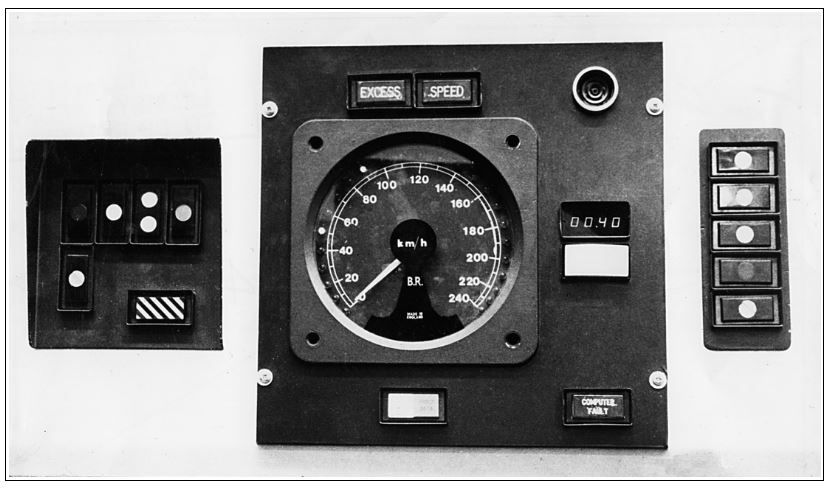
Above: SR AWS Cab setup. Development of SR-AWS, with signal past indications on left and signal approach indications on right. Note the km/h only calibrated speedometer.
During 1971 an experimental form of cab signalling (SRAWS - Signal Repeating AWS) which was being trialled in the up-direction between Byfleet [it may have been Woking] and Raynes Park (as well as in the New Forest area). The cab layout showed the driver the aspect of the next signal and the one that the train had just passed. Its used a coax aerial loop figure of eight in the track with a frequency module in the signal location to pass a radio frequency code to the train depending on the signal aspect. Development of SRAWS ended in 1975 when the British Railways Board dictated that the Southern Region should equip its lines with standard BR AWS.
The second video can be found here https://archive.org/details/bbc-horizon-08-28-rail-crash-8-may-1972 From 46.10.Unfortunately both YouTube videos on that thread seem to be blocked now.
Riding on an A class loco towards Dublin in the 1980s, as soon as we got to Greystones the driver grabbed a kitchen roll, folded a couple of sheets of paper, slid them behind a conduit and blanked ‘the damn thing’ off.The CAWS system that the Republic of Ireland* bought in from the USA, is similar in showing current authority level but seems to have only one button,
I did suggest 2 buttons later...Riding on an A class loco towards Dublin in the 1980s, as soon as we got to Greystones the driver grabbed a kitchen roll, folded a couple of sheets of paper, slid them behind a conduit and blanked ‘the damn thing’ off.
The CAWS TC code frequencies used and the onboard inductive pickup technology are identical in principle to those of the pioneering 1920s Pennsylvania RR system, developed by Union Switch & Signal.The CAWS system that the Republic of Ireland* bought in from the USA, is similar in showing current authority level but seems to have only one button, so presumably SRAWs could have reduced the buttons: perhaps just 2 by using a different button for single yellow or red, with a current authority display.
Only 3 lines retain tradition token operation - Ballybrophyn to Killonan Junction via Nenagh, Limerick Junction to Waterford West Junction, and the section of the Tara branch from Platin to Tara. All 3 see extremely limited traffic. The vast majority of the IÉ network is TCB, and all new lines would be TCB or successor regulations, no new token working would be introduced.CAWS has not proved economical for many of Ireland's long rural single-track lines. The system needs continuous track circuiting to function at all, and individual track circuits of the type employed can be no longer than 1500m. ... Traditional token or tablet operations, by contrast, require little if any intermediate equipment.
I certainly wasn't advocating any new token systems, just highlighting how unsuitable a fully track-circuited solution using traditional technology was for long single tracks! Token working hung on for much longer than expected on many other lines because of that.Only 3 lines retain tradition token operation - Ballybrophyn to Killonan Junction via Nenagh, Limerick Junction to Waterford West Junction, and the section of the Tara branch from Platin to Tara. All 3 see extremely limited traffic. The vast majority of the IÉ network is TCB, and all new lines would be TCB or successor regulations, no new token working would be introduced.
The Network Statement has a map in Appendix 5, page 98: https://assets-eu-01.kc-usercontent...bae8/2e6400f7-83f9-4e08-9ccb-3c9425a8ba4a.pdf
However you are correct that CAWS has had limited rollout, with only the Dublin area and the main lines to Belfast, Cork, Limerick and Athlone fitted. The DART area and rolling stock had an ATP system fitted but AIUI it was never required for other stock, and is now in the process of being replaced by ETCS L1. In theory ETCS L1 will be rolled out across the entire TCB fitted network by 2040, with the CAWS-Fitted Sections being left until later.
It did hang on a while, but remaining token working is comparatively short lines with extremely low traffic. I suspect EU money helped get some of the more remote lines over the approval line!I certainly wasn't advocating any new token systems, just highlighting how unsuitable a fully track-circuited solution using traditional technology was for long single tracks! Token working hung on for much longer than expected on many other lines because of that.
I expect part of it is also just the much lower levels of traffic in Ireland. The risk of collision is much lower if there's nothing to collide with. The intercity routes operate on single figure trains per day.As to axle counters, these have been used in several mini-CTC schemes that have taken over most of the single lines, and these do not have CAWS, just as the mechanical/token boxes before them had no warning or protection systems, I expect the safety case argued.
Where axle counters for train detection are also now being used in renewing and enhancing busy, complex areas that already have CAWS, I have read that, pending any new ETCS fitment, the codes will continue to be transmitted through the rails or additional antenna wires clipped to their insides.
ThanksThe second video can be found here https://archive.org/details/bbc-horizon-08-28-rail-crash-8-may-1972 From 46.10.
There's a compelling argument that single lines are a special case, sometimes running at near 100% capacity even with such a sparse service, and thus repeatedly scheduling opposing trains to be near each other, and a looming conflict point at each end of every passing loop.I expect part of it is also just the much lower levels of traffic in Ireland. The risk of collision is much lower if there's nothing to collide with. The intercity routes operate on single figure trains per day.
Thanks for that. The indicator and button units that I have are exactly the same. Interestingly, the subsidiary indication depicts a "Southern Railway" type subsidiary (floodlight disc), rather than a "BR standard" position light (two white lights), showing it's Southern origins.This website has some details and a photo of the cab console.


Very interesting, thanks. I guess they tried to make the depiction of the signal being approached as much like the real signal as possible, but that wouldn't work for the buttons. Which yellow would you press for a double yellow?Thanks for that. The indicator and button units that I have are exactly the same. Interestingly, the subsidiary indication depicts a "Southern Railway" type subsidiary (floodlight disc), rather than a "BR standard" position light (two white lights), showing it's Southern origins.
On that photo, the signal passed display has two yellows depicted on a single display (I have one of these). However, the signal approaching display appears to be arranged as a colour light head, with upper and lower yellows. Why do it differently?
I have a mix of indication-only and combined button and indication units. One of the green aspect units is a combined button and indication unit. However, the video says that the driver didn't need to acknowledge a green, so why would a green display need a button?
From my recollection of the system, it worked in conjunction with the usual AWS. So on passing a permanent magnet, the train-born unit would both look for the usual electro, and the additional aspect information from the wires. At installations with only standard AWS, it would give the usual "sunflower " indication, in this case the black/yellow striped indicator (I have several of these).
== Doublepost prevention - post automatically merged: ==
Here are some pictures of some of the SRAWS switch/indication units I have.
The first shows the two versions: switch and indication, and indication-only.
The second shows the different types: red, yellow, double-yellow, green, sub and AWS.
The indications are driven by two small filament bulbs in parallel (this was before white LEDs became readily available)
View attachment 213017View attachment 213018
I have a mix of indication-only and combined button and indication units. One of the green aspect units is a combined button and indication unit. However, the video says that the driver didn't need to acknowledge a green, so why would a green display need a button?
Impossible to tell from what I have. Many of them have cut wires on the indication block, but only one unit has any wires left on the switch block. However, many of the switch terminals are missing the securing nuts, suggesting that the terminals were used. They seem to have taken care with disconnecting the switch wiring, but got fed up by the time they got to the indication wiring and just cut the wires! It is also possible of course that they were reused for something at the RES, and the wiring is from that.Where the green switches actually wired up, as it was a prototype system they could have used switches out of the parts bin and just put a green gel on the switch?

The Soviet Union installed ALSN continuous train protection across a lot of their network very early on, with widespread deployment in the 1940s. As far as I can tell this is the earliest any such system was installed on a large scale and it is still used to this day. It works by passing AC pulses through the rails (similar to how the French TVM cab signalling works and US/Ireland installations).What is the earliest incab signalling was feasable?
I agree but it is not necessary to design the control interface as a set of separate buttons. A dial or similar would allow quick response and building muscle memory while still requiring actually correctly reading the signal. Now this isn't a perfect solution either, it could result in more accidental train stops than ideal in early testing, but the point that a better control interface was possible still stands.Having to find the right button out of a selection of five would have distracted drivers from observing the route ahead, putting them under pressure to do it quickly. I suspect that it would have turned into a quick reaction test: just press whichever button is flashing as quickly as possible.
CAWS has a single button. The alert level varies according to whether the cab display shows an aspect upgrade or downgrade from the last indication. An upgrade triggers a discreet warble notification which doesn't need acknowledgement, while a downgrade triggers a more urgent sound and illuminates the acknowledge button, which must be pressed within ~7 seconds to avoid an automatic brake application for a fixed time period of 60 seconds (not to a stop like BR AWS). Once a downgrade has been successfully acknowledged, the system exerts no further influence on the train's progress, but the cab indicator forms a reminder of the last aspect passed.The Soviet Union installed ALSN continuous train protection across a lot of their network very early on, with widespread deployment in the 1940s. As far as I can tell this is the earliest any such system was installed on a large scale and it is still used to this day. It works by passing AC pulses through the rails (similar to how the French TVM cab signalling works and US/Ireland installations).
To clarify, this is not actual cab signalling in the sense that lineside signals are not used, but it provides continuous signal and speed indications and can brake the train if needed.
I agree but it is not necessary to design the control interface as a set of separate buttons. A dial or similar would allow quick response and building muscle memory while still requiring actually correctly reading the signal. Now this isn't a perfect solution either, it could result in more accidental train stops than ideal in early testing, but the point that a better control interface was possible still stands.
Pulse code track circuits were first developed in the USA after the Interstate Commerce Commission (forerunner to the Federal Railroad Administration in rail regulation) mandated automatic train stop protection for operations over 79mph in 1922. The Pennsylvania RR was first to achieve a live implementation of the new Union Switch and Signal pulse code technology in 1933 in the Philadelphia area.For those interested, the general implementation of ALSN used currently has a single 'button' to react to an aspect change. As the system is capable of braking the train it is unnecessary to make the driver select the correct aspect (and don't forget that German & USSR signals are a lot more complicated). The system also does not show the exact aspect, again because it was impractical to make it capable of doing so - instead the signal is simplified into a few distinct indications which suffice for safety. The driver still needs to actually read the lineside signal.
