• Our new ticketing site is now live! Using either this or the original site (both powered by TrainSplit) helps support the running of the forum with every ticket purchase! Find out more and ask any questions/give us feedback in this thread!

Report of collision Bedford (Elstow) - 19/06/26

CalderRail

Member
Joined
21 Aug 2013
Messages
284
What will also be of note would be at what point the signaller was aware that WH154 had been passed at danger and what - if any - action they took. I imagine we’re talking seconds, in which case there was nothing further they could do to intervene. Perhaps they were on with the driver of the 810 discussing the AWS issue.
I don't think there's a lot of distance between WH154 and WH152.
 
Sponsor Post - registered members do not see these adverts; click here to register, or click here to log in
R

RailUK Forums

yorkie

Forum Staff
Staff Member
Administrator
Joined
6 Jun 2005
Messages
78,463
Location
Yorkshire
This thread is now temporarily locked until further information comes to light.

There are other related threads that currently remain open, such as:


Cowley

Forum Staff
Staff Member
Global Moderator
Joined
15 Apr 2016
Messages
18,944
Location
Devon
A little bit of extra information provided to us by @liamf656 that we felt might be worth adding.

Not sure if this requires a new thread or if it can be added here but as of 29/06/26 EMR have retired the headcodes 1B67 and 1H46. Their new headcodes are 1B69 and 1H47. The change has been inputted in all systems and thus is viewable on realtimetrains.co.uk

Edit: and a bit more information

All the passengers taken to hospital after last month's Bedford train crash are out of a critical condition.

The day after the crash, British Transport Police said nine people had been critically injured, but the most seriously hurt people are improving.
 
Last edited by a moderator:

Mag_seven

Forum Staff
Staff Member
Global Moderator
Joined
1 Sep 2014
Messages
12,016
Location
here to eternity
An update on the deceased driver:

A train driver died from traumatic injuries to the brain and chest in the Bedfordshire train crash, an inquest has heard.

Shaun Burton, 60, died when his train ploughed into the back of another service at Elstow, near Bedford, on 19 June. It left 162 people injured, including 102 who required hospital treatment.


ainsworth74

Forum Staff
Staff Member
Global Moderator
Joined
16 Nov 2009
Messages
31,123
Location
Redcar
The RAIB have today published an interim report in this accident:

Introduction

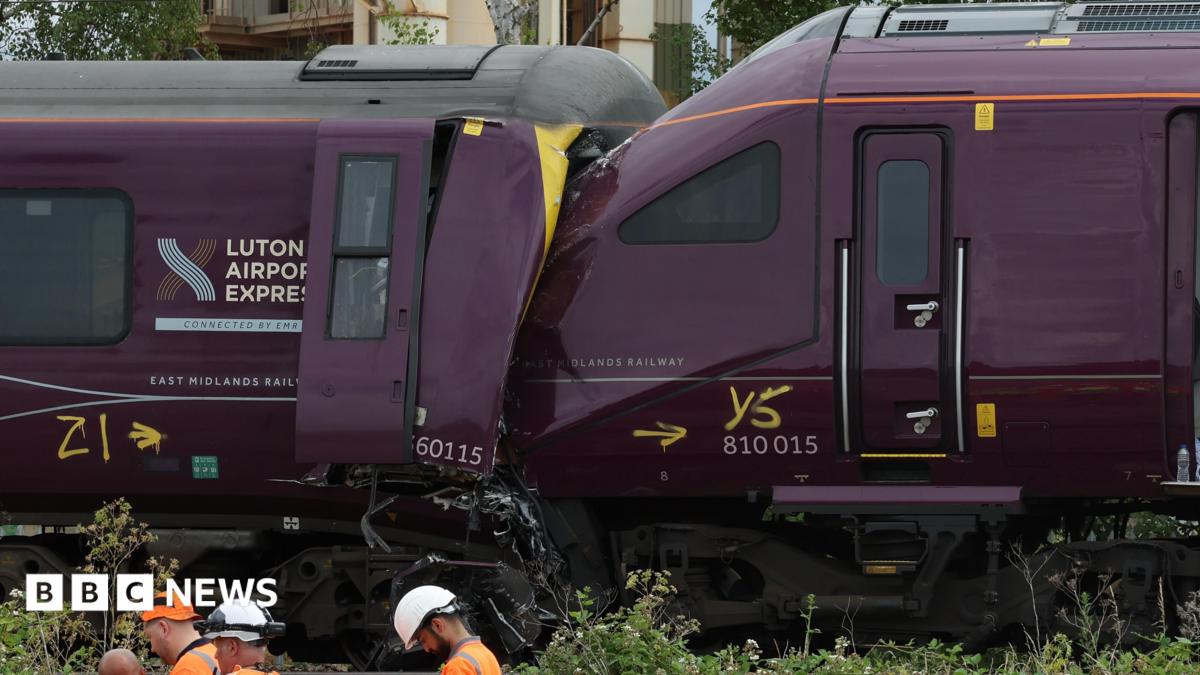
1 At around 17:13 on Friday 19 June 2026, train reporting number 1H46, the 16:40 passenger service from Corby to London St Pancras, collided with the rear of train reporting number 1B67, the 15:50 passenger service from Nottingham to London St Pancras. Train 1B67 was stationary when the accident occurred. Both trains were operated by East Midlands Railway (EMR).

2 The collision took place on Network Rail’s Midland Main Line approximately 2.5 miles (4 km) south of Bedford station (figure 1). The driver of train 1H46 suffered fatal injuries in the collision. Of the estimated 257 people on board the two trains, more than 160 were injured. Significant damage was caused to the trains, both of which derailed.

3 Train 1B67 was stationary beneath the gantry supporting signal WH152 when the accident occurred (figure 2) and had come to an unexpected stop following an automatic emergency brake application. As train 1B67 was occupying the track in the vicinity of signal WH152, the preceding signal, WH154, was displaying a red (danger) aspect to protect the train from other movements on that line.

4 Forward-facing CCTV (FFCCTV) footage from train 1H46 shows that, as it approached and passed signal WH154, the signal was correctly displaying a red aspect. Train 1H46 was travelling at approximately 58 mph (93 km/h) and accelerating when it passed this signal.

5 Having passed signal WH154, train 1H46 proceeded towards train 1B67, approaching it on a right-hand curve. Analysis of data downloaded from the on-train data recorders (OTDR, sometimes called ‘the black box’) fitted to train 1H46 shows that the driver first applied the brakes around 10 seconds before the collision, while the train was travelling at approximately 76 mph (122 km/h). OTDR data also indicates that the speed of the train had reduced to around 50 mph (80 km/h) at the point of collision.

6 RAIB investigations, like many others, start by examining the immediate events around an accident and then working outwards to determine why they occurred, and to find any underlying factors. That means that a report published at the early stages of an investigation may contain information about immediate events without necessarily providing an explanation as to why they occurred. The reasons why train 1H46 passed signal WH154 at danger continue to form part of the ongoing investigation.

 

HC1998

Member
Joined
20 May 2017
Messages
28

Snow1964

Established Member
Joined
7 Oct 2019
Messages
11,210
Location
West Wiltshire
I’ll have a read later. Thanks for posting this, was meaning to check if there were updates. So I guess we have a very rough sketch of the facts. Will be interesting to see the root cause and if it leads to new recommendations etc.
It seems the AWS electromagnet on the track had been installed low, 16mm lower than the permanent magnet on the track, but work is ongoing to see if this caused the 810 to get the AWS fault as AWS triggered on the 810 but signal was green) that led to its emergency braking and 810 stopping.

Seems also driver of 360 acknowledged the AWS at red signal, but continued to accelerate, based on data logging. But no suggestions at this stage as to why.
 

DDB

Member
Joined
11 Sep 2011
Messages
728
I was surprised to read that the loss of the power to the train meant GSM-R calls couldn't be made or received. I would have assumed that a battery backup would be fitted?
 

Haywain

Veteran Member
Joined
3 Feb 2013
Messages
24,816
The RAIB have today published an interim report in this accident:
Thanks for posting this. It makes interesting reading. I suspect that the biggest question - why the driver of 1H46 continued to accelerate after passing a red signal - will never be answered, but the interim report does raise some other questions. I guess we'll wait many months for the final report.
Will be interesting to see the root cause and if it leads to new recommendations etc.
That, of course, is for the final report.
 
Last edited:

edwin_m

Veteran Member
Joined
21 Apr 2013
Messages
28,718
Location
Nottingham
Based on a quick scan, unsurprisingly no root cause. The main item I haven't seen before was more details on why the 810 stopped unexpectedly. The AWS electromagnet at the previous signal was positioned out of tolerance, possibly leading to the false caution indication that was recorded, and the driver under training on the 810 may have got confused between its AWS/TPWS panel and the type they were more used to. My own comment is that this fault could not have contributed to the subsequent failure of the 360 to stop at that signal, as it would only come into play when that signal was green.

There are also photos of each car to car interface, showing that the "crumple zones" on the 360 deformed fairly consistently, probably as designed, but that all cars of this unit thus have significant structural damage that may be uneconomic to repair. Deformation of the 810 structure is less obvious. I didn't see any comment on how one car of the 810 was derailed and apparently foul of the adjacent track.
I was surprised to read that the loss of the power to the train meant GSM-R calls couldn't be made or received. I would have assumed that a battery backup would be fitted?
I assume this is one of the issues leading up to the recent strikes by on-train staff.
 

AlterEgo

Verified Rep - Wingin' It! Paul Lucas
Joined
30 Dec 2008
Messages
29,563
Location
LBK
It's interesting the signaller received the first report of an accident from a passenger using a signal post telephone. Wonder if the passenger was (ex?) Train crew or operational staff.
 

Haywain

Veteran Member
Joined
3 Feb 2013
Messages
24,816
Based on a quick scan, unsurprisingly no root cause.
I believe that interim reports only ever tell us what actually happened and what is going to be investigated for the full report.

I assume this is one of the issues leading up to the recent strikes by on-train staff.
Given that the same problem applied to the considerably older class 360, and it therefore is not a new problem solely associated with the class 810, that would be rather strange.
 

HC1998

Member
Joined
20 May 2017
Messages
28
It's interesting the signaller received the first report of an accident from a passenger using a signal post telephone. Wonder if the passenger was (ex?) Train crew or operational staff.
Good presence of mind either way. What would they need to do? Presumably it’s locked? I guess you could improvise and tell the signaller the ID plate attached to the signal and explain what happened?
 

baz962

Established Member
Joined
8 Jun 2017
Messages
3,669
Thanks for posting this. It makes interesting reading. I suspect that the biggest question - why the driver of 1B67 continued to accelerate after passing a red signal - will never be answered, but the interim report does raise some other questions. I guess we'll wait many months for the final report.

That, of course, is for the final report.
The driver of 1B67 didn't pass a red signal.
 

edwin_m

Veteran Member
Joined
21 Apr 2013
Messages
28,718
Location
Nottingham
Good presence of mind either way. What would they need to do? Presumably it’s locked? I guess you could improvise and tell the signaller the ID plate attached to the signal and explain what happened?
I don't think they are locked but they are somewhere the public shouldn't have access to. The system should tell the signaller which signal the call is coming from, although rules require drivers phoning in also to confirm where they are.
 

millemille

Member
Joined
28 Jul 2011
Messages
410
Location
Derbyshire
I was surprised to read that the loss of the power to the train meant GSM-R calls couldn't be made or received. I would have assumed that a battery backup would be fitted?
GSM-R is powered from the train batteries as a back up in the event of a loss of traction power but I would presume that the damage to both trains was so significant that battery power was lost (short circuits in cabling etc.).
 

Iskra

Established Member
Joined
11 Jun 2014
Messages
10,723
Location
West Riding
GSM-R is powered from the train batteries as a back up in the event of a loss of traction power but I would presume that the damage to both trains was so significant that battery power was lost (short circuits in cabling etc.).
There is an ongoing issue where, when rebooted; 810’s lose GSMR. This takes longer than you would expect to reinstate.
 

fishwomp

Established Member
Joined
5 Jan 2020
Messages
1,336
Location
milton keynes
I was surprised to read that the loss of the power to the train meant GSM-R calls couldn't be made or received. I would have assumed that a battery backup would be fitted?
_both_ trains: the 360 and 810. That's of no bearing to the cause of the incident - but it is a staggering vulnerability. That the on board passengers' and crew's mobiles work, but safety critical comms does not.
.
* [..]collided with the rear of train 1B67 at around 17:13:35.
* Bedfordshire Fire and Rescue Service was notified of the accident at 17:14 by a 999 call from the train and passed this information to Network Rail’s control room in Derby.
* the 1B67 driver and guard applied track circuit clips - it doesn't say when, but it does say 'immediate aftermath'.
* At 17:19, the signaller received the first report of the accident from a passenger who was using a signal post telephone at the gantry for signal WH152.
* This was followed shortly thereafter by another call from the same signal post telephone from the driver of train 1B67 who also reported the accident.
* Signaller confirmed to driver OLE power was isolated [must've been ~17:20].
* First emergency on site: police 17:24, fire and rescue 17:28, ambulances 'by' 17:35
We are very lucky nothing on other running lines struck.
 

Haywain

Veteran Member
Joined
3 Feb 2013
Messages
24,816
I was surprised to read that the loss of the power to the train meant GSM-R calls couldn't be made or received. I would have assumed that a battery backup would be fitted?
I imagine that will be addressed in the full report, although GSM-R is due to be replaced.
 

Harpo

Established Member
Joined
21 Aug 2024
Messages
3,912
Location
Newport
My biggest takeaways from this are that the SPAD driver (the 360) acknowledged the AWS at the red signal, so was conscious and able to react quickly. A slow reaction would have caused AWS to apply the brakes.

Secondly, the loss of power to GSMR on the 810 preventing an emergency call is deeply worrying. The result is a 5.5 minute lag between the collision and first report to the signaller. It’s incredibly lucky that there was nothing on the down fast in that time.
 

ainsworth74

Forum Staff
Staff Member
Global Moderator
Joined
16 Nov 2009
Messages
31,123
Location
Redcar
I don't see how the AWS fault on 1B67 has anything to do with the spad by 1H46.
Because without the fault 1H46 wouldn't have had anything to run into the back of. Obviously 1B67's fault didn't cause the SPAD but it's the reason why the consequences of the SPAD were so severe.
 

driver9000

Established Member
Joined
13 Jan 2008
Messages
4,569
I don't believe they are - I can't recall ever seeing a lock on the door of the box containing a signal post phone.

I don't know the area this tragic collision happened but there's lots of SPTs on the network which need a BR1 key to open the locked case the phone is in. The report says a passenger was able to make a call so it suggests the SPT is in an unlocked case or they were off duty railway staff with keys on them. Either way they made a prompt call to stop other trains and alert the Signallers.
 

Haywain

Veteran Member
Joined
3 Feb 2013
Messages
24,816
Either way they made a prompt call to stop other trains and alert the Signallers.
To alert the signaller, yes, but the driver and train manager of 1B67 took immediate steps to stop other trains.
there's lots of SPTs on the network which need a BR1 key to open the locked case the phone is in.
Fair enough. Years ago I used a SPT* not that far away from the crash site and the case didn't have a lock.

*Probably wrong to do so, but hey ho.
 

NSEWonderer

Established Member
Joined
5 Dec 2020
Messages
2,909
Location
London
Chain of events that once again led to a collision had anyone of them been broke, the collision doesn't happen.
I found it interesting that the right side failure lead the 1B67 drivers to confused potentially and not acknowledge the AWS indication leading to the emergency brakes applying. Screenshot_20261001_113159_My Files.jpg

Interestingly same signal, same traction this fault occured again and the driver there seemed to react on time Screenshot_20261001_113716_My Files.jpg
 

tram21

Established Member
Joined
29 Dec 2022
Messages
1,335
Location
Nottingham
We are very lucky nothing on other running lines struck

It’s incredibly lucky that there was nothing on the down fast in that time.
There were trains on both lines approaching the area very rapidly at the time of the collision. Had it not been for the heroic actions of the Train Manager of 1B67 putting the track clips down, the accident could have been much, much worse.

It's always been good to see both EMR & RMT commending the train crew of 1B67.
 

GadgetMan

Member
Joined
9 Jan 2012
Messages
981
I was surprised to read that the loss of the power to the train meant GSM-R calls couldn't be made or received. I would have assumed that a battery backup would be fitted?

There are Two versions of GSMR units available.

One has a back up battery, these are fitted to the less reliable old diesel trains. So in the event the train loses electrical power the battery in the GSMR will supply power to it.

Then there's the version without fitted to most trains. These trains are very vulnerable as although their electrical systems are more reliable, the trains batteries are usually on one of the middle carriages, so if the carriages separate for any reason then all power including to the GSMR is lost.

I can only assume the GSMR units with back up batteries cost more.
 

Top