This isn't about the actual crash. This article was on the BBC today https://www.bbc.co.uk/news/articles/crn8ez02p6qxo. It is the signal just beyond the bridge on the elevated line that interested me. Never seen a double colour light signal like that before. I assume the double signal is for a junction. Was this standard practice for signals at junctions back then. When did route indicators become the norm?

-
Our new ticketing site is now live! Using either this or the original site (both powered by TrainSplit) helps support the running of the forum with every ticket purchase! Find out more and ask any questions/give us feedback in this thread!
You are using an out of date browser. It may not display this or other websites correctly.
You should upgrade or use an alternative browser.
You should upgrade or use an alternative browser.
Strange signal near St John's on BBC report
- Thread starter Kevin51
- Start date
Sponsor Post - registered members do not see these adverts; click here to register, or click here to log in
R
RailUK Forums

Interesting that the plaque was named "St John's" with an apostrophe - I was always under the impression it was "St Johns" which is indeed what the nameplates for Southeastern call it and indeed is how National Rail Enquiries spells it.
The roads and church do have the apostrophe so I do wonder how it came to have this quirky difference.
The roads and church do have the apostrophe so I do wonder how it came to have this quirky difference.
Gloster
Veteran Member
Interesting that the plaque was named "St John's" with an apostrophe - I was always under the impression it was "St Johns" which is indeed what the nameplates for Southeastern call it and indeed is how National Rail Enquiries spells it.
The roads and church do have the apostrophe so I do wonder how it came to have this quirky difference.
Curiouser and curiouser. The district is St Johns and so has the station been since opening. Were I a cynic I would suggest that the plaque has been prepared using a computer programme and, even if it was correct when work started, spellcheck or similar has altered it, and nobody has thoroughly proof-checked it.
I put an apostrophe because the BBC did. The online map I have doesn't have the apostrophe. And on station names did you see this https://www.bbc.co.uk/news/videos/c24j5n595y9o. Seems railway companies have quirky rules about station names. There is Earl's Court (with) and Barons Court (without). Nothing like consistency.
How long after the accident was this photo taken? Quite a lot of wreckage appears to have been removed and, though still murky, the "pea soup" fog which was lying at the time of the accident has lifted as well. The signal aspects are clearly visible though - much easier to read than semaphores would have been in these lighting conditions.
Gloster
Veteran Member
How long after the accident was this photo taken? Quite a lot of wreckage appears to have been removed and, though still murky, the "pea soup" fog which was lying at the time of the accident has lifted as well. The signal aspects are clearly visible though - much easier to read than semaphores would have been in these lighting conditions.
Probably two days, with a day each way’s margin of error. Peter Tatlow’s book (Oakwood, 2007) has a photo that shows the bridge clear of track and ballast on Sunday 8th.
Merle Haggard
Established Member
Just as an observation; the use of the apostrophe for both the disaster and the settlement society suggests that one St. John was personally responsible. A quirk of the possessive case.
Interesting that the pedant that inserted the apostrophe did not include a full stop after the abbreviation of 'Saint' ...
I remember the disaster as a young trainspotter and BBC Radio and newspapers referred to it as at 'Lewisham'. The Ministry report calls it 'Accident at St. Johns station Lewisham' with that punctuation (or lack of).
Interesting that the pedant that inserted the apostrophe did not include a full stop after the abbreviation of 'Saint' ...
I remember the disaster as a young trainspotter and BBC Radio and newspapers referred to it as at 'Lewisham'. The Ministry report calls it 'Accident at St. Johns station Lewisham' with that punctuation (or lack of).
Gloster
Veteran Member
Just as an observation; the use of the apostrophe for both the disaster and the settlement society suggests that one St. John was personally responsible. A quirk of the possessive case.
Interesting that the pedant that inserted the apostrophe did not include a full stop after the abbreviation of 'Saint' ...
It is normal practice not to use a full stop if the abbreviation ends in the same letter as the full word: Dr, Mrs, Rd, etc. However, it can be used to avoid ambiguity, but in this case the full stop is used after St. for Street, but not St for Saint.
norbitonflyer
Established Member
The accident happened at 6:20pm, so as the photograph is taken in daylight it must be at least 14 hours later (sunrise in early December is about 8am GMT) - plenty of time for the fog to lift.How long after the accident was this photo taken? Quite a lot of wreckage appears to have been removed and, though still murky, the "pea soup" fog which was lying at the time of the accident has lifted as well. The signal aspects are clearly visible though - much easier to read than semaphores would have been in these lighting conditions.
Merle Haggard
Established Member
It is normal practice not to use a full stop if the abbreviation ends in the same letter as the full word: Dr, Mrs, Rd, etc. However, it can be used to avoid ambiguity, but in this case the full stop is used after St. for Street, but not St for Saint.
Thanks, that's interesting, I didn't know that.
When words are abbreviated by truncation then ' was used rather than . , seems to have died out now. An example is Wellingboro' place names were the common examples.

Resignalled 1929; I think the same may have been used on the Brighton line in 1932, but fairly sure Waterloo in 1937 used feathers.This isn't about the actual crash. This article was on the BBC today https://www.bbc.co.uk/news/articles/crn8ez02p6qxo. It is the signal just beyond the bridge on the elevated line that interested me. Never seen a double colour light signal like that before. I assume the double signal is for a junction. Was this standard practice for signals at junctions back then. When did route indicators become the norm?
The signal in the photo is a junction signal. It is at the top of the ramp down to Lewisham station so that if at Red, trains were not trying to stop on the steeper gradient with the risk of an over-run across the complex junction on the London side of the station. Left-hand aspect was used for trains routed onto the line for Blackheath and thence either the Charlton/Woolwich line or the Bexleyheath line. The right-hand aspect was for trains running into the other set of platforms from whence they could go to Hither Green or onto the Ladywell/Catford Bridge line.......I assume the double signal is for a junction. Was this standard practice for signals at junctions back then. When did route indicators become the norm?
The colour light signals in that area dated from 1929 and before the Junction Indicator ('Feather') came into use only a few years later, around 1936 on the Southern Railway.
Theatre indicators also came in in the mid-1930s.
== Doublepost prevention - post automatically merged: ==
1936, according to Kitchenside & Williams "Two Centuries of Railway Signalling"; but they only had three lamps. Theatre indicators were also part of that resignalling from Waterloo to Hampton Court Junction.Resignalled 1929; I think the same may have been used on the Brighton line in 1932, but fairly sure Waterloo in 1937 used feathers.
As an aside, I was in the first year of secondary school half a mile from the crash site. We were sent home two hours early because of the smog on the day of the crash and a bus journey home, normally 20-25 minutes, took a bit over two hours!
Last edited:

berwicksfinest
Member
- Joined
- 16 Feb 2014
- Messages
- 302
Also 40th Anniversary of the Colwich accident today
MadMac
Established Member
Edinburgh Waverley had this sort of arrangement in the 1936 resignalling.Resignalled 1929; I think the same may have been used on the Brighton line in 1932, but fairly sure Waterloo in 1937 used feathers.
And also the 120th anniversary of the 1906 Grantham crash. The actions of the crew that night is still a mystery to this day!Also 40th Anniversary of the Colwich accident today

4COR
Member
My grandmother would have normally been on the Hayes service that was hit by 34066 (she would have changed at Elmer's End for Woodside) but that evening with some fortune had missed the train...

izvor
Member
Well this particular pedant never knew that! Thanks.It is normal practice not to use a full stop if the abbreviation ends in the same letter as the full word: Dr, Mrs, Rd, etc. However, it can be used to avoid ambiguity, but in this case the full stop is used after St. for Street, but not St for Saint.

Tracked
Established Member
Looking at the plaque I'd always known this as "The Lewisham Crash", had a look at the accident report and they describe it as
"near
St. Johns Station
Lewisham"
"near
St. Johns Station
Lewisham"
norbitonflyer
Established Member
So, essentially, replicating what a semaphore junction signal would do - one arm for each route.The signal in the photo is a junction signal.
The colour light signals in that area dated from 1929 and before the Junction Indicator ('Feather') came into use only a few years later, around 1936 on the Southern Railway.
Theatre indicators also came in in the mid-1930s.
Signalling was an issue in the events leading up to the accident. The rather basic train describer system of the time only duistinguished between "electrc" and "steam". This led the signalman at parks Bridge (next box down the line) to believe a Hastings service (one of the new diesel-electric units) was the Hayes train and held it unnecessarily at parks Bridge waiting for a gap in the up fast traffic to route it across the junction, and then waiting furtherb to unliock himnslef when the driver refused the "wrong stick". This caused the following train (the real Hayes train) to be held at the signal behind, where it was hit by the Ramsgate train.
== Doublepost prevention - post automatically merged: ==
Various theories exist, but one of the most likely is that the brakes had not been connected correctly after a loco change at Peterborough, due to the inexperince of the "premium apprentice" acting as fireman on that train. A similar situation to what happened to the Caledonian Sleeper at Edinburgh in 2019, fortunately in that case without distarous consequences.And also the 120th anniversary of the 1906 Grantham crash. The actions of the crew that night is still a mystery to this day!
Last edited:
It was indeed nearer to the latter station, but it was in the Lewisham area which was easier to identify during the ensuing news reports. Indeed, a look at the plan near the end of the MoT report shows that the last three coaches of the train from Cannon Street were still in the St John's platform. (As you may appreciate from my post #12 I was a resident of SE London and knew the area well.)Looking at the plaque I'd always known this as "The Lewisham Crash", had a look at the accident report and they describe it as
"near
St. Johns Station
Lewisham"
norbitonflyer
Established Member
Also avoided any confusion with Bedford St Johns station (which had acquired the suffix in 1924 when it and the younger Midland station both came under the control of the LMS)It was indeed nearer to the latter station, but it was in the Lewisham area which was easier to identify during the ensuing news reports. Indeed, a look at the plan near the end of the MoT report shows that the last three coaches of the train from Cannon Street were still in the St John's platform. (As you may appreciate from my post #12 I was a resident of SE London and knew the area well.)
The Enquiry ruled out brake failure as a likely cause of the accident. The loco was coupled to the train at Peterborough by a shunter (not fireman Talbot, the premium apprentice) and this was supervised by a station forman. A stationary brake test was then satisfactorily performed, and the rear guard‘s vacuum gauge was reading correctly throughout the run to Grantham. All three gave witness statements. The guard also stated that just prior to the derailment that the wheels of his van were skidding, and observers at Grantham saw sparks flying from wheels, implying the brakes were in working order….but unfortunately applied far too late.Various theories exist, but one of the most likely is that the brakes had not been connected correctly after a loco change at Peterborough, due to the inexperince of the "premium apprentice" acting as fireman on that train. A similar situation to what happened to the Caledonian Sleeper at Edinburgh in 2019, fortunately in that case without distarous consequences.
Gloster
Veteran Member
The Enquiry ruled out brake failure as a likely cause of the accident. The loco was coupled to the train at Peterborough by a shunter (not fireman Talbot, the premium apprentice) and this was supervised by a station forman. A stationary brake test was then satisfactorily performed, and the rear guard‘s vacuum gauge was reading correctly throughout the run to Grantham. All three gave witness statements. The guard also stated that just prior to the derailment that the wheels of his van were skidding, and observers at Grantham saw sparks flying from wheels, implying the brakes were in working order….but unfortunately applied far too late.
The Grantham accident remains a mystery, but a possibility that has started to be considered in recent years is that the driver suffered a micro-sleep while the fireman was busy with other matters and did not notice until too late. This has been cogently put forward as an explanation for the Salisbury derailment three months earlier. The fireman, although a premium apprentice, had spent most of the last nine months firing. But I doubt that there will ever be certainty.
Merle Haggard
Established Member
I had a look in my 1916 copy of the handbook of Stations and it opened a whole can of ... apostophes
It does show "St. John's" with that punctuation for the station then in Kent, as well as one with the same name on the Isle of Man and a cross reference to "Tipton St. John's".
There are lots of saints shown as possessive - I had forgotten Derby St. Mary's where condemned locos were stored.
Curiously, however, there's "St. Monans" and "St. Neots" with no apostrophe. Perhaps the 's' was part of the name.
And "St. Blazey Junction", "St. Austell" and "St. Enoch" without the possessive.
Examples from many listed.
It does show "St. John's" with that punctuation for the station then in Kent, as well as one with the same name on the Isle of Man and a cross reference to "Tipton St. John's".
There are lots of saints shown as possessive - I had forgotten Derby St. Mary's where condemned locos were stored.
Curiously, however, there's "St. Monans" and "St. Neots" with no apostrophe. Perhaps the 's' was part of the name.
And "St. Blazey Junction", "St. Austell" and "St. Enoch" without the possessive.
Examples from many listed.
Common in London. In Kings Road, Chelsea, I found three versions, apostrophe before the s, after it, and not al all. All on street nameplates put up by the same council.Interesting that the plaque was named "St John's" with an apostrophe - I was always under the impression it was "St Johns" which is indeed what the nameplates for Southeastern call it and indeed is how National Rail Enquiries spells it.
The roads and church do have the apostrophe so I do wonder how it came to have this quirky difference.
For the signal, different companies (or more precisely different signal engineers) took up route feathers at different times. This would be a splitting signal for the 'double scissors' at Lewisham, either into the Bexleyheath or the Sidcup platforms. there were splitting signals like this elsewhere on the Southern. The UK standard for the indicators was 5 white lights, but the Southern long did only three lights for them. Sometimes the differences arose because different companies used different signalling contractors, and the first to use something patented it so others had to come up with something different.
The RCH 1904 Handbook shows the apostrophe. Dendy Marshall's History of the Southern omits it. There is no entry in the Changes to Station Names list either. There are 13 entries for various St John's in the RCH Handbook (but only one on the SE&C). All have apostrophes.

A lot will come down to who was talking to whom when names started being codified - just down the road from Tipton St J is Ottery St Mary (no ‘s at all) - I suspect that at one point both names were a bit like the modern day Tesco / Tesco’s and each has settled down by happenstance on different sides of the debate as it were.I had a look in my 1916 copy of the handbook of Stations and it opened a whole can of ... apostophes
It does show "St. John's" with that punctuation for the station then in Kent, as well as one with the same name on the Isle of Man and a cross reference to "Tipton St. John's".
There are lots of saints shown as possessive - I had forgotten Derby St. Mary's where condemned locos were stored.
Curiously, however, there's "St. Monans" and "St. Neots" with no apostrophe. Perhaps the 's' was part of the name.
And "St. Blazey Junction", "St. Austell" and "St. Enoch" without the possessive.
Examples from many listed.

Dr Hoo
Established Member
There are apparently 126 recognised, canonised Saints John!
Gloster
Veteran Member
There are apparently 126 recognised, canonised Saints John!
Apparently John is the most common name for a Saint, making it Top of the Popes.
More seriously, this one should really have an apostrophe as the area takes its name from the Church of St John in Deptford.

Springs Branch
Established Member
. . . . Never seen a double colour light signal like that before. I assume the double signal is for a junction. Was this standard practice for signals at junctions back then. When did route indicators become the norm?
Manchester Victoria & Exchange stations were re-signalled around the same time (also with Westinghouse as contractors, IIRC) and that installation also featured 'splitting' 4-aspect signals to indicate routes through junctions.The signal in the photo is a junction signal. . . . . . The colour light signals in that area dated from 1929 and before the Junction Indicator ('Feather') came into use only a few years later, around 1936 on the Southern Railway. Theatre indicators also came in in the mid-1930s.
Where more than two routes needed to be indicated (or space was limited for other reasons), then American-looking 4-aspect cluster signals were used in preference to more familiar 'linear' signals.
Examples of cluster signals could be found around Man Vic/Exchange and London Bridge back in the day - but never caught on more widely.
See below for an installation just outside London Bridge Station. You can imagine the sighs of relief when feathers and theatre route displays were invented!
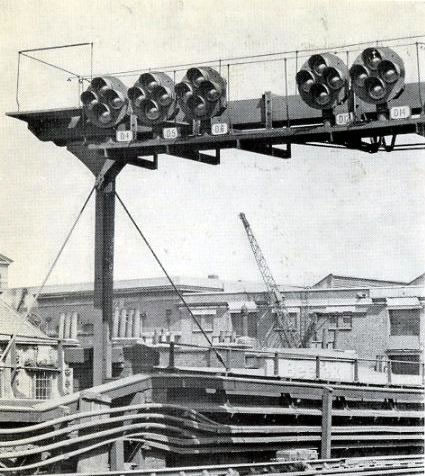
Source: Borough Market Junction Signal Box at https://www.wbsframe.mste.co.uk/public/index.htm
One other quirk of those early 'linear' 4-aspect colour lights was that aspects were arranged in a different sequence to the standard seen today. In the early installations, the order of aspects, reading from top to bottom, was G Y R Y, rather than the familiar Y G Y R. I think a few of the 'wrong way up' LMS-pattern signals survived at Wigan Wallgate into the 21st century on the Southport/Liverpool side of the station.
So, looking at the OP's link to the BBC story - a close observer of the photo might wonder why the side-by-side junction signals both seem to be showing single yellow aspects. In fact they are likely to be early Westinghouse examples, both showing Red.