
-
Our new ticketing site is now live! Using either this or the original site (both powered by TrainSplit) helps support the running of the forum with every ticket purchase! Find out more and ask any questions/give us feedback in this thread!
You are using an out of date browser. It may not display this or other websites correctly.
You should upgrade or use an alternative browser.
You should upgrade or use an alternative browser.
The cost of living agenda - how should the railway contribute ?
- Thread starter yorksrob
- Start date

Sponsor Post - registered members do not see these adverts; click here to register, or click here to log in
R
RailUK Forums
There isn’t a singular right size. The British state has always tended to be 5% smaller than continental counterparts and there are always options to manage that difference. On some things tax funding vs charge funding makes little difference.
The news of the AI/Robo taxis launching in London https://www.bbc.co.uk/news/articles/ce9e838jzpzo made me think that, although currently driverless trains are currently restricted to DLR which was purpose built for this. If you can design a system which can drive a car through the middle of London, with pedestrians, scooters, bikes other cars etc, then an AI driven train with the data which ERTMS provides on a normal railway should relatively be achievable.
Conversely, automating the service provided by onboard staff, particularly catering (vending machines are possible, but limited) is relatively harder. So we may see a shift away from DOO, to a situation where the only staff on the train are there to provide customer service, revenue protection etc.
The benefit is I suppose the saving is now on the expensive member of staff rather than the cheap one which should allow either reduced subsidy or fares.
Conversely, automating the service provided by onboard staff, particularly catering (vending machines are possible, but limited) is relatively harder. So we may see a shift away from DOO, to a situation where the only staff on the train are there to provide customer service, revenue protection etc.
The benefit is I suppose the saving is now on the expensive member of staff rather than the cheap one which should allow either reduced subsidy or fares.

Farigiraf
Established Member
Except they can't, or at least not faultlessly.If you can design a system which can drive a car through the middle of London, with pedestrians, scooters, bikes other cars etc
Not the best way to go IMO, when it inevitably messes up.then an AI driven train with the data which ERTMS provides on a normal railway should relatively be achievable.
London could try making all that GDP without all the agricultural, industrial, dormitory, environmental etc services provided by the rural/outside areas. It might have difficulty.
Far from me being a separatist, but it's statements that this that reveal an astounding level of ignorance.
A purely hypothetical, independent (wider) London & South East (the 3 government office regions of Greater London, South East, and East of England) would have almost the exact same land area and population as the Netherlands. In other words it would entirely resemble a typical European country with an entirely typical urban/rural mix. Modern agricultural markets are continental sized. As a source of wider agricultural produces, the European continent with its wider range of climates is far more attractive than the rest of England.
An independent London & South East would have the same high productivity as the Netherlands, and like the Netherlands be able to keep all of its money. In other words the London & South East Netherlands would no longer have to give its money away to the rest of England Belgium.
At some point in the development of everything which works, there has been a point where it didn't.Except they can't, or at least not faultlessly.
Not the best way to go IMO, when it inevitably messes up.
They're not perfect, hence why current trials do have a human driver as backup, but I believe the computers are already having fewer incidents per mile than human drivers, I don't think it's going to happen next year, but in 10 or 20 years it's highly likely.
Far from me being a separatist, but it's statements that this that reveal an astounding level of ignorance.
A purely hypothetical, independent (wider) London & South East (the 3 government office regions of Greater London, South East, and East of England) would have almost the exact same land area and population as the Netherlands. In other words it would entirely resemble a typical European country with an entirely typical urban/rural mix. Modern agricultural markets are continental sized. As a source of wider agricultural produces, the European continent with its wider range of climates is far more attractive than the rest of England.
An independent London & South East would have the same high productivity as the Netherlands, and like the Netherlands be able to keep all of its money. In other words the London & South East Netherlands would no longer have to give its money away to the rest of England Belgium.
I see that you've annexed the rural south east there !
I think you'll find that the Netherlands is very much interconnected economically and politically with the surrounding countries in Europe.
I see that you've annexed the rural south east there !
I think you'll find that the Netherlands is very much interconnected economically and politically with the surrounding countries in Europe.
London & (wider) South East is an integrated knowledge economy / labour market.
Netherland's fiscal 'exposure' (for lack of a better word) to poorer parts of Europe (through EU budget contributions, which I daresay an independent L&SE would be happily part of) is far more limited to L&SE's to the rest of the UK.
Farigiraf
Established Member
Car drivers maybe but not train drivers, who are expected (and paid appropriately) to not get into any at all. Incidents and accidents may happen semi-regularly on the road network, and it's more or less accepted as an occasional trade-off for "personal liberty" (to crash your car?), but the railway is very much expected to not harm passengers who pay to be carried safely to their destination. When the railway fails at this, the press helicopters rapidly end up on the scene.fewer incidents per mile than human drivers
I've no doubt that self-driving vehicles are capable of performing their task decently well, but that task just doesn't suit modern needs as much as advocates of it think. We need less cars on urban roads, not more, and we need a railway that spends the right amount of money to try not murder anybody - i.e. to get close to 100% accident-free. If that can be achieved then great, but I'm yet to see evidence of that.
Automation on a fully grade separated metro system is of course a different thing, which the DLR (and other light metros around the world) excels at, but this can be done with already existing systems rather than half-baked.startups.Though some more staffing (at stations if not on trains) would be nice as east London isn't entirely made up of crime free leafy suburbs.
Last edited:
Going by the referendum result, the South East doesn't appear much more likely to rejoin the EU than the rest of the country:
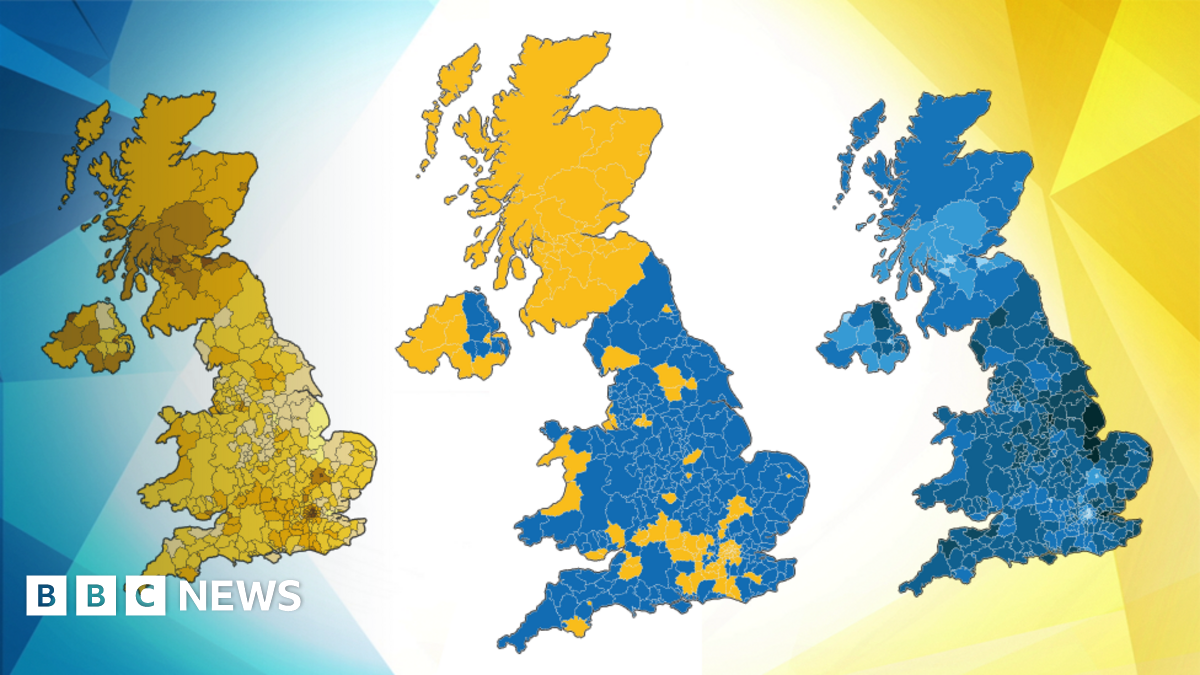
 www.bbc.co.uk
This is all getting rather off-topic.
I reaffirm my case that the railway has a positive role to play in the cost of living crisis - but not without some amendment to the current high fare regime.
EU referendum: The result in maps and charts
How did the Leave camp clinch victory in the referendum on the UK's membership of the EU after what was a very closely fought contest?
www.bbc.co.uk
This is all getting rather off-topic.
I reaffirm my case that the railway has a positive role to play in the cost of living crisis - but not without some amendment to the current high fare regime.
Last edited:
Farigiraf
Established Member
We get that there are parts of the world that are doing well financially and that if we left them alone they could get a lot of things done. However, there is a whole other world out there of regions that don't contribute much - most existing profitable regions were like this at some point. Without some kickstart or motivation to allow a region to thrive, they will usually remain as they are - the EU, which some may say is holding NL down financially, is doing exactly this in many countries which were, to say it lightly, undesirable for foreign investors just a few decades ago.London & (wider) South East is an integrated knowledge economy / labour market.
Netherland's fiscal 'exposure' (for lack of a better word) to poorer parts of Europe (through EU budget contributions, which I daresay an independent L&SE would be happily part of) is far more limited to L&SE's to the rest of the UK
Since we left the EU it's even more important that we don't leave our poorer regions behind, as we don't have someone else to pay for most it instead. Of course I recognise that a tramway in Stoke or new railway to Consett is far from enough to make it desirable for private sector investment, but that doesn't make it pointless - it's just one piece of the puzzle. Before we run out of the money required to pay for all these "pieces" of regeneration & growth, we should make the most of the opportunity. Not to mention the quality of life improvements resulting from such things which may encourage people to vote for proven liars a bit less.
Last edited:
Car drivers maybe but not train drivers, who are expected (and paid appropriately) to not get into any at all. Incidents and accidents may happen semi-regularly on the road network, and it's more or less accepted as an occasional trade-off for "personal liberty" (to crash your car?), but the railway is very much expected to not harm passengers who pay to be carried safely to their destination. When the railway fails at this, the press helicopters rapidly end up on the scene.
I've no doubt that self-driving vehicles are capable of performing their task decently well, but that task just doesn't suit modern needs as much as advocates of it think. We need less cars on urban roads, not more, and we need a railway that spends the right amount of money to try not murder anybody - i.e. to get close to 100% accident-free. If that can be achieved then great, but I'm yet to see evidence of that.
Automation on a fully grade separated metro system is of course a different thing, which the DLR (and other light metros around the world) excels at, but this can be done with already existing systems rather than half-baked.startups.Though some more staffing (at stations if not on trains) would be nice as east London isn't entirely made up of crime free leafy suburbs.

Signals Passed at Danger – RSSB Graphic Insights
A signal passed at danger (SPAD) occurs when a train passes a signal showing a stop aspect or movement authority without authorisation. By analysing and monitoring SPAD data we help industry reduce and prevent these events through a better understanding of their trends, risk profile and...
 www.rssb.co.uk
While the railway is undoubtedly safer than the road, 260 SPADs per year is not zero.
SPADS aren't deaths though, on the roads there are over 260 deaths every two monthsSignals Passed at Danger – RSSB Graphic Insights
A signal passed at danger (SPAD) occurs when a train passes a signal showing a stop aspect or movement authority without authorisation. By analysing and monitoring SPAD data we help industry reduce and prevent these events through a better understanding of their trends, risk profile and...
While the railway is undoubtedly safer than the road, 260 SPADs per year is not zero.
We get that there are parts of the world that are doing well financially and that if we left them alone they could get a lot of things done. However, there is a whole other world out there of regions that don't contribute much - most existing profitable regions were like this at some point. Without some kickstart or motivation to allow a region to thrive, they will usually remain as they are - the EU, which some may say is holding NL down financially, is doing exactly this in many countries which were, to say it lightly, undesirable for foreign investors just a few decades ago.
Since we left the EU it's even more important that we don't leave our poorer regions behind, as we don't have someone else to pay for most it instead. Of course I recognise that a tramway in Stoke or new railway to Consett is far from enough to make it desirable for private sector investment, but that doesn't make it pointless - it's just one piece of the puzzle. Before we run out of the money required to pay for all these "pieces" of regeneration & growth, we should make the most of the opportunity. Not to mention the quality of life improvements resulting from such things which may encourage people to vote for proven liars a bit less.
What I'm trying to get at is that the principles of fiscal redistribution aren't as sacrosanct as some would like to believe, and any moral argument is over as good as it being accepted by the polity (and certain members overstate that acceptance).
We've got less money to go around, and it's even more crucial that that money is spent on regenerative endeavours over subsidising current consumption. The current cost of living challenge is the result of decades of under-investment in productivity. While acute problems should get some temporary relief, there is a chronic element where current available resources cannot afford to treat the symptoms.
With other parts of society wanting to expand the size of the state (most notably health and social care obligations of an aging society that says non to immigration), other parts of the state must shrink in the face of a static tax base. The government wants to reduce day-to-day rail subsidy and that needs to be allowed to happen.
What I'm trying to get at is that the principles of fiscal redistribution aren't as sacrosanct as some would like to believe, and any moral argument is over as good as it being accepted by the polity (and certain members overstate that acceptance).
We've got less money to go around, and it's even more crucial that that money is spent on regenerative endeavours over subsidising current consumption. The current cost of living challenge is the result of decades of under-investment in productivity. While acute problems should get some temporary relief, there is a chronic element where current available resources cannot afford to treat the symptoms.
With other parts of society wanting to expand the size of the state (most notably health and social care obligations of an aging society that says non to immigration), other parts of the state must shrink in the face of a static tax base. The government wants to reduce day-to-day rail subsidy and that needs to be allowed to happen.
Productivity should be increased by industry and business as part of their raison d'etre. Why isn't this happening ?
Are too many servicing debt imposed on them through takeovers that offer no benefit to the country ? Easyjet, Cadburys, Manchester Utd FC.
As I've mentioned earlier, AI will mean that the state will have to do a lot more for people one way or another. Laissez-faire economics may not be up to the job.
Productivity should be increased by industry and business as part of their raison d'etre. Why isn't this happening ?
Industry and businesses do not exist in a vacuum. They are only as good as the people they do/can employ. Why are knowledge jobs so under-represented outside London & South East compared to similar-sized European metropolitan areas? Companies just can't find the skills there.
Industry and businesses do not exist in a vacuum. They are only as good as the people they do/can employ. Why are knowledge jobs so under-represented outside London & South East compared to similar-sized European metropolitan areas? Companies just can't find the skills there.
Could it be that our centralized economy, where political, economical and judicial power is concentrated in the capital, attracts most of the business ?
The skills tend to move where the jobs are.
The Netherlands and Germany, for example, don't have such a concentration of power.
There are good universities and intelligent people all around the country.
Could it be that our centralized economy, where political, economical and judicial power is concentrated in the capital, attracts most of the business ?
The skills tend to move where the jobs are.
The Netherlands and Germany, for example, don't have such a concentration of power.
There are good universities and intelligent people all around the country.
If the available skills can easily be concentrated in London then it means there aren't enough skills.
London is expensive, London is crowded. If skills existed from other regions in big numbers then knowledge hubs would have sprung up around the country, because the lack of the diseconomies of scale experienced in London would be attractive to both the people and the employers.
It's not like knowledge hubs don't exist outside of London. Edinburgh and Bristol are successful because they have the people there. The knowledge hubs of Leeds and Sheffield are undersized because only posh north Leeds and posh west Sheffield participate in them. If skills emerge in south Leeds and east Sheffield, then the existing local knowledge hubs would be very attractive to them relative to battling the high cost and stress of London.
If the available skills can easily be concentrated in London then it means there aren't enough skills.
London is expensive, London is crowded. If skills existed from other regions in big numbers then knowledge hubs would have sprung up around the country, because the lack of the diseconomies of scale experienced in London would be attractive to both the people and the employers.
It's not like knowledge hubs don't exist outside of London. Edinburgh and Bristol are successful because they have the people there. The knowledge hubs of Leeds and Sheffield are undersized because only posh north Leeds and posh west Sheffield participate in them. If skills emerge in south Leeds and east Sheffield, then the existing local knowledge hubs would be very attractive to them relative to battling the high cost and stress of London.
South Leeds and East Sheffield are only part of the equation. There are skills all over Yorkshire. Why do they gravitate towards London ? Because the power is there, followed by the business.
That's very vague, though. Subsidy can be reduced in a lot of ways, and a lot of those ways are clearly things that the government is unwilling to do, like engage in an extended fight with the unions over pay rises.The government wants to reduce day-to-day rail subsidy and that needs to be allowed to happen.
South Leeds and East Sheffield are only part of the equation. There are skills all over Yorkshire. Why do they gravitate towards London ? Because the power is there, followed by the business.
That's an extremely simplistic, if not outright erroneous way, of looking at things.
coppercapped
Established Member
Eh? Did you read what I wrote and the references I pasted into my post?I'm saying that it doesn't really say much about how much "the rich" vs. "the poor" use trains.
The survey/analysis/study quite clearly showed that, at the time and however imperfect the socio-economic groupings used, people with higher incomes used the trains more and spent more than those with lower incomes.
I now recall a bit more about the point that the Transport Minister/Secretary was trying to make - that it didn't seem to make sense that the subsidy paid to the railways mainly benefited the better off and that they should pay more for the privilege.
(And, no, I am not going to search through up to thirty years of back numbers of Modern Railways to find the exact quote...!)
Eh? Did you read what I wrote and the references I pasted into my post?
The survey/analysis/study quite clearly showed that, at the time and however imperfect the socio-economic groupings used, people with higher incomes used the trains more and spent more than those with lower incomes.
I now recall a bit more about the point that the Transport Minister/Secretary was trying to make - that it didn't seem to make sense that the subsidy paid to the railways mainly benefited the better off and that they should pay more for the privilege.
(And, no, I am not going to search through up to thirty years of back numbers of Modern Railways to find the exact quote...!)
Exactly, the taxes that go to subsidising cheaper fares come from the very same people in the first place. So just cut out the middle man.
Farigiraf
Established Member
I'm not arguing for increased fiscal redistribution from a moral standpoint - while it's a well-meaning worldview and great place to start from, if not managed properly it can be financially unsustainable long-term. What I am arguing for is a rethink of why we do it, and recognition of the fact that there's no such thing as a 'charity case' location, just a place with a history of poor management and not enough investment.What I'm trying to get at is that the principles of fiscal redistribution aren't as sacrosanct as some would like to believe, and any moral argument is over as good as it being accepted by the polity (and certain members overstate that acceptance).
I don't only think that good public transportation should be more widespread and affordable to all because it's the ethical thing to do, it's been proven again and again that this is exactly what brings regeneration and growth. If it doesn't seem to be making a difference, that's probably because it's not competitive enough with alternatives. To fix that, you make it competitive, not give up and continue the status quo. The private sector will happily come in, creating skilled and knowledgeable jobs (and pocketing the profits) once there is a reason to come, but to achieve that it's the public sector's job to actually make some of these increasingly soulless and unproductive car parks/highways disguised as towns into liveable places with lots of opportunities.
Your first point and the rest of it counteract each other. Besides the obvious ethical consideration that making life worse in order to make it better long-term rarely pays off, and makes a lot of people mad at you (often also leads to extremism), the challenge is to determine what's a pointless money sink and what's an economic multiplier. It's usually obvious enough.We've got less money to go around, and it's even more crucial that that money is spent on regenerative endeavours over subsidising current consumption. The current cost of living challenge is the result of decades of under-investment in productivity. While acute problems should get some temporary relief, there is a chronic element where current available resources cannot afford to treat the symptoms.
With other parts of society wanting to expand the size of the state (most notably health and social care obligations of an aging society that says non to immigration), other parts of the state must shrink in the face of a static tax base. The government wants to reduce day-to-day rail subsidy and that needs to be allowed to happen.
You may see it differently, but I'd say that most of the current 'liabilities' of the welfare state are working in our favour. Good healthcare and social care creates more taxpayers, good education increases the amount of tax paid per person, and also creates a population that recognises these benefits, and a good public transport system is allowing the few lucky places to make enough money to achieve all these other things in an efficient and environmentally friendly way. Then you also have the various other social safety nets, housing, the BBC etc, which have also made a notable difference to the way we live our lives - a system that is not going to be undone, except maybe through the backdoor by those not thinking it through, because people value it.
Perhaps the distribution of funding between sectors is uneven but that's democracy - if you propose a way of balancing it out without also losing all credibility and public support (that is without explicitly lying to people) I'd like to hear it. The fact that a heavy strain on a number of these services is causing them to become less efficient and overall improve people's lives to a lesser degree is indicative of the fact that demand has met capacity. You could try all sorts of LNER-style reforms in these sectors, or even reduce the amount of people allowed to access these services (usually done in an unscientific and populist way) but it's just creating problems down the road. The capacity has to grow to meet the demand - it's a big ask but it's not impossible, and the closer you get to achieving that, the faster the money will start coming in and people may start hating each other a bit less as well.
Hence why the city's overflowing into the home counties already. What little character these counties have left after the 20th century New Towns programme is being wiped out altogether as small villages within commuting distance of London are having a few hundred homes plonked on with little thought. There isn't capacity in the healthcare or educational system, nor is there the London-style transport you can expect from within the boroughs in these places. If densifying within Greater London is happening too slowly then it may be worth considering other inner city areas to 'Londonise'. Manchester, Birmingham and Bristol are getting there, with a few others chasing behind, but these will face the same issues as London eventually, potentially much quicker, because urban redevelopment of 20th-century design failures is such a no-no in British local politics. Then you have Oxford and Cambridge which are practically full already.London is expensive, London is crowded. If skills existed from other regions in big numbers then knowledge hubs would have sprung up around the country, because the lack of the diseconomies of scale experienced in London would be attractive to both the people and the employers.
But the key point with these places, which are primarily up the priority list due to the agglomeration effect, is that they thrive a little more every time the public sector tries to be proactive. If you just tried a little in Sheffield for example - including (but not limited to) urban redevelopment, densification along key corridors, investment in local education and fixing the bottlenecks that are causing its long-distance transport to be so mediocre, I'd be frankly shocked to not see it start being a little productive. But these are not strategies that the market sorts out for itself, which results in the stagnation the city's currently facing.
Lowering taxes is just free money. People can do with it whatever they like, which is both positive and negative. The good part is that it allows for flexibility which the state can't accommodate for. The bad part is that it often reinforces an unsustainable status quo. Targeted subsidy combats that by encouraging change that'll overall improve things for everybody - modal shift caused by cheap fares is exactly one of those things.So just cut out the middle man.
If the public transport simply can't support the increased usage then it needs to catch up - which is why there aren't serious proposals to e.g. make peak time travel cheaper and therefore accessible to lower income groups as well - but the bus fare cap is a good demonstrator of what could be done, even if the implementation isn't perfect. A blanket reduction of a few quid in tax might pay for some shopping or fuel, it won't encourage families to take the bus for a day out somewhere for example, which does have a greater overall impact on society.
Last edited:
Your original post specifically mentioned the NRS social grades. Your quote in your reply, however, was about the NS-SEC classification system, which is different to the NRS system does. Also, as the government itself admits, within an NS-SEC grouping there can be much variation of income, nor is it necessarily the case that the "higher" one's job is on the NS-SEC system the more one earns:Eh? Did you read what I wrote and the references I pasted into my post?
The survey/analysis/study quite clearly showed that, at the time and however imperfect the socio-economic groupings used, people with higher incomes used the trains more and spent more than those with lower incomes.
I now recall a bit more about the point that the Transport Minister/Secretary was trying to make - that it didn't seem to make sense that the subsidy paid to the railways mainly benefited the better off and that they should pay more for the privilege.
(And, no, I am not going to search through up to thirty years of back numbers of Modern Railways to find the exact quote...!)

Chapter 1: Introduction
Occupational class versus earnings
Types of jobs are not always tied to how much you earn. Sometimes people in lower occupational classes earn more than those in higher occupational classes. For example, speech and language therapists count as higher professionals, NS-SEC 1, because their job requires a first degree for entry and experience-related training, and the practical application of a body of knowledge to instruct others. Yet their average salary is lower than that of many working-class occupations, including some routine manual occupations.
Example occupations, their NS-SEC classes and median salaries
- Speech and language therapists: NS-SEC 1 – higher professional. Median salary: £31,932.
- Train and tram drivers: NS-SEC 5 – higher working class. Median salary: £63,807.
- Air conditioning and refrigeration installers and repairers: NS-SEC 6 – higher working class. Median salary: £39,818.
- Large goods vehicle drivers: NS-SEC 7 – lower working class. Average salary: £36,847.[footnote 10]
There can also be great variation in earnings within a class. For example, teaching assistants earn an average of £19,033, and rail travel assistants earn an average of £36,080, yet both occupations are classified as ‘intermediate’.[footnote 11] Apart from different salaries, these jobs may also have very different working conditions.
And, finally, 2 people doing the same type of work can be in different classes if one is an employee and the other is self-employed since the self-employed tend to be classed as intermediate. For example, a bricklayer who is an employee would be in NS-SEC 7, lower working class, while a self-employed bricklayer would be in NS-SEC 4, intermediate class. The salaries in these 2 cases may also be very different.
coppercapped
Established Member
Some 40 years ago I joined a Silicon Valley-based computer manufacturing company. I was based in Europe but had occasion to visit the Bay Area several times a year. The first time I went (for my job interview!) I was taken aback by the number of Ferraris, Mercedes, Porsches, Jaguars and US muscle cars in the company’s car parks. Compared to the rusty Austin 1100s I was used to it was a different planet. I was told that many staff used some of the profits they made following the Initial Public Offering of the company’s shares to buy these cars.
So the previous posts concerning the connection between growth and spending on infrastructure is a subject that has interested me for a long time. My conclusion is that there is no direct connection, as both @NCT and @Magdalia emphasise.
My argument is as follows, it’s a bit long - sorry.
Although the necessary conditions for a financially successful area can be identified, success is not automatically achieved. However, one of the pre-requisites for success that is not often mentioned is that one has to accept risk - the risk that your idea may not be what people wanted. Your company folds and the investors lose their money[1].
The corollary of this is that there is also a risk that some people will become very rich. These very rich people then become the investors in the next round of start-ups. However being very rich in the UK exposes one to all amounts of hassle - starting with the taxman, politicians who see them as an easy source of money and going on down to the chavs who scratch paint on new cars[2].
The USA does not have this aversion to wealth. Wealth creates jobs. Where are the UK equivalents of Apple, nVidia, Microsoft and Oracle who together employ hundreds of thousands...? This is not a failure of 'The North’[3] specifically, but of the UK attitude to risk and wealth generally.
In the UK it seems to be difficult to get enough people to think of markets outside the UK, unless it is the US or other bits of the English speaking world. They are self-limiting in their aspirations. From the West Coast of the US the UK is simply seen as a part of 'Europe' which is somewhere past New York City. ‘Europe’ is perceived as trailing the US in high tech matters[4]. OK, I know there are exceptions - Airbus, Rolls-Royce, some pharmaceutical companies, ARM, ASML, Carl Zeiss and the world-wide-web protocols). The result is that computer products designed for the US market become, de facto, the world's standards. Don't tell me that the UK has a strong IT industry - with the exception of ARM (now foreign owned) it doesn't. What it does have is a lot of companies writing databases and installing cables but the underlying technology is all American - the network standards, the computer chips, data storage, the computers and the operating systems. US companies think big - it was only partly a joke that my old company used the advertising line "Changing the World - One Person at a Time".
So, rather than complaining that London is stealing 'The North's' cash it is essential to identify and provide good reasons why people and ideas should stay in 'The North'[5]. Some twenty years ago Paul Graham, a Silicon Valley-based venture capitalist, wrote an article about the possibility of duplicating Silicon Valley elsewhere. It can be found here https://www.paulgraham.com/siliconvalley.html Although it’s now a bit dated it is still well worth reading, especially in the context of generating growth because as sure as night follows day significant growth will not come from existing industries. Growth comes from new industries as is exemplified by the example of Cambridge - which incidentally ticks all the boxes of a nice place to live for Paul Graham’s ‘nerds’.
There is no implication that Northerners™ have less brain than those living elsewhere or that there is something in the water. People are equally intelligent, adaptable and inventive whereever they live. But the framework in which they live and work has to encourage a belief in a future which is better than the now.
[1] This why governments (and banks) are incredibly bad at selecting 'industry champions' or investing in start-ups. They generally invest in companies that already exist - which is too late - and are scared of losing their money otherwise the Opposition will lambast the Government, or the shareholders their Board. The money has to come from private individuals who don't mind losing a million or two in the hope that one in ten investments is successful.
[2] Exemplified also by the discussions from time to time in this Forum as to whether people should travel first class in trains.
[3] A term meaning everywhere outside Lunnon, m’Lud.
[4] And the Americans are now worried about China…
[5] The countryside is beautiful but it's not enough - you don't live in the garden, especially in winter. There are bright, intelligent people in these businesses. With the money will come the requirements for quality infrastructure: nice houses; good schools; world-class concerts; the operas; comfortable public transport; airports with direct links to China, Japan and the USA. The restaurants and the rock music. At this point get the infrastructure right and success will be self-perpetuating.
== Doublepost prevention - post automatically merged: ==
Oops, no content. I pressed the wrong 'button' and then there is no going back!
So the previous posts concerning the connection between growth and spending on infrastructure is a subject that has interested me for a long time. My conclusion is that there is no direct connection, as both @NCT and @Magdalia emphasise.
My argument is as follows, it’s a bit long - sorry.
Although the necessary conditions for a financially successful area can be identified, success is not automatically achieved. However, one of the pre-requisites for success that is not often mentioned is that one has to accept risk - the risk that your idea may not be what people wanted. Your company folds and the investors lose their money[1].
The corollary of this is that there is also a risk that some people will become very rich. These very rich people then become the investors in the next round of start-ups. However being very rich in the UK exposes one to all amounts of hassle - starting with the taxman, politicians who see them as an easy source of money and going on down to the chavs who scratch paint on new cars[2].
The USA does not have this aversion to wealth. Wealth creates jobs. Where are the UK equivalents of Apple, nVidia, Microsoft and Oracle who together employ hundreds of thousands...? This is not a failure of 'The North’[3] specifically, but of the UK attitude to risk and wealth generally.
In the UK it seems to be difficult to get enough people to think of markets outside the UK, unless it is the US or other bits of the English speaking world. They are self-limiting in their aspirations. From the West Coast of the US the UK is simply seen as a part of 'Europe' which is somewhere past New York City. ‘Europe’ is perceived as trailing the US in high tech matters[4]. OK, I know there are exceptions - Airbus, Rolls-Royce, some pharmaceutical companies, ARM, ASML, Carl Zeiss and the world-wide-web protocols). The result is that computer products designed for the US market become, de facto, the world's standards. Don't tell me that the UK has a strong IT industry - with the exception of ARM (now foreign owned) it doesn't. What it does have is a lot of companies writing databases and installing cables but the underlying technology is all American - the network standards, the computer chips, data storage, the computers and the operating systems. US companies think big - it was only partly a joke that my old company used the advertising line "Changing the World - One Person at a Time".
So, rather than complaining that London is stealing 'The North's' cash it is essential to identify and provide good reasons why people and ideas should stay in 'The North'[5]. Some twenty years ago Paul Graham, a Silicon Valley-based venture capitalist, wrote an article about the possibility of duplicating Silicon Valley elsewhere. It can be found here https://www.paulgraham.com/siliconvalley.html Although it’s now a bit dated it is still well worth reading, especially in the context of generating growth because as sure as night follows day significant growth will not come from existing industries. Growth comes from new industries as is exemplified by the example of Cambridge - which incidentally ticks all the boxes of a nice place to live for Paul Graham’s ‘nerds’.
There is no implication that Northerners™ have less brain than those living elsewhere or that there is something in the water. People are equally intelligent, adaptable and inventive whereever they live. But the framework in which they live and work has to encourage a belief in a future which is better than the now.
[1] This why governments (and banks) are incredibly bad at selecting 'industry champions' or investing in start-ups. They generally invest in companies that already exist - which is too late - and are scared of losing their money otherwise the Opposition will lambast the Government, or the shareholders their Board. The money has to come from private individuals who don't mind losing a million or two in the hope that one in ten investments is successful.
[2] Exemplified also by the discussions from time to time in this Forum as to whether people should travel first class in trains.
[3] A term meaning everywhere outside Lunnon, m’Lud.
[4] And the Americans are now worried about China…
[5] The countryside is beautiful but it's not enough - you don't live in the garden, especially in winter. There are bright, intelligent people in these businesses. With the money will come the requirements for quality infrastructure: nice houses; good schools; world-class concerts; the operas; comfortable public transport; airports with direct links to China, Japan and the USA. The restaurants and the rock music. At this point get the infrastructure right and success will be self-perpetuating.
== Doublepost prevention - post automatically merged: ==
Oops, no content. I pressed the wrong 'button' and then there is no going back!
Last edited:
That's an extremely simplistic, if not outright erroneous way, of looking at things.
That's no more simplistic or erroneous than the suggestion that
"We shouldn't have a network railcard in the rest or the country because the South East is a net contributor to revenue" argument.
I'm not arguing for increased fiscal redistribution from a moral standpoint - while it's a well-meaning worldview and great place to start from, if not managed properly it can be financially unsustainable long-term. What I am arguing for is a rethink of why we do it, and recognition of the fact that there's no such thing as a 'charity case' location, just a place with a history of poor management and not enough investment.
I don't only think that good public transportation should be more widespread and affordable to all because it's the ethical thing to do, it's been proven again and again that this is exactly what brings regeneration and growth. If it doesn't seem to be making a difference, that's probably because it's not competitive enough with alternatives. To fix that, you make it competitive, not give up and continue the status quo. The private sector will happily come in, creating skilled and knowledgeable jobs (and pocketing the profits) once there is a reason to come, but to achieve that it's the public sector's job to actually make some of these increasingly soulless and unproductive car parks/highways disguised as towns into liveable places with lots of opportunities.
Merseyrail, Supertram or T&W Metro have not brought regeneration or growth. Birkenhead remains desolate, jobs and population moved away from T&W metro served town and city centres towards Barratt estate and business parks off motorways. Almost nothing has happened in the 10 years since Metrolink Ashton line opened.
Your first point and the rest of it counteract each other. Besides the obvious ethical consideration that making life worse in order to make it better long-term rarely pays off, and makes a lot of people mad at you (often also leads to extremism), the challenge is to determine what's a pointless money sink and what's an economic multiplier. It's usually obvious enough.
You may see it differently, but I'd say that most of the current 'liabilities' of the welfare state are working in our favour. Good healthcare and social care creates more taxpayers, good education increases the amount of tax paid per person, and also creates a population that recognises these benefits, and a good public transport system is allowing the few lucky places to make enough money to achieve all these other things in an efficient and environmentally friendly way. Then you also have the various other social safety nets, housing, the BBC etc, which have also made a notable difference to the way we live our lives - a system that is not going to be undone, except maybe through the backdoor by those not thinking it through, because people value it.
Perhaps the distribution of funding between sectors is uneven but that's democracy - if you propose a way of balancing it out without also losing all credibility and public support (that is without explicitly lying to people) I'd like to hear it. The fact that a heavy strain on a number of these services is causing them to become less efficient and overall improve people's lives to a lesser degree is indicative of the fact that demand has met capacity. You could try all sorts of LNER-style reforms in these sectors, or even reduce the amount of people allowed to access these services (usually done in an unscientific and populist way) but it's just creating problems down the road. The capacity has to grow to meet the demand - it's a big ask but it's not impossible, and the closer you get to achieving that, the faster the money will start coming in and people may start hating each other a bit less as well.
If people value something, then people need to pay for it. The tax base needs to be broadened. The country has been low-level fvcking around over the last half century and it'd be naive to think one can simply avoid the 'find out' stage. And if a section of the populace wants to find out the hard way then sometimes there's not much that can be done to stop it. I hope it doesn't come to that.
Hence why the city's overflowing into the home counties already. What little character these counties have left after the 20th century New Towns programme is being wiped out altogether as small villages within commuting distance of London are having a few hundred homes plonked on with little thought. There isn't capacity in the healthcare or educational system, nor is there the London-style transport you can expect from within the boroughs in these places. If densifying within Greater London is happening too slowly then it may be worth considering other inner city areas to 'Londonise'. Manchester, Birmingham and Bristol are getting there, with a few others chasing behind, but these will face the same issues as London eventually, potentially much quicker, because urban redevelopment of 20th-century design failures is such a no-no in British local politics. Then you have Oxford and Cambridge which are practically full already.
But the key point with these places, which are primarily up the priority list due to the agglomeration effect, is that they thrive a little more every time the public sector tries to be proactive. If you just tried a little in Sheffield for example - including (but not limited to) urban redevelopment, densification along key corridors, investment in local education and fixing the bottlenecks that are causing its long-distance transport to be so mediocre, I'd be frankly shocked to not see it start being a little productive. But these are not strategies that the market sorts out for itself, which results in the stagnation the city's currently facing.
Absolutely Londonise those other places. The beauty of that is, given the low base of a lot of such cities, the first places you start are those within cycling and bus radii like Collyhurst and South Leeds which don't need expensive mass transit solutions. Then you find those places with good quality rail transport that's been running under-capacity for 30 years. 6-car trains between Blackpool and Manchester are running at far lower passenger density than equivalent London - Home County services. Put money in education and housing acceleration. Get Holt Town built, build flats around Etihad and on top of the ASDA. Don't just pour more money at Northern or Metrolink.
Lowering taxes is just free money. People can do with it whatever they like, which is both positive and negative. The good part is that it allows for flexibility which the state can't accommodate for. The bad part is that it often reinforces an unsustainable status quo. Targeted subsidy combats that by encouraging change that'll overall improve things for everybody - modal shift caused by cheap fares is exactly one of those things.
If the public transport simply can't support the increased usage then it needs to catch up - which is why there aren't serious proposals to e.g. make peak time travel cheaper and therefore accessible to lower income groups as well - but the bus fare cap is a good demonstrator of what could be done, even if the implementation isn't perfect. A blanket reduction of a few quid in tax might pay for some shopping or fuel, it won't encourage families to take the bus for a day out somewhere for example, which does have a greater overall impact on society.
I'm not talking about lowering taxes. I'm talking about how the state can manage ballooning demands from demographic change when the appetite of the existing tax base to pay more is next to zero. Some things need to come out of the state.
coppercapped
Established Member
I say again that I read the article a long time ago — probably some twenty or thirty years. I understand now that the classifications were changed at some point and that it disturbs you that I may have used the wrong one. Sorry.Your original post specifically mentioned the NRS social grades. Your quote in your reply, however, was about the NS-SEC classification system, which is different to the NRS system does. Also, as the government itself admits, within an NS-SEC grouping there can be much variation of income, nor is it necessarily the case that the "higher" one's job is on the NS-SEC system the more one earns:
Chapter 1: Introduction
www.gov.uk
But I notice that at no point have you disagreed with the general conclusion of the survey/analysis/study performed then that ‘the better off’ make more use of the trains than ‘the less well off’.
Since I don't have the study to hand, I can't really give a conclusion about whether or not it was accurate or not.I say again that I read the article a long time ago — probably some twenty or thirty years. I understand now that the classifications were changed at some point and that it disturbs you that I may have used the wrong one. Sorry.
But I notice that at no point have you disagreed with the general conclusion of the survey/analysis/study performed then that ‘the better off’ make more use of the trains than ‘the less well off’.