
-
Our new ticketing site is now live! Using either this or the original site (both powered by TrainSplit) helps support the running of the forum with every ticket purchase! Find out more and ask any questions/give us feedback in this thread!
You are using an out of date browser. It may not display this or other websites correctly.
You should upgrade or use an alternative browser.
You should upgrade or use an alternative browser.
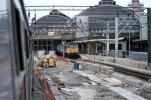
Manchester Piccadilly platforms 13/14 in the early '80's
- Thread starter 158801
- Start date
Sponsor Post - registered members do not see these adverts; click here to register, or click here to log in
R
RailUK Forums
4xEMU per hour from Altrincham, one to Hazel Grove, one to Alderley Edge via Stockport, one to Crewe via Stockport, one to Alderley Edge via Styal. 1xDMU per hour, terminating and reversing from/to Liverpool Lime Street (arrive xx.19, depart xx.27, so fitted between two EMU through services). Prior to Hazel Grove electrification, the service went to Alderley Edge via Styal; following the Hazel Grove electrification the second service via Styal started from the main station. That’s 1981-82., but pretty much as in the 1970s when I went to school and used Oxford Road to Piccadilly to get home.
In the 1970s there were a couple of rush hour services Oxford Road-Buxton line, using platform 1 at Oxford Road, but these stopped when the line to Hazel Grove was electrified.
So 4 trains per hour plus one terminator - not busy. If you just missed a train from Oxford Road to Piccadilly you had a 15 minute wait (except for the additional Liverpool terminator) or a 10 minute walk.
https://railcar.co.uk/type/class-115/manchester-liverpool gives information on the Liverpool services, and the Altrincham EMUs were AM4/Class 304 except very rarely when AM10/Class 310 appeared.
In the 1970s there were a couple of rush hour services Oxford Road-Buxton line, using platform 1 at Oxford Road, but these stopped when the line to Hazel Grove was electrified.
So 4 trains per hour plus one terminator - not busy. If you just missed a train from Oxford Road to Piccadilly you had a 15 minute wait (except for the additional Liverpool terminator) or a 10 minute walk.
https://railcar.co.uk/type/class-115/manchester-liverpool gives information on the Liverpool services, and the Altrincham EMUs were AM4/Class 304 except very rarely when AM10/Class 310 appeared.
Last edited:
Bletchleyite
Veteran Member
Did the terminator reverse in 13 or 14, or did it arrive at 13, tip out and go into the reversing siding to return in 14?
In the platform. Booked platform 14.Did the terminator reverse in 13 or 14, or did it arrive at 13, tip out and go into the reversing siding to return in 14?
Also, I don’t think there was a reversing siding. The current one wasn’t there because Mayfield station was still in use for non-passenger trains. The Midland Engine siding was used by AC electric locos between turns.
Last edited:
Merle Haggard
Established Member
Might be worth pointing out that the extension of the Altrincham service from Oxford Road to Piccadilly was not that long before 1980.
I have an idea - I'm far from sure - that there was also a bay platform alongside 13/4 before the London Road/Piccadilly rebuild around 1960.
Just to point out really that the increase in use of 13/14 has been steady even before 1980s, and the infrastructure reduced.
I have an idea - I'm far from sure - that there was also a bay platform alongside 13/4 before the London Road/Piccadilly rebuild around 1960.
Just to point out really that the increase in use of 13/14 has been steady even before 1980s, and the infrastructure reduced.
See https://www.railforums.co.uk/threads/line-pairings-on-a-4-track-railway.241547/#post-6003988 for earlier layout. There were 3 MSJ&A platforms, yes.
The AC electrification to Altrincham (and hence reinstatement of through services to Piccadilly and beyond) was in 1971, it was always there for me because I only started using the services from September 1973. The DC service ran to Manchester London Road (later Piccadilly) from 1931, but was cut back to Oxford Road in 1959 when London Road was rebuilt, electrified at 25kV and renamed Piccadilly. The 25kV went to Oxford Road and the DC from Altrincham went into the two bay platforms on the north side of Oxford Road station (now reduced to one).
The pre-1971 service through Piccadilly was similar to the early 1980s service; the AC EMU service started from Oxford Road rather than Altrincham of course but ran every 15 minutes to Alderley Edge via Stockport, Alderley Edge via Styal, Crewe via Stockport and Alderley Edge via Styal. The Liverpool terminator (between 1969 and 1971) arrived at xx.26 and departed after reversing at xx.34. The two extra Buxton line services in the peaks, two in the morning and two in the afternoon, ran also and ran through the 1970s as mentioned above.
The AC electrification to Altrincham (and hence reinstatement of through services to Piccadilly and beyond) was in 1971, it was always there for me because I only started using the services from September 1973. The DC service ran to Manchester London Road (later Piccadilly) from 1931, but was cut back to Oxford Road in 1959 when London Road was rebuilt, electrified at 25kV and renamed Piccadilly. The 25kV went to Oxford Road and the DC from Altrincham went into the two bay platforms on the north side of Oxford Road station (now reduced to one).
The pre-1971 service through Piccadilly was similar to the early 1980s service; the AC EMU service started from Oxford Road rather than Altrincham of course but ran every 15 minutes to Alderley Edge via Stockport, Alderley Edge via Styal, Crewe via Stockport and Alderley Edge via Styal. The Liverpool terminator (between 1969 and 1971) arrived at xx.26 and departed after reversing at xx.34. The two extra Buxton line services in the peaks, two in the morning and two in the afternoon, ran also and ran through the 1970s as mentioned above.
Last edited:

GRALISTAIR
Established Member
Class 31s used to go through because to get lines under the number (aka grice/cop for haulage) I would cheat and do Picc to Oxford Road and back! (I know, I was sad!)
Timed as D175 in 1986, but may have started a year or two before, was still DMU in 1983-4.Class 31s used to go through because to get lines under the number (aka grice/cop for haulage) I would cheat and do Picc to Oxford Road and back! (I know, I was sad!)
And, yes, you were sad!
They ran through from Sheffield so there was no issue with reversing in platform 14. The only other addition to the 4 through EMUs from Altrincham was that the Alderley Edge via Styal service which had started from the main station at Piccadilly changed to start from Oxford Road, so there were 5 through EMUs per hour plus the Liverpool-Sheffield.
EMUs:
- Oxford Road to Alderley Edge via Styal
- Altrincham to Alderley Edge via Styal
- Altrincham to Alderley Edge via Stockport
- Altrincham to Crewe via Stockport
- Altrincham to Hazel Grove
Presumably the lack of a reversing service blocking a platform for 10 minutes allowed the extra service with little negative impact.
Last edited:
Sir Felix Pole
Established Member
Prior to the '59/'60 rebuild, trains for Liverpool via Lymm and Ditton Junction also left from the 'South Junction' (as they were referred to) platforms. Provision was made for them at the rebuilt Oxford Road, only for the service to be withdrawn a couple of years later.Might be worth pointing out that the extension of the Altrincham service from Oxford Road to Piccadilly was not that long before 1980.
I have an idea - I'm far from sure - that there was also a bay platform alongside 13/4 before the London Road/Piccadilly rebuild around 1960.
Just to point out really that the increase in use of 13/14 has been steady even before 1980s, and the infrastructure reduced.

Helvellyn
Established Member
- Joined
- 28 Aug 2009
- Messages
- 2,563
How much extra traffic did the Windsor Link opening add, when it diverted traffic from Victoria via Piccadilly?
Newcastle-Liverpool loco-hauled TransPennine services were still only one train every two hours at that point. The Glasgow/Edinburgh to Manchester InterCity services were every 3/4 hours, and must have terminated in 13 then run ECS to Longsight.
Newcastle-Liverpool loco-hauled TransPennine services were still only one train every two hours at that point. The Glasgow/Edinburgh to Manchester InterCity services were every 3/4 hours, and must have terminated in 13 then run ECS to Longsight.
To something like 10 trains per hour, initially, or one every 6 minutes.How much extra traffic did the Windsor Link opening add, when it diverted traffic from Victoria via Piccadilly?
Newcastle-Liverpool loco-hauled TransPennine services were still only one train every two hours at that point. The Glasgow/Edinburgh to Manchester InterCity services were every 3/4 hours, and must have terminated in 13 then run ECS to Longsight.
For example 1990-91
- 12:04 DMU(A) from Wigan Wallgate to Cheadle Hulme
- 12:07 EMU Altrincham to Wilmslow via Styal
- 12:13 D210 Liverpool Lime Street CLC to Newcastle
- 12:18 DMU(S) Blackpool North to Nottingham UNTIL 28 SEP
- 12:22 EMU Altrincham to Crewe via Stockport
- 12:25 DMU(S) Blackpool North to Stockport
- 12:34 DMU(S) Southport to Cheadle Hulme
- 12:38 EMU Altrincham to Alderley Edge via Styal
- 12:45 DMU(S) Liverpool Lime Street CLC to Cambridge
- 12:50 EMU Altrincham to Alderley Edge via Stockport
- 12:55 DMU(S) Blackpool North to Stockport
Glasgow/Edinburgh tended to run through, eg 1M95 Glasgow-Birmingham International 14:18, 1M22 Edinburgh-Birmingham New Street 11:18 and the 12:18 Blackpool-Nottingham was run in the same slot but only UNTIL 28 SEP.
The xx.13 to York/Darlington ran in hours when the service didn’t go to Newcastle, either D210 or DMU(S).
Hazel Grove services didn’t run, there were 2/hour Piccadilly-Buxton with one of them semi-fast in 47 minutes.
Essentially going from 1 train every 15 minutes to 1 train every 10 minutes to 1 train every 6 minutes was leading to the 2018 disaster of trying to cram too many trains through the corridor.
Last edited:
KevinTurvey
Member
- Joined
- 9 Oct 2016
- Messages
- 261
Attached below is a picture taken in Feb 1989 looking back at the platform extension works, taken from a Liverpool - Leeds bound train passing through 13 (formed very unusually of MK1 compartment stock this time) The extension works must have been considerable looking at where the blockwork walls are which I believe now forms the southern end of 13/14.
It must have been a nightmare trying to push the number of trains through what would have been short platforms from the Windsor Link opening in 1987, until the extended platforms were complete in about 1990, and the Altrincham trains removed.
Interestingly, I note the Birse sign where the new footbridge is, who were a nightmare for the construction industry at the time, the new kid on the block who were very good at undercutting all the established contractors, yet not able to turn a profit for themselves for many a year, until they were insolvent/bought out and shut down.
It must have been a nightmare trying to push the number of trains through what would have been short platforms from the Windsor Link opening in 1987, until the extended platforms were complete in about 1990, and the Altrincham trains removed.
Interestingly, I note the Birse sign where the new footbridge is, who were a nightmare for the construction industry at the time, the new kid on the block who were very good at undercutting all the established contractors, yet not able to turn a profit for themselves for many a year, until they were insolvent/bought out and shut down.
Attachments
This ran until May 1986.1xDMU per hour, terminating and reversing from/to Liverpool Lime Street (arrive xx.19, depart xx.27
This started in May 1986, facilitated by the opening of the Hazel Grove Chord, allowing trains to/from Sheffield to run into Piccadilly via Stockport instead of New Mills.Class 31s used to go through because to get lines under the number (aka grice/cop for haulage) I would cheat and do Picc to Oxford Road and back! (I know, I was sad!)
Until the Windsor Link opened there were a few passenger trains that meandered round the east side of Manchester, firstly via the Philips Park curve and, after the Hazel Grove Chord opened, via the Ashton Moss curve.How much extra traffic did the Windsor Link opening add, when it diverted traffic from Victoria via Piccadilly?
GRALISTAIR
Established Member
It certainly contributed to the massive choke point of the Castlefield corridor becoming the most congested infrastructure in the country.How much extra traffic did the Windsor Link opening add, when it diverted traffic from Victoria via Piccadilly?
Pyewipecarshed
Member
By 1992 the two-track section from Piccadilly to Oxford Road was divided into twelve paths per hour each way.How much extra traffic did the Windsor Link opening add, when it diverted traffic from Victoria via Piccadilly?
Newcastle-Liverpool loco-hauled TransPennine services were still only one train every two hours at that point. The Glasgow/Edinburgh to Manchester InterCity services were every 3/4 hours, and must have terminated in 13 then run ECS to Longsight.
In the daytime these were divided into;
-4 per hour each way for electric services to and from Deansgate (the line on towards Altrincham having been converted to Metrolink tram).
These were 2x Deansgate to Hazel Grove and 1 each Deansgate to Crewe via Stockport and Deansgate to Alderley Edge via Stockport, and vice versa.
-4 per hour each way for Windsor Link services. 2 per hour Blackpool North to Stockport and 1 each Southport to Buxton and Wigan Wallgate to Chester, and vice versa. Occasionally a Stockport would start/terminate at Preston instead of Blackpool, and some of the Wallgate turns extended to/from Kirkby.
-2 per hour each way for Regional Railways Express services: 1 Norwich to Liverpool and 1 Newcastle to Liverpool, and vice versa.
Path 11 was used every two hours by the Intercity Cross Country Glasgow to Manchester, which by that time extended to Birmingham. On the opposite hour it was used for freight.
Finally path 12 was kept spare and was available for additional freight or charter trains etc.
Obviously during the evening when passenger requirements reduced more paths were used for freight.

daodao
Established Member
Before May 1969, the CLC line express service from Liverpool to Manchester terminated at Central station. It was only diverted to Piccadilly following the closure of Central station.The pre-1971 service through Piccadilly was similar to the early 1980s service; the AC EMU service started from Oxford Road rather than Altrincham of course but ran every 15 minutes to Alderley Edge via Stockport, Alderley Edge via Styal, Crewe via Stockport and Alderley Edge via Styal. The Liverpool terminator arrived at xx.26 and departed after reversing at xx.34. The two extra Buxton line services in the peaks, two in the morning and two in the afternoon, ran also and ran through the 1970s as mentioned above.
Until 1962, there was also an infrequent slow service from Liverpool to Manchester London Road station, terminating in the MSJ&A platforms; it ran via Dunham Massey [pictured in my moniker].
Last edited:
Thank you, good point, I clarified the dates in my original post to be clearer.Before May 1969, the CLC line express service from Liverpool to Manchester terminated at Central station. It was only diverted to Piccadilly following the closure of Central station.
== Doublepost prevention - post automatically merged: ==
The freightliner depot at Longsight was also open until 1987, so fewer freight trains would have gone through Piccadilly before it closed.
Last edited: