greatkingrat
Established Member
- Joined
- 20 Jan 2011
- Messages
- 3,314
The ladder is for climbing down from a (right way up) train, not for climbing out of a train on its side.


I don’t know for sure but I would imagine just the one complete unit. Inter-unit connections would be different again plus that coupling will have taken some brunt with it being the connection between the upright and horizontal coachDoes anyone know if the rescue locos are just taking the single lead unit or the coach from the 2nd unit that didn’t derail too?
A photo from Brighton seen on another group confirms it is just the single unitI don’t know for sure but I would imagine just the one complete unit. Inter-unit connections would be different again plus that coupling will have taken some brunt with it being the connection between the upright and horizontal coach
From maps, it looks like a track rather than a road so unlikely to get anything tall enough. The lack of any mention of a bridge strike in either coverage to now or the RAIB statement suggests that it’s not a factorIs it possible the distortion couid be due to a bridge strike?
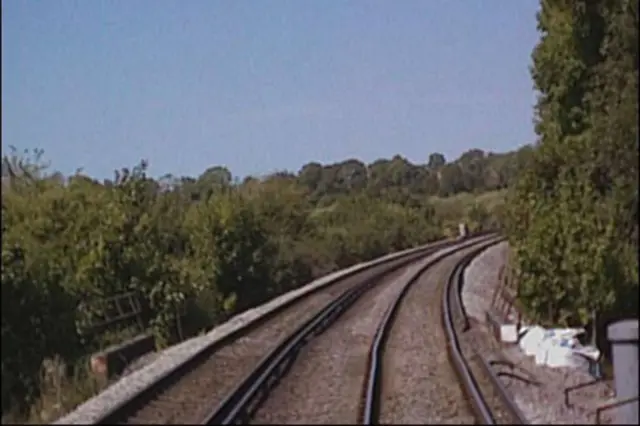
The low wall and railing clearly visible on the left show some sort of underbridge.Image from BBC said to be 1 hour before the incident. That would explain the previous train that went over this with a big jolt. (Image source: RAIB)
"I don't think it's appropriate to speculate, but [immediately speculates]"I don't think it appropriate to speculate, but I do wonder ...
The ladder is for climbing down from a (right way up) train, not for climbing out of a train on its side.
There is only one ladder per unit, so if your coach is on its side it's pot luck whether you have access to it.Doesn’t every unit carry a ladder for this purpose? Some definitely have it visible to the public, am assuming others do but in a cupboard somewhere.

What is known already is in this thread already.Good morning
Have they released any information as to why the train left the rails yet?
ThanksWhat is known already is in this thread already.
Railway tracks are held in tension to be firm enough for trains to run on safely. Metal expands when it is hot. That expansion is allowed for in the way that tracks are laid and maintained. However, if the expansion goes beyond what is allowed for, the metal may bend (“buckle”) and go out of shape. This has caused derailments in the past.How would this of happed to the track please, i know very little about tracks and would like to know and try and understand as a novice.

To clarify, the force is compression rather than tension when the rail is above the Stress Free Temperature, which is when buckling is a risk.Railway tracks are held in tension to be firm enough for trains to run on safely.
Railway tracks are held in tension to be firm enough for trains to run on safely. Metal expands when it is hot. That expansion is allowed for in the way that tracks are laid and maintained. However, if the expansion goes beyond what is allowed for, the metal may bend (“buckle”) and go out of shape. This has caused derailments in the past.
That is one suggestion for the cause of this derailment. Another, also pointed to by the RAIB statement, is that the earthworks under the train moved, meaning the line was no longer smooth. This may have been caused by drying out of the material that the embankment was made from, and it’s also been observed that the derailment site was next to a bridge - which opens the possibility of any change in the earthworks happening abruptly.
There is likely to be a significant delay before we hear more officially - RAIB reports typically take about a year to produce. There may be an update after the vehicles are removed if more evidence becomes safely accessible but I will not be holding my breath for that
To clarify, the force is compression rather than tension when the rail is above the Stress Free Temperature, which is when buckling is a risk.
This area is Continuous Welded Rail.Many many thanks for explaining this to me it is very much appreciated.
May i ask would this track be a continuous track (with the joints welded or whatever they do to them)
Or would it be separate bits of track with expansion gaps between them (like when you go onto an elevated bridge)
Apologies for my ignorance in all of this
Thanks

There's an updated BBC news article here: BBC News LinkSouthern has posted an image either on their Instagram or another social media and shows a 387 carriage being recovered
It has some pictures of the recovery operation, and a link to a video on X of 387172 being removed.Video posted on social media, external showed carriages that did not derail being transported through Lewes station overnight, as recovery work continues at the site.
Network Rail said two out of four carriages at the site were lifted and moved on Thursday, with two others to be moved on Friday.
Temporary foundations and platforms for heavy machinery were built and specialist cranes brought in...
It's a slightly worrisome thought but generally speaking even a vehicle on its side you'll be able to clamber over seat backs and vestibule doors to reach the gangway either to another vehicle or the outside. Must admit however I have spent a bit of time recently eyeing up the 156 and 158 vehicles I've been in thinking about how easy/difficult it would be to maneuverer around them if the walls became the ceiling and the floor! The vestibules on both could be quite tricky for someone who isn't tall or doesn't have great upper body strength. Moving around the carriage itself though I don't think would be especially hard however.Out of curiosity, I've never considered this before, but how DO you self-evacuate from a carriage which is on its side ? Is it a question of breaking a window above your head and climbing ? Not sure I'd like to have to try it in the event of a fire (though I assume that there's not a huge amount of flammables on an electric train...), or indeed if water was rising !!
There's quite a dramatic picture that circulated on social media of the ladder being used by the OBS (assumed) to evacuate people via a disconnected gangway from one of the vehicles on its side. So the ladder very much can be used to climb down from a train on its side.The ladder is for climbing down from a (right way up) train, not for climbing out of a train on its side.
Aha found it again!There's quite a dramatic picture that circulated on social media of the ladder being used by the OBS (assumed) to evacuate people via a disconnected gangway from one of the vehicles on its side. So the ladder very much can be used to climb down from a train on its side.

It isn't a road beneath and, in any case, any strike hard enough to deform both tracks would certainly have required closure, not to mention demolishing the parapets in the process. I also think we would have heard about such a bridge strike by now.Is it possible the distortion couid be due to a bridge strike?

The BBC News article linked in the previous post above says:The reopening date has been announced internally at network rail so shouldn't be too long before its public.
That’s a Tuesday.The line between Haywards Heath and Lewes is expected to reopen on 1 September.
…
… John Whitehurst, GTR chief executive, said: "Getting the line open in time for the end of the school holidays is an absolute priority for us, and we are working closely with Network Rail to achieve this despite very challenging circumstances."
Its a rather wild photo that even though obviously it could have been way worse. Well done to the onboard staff, imagine being that guy, I don't know if I'd save and keep that photo or never want to think about it again! I thought the calmness of the announcements that got reported on was very good too, last thing you want is panic in the rest of the train.(Image shows OBS footing a ladder whilst a passenger starts to climb down from the broken gangway of a 387 vehicle on its side)
