
Ok thanksIt’s an RTT bug. That should be 75.


Ok thanksIt’s an RTT bug. That should be 75.
Related to the derailment, do we have any information on the 20mph speed restriction from Polegate to Southerham Junction which has been in place since Friday. This appears to be separate to the landslip between Polegate and Willingdon Junction. Whilst a different portion of the East Coastway it does seem to be related to the derailment based on the timing.
It’s an RTT bug. That should be 75.
Are they restricted to 33mph light engine(s)? That can't be easy to path in the evening peak!
Send one up the Down Rd from Lewes haul back to Lewes then attach the other loco and your top n tail for the reverse move at Brighton back into Lovers WalkOr they'll run one loco down to do the pickup, and have the other attach wherever the reversal takes place.
I'm sure they have a plan, anyway.
Need to get the 47s on both ends of the train for that to happen, only place that can be done (at least during service) would be somewhere like Eastbourne or Newhaven marine where they can take one of the double headed 47s and change to top and tail, for the onward move to wherever.
Considering the cranes are blocking the up line at cooksbridge and I believe there is a mobile maintenance train in the mix somewhere as well, my guess is the 47s will run together to Lewes, join the 387 at the front together, take it somewhere so it can properly be made top and tail formation.
Just my thoughts

IIRC it is an RTT problem. Originally the system feed problem was the other way round, so RTT edited their system to deal with it but then the VSTP bug was fixed, but RTT never switched back.It isn't an RTT bug, it is in the assumptions for VSTP data that feeds RTT and many other systems.
33ms^-1 = 75mph
Haywards Heath in the first instance, is just the limit of the available driver’s route knowledge today. Nothing more than that.The loco driver, may need to stay overnight and there is a Premier Inn right by the railway station in Haywards Heath. It could be a simple as that! To choose Haywards Heath!

So there'll be a pilotman who signs the route in the morning then?Haywards Heath in the first instance, is just the limit of the available driver’s route knowledge today. Nothing more than that.
It’s already made it into P1 at LewesSo there'll be a pilotman who signs the route in the morning then?
I thought I heard something diesel-like from my home near the station!

There are options at Lewes to get the loco on the other end, if a bit of a faff.Need to get the 47s on both ends of the train for that to happen, only place that can be done (at least during service) would be somewhere like Eastbourne or Newhaven marine where they can take one of the double headed 47s and change to top and tail, for the onward move to wherever.
Five days on from the derailment at #Lewes, we've undertaken key works to prepare the site for the next stage of the operation.
We remain focused on working with our partners to reopen the line as soon as safely possible.
An update from Lucy McAuliffe, route director for Sussex.

Mention about rescuing people’s luggage off the train there. See other thread.Network Rail have issued a video.
So far they have been building a large vehicle compound / car park (couldn't they use a minibus shuttle from nearby existing parking area, do their staff not walk anywhere ?) rather than spend time building a short term temporary compound
Also built a hard standing base for cranes, and doing some ecology work. They have also temporarily rerouted some signal cables.
Doesn't look like they have actually done any recovery so far of the toppled vehicles, and video suggests they still haven't got a clue when line might reopen
So far they have been building a large vehicle compound / car park (couldn't they use a minibus shuttle from nearby existing parking area, do their staff not walk anywhere ?) rather than spend time building a short term temporary compound
So the implementation of a 10m 28ch unforeseen 20 mph speed restriction (from 90) (Southerham to Polegate), Closure of Polegate to Willingdon Junction, Closure of 24m 55ch Hurst Green to Uckfield all within 24 hours of the derailment on track condition is all a coincidence?Timing is Coincidence, other than the dry weather and drivers being (understandably) a little more cautious in callimg in alignment defects.
So the implementation of a 10m 28ch unforeseen 20 mph speed restriction (from 90) (Southerham to Polegate), Closure of Polegate to Willingdon Junction, Closure of 24m 55ch Hurst Green to Uckfield all within 24 hours of the derailment on track condition is all a coincidence?
But was the identification of the issues prompted by the derailment?Depends on what you mean by coincidence. Have these banks all gone off at the same time? yes. Are they on similar geology? yes. Have they had the same rainfall in the past three months? yes.
Is it a result of the derailment? no.
Spoke to one of the signallers yesterday, they said its cause there's a lot of 20MPH esr in the area the drivers were constantly doing 20-50-20 etc someone decided to do a blanket 20mph esr. There's a few reminders on the panel that if the blanket 20mph is removed theres an actual 20mph esr underneath itRelated to the derailment, do we have any information on the 20mph speed restriction from Polegate to Southerham Junction which has been in place since Friday. This appears to be separate to the landslip between Polegate and Willingdon Junction. Whilst a different portion of the East Coastway it does seem to be related to the derailment based on the timing.
- The railway between Lewes and Hayward Heath will be closed for at least one more week as the train is recovered and tracks are repaired

 www.bbc.co.uk
Back in my day you carried heavy plant both ways up hill in horizontal rain and we enjoyed it! It was character building! Young people these days don't know their born!There will be heavy plant to manhandle, you don’t put that in a minivan.


At around 15:54 on Thursday 13 August 2026, train 1F34, the 14:24 London Victoria to Eastbourne passenger service, operated by Southern (Greater Thameslink Railway), derailed at Lewes in East Sussex. The derailment took place around 1 mile (1.6 kilometres) north of Lewes station.
Train 1F34 was formed of eight vehicles. The rear three vehicles derailed and subsequently overturned during the accident, coming to rest on their sides on the railway’s embankment. The front five vehicles did not derail.
Around 150 people were on the train when it derailed. There were 30 people injured in the accident, with 20 people requiring hospital treatment, some with serious injuries. Significant damage was caused to the train and to railway infrastructure.
RAIB was notified of the accident at 16:02 and immediately deployed a team of inspectors and support staff to the site, with the first inspectors arriving at 19:11. RAIB’s team worked alongside the British Transport Police, the Office of Rail and Road, and the railway companies involved, to secure and recover the necessary evidence to support our independent safety investigation.
RAIB released the site of the accident to Network Rail at 14:09 on Saturday 15 August 2026, to allow for repair of the infrastructure and recovery of the train. RAIB inspectors and support staff continued to work at the site of the accident until Monday 17 August.
The recovery of the train will be complex and will include the derailed vehicles being lifted by rail crane and moved by road to secure storage. RAIB’s liaison with rail industry recovery teams to facilitate this work, and to ensure that evidence is preserved, is ongoing.
Data from the on-train data recorder (OTDR, sometimes called ‘the black box’) from the front vehicle of train 1F34 has been downloaded, and is currently being analysed. Data from the remaining recorders on the train will be obtained during recovery operations. CCTV recordings, signalling data and radio communications data have also been obtained. The train, track, and embankment at the site of the accident have been examined and surveyed by various methods including laser scanning and aerial photography.
The accident took place on Network Rail’s East Coastway line, between Cooksbridge station and Lewes Tunnel. The railway here has two tracks. These are the Up Lewes and Down Lewes lines (which direct trains towards London, and away from London, respectively). The derailment took place on the Down Lewes line at around 48 miles and 60 chains, where the maximum permissible speed for the type of train involved in the accident is 70 mph (113 km/h).
Train 1F34 was formed of two class 387 electric multiple units (EMUs) coupled together, each consisting of four vehicles. Preliminary analysis of OTDR data obtained from the front vehicle shows that the train was travelling at around 65 mph (105 km/h) as it approached the point of derailment. Preliminary OTDR data analysis also shows that the driver applied the train’s brakes as it passed the point of derailment, and that the train started to decelerate.
Marks observed on the rails near the point of derailment are consistent with the wheels of the derailed rear vehicles having climbed over the rails. Forward‑facing CCTV images from train 1F34 and forward and rearward‑facing CCTV images obtained from preceding services using these lines on 13 August show that a track geometry irregularity existed on the immediate approach to the point of derailment, prior to the accident occurring. There was also evidence of previous track maintenance activity in this area. Following the accident, RAIB has received several reports of rough riding at the location of the derailment from passengers on other trains. RAIB continues to analyse evidence relating to the derailment sequence and the status of the track.
The weather on the day of the accident was hot and sunny, with little wind. The ambient air temperature at the time of the derailment was recorded as being around 27 degrees Celsius by the nearest weather station to the accident (which was at Brighton City Airport). The accident took place during a sustained period of hot and dry weather.
The embankment on which the railway runs at this location is constructed of clay and sits on alluvial/alluvium deposits (consisting of loose clay, silt, sand and gravel). Both are sensitive to variations in water content and may undergo movement as moisture levels change. Although, at this stage, there is no evidence to indicate that a significant embankment slip occurred before the accident, there is evidence that some movement had previously taken place.
Our investigation will seek to identify the sequence of events which led to the accident. It will also consider:
Some of the information discussed in this web entry may be refined as RAIB’s investigation progresses.
- the exact mechanism by which train 1F34 derailed
- the status of the track at this location and how it was inspected and maintained
- the condition of the embankment, including the presence of any coincident risk factors (such as sustained hot weather, nearby structures, and vegetation), and how it was inspected and maintained
- the weather conditions in the area on the day of the accident, and in the weeks and months preceding it
- the effectiveness of any mitigation measures intended to address the risks of operating trains in hot weather
- the condition of train 1F34 and the crashworthiness performance of the rear three vehicles of the train during the derailment
- the emergency response to the accident
- any relevant underlying factors, including any actions taken in response to previous relevant safety recommendations.

The Health & Safety at work act, CDM 2015 regulations and their associated provisions on staff welfare don't stop when its a derailment recover either.Network Rail have issued a video.
So far they have been building a large vehicle compound / car park (couldn't they use a minibus shuttle from nearby existing parking area, do their staff not walk anywhere ?) rather than spend time building a short term temporary compound
Also built a hard standing base for cranes, and doing some ecology work. They have also temporarily rerouted some signal cables.
Doesn't look like they have actually done any recovery so far of the toppled vehicles, and video suggests they still haven't got a clue when line might reopen

Luxury!Back in my day you carried heavy plant both ways up hill in horizontal rain ...
Thanks for posting, but can you please edit your post to include a text description, for the benefit of our blind members/readers (who rely on text-to-speech software), thanksImage from BBC said to be 1 hour before the incident. That would explain the previous train that went over this with a big jolt. (Image source: RAIB)
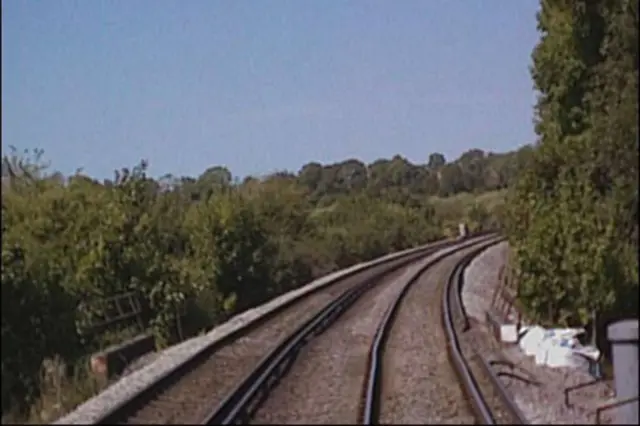
Is it me or does the up line also look distorted?Image from BBC said to be 1 hour before the incident. That would explain the previous train that went over this with a big jolt. (Image source: RAIB)
