Not for building new routes, but works from using existing terminals and train utilisation.
Existing infrastructure needs to, well, exist.

Not for building new routes, but works from using existing terminals and train utilisation.

Existing infrastructure does exist. There are 4 probably usable interfaces between HS1/Channel tunnel and the classic GB network.Existing infrastructure needs to, well, exist.
Existing infrastructure does exist. There are 4 probably usable interfaces between HS1/Channel tunnel and the classic GB network.
1. NLL connection at St Pancras
2. Ripple lane sidings in Barking
3. Ashford international
4. Dollands Moor sidings/the channel tunnel itself
*In theory* a GBRf 92 could take a 16 carriage mk5 sleeper train down the WCML, then through Kensington Olympia and Wandsworth Rd onto the old route to the Channel Tunnel...is that correct?

I believe they can run on HS1/CTRL, but I'm not sure about anything past Dollands Moor towards Calais.I genuinely don’t know … Do any of the 92s retain operational signalling and electrification electrification equipment for all the necessary systems on the UK network and Channel Tunnel?

Track access not sure, although there’s no reasonable obstacle to them being successful on the UK side. I believe there are available paths on the European side otherwise Virgin et al. would not be bothering.On the subject of actually likely future services, do we know of anything in relation to Virgin's plans to compete with Eurostar? Have they applied for track access or signed any contracts with Alstom over rolling stock orders?
To be honest I would've thought the biggest obstacle in this situation would've been SNCF with LGV Nord access, although legally they cannot stop competition by EU law, especially when they have a stake in every passenger service currently running on the line (100% all TGV services as well as majority shares in Eurostar). I do think it'd be great to see Virgin enter by the end of the decade.Track access not sure, although there’s no reasonable obstacle to them being successful on the UK side. I believe there are available paths on the European side otherwise Virgin et al. would not be bothering.
For rolling stock they have a “purchase rights” deal with Alstom which I believe will now become a contract for 12 Avelia Stream trainsets.
Yes I would think the same, although it would be silly of SNCF to try anything more than being slow with responses and applications. The ECJ would quickly slap anything blatant down when Virgin challenged.To be honest I would've thought the biggest obstacle in this situation would've been SNCF with LGV Nord access, although legally they cannot stop competition by EU law, especially when they have a stake in every passenger service currently running on the line (100% all TGV services as well as majority shares in Eurostar). I do think it'd be great to see Virgin enter by the end of the decade.
I genuinely don’t know … Do any of the 92s retain operational signalling and electrification electrification equipment for all the necessary systems on the UK network and Channel Tunnel?
I'm sure they will, no matter how relevant, or not, that would be.If they are canny (as opposed to cannae) they will at least mention that one of the main obstacles is Brexit / non Schengen.
I think the only other cities that could fit into a cross-Channel network would be Birmingham, Manchester and Leeds which are significant enough that HS2 was planned to serve them directly. Sleeper trains are already difficult enough to be worth the money as it is now, so adding the complexities of juxtaposed controls and different track access charges, rolling stock specification and training staff over multiple networks with different rules would be a nightmare.London to some points on the continent seems to me to be the only speculation worth even spending effort to discuss! Not that this ever stops the fantasists
As I've said before this conversation has been done to death (and way beyond) on this and other forums multiple times in the last 10 years and the answer is a clear no. The only change since then with the pruning back of HS2 is that paths on HS2 may now be available. I doubt this gets close to changing the basic economics thoughI think the only other cities that could fit into a cross-Channel network would be Birmingham, Manchester and Leeds which are significant enough that HS2 was planned to serve them directly.
Whatever capacity may or may not be avaiable on HS2 became irrelevant once the HS1/2 link was canned.The only change since then with the pruning back of HS2 is that paths on HS2 may now be available. I doubt this gets close to changing the basic economics though
I agree, however the conversation always seems to be "there's enough demand from xyz to justify an HS1/ HS2 link" and my view is that, even with a link and other issues such as security being solved there still would be (generously) an extremely marginal case, and certainly not enough to have built the link as first mooted. Anyway enough time spent on, what is to me, an obvious non starter!Whatever capacity may or may not be avaiable on HS2 became irrelevant once the HS1/2 link was canned.
I agree, however the conversation always seems to be "there's enough demand from xyz to justify an HS1/ HS2 link" and my view is that, even with a link and other issues such as security being solved there still would be (generously) an extremely marginal case, and certainly not enough to have built the link as first mooted. Anyway enough time spent on, what is to me, an obvious non starter!
The point was that that they are the only others cities that might be worth cross-Channel traffic compared to Caledonian Sleeper services. But unless the UK joins Schengen and paths become available it's not happening. It's already difficult enough getting passengers from London where the catchment is actually worth it.As I've said before this conversation has been done to death (and way beyond) on this and other forums multiple times in the last 10 years and the answer is a clear no. The only change since then with the pruning back of HS2 is that paths on HS2 may now be available. I doubt this gets close to changing the basic economics though
would there be a big enough market for this to work even to the level of subsidy the Scottish government may wish to give it...
you'd expect their homework to have been done internally on this, with some degree of consultation with Transport Scotland, Caledonian Sleeper and ScotRail on the economic prospect of it all without the need to commission any third party studies.
And completing full HS2 to fill the spine to 18tph is more economically useful than reserving some of those paths for Channel Tunnel traffic.
Well, the air + rail market for Glasgow / Edinburgh to Paris / Brussels / Amsterdam is roughly 15-20% of the air + rail market of London to Glasgow / Edinburgh.
A decent proportion of the Scotland - Amsterdam air market will be transfer passengers at Schiphol. Paris will have quite a few too. (Albeit so does Heathrow).
It’s reasonable to assume that if the same proportion of the city to city market willing to travel by sleeper between London / the South East and the Central Belt were willing to travel between the Central Belt and Paris / Brussels / Amsterdam by sleeper, there would be enough for about 2 sleeper coaches per night each way total.
The only homework necessary is to consider what happened to the last proposal for Channel Tunnel Sleeper services. That is all that is required to sink this madcap idea.
FS Italiane Group has unveiled a major €2 billion investment programme that will see its French subsidiary, Trenitalia France, acquire 19 new high-speed trains from Hitachi Rail, reinforcing its long-term ambition to expand across France and establish a direct high-speed service between Paris and London by 2029.
The new trains will enable Trenitalia France to strengthen operations on its established Paris–Lyon, Paris–Milan and Paris–Marseille routes through higher frequencies, improved passenger experience and increased capacity. Crucially, the fleet will also support the launch of the company's planned Paris–London high-speed service, which remains targeted for 2029.
Designed for operation across Europe's major high-speed rail networks, the trains will enhance cross-border interoperability and support FS Group's wider ambition of creating a truly connected European rail network.
Alongside the fleet expansion, work is continuing on schedule at the new Maisons-Alfort Pompadour maintenance facility near Paris. The depot will provide the maintenance capacity required to support a larger fleet and future international services.
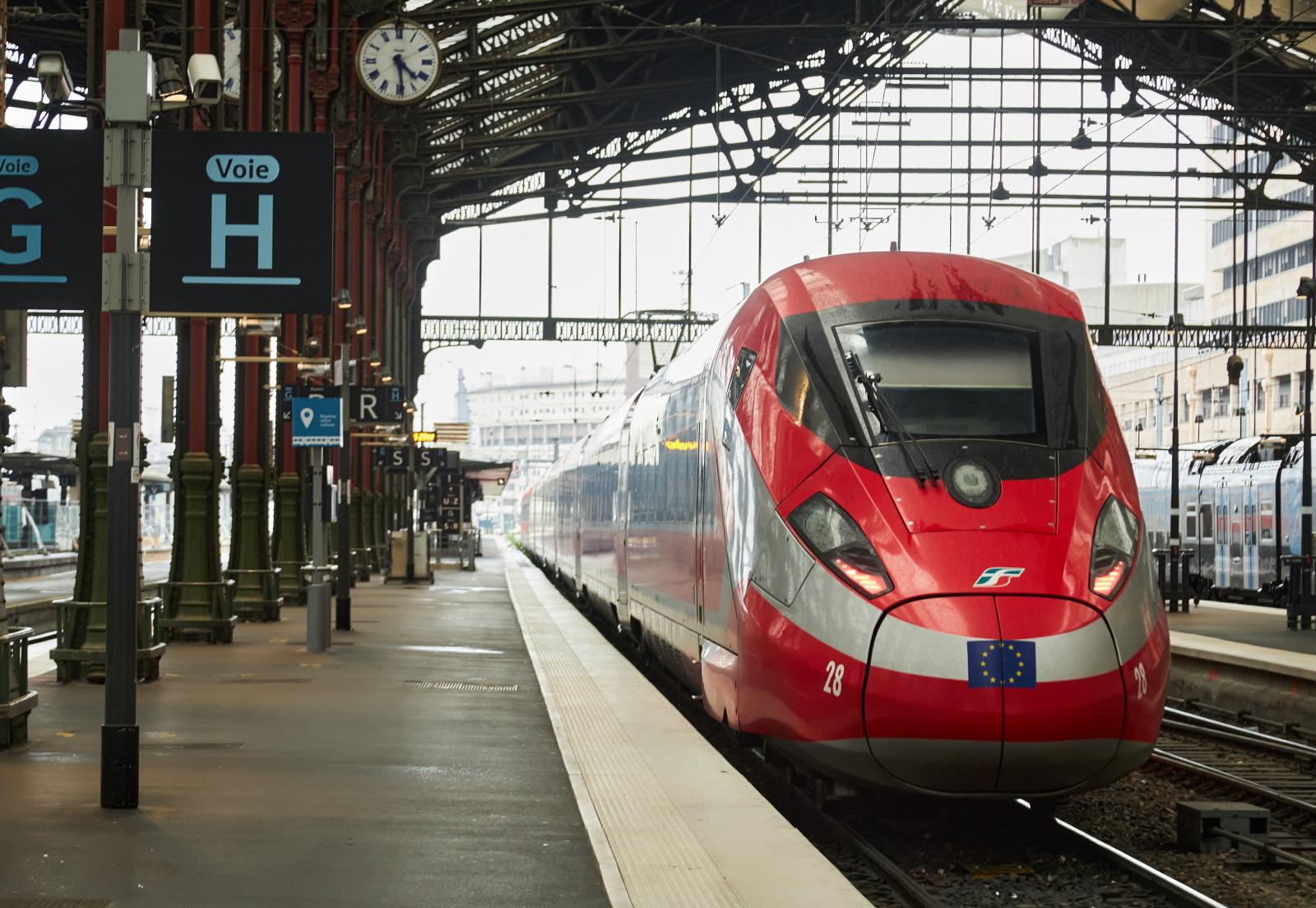
Before anyone gets carried away with this "Trenitalia places an order for 19 trains" thing https://www.railmagazine.com/news/t...ed-trains-to-spearhead-paris-london-expansion
... is the same news as was announced in December https://www.ansa.it/english/news/20...ces_63c0c38d-8688-4ccb-9a73-35a43cffdf4c.html
19 200m trains for ALL their French services, AND *theoretically* Paris-London is not many
The 19 take order to 74, and they are already in production, 9 have been delivered (most recent is numbered 109). An earlier batch of 50 have been in service in italy a few years (of which 2 are out of service due to incidents)Nothing actually new here, according to Jon Worth. But good to hear their intentions restated I suppose.
You wouldn't run the train to Dover south of London anymore, Canterbury, Ramsgate, Margate would have far more traffic.Aside from regional Eurostar and the odd Kent-North England services (1tph Dover to Manchester?), I wouldn’t imagine all that much through running. But you could have consolidated the termini of HS1, HS2 and Eurostar into one purpose built high speed station to facilitate easy interchange and tube connections. Stick it all in one station deep under Bond Street and Oxford Circus (nobody said I had to go for realism, crayons galore) and hey presto you have a direct tube link to every conventional London terminus, except the special star Fenchurch Street.
The Office of Rail and Road (ORR), the rail regulator, has today announced that on 13 August it decided to pre-approve a new framework track access agreement between HS1 Limited (trading as London St. Pancras Highspeed) and VTE OPCO Limited (Virgin Trains). The agreement will allow Virgin Trains to operate up to 20 new daily return services between London and Paris, Brussels or Amsterdam from 1 October 2030 to 31 December 2040.
Virgin Trains and London St Pancras High Speed may now enter into the agreement by 4 September 2026.
There are a number of steps before the new services will be able to run. Virgin Trains must also procure rolling stock, secure access to other rail networks, and obtain safety approvals from ORR and the relevant authorities in the EU. Virgin Trains plans to begin running services in 2030.
It would be monumentally short sighted of the ORR to give them three weeks to negotiate a complex commercial contract without knowledge that Virgin and St Pancras had something basically ready to go. The press would have a field day over the matter, and they’re already doing quite well off of the various derailments in the Southeast.Appear to have given Virgin just 3 weeks to enter into agreement with St Pancras station

