• Our new ticketing site is now live! Using either this or the original site (both powered by TrainSplit) helps support the running of the forum with every ticket purchase! Find out more and ask any questions/give us feedback in this thread!

New passenger numbers and Crowding figures published

Snow1964

Established Member
Joined
7 Oct 2019
Messages
11,015
Location
West Wiltshire
Just been released by DfT, rail passenger numbers and crowding in major cities

This publication presents statistics on rail passenger numbers into and out of major cities in England and Wales on mainline services, excluding services operated by open access operators.

Passenger demand is much higher in Greater London than in other major cities in England and Wales, so additional detail is provided for individual stations in central London.

Headline figures​

  • On a typical autumn weekday in 2025, there were on average 1,923,600 daily passenger arrivals into major cities in England and Wales. This was an increase of 3% compared with 2024, showing continued recovery in rail demand following the pandemic.
  • Whilst demand has increased across both London and major cities outside of London, crowding has decreased overall, an average of 1% (16,800) passengers per day travelled in excess of capacity (PiXC), 0.2 percentage points (pp) lower than in autumn 2024.
  • London had the highest number of arrivals, with 1,256,600 daily passengers, over 10 times higher than Birmingham, which was observed to have the second highest number of daily arrivals, at around 116,700.
  • 1 in 5 passengers (20%) were standing during the peak hours on a typical autumn weekday in 2025 across all major cities. This rose to 1 in 4 passengers in London.

Section 4.1 suggests Newcastle grew 20% in a year

section 5.3 says Bristol has highest PiXC passengers in excess of capacity

section 5.4 has busiest recorded services

section 6 has graphs, where long distance services have plenty above 110% load factors

Figure 14 section 9 suggests 5.8% rail growth in UK in a year

plenty to discuss

 
Last edited by a moderator:
Sponsor Post - registered members do not see these adverts; click here to register, or click here to log in
R

RailUK Forums

devon_belle

Member
Joined
21 Jul 2022
Messages
642
Location
Surrey
Very interesting. One take away for me is that London peak services are extremely busy, but that might be because there are fewer trains than there once were (rather than more commuters)?
 

The exile

Established Member
Joined
31 Mar 2010
Messages
9,307
Location
Somerset
section 5.3 says Bristol has highest PiXC passengers in excess of capacity
Higher even than the London average (1.4% vs 1.3%), yet no individual trains in the “top ten”. Not sure what that tells us (other than the fact that having two full trains arrive at platforms 13 and 15 simultaneously is too much for the subway stairs to cope with!).
 

Harpo

Established Member
Joined
21 Aug 2024
Messages
3,733
Location
Newport
Higher even than the London average (1.4% vs 1.3%), yet no individual trains in the “top ten”. Not sure what that tells us (other than the fact that having two full trains arrive at platforms 13 and 15 simultaneously is too much for the subway stairs to cope with!).
Having lots of 2 or 3 car trains at Bristol, including the peaks, can’t help.
 

Mcr Warrior

Veteran Member
Joined
8 Jan 2009
Messages
17,152
Noted the two "busiest" trains on the network reportedly being the 08:09 (Thameslink) Bedford to Three Bridges with a load factor of 176% upon arrival into St. Pancras and the 17:46 (West Midlands) London Euston to Crewe with a load factor of 170% upon departure from Euston. That's wearing if you're doing it regularly!
 

swt_passenger

Veteran Member
Joined
7 Apr 2010
Messages
34,227
Higher even than the London average (1.4% vs 1.3%), yet no individual trains in the “top ten”. Not sure what that tells us (other than the fact that having two full trains arrive at platforms 13 and 15 simultaneously is too much for the subway stairs to cope with!).
Doesn’t it just tell you that some of their stats, like section 5.3 figure 8, exclude London, some are London only, and some are both? I think there are potentially many hundreds of peak trains into London, it doesn’t really seem much of a surprise that the top ten is all London. I expect it’s the same in all the earlier reports?
 

The exile

Established Member
Joined
31 Mar 2010
Messages
9,307
Location
Somerset
Doesn’t it just tell you that some of their stats, like section 5.3 figure 8, exclude London, some are London only, and some are both? I think there are potentially many hundreds of peak trains into London, it doesn’t really seem much of a surprise that the top ten is all London. I expect it’s the same in all the earlier reports?
Except the top ten is not all London - though to be fair 9 of them are.
One of the things I suspect it does show is the proportion of trains in the Bristol area that are operated with 40% to 60% of the intended number of carriages.
 

SeanM1997

Member
Joined
2 Feb 2016
Messages
566
Just been released by DfT, rail passenger numbers and crowding in major cities


Section 4.1 suggests Newcastle grew 20% in a year

section 5.3 says Bristol has highest PiXC passengers in excess of capacity

section 5.4 has busiest recorded services

section 6 has graphs, where long distance services have plenty above 110% load factors

Figure 14 section 9 suggests 5.8% rail growth in UK in a year

plenty to discuss
Hasn't the 1746 London Euston - Crewe been extended to 10 coaches (previously 8?). Is this including that, or is it still 170% over capacity with that included?
 

Magdalia

Established Member
Joined
1 Jan 2022
Messages
7,296
Location
The Fens
Just been released by DfT, rail passenger numbers and crowding in major cities
Thanks for finding and sharing this.

Unlike the Origin and Destination Matrix, this is based on passenger counts not ticket sales.

The detailed hour by hour breakdowns in the RAI0202 spreadsheet (link at bottom of figure 1) are particularly interesting. If your local big station is in the dataset, then it is worth a look.

== Doublepost prevention - post automatically merged: ==

BBC report on the most overcrowded trains here:


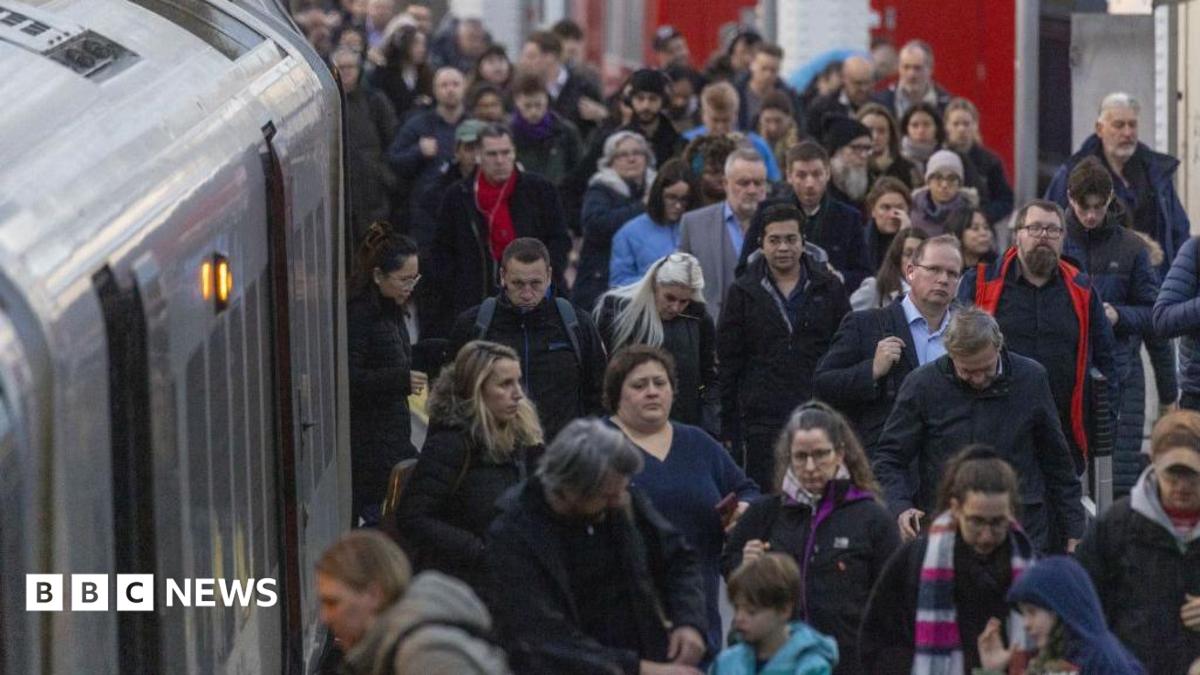
The most overcrowded train service in England and Wales last autumn was a Thameslink morning rush hour service between Bedford and Three Bridges in West Sussex, according to the Department for Transport (DfT).

Second on the list was a West Midlands service from London Euston to Crewe, Cheshire, departing at 17:46, the government figures reveal.

Overall, they show overcrowding on commuter trains serving major English and Welsh cities fell slightly, for the first time since 2020, due to an increase in capacity.

Only 1.1% of peak-time travellers were on an overcrowded train, the DfT said. More than 1.2 million of the average 1.9 million journeys on a typical autumn day were in London.
 
Last edited:

AM9

Veteran Member
Joined
13 May 2014
Messages
16,007
Location
St Albans
Noted the two "busiest" trains on the network reportedly being the 08:09 (Thameslink) Bedford to Three Bridges with a load factor of 176% upon arrival into St. Pancras and the 17:46 (West Midlands) London Euston to Crewe with a load factor of 170% upon departure from Euston. That's wearing if you're doing it regularly!
Interestingly if the current RTT entry for the busiest train in the UK (Thameslink 9T81 0713 Bedford to Three Bridges) is shows a class 700/0 - 8 car, whereas 12 car class 700/1 is the normal stock for the BML fasts. Unless this is a school holiday change, is it just a repositioning move in the diagram at a pretty inconvenient time, e.g. to transfer to depot or return northwards as a Cambridge slow.?
 

6Gman

Established Member
Joined
1 May 2012
Messages
9,185
My first job on the railway was recording train loadings. The information reached me within a few days of real-time (paper charts completed by the Guard and sent via BR internal posts). If I spotted consistent overcrowding I could speak to my boss and arrange strengthening where appropriate and practical. From incident to strengtheing was a matter of weeks.

Today it seems to take months to publish the data. Is anything done in the meantime to actually address the issue?
 

LNW-GW Joint

Veteran Member
Joined
22 Feb 2011
Messages
21,897
Location
Mold, Clwyd
The BBC has a piece on the 10 most crowded rail services (data from ORR/DfT):
The most overcrowded train service in England and Wales last autumn was a Thameslink morning rush hour service between Bedford and Three Bridges in West Sussex, according to the Department for Transport (DfT).
Second on the list was a West Midlands service from London Euston to Crewe, Cheshire, departing at 17:46, the government figures reveal.
Overall, they show overcrowding on commuter trains serving major English and Welsh cities fell slightly, for the first time since 2020, due to an increase in capacity.
Only 1.1% of peak-time travellers were on an overcrowded train, the DfT said. More than 1.2 million of the average 1.9 million journeys on a typical autumn day were in London.
The DfT says work is under way to improve capacity where there are pinch points during peak hours.

The wider DfT comment was:
"Bringing track and train together under Great British Railways will support further improvements, helping create a joined-up service that puts passengers first."

I was particularly interested in the pair of LNR trains in the top 10 list: the 1746 Euston-Crewe and the 1758 Euston-Birmingham.
Presumably the main overcrowding was between Euston and Milton Keynes (with load factors of 170% and 146% respectively).
So what, exactly, will GBR bring to that flow? Presumably Avanti and LNR services will be merged into one operation.
Will the excess passengers be allowed to use the parallel Avanti services as they are supposedly "lightly loaded" in the peak? And at what fare?
The WCML is "full" and already at maximum efficiency during the peak, with some LNR services using the fast lines.
How can GBR beat the expert professional development of the WCML VHF timetable over nearly two decades?
There are no extra Pendolinos or 730s available, or paths out of Euston.

I have yet to see any change that "puts passengers first" except possibly the freedom to use other TOCs' services during disruption.
 

Krokodil

Established Member
Joined
23 Jan 2023
Messages
6,524
Location
Wales
paper charts completed by the Guard
John Davies was very skeptical of the passenger loadings sent in by guards. What does "full & standing" mean, is one person standing or one hundred? He got the local rail users group to do surveys.

Today it seems to take months to publish the data. Is anything done in the meantime to actually address the issue?
We've had persistent overcrowding for many years. passengers left behind, women fainting, staff abused, many delay minutes...

All that has been done is a couple of minutes added to station dwell times.

See also: Crosscountry
 

Russel

Established Member
Joined
30 Jun 2022
Messages
5,376
Location
Lichfield
The BBC has a piece on the 10 most crowded rail services (data from ORR/DfT):


The wider DfT comment was:


I was particularly interested in the pair of LNR trains in the top 10 list: the 1746 Euston-Crewe and the 1758 Euston-Birmingham.
Presumably the main overcrowding was between Euston and Milton Keynes (with load factors of 170% and 146% respectively).
So what, exactly, will GBR bring to that flow? Presumably Avanti and LNR services will be merged into one operation.
Will the excess passengers be allowed to use the parallel Avanti services as they are supposedly "lightly loaded" in the peak? And at what fare?
The WCML is "full" and already at maximum efficiency during the peak, with some LNR services using the fast lines.
How can GBR beat the expert professional development of the WCML VHF timetable over nearly two decades?
There are no extra Pendolinos or 730s available, or paths out of Euston.

I have yet to see any change that "puts passengers first" except possibly the freedom to use other TOCs' services during disruption.

They will probably take the "increase ticket prices and hope the problem goes away" approach, also known as the XC approach...
 

Kite159

Veteran Member
Joined
27 Jan 2014
Messages
22,709
Location
West of Andover
John Davies was very skeptical of the passenger loadings sent in by guards. What does "full & standing" mean, is one person standing or one hundred? He got the local rail users group to do surveys.
And quite often it can be that one part of the train has quite a few standees but the opposite end could be empty seats! Commuters do tend to spread out a bit more than leisure travellers.
 

Stephen42

Member
Joined
6 Aug 2020
Messages
803
Location
London
Interestingly if the current RTT entry for the busiest train in the UK (Thameslink 9T81 0713 Bedford to Three Bridges) is shows a class 700/0 - 8 car, whereas 12 car class 700/1 is the normal stock for the BML fasts. Unless this is a school holiday change, is it just a repositioning move in the diagram at a pretty inconvenient time, e.g. to transfer to depot or return northwards as a Cambridge slow.?
The 0713 train goes into the depot at Three Bridges after that trip. It comes from an 8-car siding in the standard timetable and would need alterations to lengthen, it's likely to get an 8-car into the depot.

Much of list is as the standing allowance is only given to trains calling at a station 20 minutes or fewer before their busiest point. Some of the metro 700 services have people standing for the same length of time but won't feature in the list even if they had more people on them as the allowance is higher. 76% of seated capacity standing is half the stated standing capacity of an 8-car class 700.
Today it seems to take months to publish the data. Is anything done in the meantime to actually address the issue?
Most data sets take a while to formally publish. Several operators have real time dashboards of how many people are on each train and many more would have timely access to the automated passenger count figures.

Similar trains are on the list every year as the methodology used diverges from what is considered acceptable by the rail industry.
 

London Trains

Established Member
Joined
9 Oct 2017
Messages
1,206
Much of list is as the standing allowance is
only given to trains calling at a station 20 minutes or fewer before their busiest point. Some of the metro 700 services have people standing for the same length of time but won't feature in the list even if they had more people on them as the allowance is higher. 76% of seated capacity standing is half the stated standing capacity of an 8-car class 700.
Indeed, the only two services on the list which will include a standing allowance are the TfW service and the Epsom to London Bridge service.
 

6Gman

Established Member
Joined
1 May 2012
Messages
9,185
John Davies was very skeptical of the passenger loadings sent in by guards. What does "full & standing" mean, is one person standing or one hundred? He got the local rail users group to do surveys.
Who was John Davies?
 

mattmattmatt

New Member
Joined
24 Jan 2024
Messages
2
Location
Hampshire
No surprise at seeing the Alton line being SWR's busiest. It's time the line saw 3tph to Waterloo, with one service being non-stop from Ash Vale (shaving 15-20mins off peak journey times)

The 2nd track from Farnham to Alton must be reinstated too.
 

TheSmiths82

Member
Joined
29 Jun 2023
Messages
601
Location
Manchester
I am wondering how many passengers on that London to Crewe LNW are actually going to Manchester and changing onto a Northern/TFW or even Avanti service to continue the journey? I can now get Avanti tickets quite cheap via a work scheme (it doesn't have to be for work purposes) but then I used to often use the service to Crewe and then get continue the journey via TFW to Manchester. It was very cheap (around £40 return) and that was off peak return too (it is a bit more expensive now).
 

Krokodil

Established Member
Joined
23 Jan 2023
Messages
6,524
Location
Wales
Who was John Davies?
Divisional Passenger Manager at Cardiff in the 1980s, ended up as Regional Railways' Wales manager. Believed strongly that cutting costs in isolation was the way to cut yourself out of business, you had to find ways to grow revenue too. Quite the opposite of the managed decline expected of the Provincial sector.

Wrote a couple of good books.
 

David Bullock

Member
Joined
18 Mar 2018
Messages
69
I’m not convinced it’s methodologically sound to completely omit Elizabeth line data when doing comparisons with 2019.

A new railway opened and loads of people are using it, that is significant for the railway. It’s also not the case that all of the journeys are ones which would have otherwise been tube journeys. Some passengers would have taken GA, GWR or Heathrow Express. Many, with a shiny new railway and fast comfortable trains will have taken that journey when perhaps they would have avoided it before.

Omitting it from the statistics and saying it’s more “like for like” would be like omitting TRU passenger numbers because it relieved the M62. It’s all modal shift at the end of the day.
 

LLivery

Established Member
Joined
13 Jul 2014
Messages
1,707
Location
Southeastern land
How is London Overground never on these top ten stats when people regularly get left behind on the northern end of the Sydenham corridor AM peak? I've never seen crowding as bad as LO, anywhere.
 

JamesT

Established Member
Joined
25 Feb 2015
Messages
4,824
I’m not convinced it’s methodologically sound to completely omit Elizabeth line data when doing comparisons with 2019.

A new railway opened and loads of people are using it, that is significant for the railway. It’s also not the case that all of the journeys are ones which would have otherwise been tube journeys. Some passengers would have taken GA, GWR or Heathrow Express. Many, with a shiny new railway and fast comfortable trains will have taken that journey when perhaps they would have avoided it before.

Omitting it from the statistics and saying it’s more “like for like” would be like omitting TRU passenger numbers because it relieved the M62. It’s all modal shift at the end of the day.
They don’t completely omit it, there are statistics both with and without.
But as it notes, a considerable number of journeys transferred across from TfL services that aren’t counted. But those TfL services are still rail, so there isn’t really modal shift.
If we celebrate rail passengers being up 6% versus pre-pandemic, do we do the opposite for London Underground being down 9%?
Ideally there would be combined numbers for all rail regardless of operator to get a holistic view. But absent that, having the version of the statistics omitting the Elizabeth line does give the most reliable way of comparing.

== Doublepost prevention - post automatically merged: ==

How is London Overground never on these top ten stats when people regularly get left behind on the northern end of the Sydenham corridor AM peak? I've never seen crowding as bad as LO, anywhere.
The stats appear to concentrate on commuter services into city centre stations or zone 1 termini for London. So they may just not be looking at LO for this. The other thought is that the statistic is passengers in excess of capacity. LO stock is designed for lots of standees, so may not be as overcrowded in percentage terms as another operator’s services.
 
Last edited:

Snow1964

Established Member
Joined
7 Oct 2019
Messages
11,015
Location
West Wiltshire
How is London Overground never on these top ten stats when people regularly get left behind on the northern end of the Sydenham corridor AM peak? I've never seen crowding as bad as LO, anywhere.
The data appears to be taken at terminus stations and a few selected stations eg Vauxhall (but how these stations are selected, and others just before interchanges where many alight aren't selected, is not explained). The choice of these extra stations appears to be be historic from years ago and thus does not include busy sections of line not near a city terminus.

It also says that sampling can be as low as 1-4 days per year, thus having statistical error factor.
 

Harpo

Established Member
Joined
21 Aug 2024
Messages
3,733
Location
Newport
The choice of these extra stations appears to be be historic from years ago and thus does not include busy sections of line not near a city terminus.
An obvious one is GEML outer services. With five major options to transfer to at Stratford westbound, I wonder how load factors east of Stratford look?

Similarly, didn’t C2c have to address some severe loadings between Barking and West Ham?
 

The exile

Established Member
Joined
31 Mar 2010
Messages
9,307
Location
Somerset
The data appears to be taken at terminus stations and a few selected stations eg Vauxhall (but how these stations are selected, and others just before interchanges where many alight aren't selected, is not explained). The choice of these extra stations appears to be be historic from years ago and thus does not include busy sections of line not near a city terminus.

It also says that sampling can be as low as 1-4 days per year, thus having statistical error factor.
Doesn’t it explain that they look at the first/last stop in Z1 for “London” journeys?
 

Snow1964

Established Member
Joined
7 Oct 2019
Messages
11,015
Location
West Wiltshire
Doesn’t it explain that they look at the first/last stop in Z1 for “London” journeys?
Yes, I agree, but doesn't explain why sampling methodology only uses this, even where a train might already have partially emptied at an earlier station that provides connections to other parts of London.

There is some double standards at play, because DfT will use 'churn' at places like Clapham Junction to explain why no spare seats at places like Kingston (about 30 minutes from Waterloo) don't fall foul of the 20 minute standing rule.

My nearest city, Bath (although not large city per their selection definition), sees lot of churn, I have seen 2car 158s take 6 or 7 minutes whilst churn takes place because crush loaded to nearer 200% of seating capacity. But these are not selected for inclusion.
 

The exile

Established Member
Joined
31 Mar 2010
Messages
9,307
Location
Somerset
My nearest city, Bath (although not large city per their selection definition), sees lot of churn, I have seen 2car 158s take 6 or 7 minutes whilst churn takes place because crush loaded to nearer 200% of seating capacity. But these are not selected for inclusion.
That’ll be because, short-forms aside (which can slip through the net as these figures are based on actual counts), the biggest problems at Bath are not during the weekday peaks. And yes, it’s my local station…
 

Top