• Our new ticketing site is now live! Using either this or the original site (both powered by TrainSplit) helps support the running of the forum with every ticket purchase! Find out more and ask any questions/give us feedback in this thread!

No Contractor's Names in Closure File?

Andy873

Established Member
Joined
23 Mar 2017
Messages
1,412
Apart from one letter which has the company name (for the removal of one bridge), which by the way someone has scribbled out, there are no company names regarding who removed the track, ballast, and bridges on the Gt. Harwood section of the loop line - Why? and why has someone scribbled out that company name?

I'm talking here about a copy of eighty eight BR letters, minutes of meetings, and drawings etc covering the closing of the Harwood section (1963-1968) which I got from the National Archives.

The information is made available under the Open Government License V3.0

Anyone got any theories please?
 
Sponsor Post - registered members do not see these adverts; click here to register, or click here to log in
R

RailUK Forums

Morayshire

Member
Joined
6 Feb 2019
Messages
302
Perhaps the records did not include the actual contract file?

Or the documents were removed/redacted prior to moving to the archives as they were deemed to be commercially sensitive?
 

Andy873

Established Member
Joined
23 Mar 2017
Messages
1,412
Perhaps the records did not include the actual contract file?
Possibly, but everything else seems to be included.

Or the documents were removed/redacted prior to moving to the archives as they were deemed to be commercially sensitive?
And this is my feeling too!

In one of these letters dated 3 February 1965, the manager of Head Office of the LM Region (Euston) writes to the C.C.E. in Manchester (Chief Civil Engineer's Dept) informing them of five lines ready for disposal (Removal of track). The one the CCE Dept was interested in was the Gt. Harwood - Padiham section.

Now, the CCE are told that any of these lines that are under 6 track miles (not route miles) are to be awarded to any one of three companies already under contract, but any line 6 or more track miles (and the Harwood - Padiham section 17.75 track miles) was to be put out to competitive tender. So this letter proves to me at least that the Harwood section was indeed lifted by an outside company.

For those of you who are wondering which other lines were mentioned, here you are:

M in brackets denotes track miles to be lifted.

Blisworth Ironstone Sidings - Woodford Halse West (15.75M)
Little Hulton Mineral Branch (Plodder Lane - Walkden) (5.25M)
Carr Mill - Haydock Jcn (4.25M)
Hough Green - Widnes East Jcn (13.5M)

Finally, these documents were placed together in a file marked CLOSED UNTIL 1999.
 

WesternLancer

Veteran Member
Joined
12 Apr 2019
Messages
15,169
Possibly, but everything else seems to be included.


And this is my feeling too!

In one of these letters dated 3 February 1965, the manager of Head Office of the LM Region (Euston) writes to the C.C.E. in Manchester (Chief Civil Engineer's Dept) informing them of five lines ready for disposal (Removal of track). The one the CCE Dept was interested in was the Gt. Harwood - Padiham section.

Now, the CCE are told that any of these lines that are under 6 track miles (not route miles) are to be awarded to any one of three companies already under contract, but any line 6 or more track miles (and the Harwood - Padiham section 17.75 track miles) was to be put out to competitive tender. So this letter proves to me at least that the Harwood section was indeed lifted by an outside company.

For those of you who are wondering which other lines were mentioned, here you are:

M in brackets denotes track miles to be lifted.

Blisworth Ironstone Sidings - Woodford Halse West (15.75M)
Little Hulton Mineral Branch (Plodder Lane - Walkden) (5.25M)
Carr Mill - Haydock Jcn (4.25M)
Hough Green - Widnes East Jcn (13.5M)

Finally, these documents were placed together in a file marked CLOSED UNTIL 1999.
Sounds a bit OTT. Isn’t that the same as minutes of lots of key govt decisions up to cabinet level. 30years?

Or maybe in late 60s other government or cabinet decisions were closed for more than thirty years in those days.
 

Rescars

Established Member
Joined
25 May 2021
Messages
2,547
Location
Surrey
Apparently the Public Records Act 1967 reduced the period during which certain public records had to be in existence before they were available for public inspection from 50 years to 30 years, thus creating the "thirty-year rule". The provisions of the Act commenced on 1st January 1968.
 

WesternLancer

Veteran Member
Joined
12 Apr 2019
Messages
15,169
Apparently the Public Records Act 1967 reduced the period during which certain public records had to be in existence before they were available for public inspection from 50 years to 30 years, thus creating the "thirty-year rule". The provisions of the Act commenced on 1st January 1968.
Helpful clarification there.

Perhaps they deferred on the size of caution and placed even inocuous documents under restrictions at basic level.

At the time I imagine the winning contractors vehicles might have had their firms names on them so easy to see who had won the contract.
 

Clarence Yard

Established Member
Joined
18 Dec 2014
Messages
3,266
The default was 30 years unless….. so, going back to the pre-Kew days at Porchester Road, you had to ask for specific items (if you knew they existed) to be released and give a good reason for it.
 

Andy873

Established Member
Joined
23 Mar 2017
Messages
1,412
Thanks everyone for your comments.

I decided to look at these documents again, and I realised there's quite a few other things missing such as letters from one department informing when this (some work) will commence from etc. Also, included in these documents are BR works order numbers and all of this got me thinking...

Yes, it seems I was very wide of the mark here, and I think I can answer my own question. If I simply ignore what's missing, what do I have left? it turns out these documents only cover the processes and procedures involved in closing and dismantling of a branch line. Head Office it seems wasn't bothered in this case about which 3rd party was doing what, only that the correct department organised it.

To demonstrate this, the last two documents seem to underline this together with a giant full stop. The penultimate document are minutes of a meeting held in Padiham goods yard (April 1968), organised by the Divisional Manager (Preston) and attended by various other people representing other BR departments. This is what they decide:

1. Goods yard to close 17 June 1968.
2. Railway bridge to goods yard to be removed.
3. Gas cooker and Ascot water heater (from goods shed office) to Padiham's signal box.
4. All track in the goods yard is to be removed.
5. Double track from Rose Grove to Padiham power station to be singled.
6. Padiham signal box to be closed once line is singled.

The final document is a copy of the BR works order number for the above work, and there the file ends...

So, in the end, no mystery at all. But it seems I'm lucky these documents survived, the file was closed and put away in 1970, with a note that it should be looked at again in 1973 to decide then if it should be put in the bin or kept. In the end BR kept the file and left it closed until 1999.

There must have been many of these files in the 1960's, and this file reads almost like a 1960s BR manual regarding the process and procedures required for closing and dismantling a railway branch line. Interesting stuff!
 

Rescars

Established Member
Joined
25 May 2021
Messages
2,547
Location
Surrey
The penultimate document are minutes of a meeting held in Padiham goods yard (April 1968), organised by the Divisional Manager (Preston) and attended by various other people representing other BR departments. This is what they decide:

3. Gas cooker and Ascot water heater (from goods shed office) to Padiham's signal box.
5. Double track from Rose Grove to Padiham power station to be singled.
6. Padiham signal box to be closed once line is singled.
Comforting to know that the signaller working the final shifts at Padiham would had the opportunity to dine well and had copious quantities of hot water with which to do the washing up! :)
 

Andy873

Established Member
Joined
23 Mar 2017
Messages
1,412
Comforting to know that the signaller working the final shifts at Padiham would had the opportunity to dine well and had copious quantities of hot water with which to do the washing up! :)
@Rescars Good one! :D - Also, a toilet basin from the Ladies waiting room to the signal box cubical - Bet that was a relief!;)
 

Rescars

Established Member
Joined
25 May 2021
Messages
2,547
Location
Surrey
@Rescars Good one! :D - Also, a toilet basin from the Ladies waiting room to the signal box cubical - Bet that was a relief!;)
Signaller's relief as opposed to relief signaller then!

After all this upgrading, Padiham box sounds almost suitable for letting on Airbnb! 8-)
 

Morayshire

Member
Joined
6 Feb 2019
Messages
302
but why was it upgraded when it only had a short life expectancy?
Wasn't there an old joke along the lines of how do you know if the station/signal box/line is going to close? Answer - the station/signal box/etc gets painted!
 

thesignalman

Member
Joined
9 Jan 2012
Messages
160
but why was it upgraded when it only had a short life expectancy?
It didn't.

Padiham power stations were in full swing at the time and had an extensive layout to accommodate coal trains. A third power station there was proposed in 1964 and was probably still on the cards at this time although nothing came of it.

John
 

Andy873

Established Member
Joined
23 Mar 2017
Messages
1,412
Wasn't there an old joke along the lines of how do you know if the station/signal box/line is going to close? Answer - the station/signal box/etc gets painted!
Many a true word said in jest! This must have happened all over the place, and it certainly happened on the Gt. Harwood loop.

It didn't.

Padiham power stations were in full swing at the time and had an extensive layout to accommodate coal trains. A third power station there was proposed in 1964 and was probably still on the cards at this time although nothing came of it.
John, depends on how long you measure short lived. The decision to single the line and close Padiham box was taken at the end of April 1968, and the box closed end of June 1969 when the singling of the line was complete. 15 months from decision to actual closure.

but why was it upgraded when it only had a short life expectancy?
A very good and puzzling question and one I don't have an answer to. All I can say for certain is when BR decided to demolish the passenger station, certain assets were move from the Booking Office to the Goods Shed Office. When they decided to close the Goods Shed (and office) they then moved assets to the signal box.

An asset could be anything from the scrap value of a railway bridge right down to a toilet basin! If it had a value or could be re-used on the network it was an asset in BR's eyes.
 

thesignalman

Member
Joined
9 Jan 2012
Messages
160
John, depends on how long you measure short lived. The decision to single the line and close Padiham box was taken at the end of April 1968, and the box closed end of June 1969 when the singling of the line was complete. 15 months from decision to actual closure.
Plans can change very quickly.

John
 

Andy873

Established Member
Joined
23 Mar 2017
Messages
1,412
Plans can change very quickly.
Yes John, you're right, and things did indeed change quickly.

I forgot about the original power station at Padiham, station A. It had been there since the 1920s or so, but by now it was literally worn out and closed February 1969. Did BR know this station was closing? in a word Yes. One document I have is a joint meeting between high level BR and CEGB managers, these meetings were called when some issues between both parties needed to be resolved. A rare example of two nationalised companies actually using common sense working with each other!

My view is that the things were moved to Padiham signal box before the right BR departments knew about the closure of station A, there was always a time lag between what the CEGB announced and BR being informed. I don't know how much coal station A consumed but once it closes there would have been a reduction in the amount of coal delivered. It could be that BR simply moved more quickly after learning of this power station closure.

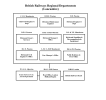
Departments that close and dismantle a branch line - Attached is a diagram I've put together showing all nine regional departments / offices involved in the closure etc of the loop line. I would have thought you could use this as some sort of template in your research about a branch line that was closed and removed. Simply change the regional locations and BR region Head Office as needed. It also explains the abbreviations! See attached.

The nine regional departments corresponded with each other and to LMR HO, Euston.

The Station Master's House - When talking about assets, there is absolutely no mention about the SM's first floor house and what was taken away. I would have thought if the goods shed office had a water heater, surely the SM's house did?

No clues at all as to when Mr. Ormerod (Last SM at Padiham) left, I know he was there late 1964 as he attended a meeting, and January 1966 the SM (now called Station Manager) of Burnley Central attends another meeting at Padiham. He either went at the end of '64 or left in '65.

The nine regional departments - Can anyone explain in plain English what each are responsible for please? Some are a little vague to me.
 

Attachments

  • BR Departments.png
    BR Departments.png
    142.6 KB · Views: 20
Last edited:

Rescars

Established Member
Joined
25 May 2021
Messages
2,547
Location
Surrey
The nine regional departments - Can anyone explain in plain English what each are responsible for please? Some are a little vague to me.
Not an answer to your query, but an equally interesting question is could the members of these departments at the time explain the governance structure, responsibilities and reporting lines? When you see this this byzantine matrix of empires it is little wonder that senior staff could be found spending time and effort on decisions and allocation of resources about salvaging minor items of equipment to refurbish structures which were to about to be demolished. Everyone doing their best whilst in significant ignorance of what others were up to and without much engagement with a master plan.
 

Andy873

Established Member
Joined
23 Mar 2017
Messages
1,412
Not an answer to your query, but an equally interesting question is could the members of these departments at the time explain the governance structure, responsibilities and reporting lines? When you see this this byzantine matrix of empires it is little wonder that senior staff could be found spending time and effort on decisions and allocation of resources about salvaging minor items of equipment to refurbish structures which were to about to be demolished. Everyone doing their best whilst in significant ignorance of what others were up to and without much engagement with a master plan.
@Rescars, you raise some interesting questions here. All I can say (and I've come across this before in my research) it does seem at times the left hand doesn't know what the right hand is doing.

In a climate of mass closures and mass redundancies even the managers must have been worried about their jobs. Perhaps things like water heaters, they could turn round and say we were so thorough we even rescued a water heater and moved from A to B, that's how thorough we were (if you get what I mean).

Regarding the dismantling of the Harwood section - One difficulty I didn't expect was the problem of the track ballast. There was over 100,000 tons of it on the section, the best offer they got was £4,000 for it, but who ever tendered this states quite clearly that they can take half of it away in a straight 6 month period, but will need longer than another 6 months to remove the rest! That's how much ballast there was supporting 17.75 track miles, certainly much more than I had ever imagined.

Surprised no one has helped out with what those departments actually did...
 

Rescars

Established Member
Joined
25 May 2021
Messages
2,547
Location
Surrey
In a climate of mass closures and mass redundancies even the managers must have been worried about their jobs. Perhaps things like water heaters, they could turn round and say we were so thorough we even rescued a water heater and moved from A to B, that's how thorough we were (if you get what I mean).
With regard to the minutiae of gas water heaters, Ascots could be a mixed blessing. My grandmother had one in her kitchen and another in her bathroom. Neither had a flue and both exhausted into the room - carbon monoxide and all. There was a caution to "open window before entering bath"! Filling even a potentially draughty signal box with a poisonous gas doesn't feel like an optimal proposition when looked at from a 21st century perspective, but I guess H&S was more optional back in the Beeching era!
 

Andy873

Established Member
Joined
23 Mar 2017
Messages
1,412
With regard to the minutiae of gas water heaters, Ascots could be a mixed blessing. My grandmother had one in her kitchen and another in her bathroom. Neither had a flue and both exhausted into the room - carbon monoxide and all. There was a caution to "open window before entering bath"! Filling even a potentially draughty signal box with a poisonous gas doesn't feel like an optimal proposition when looked at from a 21st century perspective, but I guess H&S was more optional back in the Beeching era!
That's a great point you make about the fumes, I honestly just presumed these heaters would all have had a flue. I think I remember seeing one somewhere but can't remember.

Based on the meetings at Padiham, I've realised something else is missing - No mention of any meeting to determine those assets inside either Gt. Harwood or Simonstone stations? I know an engineering team from Blackburn removed some fixtures and fittings from Harwood station prior to it's demolition.

New information regarding Gt. Harwood station demolition - What bothered me was three photos taken during the down line removal plus a newspaper account (Lancashire Evening Telegraph 30 December 1965) stating that both Harwood and Simonstone stations had now been demolished, and finally a L&Y society article written around 2,003 by Bernard Bond, who I call the Gt. Harwood station historian.

Bernard grew up in Harwood and he made friends with the station staff, he would regularly talk to them and take notes etc. He states that someone called Wilf Golley, a platelayer there recalls a Rolls Royce car used to turn up in a morning and some men would get out and carry on the demolition work, the Rolls returning at tea time to take them home. Now, what really happened was that while the Down line and sleepers were being removed (plus the footbridge) the demolition company (from Chorley) kept out of the way be starting work on the Up side buildings. Only when the Down track and sleepers etc were gone did they start on the Down platform building.

Now here's the thing - Wilf clearly states that in mid 1966 (not '65) the Rolls turned up to collect the one person still there, only to find the whole of the platform awning laying on the platform floor with no sight of the workman! 999 was called and all services turned up, they slowly lifted the awning up bit by bit but there was no one there... Turns out he was in the Royal Hotel pub downing a pint!

Wilf also states the demolition work didn't finish until near the end of 1966. In short the newspaper article had jumped the gun, and unfortunately this was reiterated in the L&Y Society book about the line (1993) and again by me.

Once more, another so called fact can now be corrected! It also shows that not all stations were demolished in a hurry, it depended on the circumstances at the time.

 

Top