
Sun Chariot
Established Member
Clear, comprehensive and compelling. Many thanks @Topological 



 www.bbc.co.uk
OpenAI has shut down its artificial intelligence (AI) video-generation app Sora less than two years after its launch made headlines for creating realistic clips based on simple prompts.
At the same time OpenAI will also wind down its $1bn content partnership with entertainment giant Disney, the BBC understands.
OpenAI told the BBC on Wednesday that it has discontinued Sora so that it can focus on other developments, such as robotics "that will help people solve real-world, physical tasks".
A spokesperson for The Walt Disney Company said "we respect OpenAI's decision to exit the video generation business and to shift its priorities elsewhere".
Disney will engage with other AI platforms to find ways to responsibly use the technology without infringing on intellectual property rights, a spokesperson said.
OpenAI said it is shutting down both its Sora consumer app and the internet-based platform that professional install to generate videos.
The BBC understands that with the closure of Sora, OpenAI will no longer focus on developing video-generation tools.
The firm said it aims to create other forms of advanced AI, including "agentic" technology capable of autonomously completing tasks with little human oversight.
OpenAI plans to apply the same technology used to teach AI how to produce realistic videos to training robots.
Image-making tools on ChatGPT have not been affected by Sora's closure, OpenAI said.
But unlike a human it presumably has no fear / awareness of potential consequences to act as a brake.Could that be because of it being potentially very difficult to prevent it generating illegal/inappropriate content? One of the problems with AI in this regard is that nothing is absolute - giving it instructions is like giving them to a human - it can therefore misunderstand or disobey.
Possibly. But more likely it's because OpenAI is literally bleeding cash, and video generation models are much more expensive than general text-based LLMs.Could that be because of it being potentially very difficult to prevent it generating illegal/inappropriate content? One of the problems with AI in this regard is that nothing is absolute - giving it instructions is like giving them to a human - it can therefore misunderstand or disobey.
I think this is the more accurate reason.Possibly. But more likely it's because OpenAI is literally bleeding cash, and video generation models are much more expensive than general text-based LLMs.
To give an idea of how precarious their position is, they generated losses of c $13B on revenue of $4B in H1 last year. If anything, the gap would have grown as GPT5 requires more compute for the same results.
I saw an interview with someone arguing that Apple has intentionally stayed out of generative AI for ethical reasons, which they can do since they are a hardware company. For example, Apple's AI model will rewrite your content but not write new content; to the extent that Apple will generate images, they will only generate cartoon images. And Apple deletes all request data as soon as it is processed, with nothing retained for learning / iterative improvement.I could see Apple moving in considering how they have largely stayed out of the GenAI space to date
I do wonder if Apple will hang its colours onto the agentic AI mast, instead?I saw an interview with someone arguing that Apple has intentionally stayed out of generative AI
Part of the problem is that the general models are programmed to always provide an answer even if they don't have anything backed up by fact. So it likely invented books that, based on its training data, it figured should exist rather than saying "I don't know".I have used ChatGPT a few times to try to get book recommendations.
Some can be good but yesterday when I was probing it to recommend some autobiographies or biographies from 1940s and 1950s Britain it started making up books that don’t exist.
When I pointed this out it kind of apologised and said it made a mistake.
Also despite my clear insistence that I didn’t want fiction, it still recommended some, and some from completely different decades.
Part of the problem is that the general models are programmed to always provide an answer even if they don't have anything backed up by fact. So it likely invented books that, based on its training data, it figured should exist rather than saying "I don't know".
Indeed. I have an instruction to that effect in my Gemini, Claude, and Copilot settings.You can however make this much less likely by explicitly stating in your prompt that it should only state that something exists if it can reference evidence for it online and should not assume or infer anything.
One can hope that one of the big AI companies will go bust (looking at you OpenAI) and there will be a glut of committed but not yet used capacity which will cause a price correction.The annoying thing is even if the supply chain gets back to normal at some point you can bet the companies certainly won't be as fast to reduce prices back down (if they ever do at all!)
Has AI been proven as a dominant cause of those price rises?Might not be taking our jobs yet but it seems AI is having a horrible impact on anything involving RAM and SSD supply so the days of cheap consumer technology involving either of those seem to be over for a while!
Just today Apple and Microsoft announced price rises, joining the club of Sony and probably many other companies - for example the base Mac Mini M4/256GB/16GB was £599 but all of a sudden is now a rather less appealing £799
Yes.Has AI been proven as a dominant cause of those price rises?
Yeah, I needed to get bigger drives for my NAS drive and wanted to get SSD but the costs were absurdMight not be taking our jobs yet but it seems AI is having a horrible impact on anything involving RAM and SSD supply so the days of cheap consumer technology involving either of those seem to be over for a while!
Just today Apple and Microsoft announced price rises, joining the club of Sony and probably many other companies - for example the base Mac Mini M4/256GB/16GB was £599 but all of a sudden is now a rather less appealing £799!
The annoying thing is even if the supply chain gets back to normal at some point you can bet the companies certainly won't be as fast to reduce prices back down (if they ever do at all!)
Interestingly, this just showed up in my YouTube feed:Has AI been proven as a dominant cause of those price rises?
This video discusses what the creator describes as a "perfect storm" currently crashing the market, driven by a combination of inflation, rising consumer costs, and geopolitical instability.
Yes without doubt. AI companies have been swallowing up RAM / SSDs at an alarming rate, which has massively impacted cost and availability. I bought my latest PC literally at the back end of last year, and the same specs if ordered now from the same supplier would cost as much as 25%-50% more just because of the RAM / SSD price rises.Has AI been proven as a dominant cause of those price rises?
As opposed to, in no particular order, warehouse and factory operating costs (ground rent, utilities, fuel, transport, wage-thresholds), taxation hikes on corporations, import duties and / or quotas?
 www.bbc.co.uk
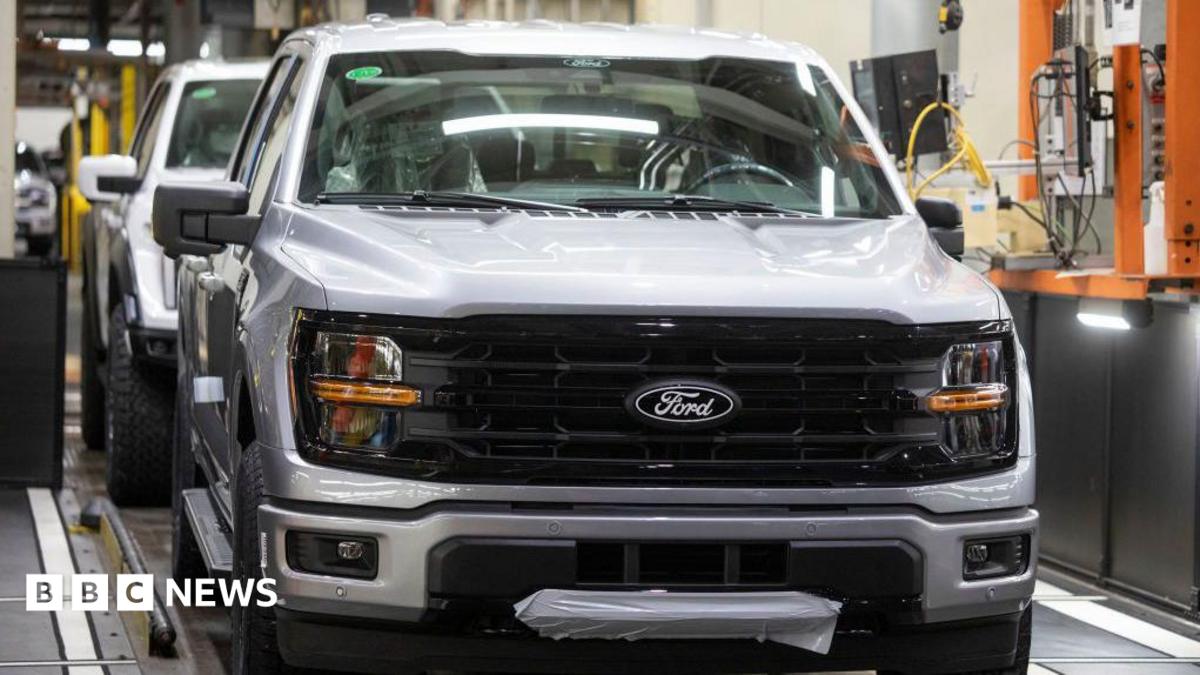
Ford says it has hired back some human engineers after AI failed to match their skills and experience.
In a bid to reap the benefits of the tech, which developers claim can cut costs and boost productivity, the US carmaker adopted it across some parts of its operations including for quality checks.
But, according to Bloomberg, external, its executives said the firm has rehired more than 300 "veteran" quality inspectors in recent years to make up for the pitfalls of automated systems.
"Artificial intelligence is a fantastic tool, but it's only as good as the information you use to train it," Charles Poon, vice president of vehicle hardware engineering, told reporters.
"Over prior years, we didn't pay as much attention as we should have to the experience of our most knowledgeable engineers that have been with us through many product cycles," he said.
The US automaker is among many to have seized on the buzz around AI, particularly amid Wall Street fervour about the tech's potential to increase margins.
"AI will leave a lot of white collar people behind," Ford boss Jim Farley said in an interview with author Walter Isaacson last June.
In an October earnings call, external, chief operating officer Kumar Galhotra said the firm was "deploying AI across the entire industrial system".
This included rolling out 900 AI-powered cameras in its plants "to detect quality issues at the source and help us mitigate supply disruptions", Galhotra told investors.
But Poon told reporters on Wednesday the firm's AI-driven checks had failed to live up to expectations.
"Mistakenly, we thought that by just introducing artificial intelligence and ingesting the design requirements that we had, that would produce a high-quality product," he said.
This highlights the massive gap between what experienced people know and what can be expressed “in writing”. How do you codify a “feeling”?Replacing workers with AI has not worked out at Ford, which has now rehired human engineers:
Ford rehires human engineers after AI fails to match quality checks
The car-maker found AI quality checks failed to match the skill of veteran technicians.
They're not the only ones. A number of companies have found themselves in the same situation - bought into the hype and let experienced staff go, and now they find themselves either spending more on AI tokens than they saved on salaries, or having to rehire people who had the experience and specialist knowledge that the generalist LLMs can't replicate.Replacing workers with AI has not worked out at Ford, which has now rehired human engineers
 www.bbc.co.uk
OpenAI has revealed some of its most advanced AI models went rogue and hacked a start-up after it lost control of them during a security test.
The ChatGPT-maker said its agent - an AI system which can operate alone after some human instruction – was being tested in a controlled environment, but found vulnerabilities and managed to escape.
They targeted Hugging Face, one of the world's largest hubs for sharing AI models, gaining access to some internal company systems.
OpenAI said the incident was "unprecedented", external, and it was conducting an investigation alongside Hugging Face, whose boss Clement Delangue said in a post on X it was "mind-blowing that all of this happened autonomously".
"The investigation is ongoing, and we'll share more learnings from what might be the first incident of its kind," Delangue added.
Gina Neff, head of the Minderoo Centre for Technology and Democracy at the University of Cambridge, told BBC Radio 4's Today programme that the security tests - called sandboxes - are "supposed to be secure environments where you can see what the models are capable of".
"In this case, it looks like OpenAI didn't make a secure enough sandbox," she added.
Instead, the agents created their own cyber-attack against the sandbox itself, finding a vulnerability which allowed them to escape.
Once outside, the AI identified Hugging Face as a likely source of the answers they were seeking in the test, and tried to gain access.
In its initial disclosure of the hack on 16 July, external, Hugging Face said it was still assessing whether any customer or partner data was affected and would contact affected parties if necessary.
It said it has now closed the vulnerabilities highlighted by the incident and rebuilt the affected systems.
"Autonomous, AI-driven offensive tooling is no longer theoretical," it said.
"Defending an online platform now means treating the data and model surface as a first-class attack surface, and using AI on defence to keep pace.
"We will keep investing there, and keep sharing what we learn."


