• Our new ticketing site is now live! Using either this or the original site (both powered by TrainSplit) helps support the running of the forum with every ticket purchase! Find out more and ask any questions/give us feedback in this thread!

The Labour Party under Andy Burnham

thenorthern

Established Member
Joined
27 May 2013
Messages
4,714
I can't speak for GBE, but GBR hasn't even really started yet other than some paint on DfT operated trains. If we want GBR to be worth it – which definitely is not guaranteed – we need to give them a chance to do it properly instead of rushing it.

It has only been 2 years after all. The Labour government has done a lot of good so far (overshadowed by several unpopular or bad things), and I for one applaud them for going after long term projects like GBR. A step away from short-termism is welcomed.

You have to remember us on this forum are somewhat knowledgeable on the railways. In reality we know not much will change and not much was ever going to change with nationalisation. To voters however there was an expectation of change.

The fare freeze was good but given most passengers think that the railways are already too expensive having a freeze on too expensive is still too expensive.
 
Sponsor Post - registered members do not see these adverts; click here to register, or click here to log in
R

RailUK Forums

gg1

Established Member
Joined
2 Jun 2011
Messages
2,498
Location
Birmingham
You have to remember us on this forum are somewhat knowledgeable on the railways. In reality we know not much will change and not much was ever going to change with nationalisation. To voters however there was an expectation of change.
I don't think GBR registered with most voters at all.

Aside from around the time of the initial announcement, I don't recall it being mentioned in any of the non-rail groups/forums I'm a member of.
 

whoosh

Established Member
Joined
3 Sep 2008
Messages
1,894
The thing is that whilst mortgage interest rates are a lot smaller now, that doesn't always mean that they are more affordable.

In 1982 when mortgage rates were 10% the average pay was £6,600 and the average home was £24,000. To make the maths easier we'll assume £0 tax but also £0 deposit.

That would mean that the interest payment for the year would average at £200 a month from £550 pay.

Land Registry suggests that average house prices are £270,000 (others say £300,000, but we'll go with the lower value) whilst average pay is £39,000. Assuming the same £0 tax and deposit, at 5.5% interest is £1,240 from £3,250 of pay

That's not easy to compare so if we factor to £200 from £1,240 for the interest payments that's pay of £525 so around £25 (5%) less pay (1982 prices) to cover the interest payments and yet the rate of interest is noticeable lower now than then (10% then vs 5.5%).

Only that's not the only difference, AI suggests that in 1982 for a house in the West Midlands for the average house price it would be a 3 bed semi-detached house whilst now the average would likely get you a 2 bed terraced house.

Also a 10% deposit of a home would be £2,400 (36.36% of average pay) in 1982 vs £27,000 (71.05% of average pay) for 10% now but still £13,500 (35.52% of average pay) making it harder to save up the 10% deposit and just as hard to save for a 5% deposit (but then higher monthly payments) in the first place.

As such, whilst interest rates were high and lower deposits are an option now, due to other factors it's still likely harder now than it was and it's likely that the size of home is also likely to be smaller.
Also, 'relief' arrived quite literally the next year in 1983, with MIRAS (Mortagage Interest Relief At Source) whereby motgage interest was subject to tax relief.
Everyone who mentions higher interest rates in the past, neglects to mention this substantial perk throughout most of the 80s and 90s.
 

styles

Established Member
Joined
7 Dec 2014
Messages
4,923
Location
Gwynedd
I don't think GBR registered with most voters at all.

Aside from around the time of the initial announcement, I don't recall it being mentioned in any of the non-rail groups/forums I'm a member of.
Not GBR specifically. Well, I do kinda remember some press releases but I wouldn't have really caught anything from watching the 10 o'clock news like a 'normal person'. But I have clocked stories on the BBC News front page shortly before each operator has been nationalised.

This story is still on the front page of the BBC London news section for example: https://www.bbc.co.uk/news/articles/ce3p7x15xl7o

Obviously it wasn't on the main front page for long when you consider what's going on in the rest of the UK/world!

In the run-up to the election I saw the nationalisation angle banded about quite a bit. It's just a bit old news to many now that it's just kind of... happening bit by bit.

Biggest rail operator nationalised: What it means​

Another train operating company will come into public ownership on Sunday when Britain's largest operator is nationalised.

Govia Thameslink Railway (GTR), which runs Thameslink, Southern, Great Northern and Gatwick Express services, will come under Department for Transport (DfT) control from 02:00 BST.

GTR is responsible for transporting millions of people, accounting for one in six passenger rail journeys.

Great British Railways (GBR) will eventually operate all passenger services by the end of 2027.
 

Merle Haggard

Established Member
Joined
20 Oct 2019
Messages
3,970
Location
Northampton
Boomer simply means a person born in the baby boom, it is not necessarily a pejorative in the same way millennial isn't.

The thing is that whilst mortgage interest rates are a lot smaller now, that doesn't always mean that they are more affordable.

In 1982 when mortgage rates were 10% the average pay was £6,600 and the average home was £24,000. To make the maths easier we'll assume £0 tax but also £0 deposit.

That would mean that the interest payment for the year would average at £200 a month from £550 pay.

Land Registry suggests that average house prices are £270,000 (others say £300,000, but we'll go with the lower value) whilst average pay is £39,000. Assuming the same £0 tax and deposit, at 5.5% interest is £1,240 from £3,250 of pay

That's not easy to compare so if we factor to £200 from £1,240 for the interest payments that's pay of £525 so around £25 (5%) less pay (1982 prices) to cover the interest payments and yet the rate of interest is noticeable lower now than then (10% then vs 5.5%).

Only that's not the only difference, AI suggests that in 1982 for a house in the West Midlands for the average house price it would be a 3 bed semi-detached house whilst now the average would likely get you a 2 bed terraced house.

Also a 10% deposit of a home would be £2,400 (36.36% of average pay) in 1982 vs £27,000 (71.05% of average pay) for 10% now but still £13,500 (35.52% of average pay) making it harder to save up the 10% deposit and just as hard to save for a 5% deposit (but then higher monthly payments) in the first place.

As such, whilst interest rates were high and lower deposits are an option now, due to other factors it's still likely harder now than it was and it's likely that the size of home is also likely to be smaller.

One factor - at least until the mid 1970s - that kept house prices low was the rationing of finance (=mortgages). With very few exceptions, only Building Societies (then mutuals of course) offered mortgages and these were funded only from deposits. Ass far as I know, no mutual borrowed on the market. As a result, mortgages were rationed (to the available deposits) so, from first hand experience in those times to obtain the clearance to get a mortgage you had to fulfil the following conditions -
Have historically saved with the Building Society for a number of years (I think it was either 5 or 7 years).
Have savings that were around 5 percent of the application value
Be a married couple, or have evidence that you were about to be so.
Limit of 3 times the man's annual salary.if your wife worked (probably had to be salaried) you got in addition 1/2 of hers.
Having obtained that clearance, you then were entitled to apply for a mortgage, but you cloud only do this when mortgages were 'released'. This usually happened on the 1st of the month, and a finite amount of money was available. You had to physivcally go into the Building Societies offices on the 1st of the month to make your app[lication (there was often a long queue!) you couldn't say 'I want a mortgage next time it's released. At least, that's how it worked with Northampton & midlands Building Society (eventually by mergers bacema Nationwide). Generally, a town only had the offices of the local building society and maybe one other nearby one - Northampton also had a Bedford Building Society office.
Because I was single* I was precluded from having a mortgage but in some restricted cases one could convince the local council to lend you the money, which is what I did (for reasons I won't elaborate on) these were generally about half or one percent above Building Society rates of interest.

* I have several times heard Michael Howard's wife complain on radio programmes that 'she couldn't get a mortgage because she was a woman'. She coudn't because she was single, and the same applied to men.

What might also be worth mentioning is a comparison between an average house bought in 1974 and one now. The former would certainly not have the double glazing now normal. Gas central heating was only possible once towns were connected to the North Sea Gas grid; as an example of why this had to be is our local gasworks couldn't keep up with the demand for cooking gas on Christmas Day, when the gas flame in our oven was hardly visible and cooking the joint took most of the day.

Also, 'relief' arrived quite literally the next year in 1983, with MIRAS (Mortagage Interest Relief At Source) whereby motgage interest was subject to tax relief.
Everyone who mentions higher interest rates in the past, neglects to mention this substantial perk throughout most of the 80s and 90s.

I have an idea that it started before that and 1983 might possibly have been when it finished. It was only applied to mortgages up to £30,000. As you say, the result was that you paid the Building Society the net amount after-tax relief. However, I think I'm right in saying it only applied to the interest element of mortgages, so at the start (almost all interest payments) it was the full amount, dwindling down as the proportion of capital repayment to interest charge increased to almost zero in th last years. This was the advantage of those 'endowment' mortgages of the time, where you took out an interest only mortgage and a policy into which you paid monthly and which. when your mortgage had to be paid off (i.e., the amount originally borrowed repaid) the cost of that was paid by the pay out from your investment. This meant that all of your mortgage repayments were free of tax, and that saving exceeded the cost off the investment ('endowment') , hope I've explained that understandably.

 

thenorthern

Established Member
Joined
27 May 2013
Messages
4,714
I don't think GBR registered with most voters at all.

Aside from around the time of the initial announcement, I don't recall it being mentioned in any of the non-rail groups/forums I'm a member of.
Renationalising the railways was a key pledge for Labour.

I agree it's only been two years but so far let's face it the railways haven't improved in that time. So far I would say on rail transport the Starmer government has been a failure.

If anyone is wondering this was the line from Labour's manifesto.

Labour will overhaul Britain’s railways. Fourteen years of Conservative neglect have failed passengers, businesses and taxpayers. We will put passengers at the heart of the service by reforming the railways and bringing them into public ownership. We will do this as contracts with existing operators expire or are broken through a failure to deliver, without costing taxpayers a penny in compensation. Great British Railways will deliver a unified system that focuses on reliable, affordable, high-quality, and efficient services; along with ensuring safety and accessibility. It will be responsible for investment, day-to-day operational delivery and innovations and improvements for passengers, working with publicly-owned rail operators in Wales and Scotland. Mayors will have a role in designing the services in their areas.


edwin_m

Veteran Member
Joined
21 Apr 2013
Messages
28,695
Location
Nottingham
This was the advantage of those 'endowment' mortgages of the time, where you took out an interest only mortgage and a policy into which you paid monthly and which. when your mortgage had to be paid off (i.e., the amount originally borrowed repaid) the cost of that was paid by the pay out from your investment. This meant that all of your mortgage repayments were free of tax, and that saving exceeded the cost off the investment ('endowment') , hope I've explained that understandably.
What you paid into was technically a life assurance policy, albeit structured to maximise benefit on maturity rather than if one died during the term. This was also some kind of tax advantage. Many people found out when they came to the end of the term that the policy was reliant on investment growth, so not guaranteed to pay off the loan and often didn't.
 

The Ham

Veteran Member
Joined
6 Jul 2012
Messages
12,036
What you paid into was technically a life assurance policy, albeit structured to maximise benefit on maturity rather than if one died during the term. This was also some kind of tax advantage. Many people found out when they came to the end of the term that the policy was reliant on investment growth, so not guaranteed to pay off the loan and often didn't.

The issues with not paying off became a significant issue later in the lifespan of the products (i.e. was more of a problem in the 90's than 80's - of course that's not the same as there weren't issues).

I know that my patents' endowment paid off the original purchase price and a good proportion of the second mortgage taken to extend their house.

Although, as noted, that wasn't the case for many and those who didn't see it pay out enough would have likely found that a significant issue (trying to be brief but aware that any financial issues can be so much more than "significant" for those impacted by them).
 

gg1

Established Member
Joined
2 Jun 2011
Messages
2,498
Location
Birmingham
Renationalising the railways was a key pledge for Labour.

I agree it's only been two years but so far let's face it the railways haven't improved in that time. So far I would say on rail transport the Starmer government has been a failure.

If anyone is wondering this was the line from Labour's manifesto.
It was, but for the bulk of the population who neither work in the industry or have any interest in trains, how many are even aware GBR is part of this? I suspect very few.

As you say, from the passenger perspective nothing has changed, evem though a number of TOCs are now state owned, you wouldn't know that as a passenger.
 

thenorthern

Established Member
Joined
27 May 2013
Messages
4,714
It was, but for the bulk of the population who neither work in the industry or have any interest in trains, how many are even aware GBR is part of this? I suspect very few.

As you say, from the passenger perspective nothing has changed, evem though a number of TOCs are now state owned, you wouldn't know that as a passenger.

Just shows the message is not getting across to passengers which again is a failure of the Starmer Government.

In London for example, the Mayor of London logo features quire a bit on TFL things like the Oyster card, transport projects and other TFL things. Maybe it's time to put "Operated by His Majesty's Government" branding on Great British Railway train.
 

JonathanH

Veteran Member
Joined
29 May 2011
Messages
23,374
Discussion tonight that there will need to be a cut in the transport capital budget (and net zero) to allow more to be spent on defence.
 

The Ham

Veteran Member
Joined
6 Jul 2012
Messages
12,036
Discussion tonight that there will need to be a cut in the transport capital budget (and net zero) to allow more to be spent on defence.

All that will do is make it more costly for the public.

Car ownership costs (average) is £3,600 a year per car, free public transport £1,000 per tax payer (and there's not a whole lot different between the numbers of cars and tax payers), yet reducing the ability to increase transport capacity would mean more delays, more delays macs higher personal fuel costs and longer travel times (and the other costs which that can incur).

Likewise, keeping us locked into oil rather than moving away puts the risk of a global event increasing fuel costs (again, further, take your pick) and again puts more pressure on individuals' costs.
 

brad465

Veteran Member
Joined
11 Aug 2010
Messages
11,522
Location
Taunton or Kent
Our Defence spending should basically be focused on drone production and anti-drone defences, along with a core minimum of everything else. We are not a big player anymore and should solely focus on protecting our shores; Iran has shown just how much potential a few drones has, while the US expends very expensive kit trying to stop them.
 

Yew

Established Member
Joined
12 Mar 2011
Messages
7,244
Location
UK
Our Defence spending should basically be focused on drone production and anti-drone defences, along with a core minimum of everything else. We are not a big player anymore and should solely focus on protecting our shores; Iran has shown just how much potential a few drones has, while the US expends very expensive kit trying to stop them.
Whilst I agree that we should be building up our capabilities with drones, basing our entire strategy around "At the moment countries haven't got cost-effective counters to this new threat into general service" is unlikely to be successful in the long term. Even now we're seeing things like inexpensive martlet missiles, DragonFire and other anti-drone systems making their way onto our ships and aircraft. At this precise moment drones may have the advantage, but it is temporary and balance between attack and defence will be restored soon.

For the question of "how do we defend against a subsonic kamikaze aircraft full of explosives" that is an answer that we have known for 80 years - the Bofors 40mm Anti Aircraft gun.

== Doublepost prevention - post automatically merged: ==

Discussion tonight that there will need to be a cut in the transport capital budget (and net zero) to allow more to be spent on defence.
If I'm honest, I think that sums up everything that is wrong with our view on state level macroeconomics over the last 40 years, we see these things as a cost, not as an investment that over the long run repays more to the exchequer than they cost. We need the infrastructure and investment and growth so that we have an economy in a state where we can afford to defend ourselves properly.
 

JamieL

Member
Joined
6 Aug 2022
Messages
955
Location
UK
Our Defence spending should basically be focused on drone production and anti-drone defences, along with a core minimum of everything else. We are not a big player anymore and should solely focus on protecting our shores; Iran has shown just how much potential a few drones has, while the US expends very expensive kit trying to stop them.
This approach is deeply flawed. The UK is heavily reliant on global trade and connectivity for all the main security sectors - military, political, food, energy, economic and environmental. The war with Iran serves as a recent reminder of this. The aim then must be to ensure we are engaged globally, including in the military sphere, as this enables us to federate our efforts with partners who share our security interests. With Western influence in decline and the international rules based order under severe strain, the requirement for global engagement is only going to increase. Within 10 years we will need the defence budget to be well over 5% of GDP. Clearly savage cuts are going to be needed elsewhere.
 

Yew

Established Member
Joined
12 Mar 2011
Messages
7,244
Location
UK
Within 10 years we will need the defence budget to be well over 5% of GDP. Clearly savage cuts are going to be needed elsewhere.
If we want Cold War levels of defence spending, we might also need to have Cold War levels of top level taxation. Similarly, the main rate of corporation tax used to be 50% in the 70s, as opposed to 20% now.
 

JamieL

Member
Joined
6 Aug 2022
Messages
955
Location
UK
If we want Cold War levels of defence spending, we might also need to have Cold War levels of top level taxation. Similarly, the main rate of corporation tax used to be 50% in the 70s, as opposed to 20% now.
The overall tax burden in the UK is already at a post-war high and will move higher next financial year. We know that Labour are incapable of doing anything other than raise taxes but that isn't the only option. It seems likely we are moving towards a future Reform Government and their plans for an insurance based health model will save £billions from general taxation which could be then allocated to defence.
 

jon0844

Veteran Member
Joined
1 Feb 2009
Messages
30,927
Location
UK
The overall tax burden in the UK is already at a post-war high and will move higher next financial year. We know that Labour are incapable of doing anything other than raise taxes but that isn't the only option. It seems likely we are moving towards a future Reform Government and their plans for an insurance based health model will save £billions from general taxation which could be then allocated to defence.

Fantastic. Then tens of thousands of us can die without a single missile being fired...
 

AlterEgo

Verified Rep - Wingin' It! Paul Lucas
Joined
30 Dec 2008
Messages
29,534
Location
LBK
Our Defence spending should basically be focused on drone production and anti-drone defences, along with a core minimum of everything else. We are not a big player anymore and should solely focus on protecting our shores; Iran has shown just how much potential a few drones has, while the US expends very expensive kit trying to stop them.

The idea the UK should retreat to a purely home defence policy is just madness. One of the most underrated assets we have is our Navy, which we use in anti-piracy and humanitarian operations. This gives us a unique mix of hard and soft power in keeping shipping lanes open where others have struggled. Our Navy is too small, rather than too large.

It's true that this would be very expensive but the issue is not that a Navy is expensive, it is that we have an unproductive country which for too long has been reliant on low waged jobs and that is why we struggle to afford these things.

The UK should absolutely invest in drone technology, yes, but this is going to be best utilised in another Ukraine style conflict by assisting allies rather than home defence. We aren't in a geopolitical situation where our immediate defence needs are right next door; we are an expeditionary force.
 

Yew

Established Member
Joined
12 Mar 2011
Messages
7,244
Location
UK
The overall tax burden in the UK is already at a post-war high and will move higher next financial year.
Given the numbers I suggested up-thread, that seems highly unlikely, how are you evidencing that point?
We know that Labour are incapable of doing anything other than raise taxes but that isn't the only option.
That's odd, after the war Labours solution was to engage in a campaign of investments designed to boost the economy and deliver growth, that doesn't seem in keeping with that analysis.
It seems likely we are moving towards a future Reform Government and their plans for an insurance based health model will save £billions from general taxation which could be then allocated to defence.
Are you suggesting that we keep national insurance at the same level, and simply don't provide healthcare. Then instead, people will pay an additional healthcare insurance premium (that could be a lot of money) how do you think the massive decrease in the spending power of ordinary people will impact the economy.

== Doublepost prevention - post automatically merged: ==

The idea the UK should retreat to a purely home defence policy is just madness. One of the most underrated assets we have is our Navy, which we use in anti-piracy and humanitarian operations. This gives us a unique mix of hard and soft power in keeping shipping lanes open where others have struggled. Our Navy is too small, rather than too large.

It's true that this would be very expensive but the issue is not that a Navy is expensive,
Small production runs don't help, if it costs, say £3 billion to design a class of ship, that cost remains the same if we build 6 or 60, and has to be factored into the price of the individual units. fortunately with the new orders we're seeing more economies of scale, as our Allies are buying the Type 26 and 31s.
it is that we have an unproductive country which for too long has been reliant on low waged jobs and that is why we struggle to afford these things.
The only path I can see out of that is state investment, crossing our fingers and praying to the "hand of the free market" doesn't seem to have worked for the last 40 years.
 
Last edited:

Harpo

Established Member
Joined
21 Aug 2024
Messages
3,901
Location
Newport
Defunding the NHS won’t help national productivity either as the health levels of the lowest paid would worsen.

Even those on private health care will suffer as treatment for each condition isn’t always limitless, something my other half discovered after getting a leg injury.
 

JamieL

Member
Joined
6 Aug 2022
Messages
955
Location
UK
Given the numbers I suggested up-thread, that seems highly unlikely, how are you evidencing that point?
You quote a single tax, you need to take a holistic view at them all.

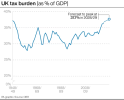
New data has revealed that the UK's current tax level burden is the highest rate on record, according to the OECD.

The news comes as separate figures showed the UK also now faces the highest level of property taxes across the developed world.

Annual revenues statistics from the OECD (Organisation for Economic Co-operation and Development) found the total tax-to-GDP ratio across the UK hit 35.3% for the 2022/23 financial year - the highest since OECD records began in 2000.

The data represents a 0.9% increase from the 34.3% record a year earlier.

The graph paints the vivid picture - Labour are throttling us with their taxes. They are not capable or competent.

Source:
 

Attachments

  • Tax_Burden_UK.png
    Tax_Burden_UK.png
    127 KB · Views: 22

JamesT

Established Member
Joined
25 Feb 2015
Messages
4,901
Given the numbers I suggested up-thread, that seems highly unlikely, how are you evidencing that point?
That will push Britain's tax-to-GDP ratio to 38.3% of economic output, a fresh post-war high,
The highest rates of some taxes may be lower than in the past, but effectively nobody paid those and they raised very little money. Consider instead VAT, introduced at 10% and now at 20% and which is paid by essentially everyone.
 

Broucek

Member
Joined
13 Aug 2020
Messages
951
Location
UK

The highest rates of some taxes may be lower than in the past, but effectively nobody paid those and they raised very little money. Consider instead VAT, introduced at 10% and now at 20% and which is paid by essentially everyone.
Yeah, the 40% rate now cuts in at £50k. A decent income but hardly "rich".

And don't start me on the £100k-£125k band....
 

edwin_m

Veteran Member
Joined
21 Apr 2013
Messages
28,695
Location
Nottingham
Labour is left in the unenviable position of trying to sort out various messes left by the Tories, particularly contraction of the economy and tax base due to austerity and Brexit and money wasted on ineffective pandemic responses.
 

JamieL

Member
Joined
6 Aug 2022
Messages
955
Location
UK
Labour is left in the unenviable position of trying to sort out various messes left by the Tories, particularly contraction of the economy and tax base due to austerity and Brexit and money wasted on ineffective pandemic responses.
The approach then is to reverse Brexit. But Labour are unwilling to do that and therefore simply cannot put the economy on course to any significant growth and can only rely on tax hikes which stiffle growth even more. Labour have got themselves into a doom loop with no way out. Burnham might give a year or two breathing space, but he too will fail.
 

edwin_m

Veteran Member
Joined
21 Apr 2013
Messages
28,695
Location
Nottingham
The approach then is to reverse Brexit. But Labour are unwilling to do that and therefore simply cannot put the economy on course to any significant growth and can only rely on tax hikes which stiffle growth even more. Labour have got themselves into a doom loop with no way out. Burnham might give a year or two breathing space, but he too will fail.
I and many others would support that, but many Labour-Reform swing voters may still support Brexit, and others regret it but don't want to re-run the rancorous debate. Hence the manifesto commitments which would prevent them going much beyond what they are doing now (but can't really shout about because it might put said voters off). Joining the EU is a slow process anyway but I'd expect to see something more tangible in the 2029 Labour manifesto.
 

Sorcerer

Established Member
Joined
20 May 2022
Messages
2,166
Location
Liverpool
The approach then is to reverse Brexit. But Labour are unwilling to do that and therefore simply cannot put the economy on course to any significant growth and can only rely on tax hikes which stiffle growth even more. Labour have got themselves into a doom loop with no way out. Burnham might give a year or two breathing space, but he too will fail.
To be fair, Labour cannot exactly "reverse Brexit" because strictly speaking it would be a new form of membership including adopting the Euro and Schengen, while a true reversal would be as things were before including opt-out conditions, something the EU won't be willing to extend.

The best we can hope for is a Norwegian or Swiss-style deal where we align on key policies while maintaining some opt outs, and I doubt the EU will be willing to extend that either. The Swiss deal has been quite frustrating for them already as it is.
 

Top