• Our new ticketing site is now live! Using either this or the original site (both powered by TrainSplit) helps support the running of the forum with every ticket purchase! Find out more and ask any questions/give us feedback in this thread!

Fantasy - Deconflicting services at Herne Hill

NCT

Established Member
Joined
18 Apr 2025
Messages
2,270
Location
London
Again, I don't understand. I haven't said anything that I think could be reasonably described as a "sweeping statement."

I simply said the fact that at various stations, including the one in discussion here, Blackfriars, trains are timetabled to turn back in less than than 8 minutes. That is true, and it routinely happens.

If you can't or won't tell me what it is you're actually asking me then I think I'll refrain from replying to you again, as I don't understand why you appear to think I've said anything that could be considered controversial.

You've been repeatedly explained factors affecting turnaround times. You are now just being rude.
 
Sponsor Post - registered members do not see these adverts; click here to register, or click here to log in
R

RailUK Forums

35B

Established Member
Joined
19 Dec 2011
Messages
5,476
Again, I don't understand. I haven't said anything that I think could be reasonably described as a "sweeping statement."

I simply said the fact that at various stations, including the one in discussion here, Blackfriars, trains are timetabled to turn back in less than than 8 minutes. That is true, and it routinely happens.

If you can't or won't tell me what it is you're actually asking me then I think I'll refrain from replying to you again, as I don't understand why you appear to think I've said anything that could be considered controversial.
I'm surprised that you've mentioned Blackfriars, as it's previously been stated that the turnarounds are effectively 12 minutes. What trains do the turnaround in less?

That's not me being awkward, just trying to understand the hypothetical options for this scenario
 

squingo44

Member
Joined
5 Jan 2026
Messages
199
Location
London
I'm pro development, but even I recognise there's a time and place for that. Intensive developments are for places with large town centres with outdated shopping centres, large big box retail sites, or large ex industrial sites. Chatham Main Line and Catford Loop have very little of these things. Predominantly owner occupied relatively nice houses are not getting bulldozed.
I'll admit that you're right about this. The places around the Chatham Main Line don't make sense to redevelop into dense neighbourhoods - yet. These proposals I'm talking about, I'm imagining they'll come a few decades in the future after all the projects currently in the mayor's transit strategy (West London Orbital, Bakerloo Line Extension, Thamesmead DLR extension, South London Metroisation, Crossrail 2) are built and we're looking for the next growth areas. That's when these proposals should be brought to the table. That's why I'm taking as an assumption that all of these projects have been built, and investigating what the next steps could be.
The Sutton loop services go through whole swaths of similar areas. Areas like Herne Hill which were rundown are now owner occupied by professionals, and highly valued. No sane politician or planner is ever going to threaten to destroy communities speculatively to deliver these new centres when the evidence is that, last time they tried, their success was at best low.
We need more housing. We need more development. We've got to fight and win the political battle so that we can rebuild the city to be fit for the future. I respect that people don't like seeing the places around them change beyond recognition, but it's something we can't afford not to do.

== Doublepost prevention - post automatically merged: ==

I don't think this necessarily follows with this:

Attempting to stimulate demand with 'aggressive housebuilding' by closing 6 local stations is a new one. Forgive me for not understanding the logic
Because currently there are two branches of the line into Victoria that are supporting both stopping and express services, significantly limiting the number of services on both - stations on both branches see 4 TPH at the moment. By moving all the express services to one branch, the other can enjoy a proper metro-style frequency of stopping service, at least 16 TPH, supporting much more housebuilding along that branch. The other branch is very close to the Bakerloo Line Extension to Hayes, so it's not like it will be getting nothing.

== Doublepost prevention - post automatically merged: ==

Every time someone suggests taking the Sutton trains out of the thameslink core they should be forced to stand at Blackfriars on the down platform in the evening peak and see which trains are arriving fully loaded. It won't be the Orpingtons, Sevenoaks or even Brighton mainline services. Streatham, Tulse Hill and Herne Hill to the core are really busy flows.
Couldn't you turn this around and use this as evidence for the fact that the Sutton Loop is underserved by the current service? It's at capacity, and needs to support many more passengers per hour. Reconfiguring it to support a greater frequency of service would solve this problem, right?

== Doublepost prevention - post automatically merged: ==

Thinking about it further, I do like the idea of a grade separated crossover south of Tulse Hill. Then then Sutton Loop trains can go into London Bridge Low Level, for 16 TPH or whatever frequency you can muster on the line with whichever infrastructure interventions you can get (namely a Wimbledon 2nd platform), and a Beckenham Junction - Crystal Palace - Tulse Hill - Herne Hill - Victoria stopping service with ~12 TPH or so. Then you get the blackfriars-orpington/sevenoaks stopping service.

== Doublepost prevention - post automatically merged: ==

That sounds like about 24tph into the eastern side of Vic, that’s double today’s peak frequency…
The number of platforms at Victoria shouldn't be the bottleneck here. There's a 3-track approach all the way from Wandsworth Road, and it looks to me like there would be space extending the third track all the way to Brixton Junction (perhaps requiring Brixton station to close?) and I don't know how many paths such a route configuration could support, but 24 feels like it ought to be doable.
 
Last edited:

35B

Established Member
Joined
19 Dec 2011
Messages
5,476
We need more housing. We need more development. We've got to fight and win the political battle so that we can rebuild the city to be fit for the future. I respect that people don't like seeing the places around them change beyond recognition, but it's something we can't afford not to do.
If that's the cause, then fight that - don't go via proxy.

But these are genuine living, breathing, communities you're talking about - and the post-war slum clearances demonstrate how difficult it is to create viable new communities in such a top down way.

Quite apart from which, the problem with London is not that it is under-developed but that it is over-developed and over-mighty within the wider UK. Further intensification is not the right answer for the country as a whole, and this kind of standalone rail scheme not a good way to achieve it in London.
 

Mattplans

Member
Joined
27 Sep 2024
Messages
715
Location
London, UK
Because currently there are two branches of the line into Victoria that are supporting both stopping and express services, significantly limiting the number of services on both - stations on both branches see 4 TPH at the moment. By moving all the express services to one branch, the other can enjoy a proper metro-style frequency of stopping service, at least 16 TPH, supporting much more housebuilding along that branch. The other branch is very close to the Bakerloo Line Extension to Hayes, so it's not like it will be getting nothing.
It is a massive downgrade in terms of what access to rail services are like in London. I am very supportive of measures to increase local services in London (especially when one considers that London is set to remain as the unicentre of the UK economy), but closing 6 local stations just severely undermines that entire philosophy and will extend journey times considerably.

And I think it bares little relevance that the Catford loop is in 'close proximity' (even that is to be debated; but let's pretend it's true for now:) because it's already been shown that trains via Catford form the busiest services in the peaks despite all of these options they seem to have. it's clear that the destinations offered by the Hayes line are not attractive to users of the Catford Loop.

despite being pathetically close to Catford Bridge, Catford is still the busiest station on the route ( It's also important to note that Catford Bridge is the most used station on the Hayes Line as well.) I'm sure you've ever had the displeasure of using some of the services on either of these routes during peak hours but they are very busy and pretty much already at capacity.

Also, I think you've fatally forgotten about Kent bound flows. Let's agree for a second that the users of Catford loop wouldn't be getting a raw deal since they're in proximity of the Hayes line - how on earth do they get to Bromley and Kent etc?

1780756106414.png

I have highlighted stations that are the key flows from Catford (busiest stop) and with your plan, I believe it would take changing trains 2 or more times to make these journeys. And I've made the assumption that Vic-Dartford would be maintained - which I honestly think you would need to scrap to achieve your plan which introduces a whole new host of issues. How are these displaced flows going to be accomodated

Also, I think you'd genuinely need to quad track the Catford loop or increase capacity on the Atlantic lines for your plan anyway? I'm not convinced that the current peak services from Vic and Blackfriars can be reliably pathed through Catford whilst accomodating Vic-Dart and London Overground (which are already set to get service uplifts)

Between 1645 and 1745, these are 14 unaffected services from Victoria and Blackfriars currently that would need to be weaved through the Catford Loop and Atlantic lines. Is this possible? Or would it need more infrastructure upgrades? if so what?

 

Recessio

Established Member
Joined
4 Aug 2019
Messages
1,523
Location
London
What "alternative" though? The same thing happens at both those stations - trains are timetabled to turn back in less than 8 minutes, and they do so. So it's clearly "deliverable."

I really don't understand what you're asking, sorry.

I'm going to quote a previous post by Bald Rick that hopefully helps explain why 8 minutes turnaround might be achievable in some places but not in others, due to the length of trains involved and the distance to crossover points:

Moorgate has scissors crossover on the platform ends, and 120m trains.

Blackfriars has trains 33% longer and pointwork up to 200m away.

Laws of physics and all that.

I.e. (and please correct me if I'm wrong Bald Rick!) but if the drivers physically have a longer distance to walk from one cab to the other, and the trains have longer to travel to crossover points, this increases the minimum time for a turnaround. The longer trains you could *maybe* mitigate with a TfL style system called "stepping back", where you have a second driver already waiting at the rear (soon to be front) cab, rather than one driver having to walk, though of course that has implications on staffing costs and rotas. But that doesn't solve the issue that longer trains take longer to cross over the points, and that the points may be further away.
 
Last edited:

squingo44

Member
Joined
5 Jan 2026
Messages
199
Location
London
It is a massive downgrade in terms of what access to rail services are like in London. I am very supportive of measures to increase local services in London (especially when one considers that London is set to remain as the unicentre of the UK economy), but closing 6 local stations just severely undermines that entire philosophy and will extend journey times considerably.

And I think it bares little relevance that the Catford loop is in 'close proximity' (even that is to be debated; but let's pretend it's true for now:) because it's already been shown that trains via Catford form the busiest services in the peaks despite all of these options they seem to have. it's clear that the destinations offered by the Hayes line are not attractive to users of the Catford Loop.

despite being pathetically close to Catford Bridge, Catford is still the busiest station on the route ( It's also important to note that Catford Bridge is the most used station on the Hayes Line as well.) I'm sure you've ever had the displeasure of using some of the services on either of these routes during peak hours but they are very busy and pretty much already at capacity.

Also, I think you've fatally forgotten about Kent bound flows. Let's agree for a second that the users of Catford loop wouldn't be getting a raw deal since they're in proximity of the Hayes line - how on earth do they get to Bromley and Kent etc?

Also, I think you'd genuinely need to quad track the Catford loop or increase capacity on the Atlantic lines for your plan anyway? I'm not convinced that the current peak services from Vic and Blackfriars can be reliably pathed through Catford whilst accomodating Vic-Dart and London Overground (which are already set to get service uplifts)

Between 1645 and 1745, these are 14 unaffected services from Victoria and Blackfriars currently that would need to be weaved through the Catford Loop and Atlantic lines. Is this possible? Or would it need more infrastructure upgrades? if so what?
I suppose that I can't advocate for withdrawing all passenger service from the Catford Loop any longer. I'd still like to route all express services that way, though, which would require the introduction of passing loops somewhere along the line - the position and cost of which would depending on the specifics of the desired final timetable.

I don't plan on removing the Victoria-Lewisham services, and I think that it would be possible to fit all these services towards Victoria by adding a 5th track between Brixton and Wandsworth Road - although this would require remodelling Clapham High Street station.

== Doublepost prevention - post automatically merged: ==

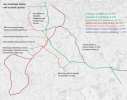
Here's an illustration of the service proposal I have at the moment.
 

Attachments

  • diagram_small.png
    diagram_small.png
    4 MB · Views: 47

Bald Rick

Veteran Member
Joined
28 Sep 2010
Messages
35,817
I think there should be, there's some space east of the viaduct immediately north of Blackfriars Junction.

There isn’t. That is now under construction for nearly 300 apartments, a 5* hotel (Madarin Oriental) and 130,000sqft of offices. Roughly speaking, a billion quid.
 

squingo44

Member
Joined
5 Jan 2026
Messages
199
Location
London
There isn’t. That is now under construction for nearly 300 apartments, a 5* hotel (Madarin Oriental) and 130,000sqft of offices. Roughly speaking, a billion quid.
But there's 5 tracks, and that can be brought down to 4 to make space, couldn't it?
 

35B

Established Member
Joined
19 Dec 2011
Messages
5,476
It's getting worseo_O

On what planet does a 12 TPH service via Birkbeck make sense? It's a quiet corner of suburbia, already significantly developed and bordering one of the green lungs that is so important in any densely built up city. The LBSC side of Junction was a single platform.

The busier section is inside Crystal Palace, which is already served by 6 TPH (2 Beckenham Junction, 2 West Croydon - Victoria, 2 London Bridge - Victoria roundabouts). Are you seriously suggesting that the remaining flat junctions can bear a 16 TPH service - or that there could plausibly be the demand for that given what we know already about the area.

That's before I continue to stumble at the idea that the answer to a need to intensify services is to trash the Kent coast service and the Catford loop in favour of a high intensity service through Sydenham tunnel and the prime building land of (checks) Dulwich college and its playing fields.

Your proposition that the city is not fit for the future (implied from "We need more development. We've got to fight and win the political battle so that we can rebuild the city to be fit for the future.") is doing some seriously heavy lifting here.

Another historical anecdote. Back when Ernest Marples ran the MoT, he commissioned Colin Buchanan to write a report on roads in London. That recommended 3 concentric rings, of which the M25 was (a) the outermost and (b) the only one built. The "middle" ring was started, and one place it ran was up the hill from Wandsworth Bridge roundabout. It cut a swathe through the area, dividing communities, and was (rightly) stopped as it reached Wandsworth Common. The effect of Trinity Road was to damage the city, and its people, not help them - something that planners have since realised.

== Doublepost prevention - post automatically merged: ==

But there's 5 tracks, and that can be brought down to 4 to make space, couldn't it?
A fifth track that's already used to mitigate conflicts. This simplification's getting very complex
 
Last edited:

Magdalia

Established Member
Joined
1 Jan 2022
Messages
7,389
Location
The Fens
I simply said the fact that at various stations, including the one in discussion here, Blackfriars, trains are timetabled to turn back in less than than 8 minutes. That is true, and it routinely happens.
A little bit of research delivers the answer. A few trains at Blackfriars are booked to turn back in 7 minutes. A quick check of Real Time Trains shows that all of them are worked by 5 car class 376s. They can turn back in 7 minutes because they are only 100 metres long, reducing the walking time by 1 minute.

Walking time is the easiest but of turnround to measure, when I was a commuter I knew that walking at 3mph covered the length of a 20m car in about 15 seconds. In those days nearly everything was 20m per car so walking the length of a 4 car train took 1 minute, walking the length of an 8 car train took 2 minutes, and walking the length of a 12 car train took 3 minutes.
 

squingo44

Member
Joined
5 Jan 2026
Messages
199
Location
London
Another historical anecdote. Back when Ernest Marples ran the MoT, he commissioned Colin Buchanan to write a report on roads in London. That recommended 3 concentric rings, of which the M25 was (a) the outermost and (b) the only one built. The "middle" ring was started, and one place it ran was up the hill from Wandsworth Bridge roundabout. It cut a swathe through the area, dividing communities, and was (rightly) stopped as it reached Wandsworth Common. The effect of Trinity Road was to damage the city, and its people, not help them - something that planners have since realised.
I don't think there's any equivalence between demolishing swathes of a neighbourhood to build a motorway and demolishing swathes of a neighbourhood to build a railway. Besides, this plan may require a lot of infrastructure, but it doesn't require much demolition.
 

squingo44

Member
Joined
5 Jan 2026
Messages
199
Location
London
On what planet does a 12 TPH service via Birkbeck make sense? It's a quiet corner of suburbia, already significantly developed and bordering one of the green lungs that is so important in any densely built up city. The LBSC side of Junction was a single platform.

The busier section is inside Crystal Palace, which is already served by 6 TPH (2 Beckenham Junction, 2 West Croydon - Victoria, 2 London Bridge - Victoria roundabouts). Are you seriously suggesting that the remaining flat junctions can bear a 16 TPH service - or that there could plausibly be the demand for that given what we know already about the area.
Would you prefer termination at Norwood Junction instead?
 

Bald Rick

Veteran Member
Joined
28 Sep 2010
Messages
35,817
I don't think there's any equivalence between demolishing swathes of a neighbourhood to build a motorway and demolishing swathes of a neighbourhood to build a railway.

Can you talk us through your thinking behind that statement?
 

squingo44

Member
Joined
5 Jan 2026
Messages
199
Location
London
There’s 5 tracks there for a reason…
A fifth track that's already used to mitigate conflicts. This simplification's getting very complex
How much does the 5th track get used? Wouldn't removing the flat crossover at Blackfriars junction reduce the need for conflict mitigation in the first place?

Here's a diagram of how I imagine the junction could work.

== Doublepost prevention - post automatically merged: ==

Can you talk us through your thinking behind that statement?
Railways provide an order of magnitude more connectivity than motorways and cause an order of magnitude less disruption to local communities by their operation. There's really no comparison between the two
 

Attachments

  • southwark_track_diagram.png
    5.8 MB · Views: 28

43074

Established Member
Joined
10 Oct 2012
Messages
2,253
Here's an illustration of the service proposal I have at the moment.
18tph on the Sutton loop, where on earth is the demand for that coming from??

Even if you assume some level of induced demand, 8tph would be overkill
 

squingo44

Member
Joined
5 Jan 2026
Messages
199
Location
London
Plus, developing land to be higher density doesn't need to be coercive at all. If you build a new high-frequency commuter service anywhere in London, any landowners near a station would make a tidy profit by selling out to developers looking to build high-rise apartments. Just take a look at any of the places that have seen the introduction of new rail services in London recently.

== Doublepost prevention - post automatically merged: ==

18tph on the Sutton loop, where on earth is the demand for that coming from??

Even if you assume some level of induced demand, 8tph would be overkill
From higher levels of housebuilding than currently projected
 

brad465

Veteran Member
Joined
11 Aug 2010
Messages
11,481
Location
Taunton or Kent
If Kent fast services were to be sent via Catford instead of Herne Hill, Canterbury Road jct-Cambria Road jct would have to be upgraded to a linespeed higher than the current 20mph, which is a painfully slow section. The Atlantic Lines manage 30mph on the flyover but this doesn't line up well with where mainline services need to start/finish the Peckham Rye-Wandsworth Road section (and is needed for Overground and freight anyway). If the Catford Loop lines between those two junctions could somehow do 30-40mph, this would be much smoother and would also potentially help Victoria-Dartford/Gravesend services, but given the nature of the area I assume this would require huge bridge modifications.
 

35B

Established Member
Joined
19 Dec 2011
Messages
5,476
Plus, developing land to be higher density doesn't need to be coercive at all. If you build a new high-frequency commuter service anywhere in London, any landowners near a station would make a tidy profit by selling out to developers looking to build high-rise apartments. Just take a look at any of the places that have seen the introduction of new rail services in London recently.

== Doublepost prevention - post automatically merged: ==


From higher levels of housebuilding than currently projected
Housebuilding where? Which landowners - and how does that fit with your desire for that intensely developed city to be liveable?
How much does the 5th track get used? Wouldn't removing the flat crossover at Blackfriars junction reduce the need for conflict mitigation in the first place?

Here's a diagram of how I imagine the junction could work.
So now a 6th track?
Railways provide an order of magnitude more connectivity than motorways and cause an order of magnitude less disruption to local communities by their operation. There's really no comparison between the two
No one's disputing the connectivity - but the disruption and division within communities is real. Besides which, you're assuming that this idea is intrinsically good without considering the people who live in the areas affected
 

squingo44

Member
Joined
5 Jan 2026
Messages
199
Location
London
How does that fit with your desire for that intensely developed city to be liveable?
More houses = lower house prices
So now a 6th track?
Yeah, there's already space for it on the viaduct pretty much

Besides which, you're assuming that this idea is intrinsically good without considering the people who live in the areas affected
I'm trying to adjust it based on feedback, I think it's getting closer to being a good idea.
 

Park47515

Member
Joined
28 Sep 2022
Messages
199
Location
London
Plus, developing land to be higher density doesn't need to be coercive at all. If you build a new high-frequency commuter service anywhere in London, any landowners near a station would make a tidy profit by selling out to developers looking to build high-rise apartments. Just take a look at any of the places that have seen the introduction of new rail services in London recently.

== Doublepost prevention - post automatically merged: ==


From higher levels of housebuilding than currently projected
Assuming you fix all the other issues that are being raised. Where are you finding enough land to stable all these new trains? Because you'll need a very big new depot for 18tph around the Sutton Loop
 

Mattplans

Member
Joined
27 Sep 2024
Messages
715
Location
London, UK
6 tph is enough. I think that should be the goal for all the metro lines in London where possible. 10m wait or less. I don't think the traditional railway could handle these changes
 

Magdalia

Established Member
Joined
1 Jan 2022
Messages
7,389
Location
The Fens
I don't think there's any equivalence between demolishing swathes of a neighbourhood to build a motorway and demolishing swathes of a neighbourhood to build a railway. Besides, this plan may require a lot of infrastructure, but it doesn't require much demolition.
Try that argument on the residents of the Poets Estate in Bedford.
Plus, developing land to be higher density doesn't need to be coercive at all. If you build a new high-frequency commuter service anywhere in London, any landowners near a station would make a tidy profit by selling out to developers looking to build high-rise apartments. Just take a look at any of the places that have seen the introduction of new rail services in London recently.

More houses = lower house prices
But where land ownership is primarily a multitude of owner occupiers this isn't what happens.

What happens instead is that the house prices go up, and the existing owners take profits either through sale of the existing property on the open market, or by remortgaging. Look at what happened to the property market around Cambridge station after electrification as an example. My impression, from passing through, is that is what has happened in Herne Hill too.

Also, bear in mind that, post Grenfell, any residential building over 18 metres high has to be very tall and very lucrative to be worthwhile, and that needs to be on big parcels of land that are impossible to assemble at most Sutton loop stations.

I'm trying to adjust it based on feedback, I think it's getting closer to being a good idea.

Whereas I think it started off as a fantasy, and its getting more and more detached from reality.
 

Mattplans

Member
Joined
27 Sep 2024
Messages
715
Location
London, UK
Like those that already exist on the Chatham mainline at Herne Hill and Kent House?
Considering SE have been unable to make any meaningful use of these loops during the upcoming Charing X closure where there's reduced capacity and more services at Victoria, I don't think they're very useful.
 

brad465

Veteran Member
Joined
11 Aug 2010
Messages
11,481
Location
Taunton or Kent
Like those that already exist on the Chatham mainline at Herne Hill and Kent House?
The Herne Hill loops are normally blocked up by Thameslink services which call there while a SE fast passes through the station. Kent House is normally only used when a fast service is running late and the Victoria stopper is able to get ahead at Shortlands, but needs to wait at Kent House instead. If the latter loops were extended to include Penge East station they'd be far more useful, but that's too costly a job with not much land space.
 

Bald Rick

Veteran Member
Joined
28 Sep 2010
Messages
35,817
Railways provide an order of magnitude more connectivity than motorways and cause an order of magnitude less disruption to local communities by their operation. There's really no comparison between the two

Could you talk us through your thinking of the first of those statements? Connectivity is about (literally) how a network connects one place with another, in terms of direct links and frequency. At face value, someone with a car has rather more connectivity than any rail system. But I’s be interested to hear how you think otherwise.


How much does the 5th track get used?

Between 10-14 times an hour depending on the time of day

Wouldn't removing the flat crossover at Blackfriars junction reduce the need for conflict mitigation in the first place?

Most of it, yes. But the lines youve drawn don’t remove the conflict, because you havent allowed for the vertical design limits, nor how the flyover line might stay in the air, nor how it could be built.
 

NorthKent1989

Established Member
Joined
13 May 2017
Messages
2,168
This is probably a long shot idea but I always thought the Sutton loop could work like this

Victoria-Clapham HS-Brixton-Herne Hill-Tulse Hill-Streatham-Then the loop
4tph, partially restores the old South London line by reconnecting Wandsworth Road & Clapham HS with Victoria again.

As for Herne Hill

What is currently platforms 1 & 2 which are both London bound platforms, platform 2 would become the Sutton platform.

Platform 3 & would become the to and from Victoria platforms as well as a Blackfriars-CHML destination service, the only crossovers then would be the services to and from Victoria.
 

squingo44

Member
Joined
5 Jan 2026
Messages
199
Location
London
Could you talk us through your thinking of the first of those statements? Connectivity is about (literally) how a network connects one place with another, in terms of direct links and frequency. At face value, someone with a car has rather more connectivity than any rail system. But I’s be interested to hear how you think otherwise.
I'm thinking in terms of passengers per hour per square foot of land used. In order to achieve the same density of passengers as a two-track railway, you'd need something stupid like a 16-lane motorway. Sure, cars commoditise location, but in a place with a public transport network as dense as London, the advantage cars have over public transport in end-to-end connectivity is heavily eroded. In addition, roads can get congested far more easily than railways can by induced demand. That's why I think building a new road alignment vs building a new rail alignment through London can't be considered the same.

== Doublepost prevention - post automatically merged: ==

But where land ownership is primarily a multitude of owner occupiers this isn't what happens.

What happens instead is that the house prices go up, and the existing owners take profits either through sale of the existing property on the open market, or by remortgaging. Look at what happened to the property market around Cambridge station after electrification as an example. My impression, from passing through, is that is what has happened in Herne Hill too.

Also, bear in mind that, post Grenfell, any residential building over 18 metres high has to be very tall and very lucrative to be worthwhile, and that needs to be on big parcels of land that are impossible to assemble at most Sutton loop stations.
You have a point, but land-use reforms coming through parliament are going to blunt the impact of this. It's going to get easier to build big developments around transport hubs like train stations. Plus, new high frequency connections to the centre of London will skew property values so heavily towards redevelopment that I don't believe there's any chance of the land around the new line staying as low-density residential. Take your pick of examples from the developments around the DLR, or the prospective developments around the Bakerloo Line Extension on Old Kent Road, or the developments in the Lea Valley along the route that Crossrail 2 is expected to take. It's the frequency that makes the difference.

== Doublepost prevention - post automatically merged: ==

Assuming you fix all the other issues that are being raised. Where are you finding enough land to stable all these new trains? Because you'll need a very big new depot for 18tph around the Sutton Loop
That's a good question. I don't have a good answer, but surely there's a large parcel of commercial land somewhere along the Sutton loop that can be bought and converted into a depot. For the Orpington-Blackfriars line, there's probably somewhere in Bromley that would work.

== Doublepost prevention - post automatically merged: ==

No one's disputing the connectivity - but the disruption and division within communities is real. Besides which, you're assuming that this idea is intrinsically good without considering the people who live in the areas affected
Shouldn't you weigh the disruption to the current communities against the future communities that can form around the new infrastructure after i gets built, though? All the people who would live in the homes that can get built because of this development?
 
Last edited:

Top