Our new ticketing site is now live! Using either this or the original site (both powered by TrainSplit) helps support the running of the forum with every ticket purchase! Find out more and ask any questions/give us feedback in this thread!
I suspect there are many people who believe that the project could simply be stopped as it is with contracts paid up and structures simply left as they are.
I suspect there are many people who believe that the project could simply be stopped as it is with contracts paid up and structures simply left as they are.
The reschedule in March 2023 is thought to have added £3.1bn in 2019 prices to costs of phase 1 according to the NAO. I do think this annual limit ends up driving further costs.
It probably does but there are two positives: one is that the current government is having to fund less of it. It won't see any benefit, only cost - so if instead of borrowing to pay for HS2, you can borrow to pay for {insert vote winning idea} instead.
The second benefit - although possibly a ship that's sailed given that so much of the physical construction is complete - is a reduction in the construction industry inflation that having Sizewell and HS2 going on at the same time was said to have caused. The projects did get blamed for that.
The Lovegrove Report has also been published (link below). It focuses on the lessons for the wider civil service when government delivers mega projects. I've given it the 10-minute skim read treatment.
Clear that DfT did not have the capacity, capability or representation on the HS2 Board to properly scrutinise the project and its leadership and understand the project's risks.
There's lots of key announcements in these documents in my opinion, although obviously the press covered some of them yesterday.
The initial opening from Old Oak to Birmingham is now "May 2036 and October 2039". I can't really get my head around the size of this delay, particularly when I see the amount of finished civil engineering along the route. At least another 10-13 years ahead, just for the first bit to open? Including Euston and Handsacre, the dates are now "May 2040 and December 2043", which as mentioned in the debate, makes you consider your mortality.
Top speed is dropped to 320kph, which I think has been widely expected. This is forecast to save "between £1 billion and £2.5 billion" by "reducing testing and commissioning time". I can believe that 360kph testing and commissioning was a big red question mark in the schedule. But there's nothing really discussing what is lost in doing this, and whether it will be a permanent loss of top speed or something that could be revisited by future generations e.g. during fleet renewals.
To cancel the project now would cost a lot of money: "overall cancellation and remediation cost estimate from £33bn to as high as £58bn (2025 prices)." This is assuming a "Realistic Remediation Scenario”, one where a law is passed allowing HS2 to leave various structures in situ. Without such legislation, "the current legal position is that land should be fully remediated, which would include demolishing all built assets, and returning land to the same condition as prior to construction". This was seen as being unrealistic given the cost to demolish all the viaducts and fill in all the tunnels, so no estimate was made for that scenario.
Based on that counterfactual of how much it would cost to stop, the Accounting Officer Assessment has concluded that "it is likely that the BCR [for completing the project] exceeds 1.5." I mean, the BCR from today onwards will look amazing, tending towards infinite, if the cost of stopping work is almost the same as the cost of continuing to completion. But the report also mentions "if current costs were known at the time of Notice to Proceed (2020), the [BCR] range would be 0.3-0.4", which isn't great. I do hope at some point the BCR of phase 2A is properly assessed, but that might not be done for decades.
On Euston, "The HS2 station will include 6 platforms, supporting all foreseeable Phase 1 services. Space will also be provided for additional platforms should they be required to support a future expansion of the network."
Nice they are still being optimistic...but yeah a big mess really. Not completing the stuff they have already set out to build would be a massive farce and really top off the last decades or so of government.
The speed (and required infrastructure for track/train) was no doubt one of the largest issues I think, hard to believe we needed 360kph trains on our tiny island in the first place with the spiralling costs associated (even more so just between birmingham and london). Interesting there's the potential for ATO removal and ETCS downgrading as well (as per https://assets.publishing.service.g...ge-of-hs2-railway-specification-and-scope.pdf) which seems like a stripping out of the "worlds first" elements that focused on innovation/tech buzzwords, purely focused on trying to get the project actually done (as it should have been imo) although I wonder if, as the contracts were already signed, this then cause extra costs?? (as per https://www.railengineer.co.uk/siemens-mobility-secures-560-million-hs2-contracts/)
It just completely beggars belief that it will be at least 10 years until the first train runs, when the bulk of the civils are done. Ok I get that laying track, overhead wires and signals takes time but 10 years? Really? How long would this take in any other country?
The initial opening from Old Oak to Birmingham is now "May 2036 and October 2039". I can't really get my head around the size of this delay, particularly when I see the amount of finished civil engineering along the route. At least another 10-13 years ahead, just for the first bit to open? Including Euston and Handsacre, the dates are now "May 2040 and December 2043", which as mentioned in the debate, makes you consider your mortality.
I too am struggling with those dates of another 10-13 years, bearing in mind that various reports have suggested vast majority of earthworks and bridges will be completed by end of 2026.
Yes there are bits that will take another year or two, but why does it take 8-11 years to fit some track, electrification, signalling (many of which are standard euro designs) then have a few months of testing prior to opening
It just completely beggars belief that it will be at least 10 years until the first train runs, when the bulk of the civils are done. Ok I get that laying track, overhead wires and signals takes time but 10 years? Really? How long would this take in any other country?
It just completely beggars belief that it will be at least 10 years until the first train runs, when the bulk of the civils are done. Ok I get that laying track, overhead wires and signals takes time but 10 years? Really? How long would this take in any other country?
I am wondering if this has been deliberately overegged. Yes I get the fact there are in year spending budgets but a) these could be increased a bit if more money was found - hence speeding things up and b) they are saying 10 years so if its running in 7 years it looks like a big achievement.
I'm pretty confident it will be completed eventually whatever colour of govt is in next - as in 3 years time I can't see there will be much civils left to do, track laying will have commenced in earnest and Old Oak Common /Curzon St will be largely structurally complete, along with the Euston tunnels complete too.....no one is going to want to spend £40-£50bn demolishing and remediating it at that stage and rightly so - it would be barking mad
Not that much in the grand scheme of things. By the end of the year it will mostly be joining up the large sections that are currently quite advanced. See plenty of tunnels/bridges/viaducts between Coventry and International. After that it's the Washwood Heath area that is obviously a long way off as it's just cleared land so far.
Not that much in the grand scheme of things. By the end of the year it will mostly be joining up the large sections that are currently quite advanced. See plenty of tunnels/bridges/viaducts between Coventry and International. After that it's the Washwood Heath area that is obviously a long way off as it's just cleared land so far.
I don't understands Wilde policy to delay any railway systems work until the civils are completed unless they just dont have the budget to fund both in parallel. However, given those contracts have all been let there must delay costs accumulating unless measures were built in at the time but I suspect not and they are in the pool of contracts being renegotiated.
I think they should publish a more detailed programme to support the 2036-39 claim, it seems incredible to the outside world. Even if the major civils run until 2030, then we allow say 2 years for track, 2 years for wiring/commissioning and 1 year for test running, and assume nothing runs in parallel, that only takes us to 2035?
That's a key learned lesson from Crossrail. The dynamic testing of the track and trains turned into a shambles, because the civils were still being completed - they had to keep postponing train tests, they were endlessly doing "finishing off" bit of civils, and then having to make the sites safe for testing (e.g. evacuation routes, turning traction power on and off), then back to construction, then make safe for testing. rinse and repeat. They tried running a cycle of 5 days of testing and 2 days of construction for a while, but that just ended up making both go slower. See e.g. https://www.building.co.uk/focus/crossrail-delay-whats-gone-wrong-and-why/5097972.article
So the aim on HS2 is to get the civils completed before any railway systems are started. For example, making sure the overbridges are all installed before the track and catenary are installed, rather than pausing testing to let the cranes back in. Or finishing all the fire safety in the tunnels before running trains through them - I remember that was a sticking point for Crossrail, when they couldn't use e.g. Bond Street station for evacuation for a while, which limited the dynamic testing, then they had to maintain safe evacuation routes through the building site of the station where there was still noisy+dusty work to be finished. So civils first, then railway systems, makes a lot of sense.
That's a key learned lesson from Crossrail. The dynamic testing of the track and trains turned into a shambles, because the civils were still being completed - they had to keep postponing train tests, they were endlessly doing "finishing off" bit of civils, and then having to make the sites safe for testing (e.g. evacuation routes, turning traction power on and off), then back to construction, then make safe for testing. rinse and repeat. They tried running a cycle of 5 days of testing and 2 days of construction for a while, but that just ended up making both go slower. See e.g. https://www.building.co.uk/focus/crossrail-delay-whats-gone-wrong-and-why/5097972.article
So the aim on HS2 is to get the civils completed before any railway systems are started. For example, making sure the overbridges are all installed before the track and catenary are installed, rather than pausing testing to let the cranes back in. Or finishing all the fire safety in the tunnels before running trains through them - I remember that was a sticking point for Crossrail, when they couldn't use e.g. Bond Street station for evacuation for a while, which limited the dynamic testing, then they had to maintain safe evacuation routes through the building site of the station where there was still noisy+dusty work to be finished. So civils first, then railway systems, makes a lot of sense.
But what about starting installation of tracks etc. in areas where the civils have been completed even if they haven't been completed on the entire route?
That's a key learned lesson from Crossrail. The dynamic testing of the track and trains turned into a shambles, because the civils were still being completed - they had to keep postponing train tests, they were endlessly doing "finishing off" bit of civils, and then having to make the sites safe for testing (e.g. evacuation routes, turning traction power on and off), then back to construction, then make safe for testing. rinse and repeat. They tried running a cycle of 5 days of testing and 2 days of construction for a while, but that just ended up making both go slower. See e.g. https://www.building.co.uk/focus/crossrail-delay-whats-gone-wrong-and-why/5097972.article
So the aim on HS2 is to get the civils completed before any railway systems are started. For example, making sure the overbridges are all installed before the track and catenary are installed, rather than pausing testing to let the cranes back in. Or finishing all the fire safety in the tunnels before running trains through them - I remember that was a sticking point for Crossrail, when they couldn't use e.g. Bond Street station for evacuation for a while, which limited the dynamic testing, then they had to maintain safe evacuation routes through the building site of the station where there was still noisy+dusty work to be finished. So civils first, then railway systems, makes a lot of sense.
I agree on testing is pointless until you have a completed system but I cant agree that once you have sections complete civils wise (at least 10miles) you don't start installing the railway systems otherwise you become resource and material constrained if you wait.
Anyhow all will be revealed when HS2 publish the new baseline later in the year.
That's a key learned lesson from Crossrail. The dynamic testing of the track and trains turned into a shambles, because the civils were still being completed - they had to keep postponing train tests, they were endlessly doing "finishing off" bit of civils, and then having to make the sites safe for testing (e.g. evacuation routes, turning traction power on and off), then back to construction, then make safe for testing. rinse and repeat. They tried running a cycle of 5 days of testing and 2 days of construction for a while, but that just ended up making both go slower. See e.g. https://www.building.co.uk/focus/crossrail-delay-whats-gone-wrong-and-why/5097972.article
So the aim on HS2 is to get the civils completed before any railway systems are started. For example, making sure the overbridges are all installed before the track and catenary are installed, rather than pausing testing to let the cranes back in. Or finishing all the fire safety in the tunnels before running trains through them - I remember that was a sticking point for Crossrail, when they couldn't use e.g. Bond Street station for evacuation for a while, which limited the dynamic testing, then they had to maintain safe evacuation routes through the building site of the station where there was still noisy+dusty work to be finished. So civils first, then railway systems, makes a lot of sense.
For instance, there far fewer underground elements, so things like evacuation is less of an issue.
Likewise, there's likely to be sections (and potentially quite long ones) where you could start installing track before the end of the completion of the civils (being done in other areas) with then the wires and signals following on (although you may install ducts during the civils so you can just draw the required cables through).
That's a key learned lesson from Crossrail. The dynamic testing of the track and trains turned into a shambles, because the civils were still being completed - they had to keep postponing train tests, they were endlessly doing "finishing off" bit of civils, and then having to make the sites safe for testing (e.g. evacuation routes, turning traction power on and off), then back to construction, then make safe for testing. rinse and repeat. They tried running a cycle of 5 days of testing and 2 days of construction for a while, but that just ended up making both go slower. See e.g. https://www.building.co.uk/focus/crossrail-delay-whats-gone-wrong-and-why/5097972.article
So the aim on HS2 is to get the civils completed before any railway systems are started. For example, making sure the overbridges are all installed before the track and catenary are installed, rather than pausing testing to let the cranes back in. Or finishing all the fire safety in the tunnels before running trains through them - I remember that was a sticking point for Crossrail, when they couldn't use e.g. Bond Street station for evacuation for a while, which limited the dynamic testing, then they had to maintain safe evacuation routes through the building site of the station where there was still noisy+dusty work to be finished. So civils first, then railway systems, makes a lot of sense.
Presumably there are still things which can be commenced. Installing the bases for electrification masts for instance, perhaps even sections of track. Can we really not start any of that before all of the civils for the entire route are complete?
Presumably there are still things which can be commenced. Installing the bases for electrification masts for instance, perhaps even sections of track. Can we really not start any of that before all of the civils for the entire route are complete?
It depends on the methods used to install them. It's likely most efficient to wait until the complete trackbed is available and then go in and install the track as a continuous effort, then run a rail-mounting electrification plant following behind.
Or at least the trackbed complete for each phase. If the delivery is concentrated on Calvert IMD, then it may be that work is ongoing at the Birmingham end but they can get laying track from Calvert to Old Oak Common, or something like that. But it wouldn't make sense to mobilise a team for a 5 mile stretch, then demobilise it for 3 months, the re-mobilise it.
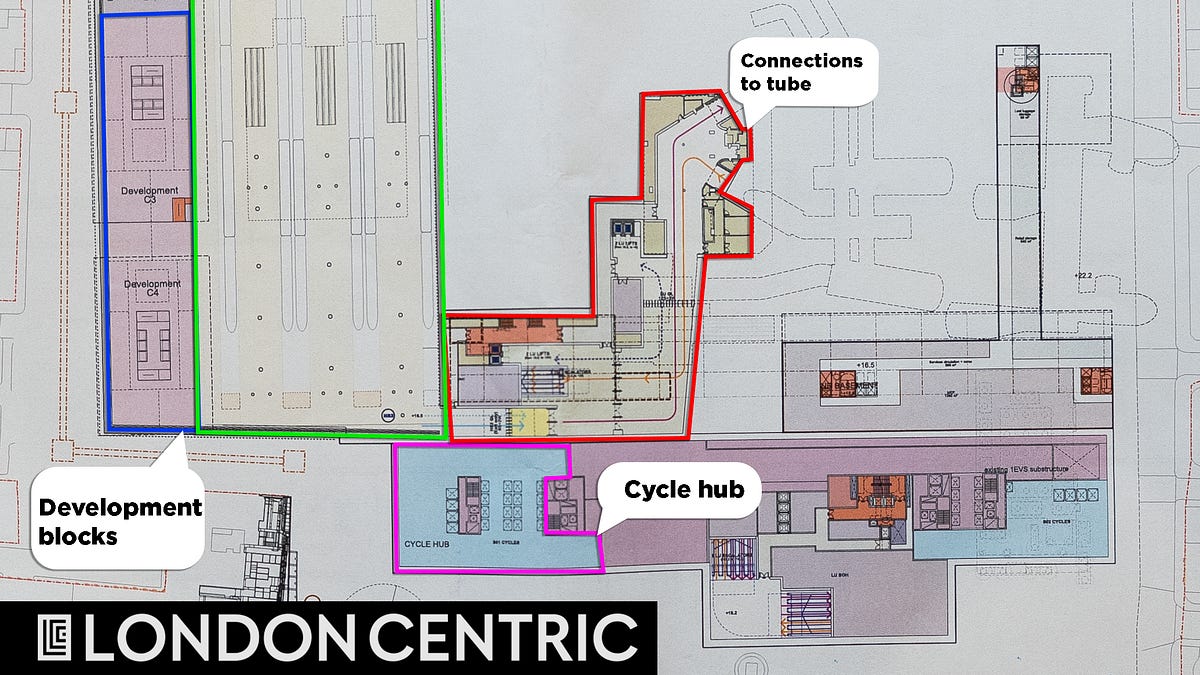
Focusing for a minute on the ongoing gigashambles that is Euston HS2 planning, London Centric has a story which includes apparently leaked info from TfL that includes a number of concerns that either are, or were until quite recently unresolved. Still, we are only about 10 years into the design and planning phase
- the new HS2 station might become overcrowded within 6 years of operation, particularly if actual HS2 use is higher than predictions (as it was with Elizabeth Line)
- inadequate capacity and funding for Euston Underground station to cope with new passengers, particularly as wider area redevelopment increases demand
- Continuing accessibility issues if the Euston concourse remains at higher levels than its platforms and the HS2 station
- Passive provision for additional platforms may only be half length to maximise space for other development, which would obviously put a permanent cap on HS2 capacity and also place the expansion platforms a further 200m from connections
- the new HS2 station might become overcrowded within 6 years of operation, particularly if actual HS2 use is higher than predictions (as it was with Elizabeth Line)
A difference between HS2 and the Elizabeth Line is that loadings can be controlled by price and availability. While the Elizabeth Line fits within the Zonal fare structure in London, demand for HS2 can genuinely be priced off to maximise revenue and manage loadings as necessary.
- inadequate capacity and funding for Euston Underground station to cope with new passengers, particularly as wider area redevelopment increases demand
Crossrail 2 would have helped but there is clearly no prospect of that being built in the next 40 years, if ever. I doubt that there is much that could really happen with Euston underground station, or obvious funding for changes.
Crossrail 2 would have helped but there is clearly no prospect of that being built in the next 40 years, if ever. I doubt that there is much that could really happen with Euston underground station, or obvious funding for changes.
The other project which could help is the Southern Approach to Heathrow if it pairs the Heathrow Express services with those through to Basingstoke and Guildford.
As that could reduce the need for passengers to travel into central London to head to/from HS2 services.
Studies (open access academic journal article on the topic with graphs) have shown that accelerations and decellerations of around 1.1-1.3m/s/s are tolerated well by the vast majority of the population, assuming they are at low values of 'jerk' (ie. the acceleration comes on or off smoothly over a few seconds). Metro lines across the world do these accelerations all day every day, with the Victoria Line regularly achieving 1.3m/s/s.
With strap hangars and grab bars I don't see much problem in making trains do those sorts of accelerations - which would allow a train to go from 0 to 200km/h in ~45 seconds or so. The challenge is in getting rolling stock that can do that all the way to high speeds.
EDIT:
I've checked, and the journal in question permits reproduction of images with credit - so credit to the authors of the article and the Urban Rail Transit journal.
If that chart is to be of use, we would need to know the acceptable percentage of the population which finds the ride intolerable. If there are strap hangers and grab bars on a high speed train, ie not everyone is sat down, it's a different world, so the acceptable percentage will be different to ours.
Is jerk coming from the power per weight of a vehicle or more the weight and inertia?
A difference between HS2 and the Elizabeth Line is that loadings can be controlled by price and availability. While the Elizabeth Line fits within the Zonal fare structure in London, demand for HS2 can genuinely be priced off to maximise revenue and manage loadings as necessary.
Am I right in thinking the basic issue is the wasted years when HS2 just focused on its own terminus between what appear to have been undefined, unfunded interventions on the mainline station, underground, bus and wider area regeneration?
Although I wonder where it says in the business case for HS2, "Oh, and by the way, we will need to ensure that HS2 peak-time trains arrive/depart Euston with empty seats because the gleaming new interchange we have built cannot handle the numbers". I think that's the point the article is getting at.
Proper OOC interchanges between HS2, the Mildmay and WLO would presumably have some similar impacts and be much cheaper, although I wonder whether taking the Victoria from Vauxhall to Euston will still be quicker. I say this because the master plans for potential new Mildmay/WLO stations around OOC do not strike me as being very good for interchange with the HS2/GWR station. More like a big version of West Hampstead <-> Thameslink, but with longer walks (might easily be 500m to .
Northern Line capacity (i.e. Camden Town upgrade) does look like a must-do project. Apparently offers 25% increase in capacity from Euston towards the West End and the City which I expect to be really big origins/destinations for HS2 passengers, plus Waterloo/CharingX/London Bridge, as well as addressing Camden Town overcrowding.
If that chart is to be of use, we would need to know the acceptable percentage of the population which finds the ride intolerable. If there are strap hangers and grab bars on a high speed train, ie not everyone is sat down, it's a different world, so the acceptable percentage will be different to ours.
In the modern era, this will primarily be a function of the fineness of the control system.
With modern inverter driven electric transmissions, it should be possible to achieve very low rates of jerk.
With more traditional solutions, some jerk is inevitable, especially with conventional couplings that have slack to take up.
On a train with presumably some form of catering and therefore the risk of spilling tea? What works for a metro doesn't necessarily work for long distance.
On a train with presumably some form of catering and therefore the risk of spilling tea? What works for a metro doesn't necessarily work for long distance.
At low jerk values the only noticeable impact of the acceleration and deceleration would appear to be the tables being on a ~6 degree slope some of the time, with smooth transitions. As long as the staff don't overfill the cups I don't think there is much likelihood of significant issues inside the cabin, even if a catering offer is a major part of the attraction of such services. Any issues with tipping over could be solved by making appropriate selections of the shape of cups.
And if we had trains that could accelerate at these rates all the way to top speeds, average journey times would be expected to decrease substantially - which would reduce the prominence of catering.
Super BEMU would need a little more modifications than just the battery packs as it is also meant to have a higher speed, much higher power and superior aerodynamics. But all those things mostly lie in the category of "tuner" modifications rather than a new vehicle. Unless there is some sort of contractual limitations that stops you modifying a class 800 unless you do it via the OEM.
The high speed metro trials might need a fair bit more modifications to make a carriage that can do 400kph and also have metro style doors and layout.
If something can be done in one country it can be done in another, the variations in people around the world in not that great. They have plenty of old people in Japan. The key point is that the Japanese ability to clear people from trains and to turn around train quickly is not a cultural accident it's a deliberate policy. If we want to turn trains around quicker we can't just cut the turnaround time and then hope it works. We actually need to invest new technologies, working practices and people to show passengers what to do we would need need to do this and probably a bunch of things that we haven't thought of.
The key thing is that all of these interventions are relatively cheap compared to building massive new stations in the centres of our major cities. The problem needs to be owned by the whole industry, not just the station designer because otherwise they are just going to come back with a bigger station.
It's not the journey people are expecting to take, so they are either scared off into cars or take a few yearly journeys to learn what they 'should know'. I would focus on the positive and inducing parts of the customer experience, eg waiting rooms under the full length of the platform, or the non-customer parts, eg looser scheduling for drivers and cleaners so they're waiting. NIMBYs will be even worse if everyone with a walking stick is de jure excluded from your high speed line.
If we did a high speed metro in the UK so most of England and Scotland is functionally commutable to every other spot with a high speed metro station the economic impacts would be absolutely massive. We'd be looking at passenger flows multiples of what we currently see on national rail and we'd be looking at millions of homes built to be within walking distance of these stations. People would be moving to live near these stations. We are not going to be worried about a small % of current infrequent users being confused about needing to hold on when the train gets moving. Also similar to the tube the vast majority of users are going to be frequent users, they effectively show infrequent users what to do by their actions, it's not like people with impaired mobility are unable to use the tube, we are not talking about shorter dwell times or faster accelerations than the tube.
== Doublepost prevention - post automatically merged: ==
On a train with presumably some form of catering and therefore the risk of spilling tea? What works for a metro doesn't necessarily work for long distance.
Nope not the concept, we don't have catering on the tube.
The concept is "blistering" acceleration for 90 seconds, hold for 3-5 minutes, decelerate at the same rate, open doors for 90 seconds. You are now 40km away from where you just were. We use this to functionally turn most of the UK city centres into one commutable area and within 1 hour or so you can get from London to Manchester.
If you want a pee or to eat just get off the train, do your stuff and get back on the next one after waiting an average of 1 minute. End to end journey time is still better than any current express train. Trains run high frequency un-complex schedules like on a metro, longer journeys are likely to involve changes, but again this is low friction because of the frequency.
There's a reason that the Bakerloo Line ends at Harrow rather than carrying on all-stops to Glasgow.
So any supposed time savings from this wacky new idea are obliterated by the fact that anyone who wants a cup of tea or to go to the toilet must get off (with all of their possessions) and do so at a station, just like on the Victorian railways? You're expecting people to travel to Scotland like this?
I don't want to be 40km from where I was. I want to be in the big city 400km away and I see no need to stop at every town on the way. I just cannot fathom the mentality behind this idea. How big do you think Milton Keynes and Luton are? If the conurbations of London, Birmingham, Manchester and the Scottish Central Belt are populous enough to fill pairs of 895s running between them, why on earth should we also stop them at every town on the way?
We are aware of an issue with emails from the Forum to Microsoft-based email accounts (hotmail/outlook/live.com email addresses). This is being looked into currently, thanks for your patience meanwhile.