• Our new ticketing site is now live! Using either this or the original site (both powered by TrainSplit) helps support the running of the forum with every ticket purchase! Find out more and ask any questions/give us feedback in this thread!

Experiences of service recovery (or lack of) on GTR Great Northern

WeGoAgain

Member
Joined
30 Apr 2014
Messages
126
Location
Cambs
Evening peak figures for the last 4 weeks.

View attachment 203626
(chart showing continuing poor punctuality on London to Ely evening peak services)

... I see splits taking 8, 10 and 8 minutes on Wed-Thurs-Fri, can't tell how long Mon-Tues took as arrival at Cambridge was early.
What times are you using to determine how long a split takes? A split can be complete but the Train is left awaiting the signal.

… but GTR do own the platform staff at Letchworth, where it still seems to be routinely taking 7-9 minutes to empty out trains.
So you're comparing an 8 car at LET with a 4 Car at CBG? Split that 7 - 9 minutes in two and it takes roughly the same time no? - Added to that, you seem to be well aware of a certain individual who - shall we say - doesn't rush around shutting Trains down at LET. Said timings are not a reliable yardstick to measure timings by.
 
Sponsor Post - registered members do not see these adverts; click here to register, or click here to log in
R

RailUK Forums

MikeWM

Established Member
Joined
26 Mar 2010
Messages
4,969
Location
Ely
What times are you using to determine how long a split takes? A split can be complete but the Train is left awaiting the signal.

As in post #713 above:

Just looking at the arrival and departure times at Cambridge for 1T07, 1T09 and 1T11 (morning) and 1T48, 1T50 and 1T52 (evening).

Yes there could be other factors at play, not just the time required for the actual split. But for 1T48 in particular, as I tend to be staring at it on Traksy as I'm standing in the cold at Cambridge North, it isn't that there are other services in the way so the delay isn't likely to be due to eg. being held at a signal while something else passes.

If the service leaves Cambridge late, I assume it spent that time splitting. If it left on time, I can't make any such assumption, for obvious reasons. Hence my 'can't tell' for a couple of services last week.

1T48 spent 10 minutes at Cambridge last night, for example. I was waiting for it at CMB and there was nothing blocking it from moving off at any point, so I assume the issue was splitting rather than signalling.
 

Magdalen Road

Member
Joined
20 Feb 2022
Messages
251
Location
Fenland
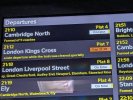
Three consecutive Kings Lynn - Kings Cross trains cancelled this evening and another is nearly 30 mins delayed due being cleaned specially. That's a new one.
Image is a photograph of a departure board with text showing a train running late with an explanation below stating it was delayed due to being cleaned specially.
 

Attachments

  • PXL_20260508_201018122.jpg
    PXL_20260508_201018122.jpg
    2.1 MB · Views: 44

Nicholas Lewis

Established Member
Joined
9 Aug 2019
Messages
8,060
Location
Surrey
I watched a pair of 377s split at Horsham again today. Before I had even got off the leading door of the 5th coach, someone had entered the cab at the rear of the 4th coach and started shutting the gangway doors. Seconds later, a driver entered the front cab of rear unit. There was a passenger needing a ramp in the rear set and a trainee member of staff being taught how to split trains. The whole process took two minutes, 23 seconds. The front portion could have departed three minutes after arrival, but the split was completed two minutes before booked departure time.

Interesting to note that the doors did not lock on the stationary front set. The uncouple button was pressed before the doors locked on the rear set. I saw the electrical connector retract and heard air hissing out of the brake pipe. Once the rear unit moved back a few inches, the doors unlocked again almost immediately. Clearly Electrostars can split quickly if the people involved are on the ball. I've not seen a slow split at Horsham.
Likewise at Redhill generally everyone is in place and they achieve under 3mins admittedly its all Southern staff.
 

WeGoAgain

Member
Joined
30 Apr 2014
Messages
126
Location
Cambs
As in post #713 above:


If the service leaves Cambridge late, I assume it spent that time splitting. If it left on time, I can't make any such assumption, for obvious reasons. Hence my 'can't tell' for a couple of services last week.

1T48 spent 10 minutes at Cambridge last night, for example. I was waiting for it at CMB and there was nothing blocking it from moving off at any point, so I assume the issue was splitting rather than signalling.
I see. It's a logical deduction, but it's more complex than that. - The split as a 'process' is usually delayed by the train (faults - mechanical and/or electrical) and passengers disembarking from the newly out of service rear 4 cars. Then there is signalling as an extra variable.
Actual detachment one train from another takes seconds.
 

MikeWM

Established Member
Joined
26 Mar 2010
Messages
4,969
Location
Ely
I see. It's a logical deduction, but it's more complex than that. - The split as a 'process' is usually delayed by the train (faults - mechanical and/or electrical) and passengers disembarking from the newly out of service rear 4 cars. Then there is signalling as an extra variable.
Actual detachment one train from another takes seconds.

Well, yes, but I assumed it was clear that I including all that (apart from signalling) as part of the process of the 'split', not just the physical movement of one part of the train from the other. I'd do the same for 387s (which didn't seem to have the same issues, whatever the issues are) and 365s splitting at Cambridge, going back many years.
 

Bikeman78

Established Member
Joined
26 Apr 2018
Messages
6,205
I see. It's a logical deduction, but it's more complex than that. - The split as a 'process' is usually delayed by the train (faults - mechanical and/or electrical) and passengers disembarking from the newly out of service rear 4 cars. Then there is signalling as an extra variable.
Actual detachment one train from another takes seconds.
In my example above, the 2m 23s is the time between the train stopping and the rear set moving back a few feet. The uncouple button was pressed about 75 seconds after stopping. So presumably the front unit could reconfigure as required from that point. The front set could have departed about three minutes after arrival. The signal was already off.
 

WeGoAgain

Member
Joined
30 Apr 2014
Messages
126
Location
Cambs
In my example above, the 2m 23s is the time between the train stopping and the rear set moving back a few feet. The uncouple button was pressed about 75 seconds after stopping. So presumably the front unit could reconfigure as required from that point. The front set could have departed about three minutes after arrival. The signal was already off.
That's a lot closer to my experience. Unless there are issues, the split process is a relatively quick one. - It seems the 379's do not announce the Train will be splitting at Cambridge so that in itself may be adding to the process. - The signal being off before the split is complete(?) I don't think I have ever ever seen, I'm not sure whether it should even be done.

Well, yes, but I assumed it was clear that I including all that (apart from signalling) as part of the process of the 'split', not just the physical movement of one part of the train from the other. I'd do the same for 387s (which didn't seem to have the same issues, whatever the issues are) and 365s splitting at Cambridge, going back many years.
Apologies if I missed your criteria.
 

Magdalia

Established Member
Joined
1 Jan 2022
Messages
7,448
Location
The Fens
Actual detachment one train from another takes seconds.
But the preparation to be ready to do that takes time. Here there are two important differences between Horsham and Cambridge, and I have watched splits at both.

One is that the churn of passengers at Cambridge is much bigger than at Horsham. When a train splits at Horsham, most passengers are staying in their seats, with only a few alighting and boarding. When a train splits at Cambridge there are lots of Kings Cross-Cambridge passengers getting off and lots of Cambridge-Fen Line passengers getting on, with conflicting movements at the train doors and on the platform.

The other is that at Horsham both portions are continuing in passenger service, so there is no requirement to empty out the rear portion before splitting. At Horsham one stage of the process is missed out completely, thus saving time. At Cambridge the rear portion, arriving very full, has to be emptied out before the doors are closed so that the actual split can be done. There are always stragglers in the rear portion, going forward into the Fens, who are oblivious to what is going on around them and only move to the front portion after they have received the verbal equivalent of a cattle prod from the platform staff.

The signal being off before the split is complete(?) I don't think I have ever ever seen, I'm not sure whether it should even be done.
From what I have seen at Cambridge, the member of platform staff that clears out the rear portion usually also gives the Train Ready to Start message to the signallers, but only after they have received confirmation from the traincrew that the train is ready.
 

MikeWM

Established Member
Joined
26 Mar 2010
Messages
4,969
Location
Ely
Apologies if I missed your criteria.

No problem, good to make definitions as precise as possible!

--

One is that the churn of passengers at Cambridge is much bigger than at Horsham. When a train splits at Horsham, most passengers are staying in their seats, with only a few alighting and boarding. When a train splits at Cambridge there are lots of Kings Cross-Cambridge passengers getting off and lots of Cambridge-Fen Line passengers getting on, with conflicting movements at the train doors and on the platform.

Someone mentioned this some pages back, but I increasingly wonder if using platform 4 is unhelpful here, as the 'moving up from the back' passengers are conflicting with the 'leaving from the front' passengers. On platform 1 (or 7 or 8) everyone would be moving in the same direction.

Last night they split 1T48 in 4 minutes, so it obviously can be done in the 5 minutes allotted, the outstanding question being why it so often takes considerably longer.
 

WeGoAgain

Member
Joined
30 Apr 2014
Messages
126
Location
Cambs
But the preparation to be ready to do that takes time.
Yes, agreed. My point was more along the lines of (aside from faults as mentioned previously), there is little to no reason a 379 split should be that much longer than a 387 split.

Someone mentioned this some pages back, but I increasingly wonder if using platform 4 is unhelpful here, as the 'moving up from the back' passengers are conflicting with the 'leaving from the front' passengers. On platform 1 (or 7 or 8) everyone would be moving in the same direction.

Last night they split 1T48 in 4 minutes, so it obviously can be done in the 5 minutes allotted, the outstanding question being why it so often takes considerably longer.
That's a good point. I also wonder whether the lack of auto onboard announcements advising passengers of the split may have a part to play. The split cannot happen until the rear 4 have been walked through by staff. Added to this, people rushing for the Train Northbound may attempt to board the nearest carriage (which is the one being terminated) potentially exasperating the issue of clearing the terminating rear 4.
 

MikeWM

Established Member
Joined
26 Mar 2010
Messages
4,969
Location
Ely
That's a good point. I also wonder whether the lack of auto onboard announcements advising passengers of the split may have a part to play. The split cannot happen until the rear 4 have been walked through by staff. Added to this, people rushing for the Train Northbound may attempt to board the nearest carriage (which is the one being terminated) potentially exasperating the issue of clearing the terminating rear 4.

The one time I have watched the splitting at Cambridge so far, a couple of months back, the train ended up being held by the platform staff for an extra 90 seconds or so post-split while a collection of people dashed down platform 4 past the empty carriages to catch it. I don't know if they were arriving from another train or just arriving at the station (but they weren't coming off the detached portion), didn't think to check at the time if something else had just arrived late.

It is nice, I suppose, for those latecomers that the train was held for them, but maybe partly explains why the split appears to take a long time if that is happening every night. (If it was splitting on platform 1, there's rather less far to go from the station entrance to get to the operative part of the train and also less obstructions than on platform 4).
 

jon0844

Veteran Member
Joined
1 Feb 2009
Messages
31,009
Location
UK
With no terminal mode on the 387s or 379s, terminating is not as easy because there's always a risk of someone getting back on before the coach has been locked out - or even walking through into an already closed off coach. Cambridge has a lot of tourists who may not speak or understand English well, which probably adds time to getting people off.

The 379s really need the PIS updated to be able to explain things properly throughout the journey like other stock. Actually, an even better solution would be a software update to lock out doors from the inside one-by-one, but I doubt that's easily doable on older stock.
 

Bikeman78

Established Member
Joined
26 Apr 2018
Messages
6,205
The signal being off before the split is complete(?) I don't think I have ever ever seen, I'm not sure whether it should even be done.
I'm sure that someone more qualified than me can comment but I don't see why it shouldn't be. If there are problems with the split, the signal can easily be put back. The next train to be affected is likely to be the following splitter 30 minutes later.
 

Bikeman78

Established Member
Joined
26 Apr 2018
Messages
6,205
But the preparation to be ready to do that takes time. Here there are two important differences between Horsham and Cambridge, and I have watched splits at both.

One is that the churn of passengers at Cambridge is much bigger than at Horsham. When a train splits at Horsham, most passengers are staying in their seats, with only a few alighting and boarding. When a train splits at Cambridge there are lots of Kings Cross-Cambridge passengers getting off and lots of Cambridge-Fen Line passengers getting on, with conflicting movements at the train doors and on the platform.

The other is that at Horsham both portions are continuing in passenger service, so there is no requirement to empty out the rear portion before splitting. At Horsham one stage of the process is missed out completely, thus saving time. At Cambridge the rear portion, arriving very full, has to be emptied out before the doors are closed so that the actual split can be done. There are always stragglers in the rear portion, going forward into the Fens, who are oblivious to what is going on around them and only move to the front portion after they have received the verbal equivalent of a cattle prod from the platform staff.
Why does the rear set need to be emptied before the split, or even (at the risk of sounding harsh) before the front continues to King's Lynn? If someone misses the front portion departing, they will be 30 minutes late. If someone is in the wrong portion at Horsham, they will also be 30 minutes late, or quite possibly more, if they end up in Barnham when they wanted Billingshurst. I still don't understand how Rotterdam can empty out 156m of double decker train faster than Cambridge can clear 80m of single deck. It's likely that the former will have a lot more people on board. Even more surprising is that Dutch stations have little in the way of station staff. I have no idea who is responsible for clearing the set but there were a few people doing it. And they had no qualms about shutting the doors midway throughout the clearing out process to reverse the rear set by a few centimetres.

Anyway, we seem to be going around in circles. The only sensible options are to speed up the process to match the schedule, or amend the schedule to allow more time.
 

Bikeman78

Established Member
Joined
26 Apr 2018
Messages
6,205
Someone mentioned this some pages back, but I increasingly wonder if using platform 4 is unhelpful here, as the 'moving up from the back' passengers are conflicting with the 'leaving from the front' passengers. On platform 1 (or 7 or 8) everyone would be moving in the same direction.
Using platform 4 is barmy because the majority of the passengers waiting to board will be adjacent to the bit that isn't going anywhere.
 

Jim

Established Member
Joined
11 Jun 2005
Messages
3,492
Location
Wick
With no terminal mode on the 387s or 379s, terminating is not as easy because there's always a risk of someone getting back on before the coach has been locked out - or even walking through into an already closed off coach. Cambridge has a lot of tourists who may not speak or understand English well, which probably adds time to getting people off.

The 379s really need the PIS updated to be able to explain things properly throughout the journey like other stock. Actually, an even better solution would be a software update to lock out doors from the inside one-by-one, but I doubt that's easily doable on older stock.
Do GN 387s not have "Off Peak" mode like a GWR one? It stops the doors being opened from the external, so split, off peak mode the set that is going to CS, one person walks rear to front closing the doors on the passenger button behind them, job done.
 

MikeWM

Established Member
Joined
26 Mar 2010
Messages
4,969
Location
Ely
Using platform 4 is barmy because the majority of the passengers waiting to board will be adjacent to the bit that isn't going anywhere.

1T50 and 1T52 have also had over-long splits and they're due to use platform 1, so maybe this is a red herring. But it does seem an odd decision to use 4 - platform 1 is used by the 1818 to Liverpool Street, but I'm not sure why that can't use 8 as most of them do. Maybe too close to the 1813 Stansted XC service that uses 8?
 

bramling

Veteran Member
Joined
5 Mar 2012
Messages
20,481
Location
Hertfordshire / Teesdale
What times are you using to determine how long a split takes? A split can be complete but the Train is left awaiting the signal.


So you're comparing an 8 car at LET with a 4 Car at CBG? Split that 7 - 9 minutes in two and it takes roughly the same time no? - Added to that, you seem to be well aware of a certain individual who - shall we say - doesn't rush around shutting Trains down at LET. Said timings are not a reliable yardstick to measure timings by.

As regards Letchworth, it doesn’t really matter what the reason(s) may be, but 8 mins is too long to empty out a train on a running line. With 2tph terminating at Letchworth in the peaks, that’s effectively occupying over a quarter of the line’s capacity, which just isn’t sustainable or viable on a line so intensively worked, and completely unmanageable when the service is disrupted. If GTR have made any efforts to deal with this then they haven’t been effective.
 

Bikeman78

Established Member
Joined
26 Apr 2018
Messages
6,205
1T50 and 1T52 have also had over-long splits and they're due to use platform 1, so maybe this is a red herring.
Which is surprising. I doubt that anyone would walk over 160m at Cambridge to try and board the four coaches furthest from the entrance. Which means that platform staff only have to clear out confused stragglers. Perhaps I'm being stupid but I cannot fathom how that can take more than five minutes.
 

jon0844

Veteran Member
Joined
1 Feb 2009
Messages
31,009
Location
UK
Do GN 387s not have "Off Peak" mode like a GWR one? It stops the doors being opened from the external, so split, off peak mode the set that is going to CS, one person walks rear to front closing the doors on the passenger button behind them, job done.

Not that I am aware of. You have to use a T-key to close each coach from the outside, which means one person shutting the train down has to go in and out of the train coach by coach. Ideally you have two people (one outside, one walking through) but if once you encounter someone who is confused, has lots of bags, or even refuses to move, the shut down process ends up heavily delayed regardless.

I suspect this is what causes a lot of delays at Letchworth because there are a number of homeless people that travel on trains and do not wish to get off, especially miles out of London, and expect to be able to stay on for the train to go back and forth. Given Letchworth terminators are blocking the entire line, I think it would make more sense to run all trains to Cambridge and if a train does need to go ECS into the sidings at Letchworth, perhaps terminate it at WGC or even Stevenage.

Failing that, have TSOs present who can remove someone with a bit more force than just asking nicely.
 

MikeWM

Established Member
Joined
26 Mar 2010
Messages
4,969
Location
Ely
I note ontimetrains.co.uk currently has Watlington as the 6th worst station in the country (!) for performance.

1779273053024.png

Downham Market is 10th worst in the country; Littleport 15th worst; Kings Lynn is in the bottom 100.

There's nothing on the horizon to help with this - indeed this is on a timetable that includes time for Cambridge South stops that aren't happening yet, so if anything things are about to get worse. Therefore I guess we'll just have to put up with this level of 'performance' for years to come?
 

bramling

Veteran Member
Joined
5 Mar 2012
Messages
20,481
Location
Hertfordshire / Teesdale
I note ontimetrains.co.uk currently has Watlington as the 6th worst station in the country (!) for performance.

View attachment 204490

Downham Market is 10th worst in the country; Littleport 15th worst; Kings Lynn is in the bottom 100.

There's nothing on the horizon to help with this - indeed this is on a timetable that includes time for Cambridge South stops that aren't happening yet, so if anything things are about to get worse. Therefore I guess we'll just have to put up with this level of 'performance' for years to come?

I think that’s a fair summary, unfortunately.

The December timetable largely de-coupled the Fen Line from the stopping services. This has resulted in a general improvement in the latter, but with disastrous consequences for the former.

IMO the only potential improvement is some smartening up of signaller performance and regulating on the route, specifically in the section controlled from York.

It’s completely untenable having situations where for example they might give priority to an LNER at Woolmer Green, delaying a GTR, and then end up holding the same LNER around Finsbury Park to give preference to the GTR they delayed - I’ve seen this sort of thing happen way too much.

Aside from that the only real solution is massively increased turnround times across the route, both the Fen Line services and at Cambridge for the Brighton/Cambridge service. The infrastructure unfortunately just doesn’t support this.
 

Watershed

Veteran Member
Associate Staff
Senior Fares Advisor
Joined
26 Sep 2020
Messages
16,828
Location
UK
Aside from that the only real solution is massively increased turnround times across the route, both the Fen Line services and at Cambridge for the Brighton/Cambridge service. The infrastructure unfortunately just doesn’t support this.
There is plenty of capacity at Kings Lynn to support longer turnrounds, since it has 2 platforms and plenty of sidings. Cambridge, Brighton and Kings Cross are admittedly much more constrained but even adding in extra time at Kings Lynn would be a start.

The problem is that any increase in turnround time would require more diagrams in service (both crew and units) which there is hardly going to be the appetite to do, especially when the DfT are seemingly pulling the purse strings ever tighter (see Avanti's summer timetable reduction - though I suspect there is more going on there than they are letting on).
 

RailwayRookie

Member
Joined
28 Jul 2023
Messages
294
Location
Norfolk
There is plenty of capacity at Kings Lynn to support longer turnrounds, since it has 2 platforms and plenty of sidings. Cambridge, Brighton and Kings Cross are admittedly much more constrained but even adding in extra time at Kings Lynn would be a start..

The single line sections between Downham Market/Littleport and Watlington/Kings Lynn and their proximity mean the tunaround times are somewhat irrelevant at Kings Lynn as the timetable allows the services to traverse the single line sections without delaying other services.

As the sections are ~9 and ~7 minutes respectively it's not easy to timetable out delays.

A further note about the Rankings is that because of the aforementioned single lines, one delayed train will inevitably delay another, either the opposite direction or the one following. So once one domino falls. The whole line does. You can't simply 'keep the on time train on time' and let the ossue fix itself

A conscientious controller may knock a train out of service (Today's 1T94 for example) at Cambridge to avoid causing delays. But that comes with it the associated cancellation of 1T15.

Add in regulating of Ely North Junction and services to and from Norwich, Peterborough and Kings Lynn all wanting the same piece of track, it's easy for a single delayed train to massacre the whole Peak service for the Fen Line.
 

Failed Unit

Established Member
Joined
26 Jan 2009
Messages
9,827
Location
Central Belt
Sadly we have had 2x Fatalities in successive weeks near Stevenage. Both again happened in the morning and both impacted GN until the end of the day.

However could someone please explain to me the logic of the follow.

1832 Welwyn Garden City - Sevenoaks departed late, so it was decided to run fast to Finsbury Park. This would probably have got it ontime to Finsbury Park.

BUT

1838 Welwyn Garden City - Moorgate was put out ahead of it. Which it followed on the slow all the way to Finsbury Park. For whatever reason the signalled decline to move it onto the Fasts at Marshmoor, Potters Bar and New Barnet. They didnt even let it overtake at Ally Pally.

Result the Sevenoaks lost more time and would not have being any worse off in its normal path.

No one won. I hope this kind of thing improves as the evening rush hour has yet again a total mess from an incident that happened in the morning.

I wondering if AI would help such situations and would think - let get this train on the very empty (because of the disruption) fast Lines. There were lots of other bizarre decisions tonight such as running a Cambridge stopping service fast to Stevenage behind an another stopping service. Why not run it fast to KX (getting the return working on time)
 

Mattplans

Member
Joined
27 Sep 2024
Messages
720
Location
London, UK
This is very common (not just a GN thing) and I honestly think TOCs need to be strongly de-incentivised from skip stopping when it's clear it isn't going to make back any time. Even when not put in front of another stopping service, it isn't uncommon to see these skip-stoppers maintain the same amount of mins late. They might as well have just stopped as booked. It comes to a point where they are just accentuating the disruption by inconveniencing passengers at the skipped stops, when it would not have been any more disruptive to allow them to travel.

Is this perhaps a sign of disjointed communications between GTR Control and the York signallers? I don't doubt someone will be along shortly offering an excuse for the shortcomings of the decision makers in these situations. You can't help thinking there's someone in front of a desk hitting "skip stop" button with no thought about the impact this might make.
 

Failed Unit

Established Member
Joined
26 Jan 2009
Messages
9,827
Location
Central Belt
The other odd one I was refering to - 2C51 and 2C53. For whatever reason 2C51 left after 2C53. 2C51 skipped all stops until Stevenage, then stopped as normal behind 2C53. Everyone on the line would have got 2C53 as it arrived first. If they had ran 2C51 fast all the way to Kings Cross it might have got there in time to run the 1854 service on time.
 

bramling

Veteran Member
Joined
5 Mar 2012
Messages
20,481
Location
Hertfordshire / Teesdale
The single line sections between Downham Market/Littleport and Watlington/Kings Lynn and their proximity mean the tunaround times are somewhat irrelevant at Kings Lynn as the timetable allows the services to traverse the single line sections without delaying other services.

As the sections are ~9 and ~7 minutes respectively it's not easy to timetable out delays.

A further note about the Rankings is that because of the aforementioned single lines, one delayed train will inevitably delay another, either the opposite direction or the one following. So once one domino falls. The whole line does. You can't simply 'keep the on time train on time' and let the ossue fix itself

A conscientious controller may knock a train out of service (Today's 1T94 for example) at Cambridge to avoid causing delays. But that comes with it the associated cancellation of 1T15.

Add in regulating of Ely North Junction and services to and from Norwich, Peterborough and Kings Lynn all wanting the same piece of track, it's easy for a single delayed train to massacre the whole Peak service for the Fen Line.

It’s interesting that there has been some level of local desire for 2tph to Kings Lynn, however this does seem to be a case of less being more - 1tph of 8-car trains seems to be the most that can be reliably supported, even if Ely North Junction were removed as a constraint. All-day 2tph would probably need full redoubling to work reliably.
 

WeGoAgain

Member
Joined
30 Apr 2014
Messages
126
Location
Cambs
...it isn't uncommon to see these skip-stoppers maintain the same amount of mins late. They might as well have just stopped as booked.

Is this perhaps a sign of disjointed communications between GTR Control and the York signallers? I don't doubt someone will be along shortly offering an excuse for the shortcomings of the decision makers in these situations. You can't help thinking there's someone in front of a desk hitting "skip stop" button with no thought about the impact this might make.
Whilst I agree that skip stopping is done to make up time I think sometimes it's about not making the Train any later. The Train would very likely continue to lose time if it stopped at all of its booked stations.

Yes, as humans we tend to be very detached from things not in our scope of view. - Those in Control only see Trains. Those Trains could be empty or they could have thousands of people on them. Control are not to know the Train loadings. Their concern is getting Trains running as close to right time as possible and not have delays accumulating and making everything departing subsequently, late(r).
 

Top