Our new ticketing site is now live! Using either this or the original site (both powered by TrainSplit) helps support the running of the forum with every ticket purchase! Find out more and ask any questions/give us feedback in this thread!
Would anyone know the likely formation of the last Grimsby Docks to King's Cross fish trains, which were hauled by BR Standard Class 9F?
Also I wonder when the last fish train ran to KGX?
Would anyone know the likely formation of the last Grimsby Docks to King's Cross fish trains, which were hauled by BR Standard Class 9F?
Also I wonder when the last fish train ran to KGX?
This is the second of four albums which aims to show the fish trains which passed Kirkby South Junction on their way along the Great Central main line through Nottingham Victoria, Leicester Central and beyond. The data is evidence based using, in the main, extracts from Working Timetables...
Would anyone know the likely formation of the last Grimsby Docks to King's Cross fish trains, which were hauled by BR Standard Class 9F?
Also I wonder when the last fish train ran to KGX?
Yes, I remember those at the Cross too, but they were painted BR blue. I can date those better, as that is when I worked there 1971 to 1973. The ones I recall from earlier were a dirty white or grey from memory. But its a long time ago.
Somewhere over 400 of the Fish Vans (at a very rough estimate) seem to have been converted to SPV Special Parcels Vans (n.b. this was not the TOPS code: that was NRV, but few carried it) between (roughly) 1973 and 1977. They did not last long and those that did were (I think) mostly moved on to contract traffic, such as Reader’s Digest from Aylesbury. They all seem to have gone by around 1981, although some became barrier wagons. They were apparently popular with the Post Office as they could be locked.
Somewhere over 400 of the Fish Vans (at a very rough estimate) seem to have been converted to SPV Special Parcels Vans (n.b. this was not the TOPS code: that was NRV, but few carried it) between (roughly) 1973 and 1977. They did not last long and those that did were (I think) mostly moved on to contract traffic, such as Reader’s Digest from Aylesbury. They all seem to have gone by around 1981, although some became barrier wagons. They were apparently popular with the Post Office as they could be locked.
The conversion to parcels use seems to have, as far as I can check, largely consisted of a deep clean. There may have been one or two minor changes to fittings.
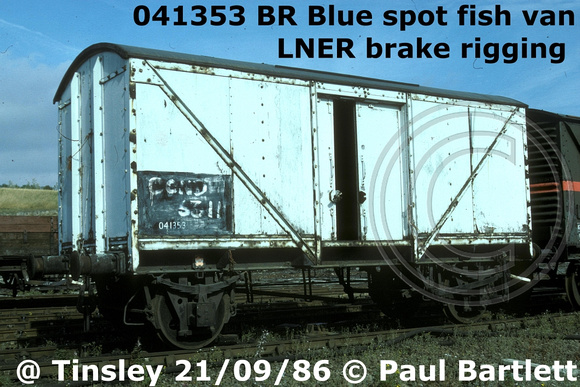
So called Blue Spot Fish vans were built between 1954 – 1961. However, only those later ones built with roller bearings carried the blue spot.
With the loss of Fish traffic in 1968 c600 became Express Parcels vans, others went to
the engineers.
So called Blue Spot Fish vans were built between 1954 1961. However, only those later ones built with roller bearings carried the blue spot. With the loss of Fish traffic in 1968 c600 became Express Parcels vans, others went to the engineers. More information and diagram in Bartlett, Paul W...
There is a great photo on the Steve Banks.org website showing a Grimsby bound fish train in 1963, link below (scroll to the bottom of the page for the relevant photo)
Railway historical research (all companies) especially workings on the LNER and BR. Railway modelling of coaches and carriages on a professional basis.
steve-banks.org
== Doublepost prevention - post automatically merged: ==
The book "The Railways around Grimsby, Cleethorpes, Immingham & North East Lincolnshire" by P K King and D R Hewins has a handful of photos showing parts of the fish trains.
The most common fish vans in Grimsby seemed to be the "Insulfish" conversions carried out by BR on many of the LNER diagram 134 10T fish vans; they were rebuilt with recessed doors.
A handful of the unrebuilt D134 vans could also be seen into the 1960s, despite officially being moved onto general traffic.
There were also a few ex-LNER diagram 23 10T vans.
Second most common, and increasing in numbers as the 60s began were the BR "blue spot" vans, ish!
From an internet rabbit hole I've gleaned the following; 500 of these vans were built to diagram 800 with oil axle boxes, followed by 558 to diagram 801 with roller bearings. Subsequently 275 of the diagram 800 examples were rebuilt with roller bearings for Aberdeen to London traffic, and it was these 275 that carried the blue spot which gave the vans their nickname.
The 225 diagram 800s which retained oil axle boxes appear to have been the most regular of the type to appear in Grimsby, followed by the roller bearing diagram 801s, none of which displayed the blue spot.
Other vans appearing in the fish trains were ex-GWR 12T, ex-LMS 12T, BR "vanfit" and BR diagram 1/200 12T ventilated vans.
Some trains also conveyed "conflat A" 4-wheel container flats with insulated containers on board.
A few partial formations from the above book are here (no photos of course due to copyright);
1960, 7 wagons visible (but not the loco)- 1x insulfish, 1x diagram 1/200, 1x "blue spot" (oil axle boxes), 1x ex-LMS 12T, 1x "blue spot", 1x diagram 1/200, 1x "blue spot"- the axle boxes on the last two blue spots cannot be identified in the photo.
1961 (1) 9F 92193 with four or five conflat A's at the head of the train leading a long string of vans, unfortunately all of which are too far from the camera to be identified.
1961 (2) K3 2-6-0 with the first two wagons in view being an ex-GWR 12T and a BR vanfit.
1964 (1) a B1 with the first two wagons of the train visible; 1x insulfish and 1x blue spot with oil axle boxes.
1964 (2) 9F 92178 with the first eight wagons in view; 2x blue spot - the axle boxes on the first are not visible due to steam from the loco, the second is a diagram 801 with roller bearings, 2x insulfish, 1x ex-LMS 12T, 3x insulfish.
Also in 1964 is a photo of 8F 48632 heading fish empties to Grimsby, no wagon details but interesting!
Finally, at the bottom of this post is a photo of a BR diagram 1/200 ventilated van as mentioned above, photo from Wikimedia Commons, taken by David Ingham and shared under Wikimedia Commons license 2.0.
== Doublepost prevention - post automatically merged: ==
The Alex track website has a photo of one of the Insulfish conversions, link below. I believe Parkside do a kit in 4mm scale if you're looking to model them.
Finally, at the bottom of this post is a photo of a BR diagram 1/200 ventilated van as mentioned above, photo from Wikimedia Commons, taken by David Ingham and shared under Wikimedia Commons license 2.0.
Diagram 1/200 was an LMS design (basically LMS D2108) of which 1300 were turned out by Wolverton in 1949; they were the first wagons to have a BR Lot number: 2001. Some of the LMS-built ones had been marked for fish traffic, although the wagons, both LMS and BR, were officially Ventilated Vans.
There is a great photo on the Steve Banks.org website showing a Grimsby bound fish train in 1963, link below (scroll to the bottom of the page for the relevant photo)
Looking at the photos on the Steve Banks site: was it standard practice to couple the fish vans on passenger trains immediately behind the locomotive? Or is is just a coincidence that they're all in that formation, or a result of photographers generally concentrating on locomotives (so fish vans are only visible on historical photos if immediately behind the loco)?
From the passengers' point of view I imagine putting the fish at the back of the train might have been preferable...
Looking at the photos on the Steve Banks site: was it standard practice to couple the fish vans on passenger trains immediately behind the locomotive? Or is is just a coincidence that they're all in that formation, or a result of photographers generally concentrating on locomotives (so fish vans are only visible on historical photos if immediately behind the loco)?
From the passengers' point of view I imagine putting the fish at the back of the train might have been preferable...
I would think that your comment on photographers concentrating on locos is probably the main reason for them appearing behind the loco in photos. I think that the tail of the train was the preferred spot for fish vans, but there would be occasions where the layout of the station where they were picked up or dropped off made marshalling them at the front a logical decision.
Looking at the photos on the Steve Banks site: was it standard practice to couple the fish vans on passenger trains immediately behind the locomotive? Or is is just a coincidence that they're all in that formation, or a result of photographers generally concentrating on locomotives (so fish vans are only visible on historical photos if immediately behind the loco)?
From the passengers' point of view I imagine putting the fish at the back of the train might have been preferable...
Operationally, it is far easier to attach wagons to a passenger train at the front. At a terminus, they can be attached to the train when the locomotive is attached just prior to departure. At an intermediate station, it avoids the need to reverse loaded passenger coaches over points not fitted out for passenger traffic.
We are aware of an issue with emails from the Forum to Microsoft-based email accounts (hotmail/outlook/live.com email addresses). This is being looked into currently, thanks for your patience meanwhile.