• Our new ticketing site is now live! Using either this or the original site (both powered by TrainSplit) helps support the running of the forum with every ticket purchase! Find out more and ask any questions/give us feedback in this thread!

Advantages of Stadler engine in the middle approach

renegademaster

Established Member
Joined
22 Jun 2023
Messages
2,222
Location
Croydon
What is actually the reasoning behind the design of the FLIRT?
I get why they didn't put it under the floor like most modern units, mainly making it easier to be level floor and less engine noise.

But it seems to come with lots of disadvantages. You have to walk through the engine to get to the other half of the train. I can imagine it would be more awkward to repair than a loco hauled train or a HST/TGV style set with engines at both ends.

Additionally compared to a push pull style set , you will always have less platformed doors, with a loco you can dangle the loco off the end of the platform but with the FLIRT you will always have the middle taken up by the engine bay.
 
Last edited:
Sponsor Post - registered members do not see these adverts; click here to register, or click here to log in
R

RailUK Forums

SECR 65

Member
Joined
2 Apr 2026
Messages
726
Location
East Sussex
Additionally compared to a push pull style set , you will always have less platformed doors, with a loco you can dangle the loco off the end of the platform but with the FLIRT you will always have the middle taken up by the engine bay.
The 755s being 3 and 4 coaches won't have too much of a platform length issue. The 745s are much longer so the impact of the engine unit on platformed doors will be negligible. Sometimes you can have a loco off the end of the platform, but not if the train must stop with the monitors / mirrors on the platform adjacent to the driver.
 

zwk500

Veteran Member
Joined
20 Jan 2020
Messages
18,641
Location
Northampton
One other advantage of the 'power pack' design is that it is intended to be easily removable/replaceable should the unit be converted into a EMU or BEMU (or presumably HMU, etc)
 

cambsy

On Moderation
Joined
6 Oct 2011
Messages
1,114
Personally I think the Flirts having diesel engines in the middle works really well, as it gives a really good environment for the passenger, and they in my opinion are the best regional units on the network, and some of the best on the whole network.

With any train, there will be pros and cons with any design and way of thinking, no train will be perfect. I think having engine in middle of unit, gives easier access for maintenance etc, and means one doesn’t have vibrating noisy engine under the coach, which big plus, and when walk through the engines, they are not unpleasantly loud and seem well sound proofed.
 

norbitonflyer

Established Member
Joined
24 Mar 2020
Messages
5,828
Location
SW London
The 755s being 3 and 4 coaches won't have too much of a platform length issue. The 745s are much longer so the impact of the engine unit on platformed doors will be negligible.
745s don't have an engine unit. They are plain EMUs.
 

Bletchleyite

Veteran Member
Joined
20 Oct 2014
Messages
113,790
Location
"Marston Vale mafia"
The original design comes from the Stadler GTW - Gelenktriebwagen (articulated powered vehicle, literally, though Triebwagen basically means multiple unit in any meaningful sense - no silly names back then). With that even the EMU version had the "power pod", the idea being that that had a traditional powered bogie with two lightweight unpowered passenger vehicles hanging off it, one on each side (though you could add extra ones), with a lightweight unpowered bogie at the other end and low floor almost throughout. This was an older design, and the pod idea was carried on into the diesel FLIRT.

The reason it's not under the floor is that it won't fit there with a low floor (though there may be ways, e.g. sideways mounting, for a UK floor height, they are designed for 760mm and lower platforms where there definitely isn't room). They elected not to go for roof mounting as some French DMUs do, not quite sure why, but that wouldn't have fitted in UK gauge. The EMU version of the FLIRT doesn't have the pod.

The FLIRT design does allow for the engines to be inside the body behind the cab - one of the Scandinavian designs is doing this. That basically gives you something like the Class 210, which was in effect a diesel Class 455 with an engine at one end. It does make that vehicle rather heavy, though, and unlike the "pod" you would get more vibration.

My guess would be that it was a case of already having a sort of suitable design to adapt, so they did.
 

ac6000cw

Established Member
Joined
10 May 2014
Messages
3,917
Location
Cambridge, UK
You have to walk through the engine to get to the other half of the train.
It's just a corridor, of the same width as the centre gangway in the passenger vehicles, and not excessively noisy to walk through when the diesel engines are running hard - no big deal, really.
I can imagine it would be more awkward to repair than a loco hauled train or a HST/TGV style set with engines at both ends.
There are large doors/removable panels on the 'corridor' side of the diesel engines, and the large louvered panels on the outside can be opened - at that point you've got maintenance access to both sides of the diesel power packs/gensets.
with a loco you can dangle the loco off the end of the platform
You can't (normally) have a lead loco beyond the platform starting signal for obvious reasons, so the loco is dead space. A diesel loco of similar rating to a fully populated, 6.7 metre long, 755 power car - 1920kW/2570hp - would be much longer and heavier. The intermediate passenger vehicles are about 15.7m and the end vehicles about 21.3m long.
 

renegademaster

Established Member
Joined
22 Jun 2023
Messages
2,222
Location
Croydon
.

You can't (normally) have a lead loco beyond the platform starting signal for obvious reasons, so the loco is dead space. A diesel loco of similar rating to a fully populated, 6.7 metre long, 755 power car - 1920kW/2570hp - would be much longer and heavier. The intermediate passenger vehicles are about 15.7m and the end vehicles about 21.3m long.
If it's on the rear with a push pull situation, you can. I understand in hindsight that's it's only really a benefit in one direction, and the few stations where the signals are beyond the platform
 

Ken X

Member
Joined
29 Nov 2021
Messages
348
Location
Horsham
Just wondering out of idle curiosity, whether it is easy to swap out a power car for heavy maintenance, or whether it is hard wired into the rest of the vehicle? I can see advantages to being able to exchange power cars to keep units running.
 

43096

On Moderation
Joined
23 Nov 2015
Messages
18,882
Just wondering out of idle curiosity, whether it is easy to swap out a power car for heavy maintenance, or whether it is hard wired into the rest of the vehicle? I can see advantages to being able to exchange power cars to keep units running.
If you have a look at a photo of one, the answer should be obvious if you look at the bogie layout.
 

stevieinselby

Established Member
Joined
6 Jan 2013
Messages
1,722
Location
Selby
A big advantage of the way the power packs have been put in intermediate vehicles in the FLIRTs is that they can be removed if/when the trains are running on fully electrified lines at some point in the future, or swapped out for a battery module as and when that is the appropriate technology, without it affecting either the passenger accommodation or the driving cabs. As soon as you combine the power pack into the same vehicle as a driving cab and/or passenger seating, you lose that flexibility and you are looking at much more expensive modifications or just lugging around a load of dead weight once it is no longer needed.
 

Russel

Established Member
Joined
30 Jun 2022
Messages
5,567
Location
Lichfield
Additionally compared to a push pull style set , you will always have less platformed doors, with a loco you can dangle the loco off the end of the platform but with the FLIRT you will always have the middle taken up by the engine bay.

How many places is this really a problem though these days? It's not like we run many 10+ coach loco hauled services any more.
 

Brightonboy

Member
Joined
20 Jan 2025
Messages
149
Location
Suffolk
It's just a corridor, of the same width as the centre gangway in the passenger vehicles, and not excessively noisy to walk through when the diesel engines are running hard - no big deal, really.

There are large doors/removable panels on the 'corridor' side of the diesel engines, and the large louvered panels on the outside can be opened - at that point you've got maintenance access to both sides of the diesel power packs/gensets.
755s serve my local station and I was somewhat dubious when they were first introduced but, having travelled on them several times since, I have to say they are so much of an improvement over what we had before. The engines are definitely less intrusive in the passenger accommodation, both for noise and vibration. The corridor through the power module feels somewhat confined but is not long nor desperately noisy (surprisingly), but in a four car unit with no buffet on a branch line the need to go through the power module is very low anyway. I don't have a problem with the seats themselves although the mixed floor heights feels a bit odd. Compared to my other recent rail trips on Thameslink and Southern, I'm happy on a 755.
 

yorkie

Forum Staff
Staff Member
Administrator
Joined
6 Jun 2005
Messages
78,497
Location
Yorkshire
How many places is this really a problem though these days?
If anywhere, it would arguably not be materially different to places where selective door operation has to be used for units elsewhere on the network.
It's not like we run many 10+ coach loco hauled services any more.
Indeed, none of the purported 'disadvantages' mentioned in the original post are actually problems at all, but there are plenty of advantages to the design.
.... The corridor through the power module feels somewhat confined but is not long nor desperately noisy (surprisingly), but in a four car unit with no buffet on a branch line the need to go through the power module is very low anyway....
Indeed, and here in Northern-land, with vastly inferior rattling stock, you physically can't walk through our new diesel trains in 4-car formations!
 

Teds

Member
Joined
14 Nov 2023
Messages
104
Location
Cambridgeshire
I would think that working on the generator sets in the pod is easier than it would be if they were mounted underfloor. Ventilation for the engines should be better too, although the 755/4s with 2 engines have fans that have to work hard in summer.

One disadvantage in the early days which doesn't seem to have been a problem in the end is the weight of the pod carried on two axles. This risked them being treated as locomotives for differential speed limits, which would have had a significant impact on schedules at least one Norwich - Cambridge.
 

43096

On Moderation
Joined
23 Nov 2015
Messages
18,882
I would think that working on the generator sets in the pod is easier than it would be if they were mounted underfloor. Ventilation for the engines is should be better too although the 755/4s with 2 engines have fans that have to work hard in summer.
The 755/4s have four engines.
 

saismee

Established Member
Joined
20 Oct 2023
Messages
1,753
Location
UK
Ventilation for the engines is should be better too although the 755/4s with 2 engines have fans that have to work hard in summer.
The 755/3s have 2 engines, the 755/4s have 4 engines, and the exhaust/cooling system is different for both. Have a look at the top of the power pack when one goes under a bridge.
 

gingerheid

Established Member
Joined
2 Apr 2006
Messages
1,726
Just wondering out of idle curiosity, whether it is easy to swap out a power car for heavy maintenance, or whether it is hard wired into the rest of the vehicle? I can see advantages to being able to exchange power cars to keep units running.
I think I read the generators can be removed from the power pack with a forklift truck?
 

tfw756rider

On Moderation
Joined
30 Nov 2024
Messages
1,997
Location
Wales (sometimes in England), thanks for replying!
The 755/3s have 2 engines, the 755/4s have 4 engines, and the exhaust/cooling system is different for both. Have a look at the top of the power pack when one goes under a bridge.
Indeed, the easiest way to tell from above is the number of exhaust pipes on the top of the power pack vehicles - 4 on 755/4s and 231s, 2 on 755/3s and 1 on 756s (though the 231 and 756 exhaust pipes have rain flaps that the 755 exhaust pipes don't have).
 
Last edited:

dk1

Veteran Member
Joined
2 Oct 2009
Messages
19,896
Location
East Anglia
I would think that working on the generator sets in the pod is easier than it would be if they were mounted underfloor. Ventilation for the engines should be better too, although the 755/4s with 2 engines have fans that have to work hard in summer.

One disadvantage in the early days which doesn't seem to have been a problem in the end is the weight of the pod carried on two axles. This risked them being treated as locomotives for differential speed limits, which would have had a significant impact on schedules at least one Norwich - Cambridge.
The fuel tank capacity was greatly reduced to allow them to travel at SP speeds.
 

ac6000cw

Established Member
Joined
10 May 2014
Messages
3,917
Location
Cambridge, UK
I think whatever compromises had to made in the UK FLIRT design to get it, the level boarding is a huge, game-changing feature, and not just for people of limited mobility - it speeds up boarding and alighting quite noticeably when people can just walk on and off without having to deal with steps, and access ramps don't have to be laboriously deployed by station staff for wheelchair and mobility scooter users.

I think I read the generators can be removed from the power pack with a forklift truck?
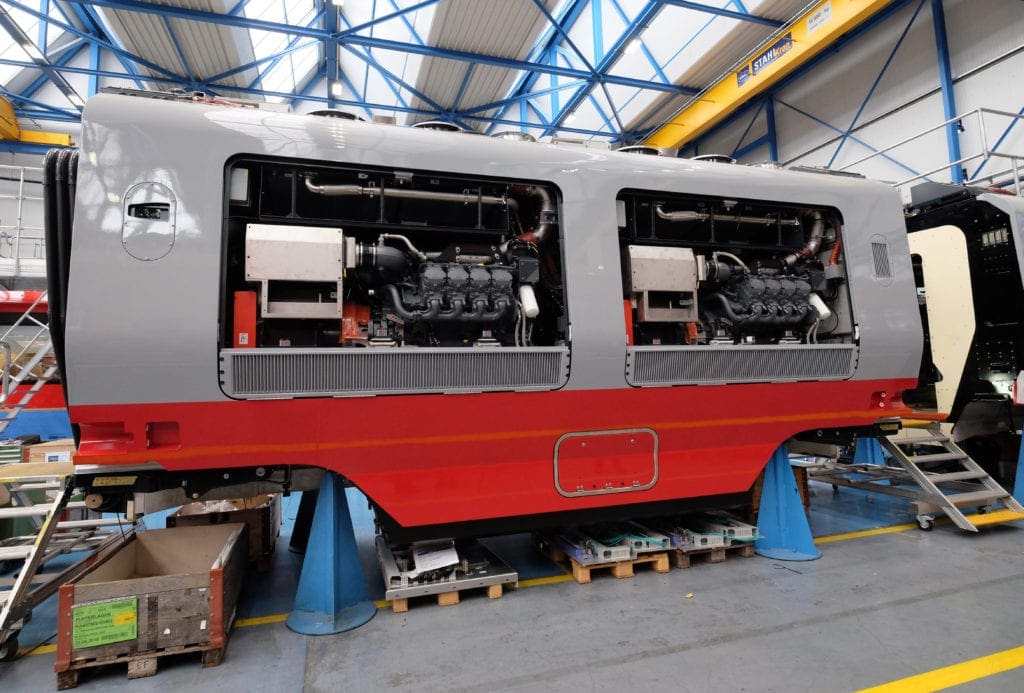
This is a photo (linked from The Railway Magazine website) of a power car under construction with the side hatches removed, showing two of the diesel gensets (the alternator will be on the left side of each engine, and the radiator is above the engine). I suspect that each genset assembly is sitting on a 'raft' that can be lifted out with a fork lift:

DSCF3015-copy-1024x693.jpg
 
Last edited:

Adrian1980uk

Member
Joined
24 May 2016
Messages
843
You have to remember the driving motors are under the floor as they're basically EMUs with a generator car in the middle providing the electric power, with the low floors I don't suppose there's room underneath for electric motor and engines.
Big advantages if GA decided to change it out for battery or there was an electrification program you could 'easily' swap or remove the power unit.
 

Snow1964

Established Member
Joined
7 Oct 2019
Messages
11,239
Location
West Wiltshire
You have to remember the driving motors are under the floor as they're basically EMUs with a generator car in the middle providing the electric power, with the low floors I don't suppose there's room underneath for electric motor and engines.
Big advantages if GA decided to change it out for battery or there was an electrification program you could 'easily' swap or remove the power unit.

Also worth noting that there are sliding gap fillers under the floor too. There are access hatches screwed into the floor in the doorways. Obviously this module has height too, so reduces space between rail height to bottom of floor.

Even if you could sideways mount a flat engine, doesn't mean it would be accessible for maintenance. Wouldn't be able to reach anything on upper side of engine if it was crammed in close to the floor.

The advantage of the pods is can easily maintain engines, even swap them if need heavy stripdown without putting train on jacks and lifting it. And of course could replace one or more diesel generators with a battery pack at later date if required
 

Harpo

Established Member
Joined
21 Aug 2024
Messages
3,938
Location
Newport
As the OP’s question is about the ‘advantages’ of the power module, I can only recommend a look at the photos of the engine rafts in the Class 197 thread and mention of components that only become accessible after the raft is removed. I am guessing that 755 engine maintenance might be easier??


ainsworth74

Forum Staff
Staff Member
Global Moderator
Joined
16 Nov 2009
Messages
31,128
Location
Redcar
I think whatever compromises had to made in the UK FLIRT design to get it, the level boarding is a huge, game-changing feature, and not just for people of limited mobility - it speeds up boarding and alighting quite noticeably when people can just walk on and off without having to deal with steps, and access ramps don't have to laboriously deployed by station staff for wheelchair and mobility scooter users.
Absolutely I think this is the real benefit of the UK FLIRT design. There are various other advantages to be sure that have been outlined but the level boarding is an absolute game-changer and makes other fleets procured in the recent past look antiquated because they don't have it.

I get Northern 156s most days to and from work and also LNER Azuma's not infrequently and the number of times you'll see people struggling with prams, luggage or just their own mobility (for instance older people who might be perfectly mobile generally but a large step down over a deep gap is tricky!). Quite apart from the delays that having to deploy wheelchair ramps engender. I mean it's basically guaranteed that if my train has to board and unload a wheelchair passenger it will pick up a minute or two of delay.

On a FLIRT however? Everyone just easily gets on and off the train be they pushing a pram, wheeling a wheelchair or just a bit less steady on their feet. It makes for a far superior passenger experience and make it operationally more efficient to boot. Everybody wins!

If I were specifying new trains then level boarding would be a cast iron requirement and if a manufacture whinges they can't do it I'd invite them to come for a ride on Merseyside, Tyne & Wear or East Anglia...
 

Goldfish62

Veteran Member
Joined
14 Feb 2010
Messages
13,224
The 755s being 3 and 4 coaches won't have too much of a platform length issue. The 745s are much longer so the impact of the engine unit on platformed doors will be negligible. Sometimes you can have a loco off the end of the platform, but not if the train must stop with the monitors / mirrors on the platform adjacent to the driver.
Modern trains don't use platform monitors/mirrors. They use in-cab CCTV.
 

ac6000cw

Established Member
Joined
10 May 2014
Messages
3,917
Location
Cambridge, UK
You have to remember the driving motors are under the floor as they're basically EMUs with a generator car in the middle providing the electric power, with the low floors I don't suppose there's room underneath for electric motor and engines.
AFAIK the motors are in the usual position within the frames of the bogies at the cab ends (with the traction electronics that drive them in the windowless body section behind the cabs). I suspect the associated 25kV step-down transformer is a low-profile design under the floor of the same car (there's definitely a large piece of equipment under the low floor section).

Even if you could sideways mount a flat engine, doesn't mean it would be accessible for maintenance. Wouldn't be able to reach anything on upper side of engine if it was crammed in close to the floor.
Conventional underfloor DMU engines are flat in the sense that they are 'horizontal' engines - basically a vertical engine turned on its side.

Usually a 'flat' engine implies an engine layout with a central crankshaft and horizontal cylinders on both sides of it - effectively a 'V' engine with a 180 degree angle between the cylinder banks. That minimises the length of it, but makes it wider and the height is similar to a horizontal engine.
 

Top