• Our new ticketing site is now live! Using either this or the original site (both powered by TrainSplit) helps support the running of the forum with every ticket purchase! Find out more and ask any questions/give us feedback in this thread!

Electric trains using unelectrified track

Sponsor Post - registered members do not see these adverts; click here to register, or click here to log in
R

RailUK Forums

contrex

Established Member
Joined
19 May 2009
Messages
1,655
Location
St Werburghs, Bristol
According to the following article in Italian published on the inauguration day it's just 'binari' (tracks) 1 & 2 which were modified to 3000V to allow the use of Vivalto EMUs:

https://www.rivieratime.news/pop-e-rock-ventimiglia-binari-3000-volt/
A lot of ballyhoo about not much, then if you ask me, in the video linked to. Binario uno e binario due. When I was last at Ventimiglia I noticed an odd kind of metal pillar about 8 ft tall, with a big fat cable coming out of it, and a long stick, with promeinent notices saying something like ATTENZIONE, PERICOLO (etc) 1500! I suppose those were volts. On the first platform on the left looking towards Menton. It looked like something you might plug into a receptacle (on a coach or loco?). Some kind of shore supply?
 

TRAX

Established Member
Joined
2 Dec 2015
Messages
1,810
Location
France

dastocks

Member
Joined
3 Nov 2021
Messages
273
Location
Hove
Many years ago I was on a locomotive hauled train from Limoges to Paris that ran on the 'wrong' line for some distance due to engineering work. The power went off for a while as we switched tracks at each end of the single line working. I assume this is because the crossovers were not wired and the pantograph was lowered while the train coasted through them.
 

zwk500

Veteran Member
Joined
20 Jan 2020
Messages
18,401
Location
Northampton
This is also done for Belgian 3kV dc trains running from Anvers to Roeselare just over the Dutch border. Holland uses 1kV5 so they roll into Roeselare quite slowly, albeit under power.
This is also the case for the Belgian services from Hasselt/Liege to Maastricht. I think the 1.5kV/3kV changeover is actually between Maastricht Randwyck and Eisjden, a few km into the Netherlands. The Maastricht - Randwyck section needs to be 1.5kV as NS units run through to Randwyck, but only the SNCB service runs between Randwyck and Eisjden.
As the local train stops at Randwyck, and the distance between the two Maastricht stations is quite short, I didn't particularly think anything of the fact it was travelling quite slow.

By the way did you mean Antwerp-Roosendaal? That's the only other electrified BE/NL connection I can see on OpenRailwayMap.
 

QueensCurve

Established Member
Joined
22 Dec 2014
Messages
2,195
This also used to happen at Chiasso when an Italian loco and coaches on a service further north eft the DC overheads south of the platforms and coasted into the station. It was then removed by a SBB shunter to allow a Swiss loco to take the train on to Zurich. The Italian loco was then returned to the DC overheads.
Simiar procedures were used at vallorbe and Domodosola. Also possibly at Basel.

== Doublepost prevention - post automatically merged: ==

The TPE electric sets do it going north on the WCML at the section break around Garstang. Usually a double bang, followed by a single
Caterall feeder station.
 
Last edited:

Dren Ahmeti

Member
Joined
17 Oct 2017
Messages
602
Location
Reading
Is this different to what the Eurostars do when they pass through similar sections on HS1, and in Calais/Lille/entering the classic lines towards Paris?
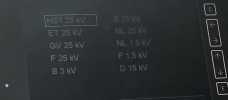
This is the “modern” switching panel layout on a Class 374.

You have to block 2 traction motors going through the tunnel due to the power draw (iirc).
 

Attachments

  • IMG_9780.png
    IMG_9780.png
    1.6 MB · Views: 106

martin2345uk

Established Member
Joined
21 Sep 2011
Messages
2,391
Location
Essex
This is the “modern” switching panel layout on a Class 374.

You have to block 2 traction motors going through the tunnel due to the power draw (iirc).
Not anymore, 374s are fine to go through the tunnel normally these days 8-)
 

zuriblue

Member
Joined
12 Oct 2014
Messages
558
Location
Baden Switzerland
Simiar procedures were used at vallorbe and Domodosola. Also possibly at Basel.

== Doublepost prevention - post automatically merged: ==
Basel has one switchable platform (4 on the SBB side, IIRC 30 on the SNCF side) which can be switched between 15 kV and 25kV. If a cross border service departed from any other platform the loco was taken off by a shunter. Nowadays anything going over the border is multi system.
 

roadierway77

Member
Joined
23 Jun 2019
Messages
429
Location
Edinburgh
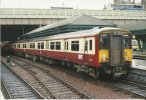
On the 24th December 2004 318254 made it to the (then) unelectrified western bay platforms at Edinburgh Waverley. Supposedly the signaller had set the incorrect road for the unit. I believe it had to be recovered with a locomotive. Photograph courtesy of Andrew Wade on Facebook.
 

Attachments

  • images (4).jpeg
    images (4).jpeg
    41.2 KB · Views: 107

Supercoss

Member
Joined
5 Jun 2016
Messages
457
On the weekend of April 13/14 th 2013 up direction Thameslink services ( class 319) which were running into St Pancras high level coasted between Kentish Town and Dock Junction (but stayed pan down until reaching platform one) due to planned work affecting overhead line feed .
A class 57/3 was on stand by at St Pancras throughout .
Down direction electric trains ran as normal .
ECML also had planned coasting around Hitchin with various degrees of success, when the pan down button pressed on some rolling stock it triggered an AWS warning in cab that required driver to press button to reset , if they failed to react quick enough, brake demand triggered. This of course was discovered the hard way.
 

Gloster

Veteran Member
Joined
4 Sep 2020
Messages
12,940
Location
Up the creek
At Padborg on the German/Danish border the OHL is simply German 15 kV 16 2/3 Hz to the south and Danish 25 kV 50 Hz to the north. It is, or was, possible for German locos to run around under their own catenary, but Danish ones had, if I remember correctly, to stop short and propel back out or be collected by a shunter. Three were no switchable sections.
 

Richard Scott

Established Member
Associate Staff
International Transport
Railtours & Preservation
Joined
13 Dec 2018
Messages
4,575
At Padborg on the German/Danish border the OHL is simply German 15 kV 16 2/3 Hz to the south and Danish 25 kV 50 Hz to the north. It is, or was, possible for German locos to run around under their own catenary, but Danish ones had, if I remember correctly, to stop short and propel back out or be collected by a shunter. Three were no switchable sections.
I seem to remember there being a big neutral gap (think similar exists or existed at Jesenice in Slovenia), where German locos would run in pan down and have a shunter propel them back to 15kV wires. Same with Danish locos coming in from Danish side. Went there on a 112 hauled train once and seem to remember that's what freight locos did. Assume, but can't remember, the 112 was at the Germany end of the train.

== Doublepost prevention - post automatically merged: ==

There was a time when whole station at Ventimiglia was wired at 1.5 kV DC to allow French dual voltage 1.5 kV DC/25kV DC locos to run in and out of the station. It meant Italian rolling stock would run in and out of the station at half power.
Potentially just quarter power available as current would be halved as well?
 

Transilien

Member
Joined
10 Mar 2024
Messages
728
Location
Ayrshire
At Modane, Italian 3kV DC locos can raise their pantograph under the 1.5kV DC supply but the loco effectively only has half the power. Of course the panto is lowered through the transition section.
Tri voltageTGV's switch from their 3kv DC pantographs to the 1.5kV DC pantographs after lowering the pantographs through the neutral section.
There was a time when whole station at Ventimiglia was wired at 1.5 kV DC to allow French dual voltage 1.5 kV DC/25kV DC locos to run in and out of the station. It meant Italian rolling stock would run in and out of the station at half power.
Is this possible to do on AC? Like a 15Kv AC train running under 25Kv AC but not the other way around.
 

bahnause

Member
Joined
30 Dec 2016
Messages
1,010
Location
bülach (switzerland)
Basel has one switchable platform (4 on the SBB side, IIRC 30 on the SNCF side) which can be switched between 15 kV and 25kV. If a cross border service departed from any other platform the loco was taken off by a shunter. Nowadays anything going over the border is multi system.
Only Track 30 could be switched; Track 4 could not. There is currently no connection between Tracks 4 and 30. There are no longer any switchable sections in Basel. From around 2030 onwards, the 15 kV/25 kV system boundary will be moved towards the SNCF line, converting the entire station to 15 kV.
 

QueensCurve

Established Member
Joined
22 Dec 2014
Messages
2,195
You have to block 2 traction motors going through the tunnel due to the power draw (iirc).
Meaning what? That 2 traction motors have to be isolated?

== Doublepost prevention - post automatically merged: ==

Basel has one switchable platform (4 on the SBB side, IIRC 30 on the SNCF side) which can be switched between 15 kV and 25kV. If a cross border service departed from any other platform the loco was taken off by a shunter. Nowadays anything going over the border is multi system.
I think most of these places have swichable wiring these days. There is quite a lot of switchgear where the line to Genf Flughaven meets the French network at Cointrin.

== Doublepost prevention - post automatically merged: ==

Is this possible to do on AC? Like a 15Kv AC train running under 25Kv AC but not the other way around.
Historically 15kV locos needed low frequency for their AC traction motors to function properly. They would not be able to use industrial frequency 25kV lines even if they could tolerate the overvoltage. I find it difficult to see any reason whey an industrial frequency tolerant 25Kv should not be able to use the 15kV supply provided the pantograph is compatible.
 
Last edited:

contrex

Established Member
Joined
19 May 2009
Messages
1,655
Location
St Werburghs, Bristol
Is this possible to do on AC? Like a 15Kv AC train running under 25Kv AC but not the other way around.
I'd be surprised, given that the 15 kV system frequency is 16.66 Hz, and the 25 kV system is 50 Hz, which would make a usable loco transformer difficult to design, to say the least.

== Doublepost prevention - post automatically merged: ==

Historically 15kV locos needed low frequency for their AC traction motors to function properly. They would not be able to use industrial frequency 25kV lines even if they could tolerate the overvoltage. I find it difficult to see any reason whey an industrial frequency tolerant 25Kv should not be able to use the 15kV supply provided the pantograph is compatible.
I think that new 15 kV locos & EMUs have not used 16.66 Hz AC motors for some decades - haven't they used rectified DC for quite a while?
 
Last edited:

Richard Scott

Established Member
Associate Staff
International Transport
Railtours & Preservation
Joined
13 Dec 2018
Messages
4,575
Historically 15kV locos needed low frequency for their AC traction motors to function properly. They would not be able to use industrial frequency 25kV lines even if they could tolerate the overvoltage. I find it difficult to see any reason whey an industrial frequency tolerant 25Kv should not be able to use the 15kV supply provided the pantograph is compatible.
Fairly sure they were DC motors and the lower frequency reduced commutator arcing as running on AC (possible to do as current switched in field and rotor at same time so motor rotated in one direction).
 
Joined
5 Aug 2015
Messages
869
Location
Norfolk
I don't have the electrical engineering understanding to answer this question myself, but what would happen to a bog standard 25kV 50Hz train if you fed it the wrong frequency? Would the rectifier have a problem with this?
 

Pigeon

Member
Joined
8 Apr 2015
Messages
1,123
The transformer would overheat, perhaps even saturate and then things go bang (hopefully just the circuit breakers).

One of the disadvantages of the one-third-frequency system is that all the transformers have to be 3 times bigger than for 50Hz.
 

edwin_m

Veteran Member
Joined
21 Apr 2013
Messages
28,589
Location
Nottingham
Fairly sure they were DC motors and the lower frequency reduced commutator arcing as running on AC (possible to do as current switched in field and rotor at same time so motor rotated in one direction).
Historically this was the way AC traction operated. However, more recent designs have power electronics which use the supply to produce an AC frequency that depends on the speed and desired acceleration/deceleration, which is fed into three-phase AC motors. This is similar for all traction supply voltages and frequencies.
 

Richard Scott

Established Member
Associate Staff
International Transport
Railtours & Preservation
Joined
13 Dec 2018
Messages
4,575
Historically this was the way AC traction operated. However, more recent designs have power electronics which use the supply to produce an AC frequency that depends on the speed and desired acceleration/deceleration, which is fed into three-phase AC motors. This is similar for all traction supply voltages and frequencies.
Not sure what you're getting at here as last part irrelevantto my statement, which was that traditionally unrectified AC was fed into DC motors and the lower frequency kept arcing on the commutators to an acceptable minimum.
Recent designs rectify AC to DC then convert it to 3-phase AC for the 3-phase motors.
 

GordonT

Established Member
Joined
26 May 2018
Messages
1,678
From many of the above posts it looks like there could be the makings of a good thread on the 'International Transport' forum specific to the logistics of where various countries and various voltages converge?
 

Falcon1200

Established Member
Joined
14 Jun 2021
Messages
6,497
Location
Neilston, East Renfrewshire
On the 24th December 2004 318254 made it to the (then) unelectrified western bay platforms at Edinburgh Waverley.

There was also an occasion when a Virgin Cross Country HST working was replaced by an electric loco-hauled set, the NR Controller (not me!) did not advise the Signaller, the train was routed via the then unwired central Mound Tunnel, the Driver took the route and the train became dewired. Causing a lot of delay.....
 

edwin_m

Veteran Member
Joined
21 Apr 2013
Messages
28,589
Location
Nottingham
Not sure what you're getting at here as last part irrelevantto my statement, which was that traditionally unrectified AC was fed into DC motors and the lower frequency kept arcing on the commutators to an acceptable minimum.
Recent designs rectify AC to DC then convert it to 3-phase AC for the 3-phase motors.
Just clarifying for the benefit of people who might think the historical situation still applies. Many on this forum seem to be confused by the idea of a DC train using AC motors (or indeed vice versal).
 

contrex

Established Member
Joined
19 May 2009
Messages
1,655
Location
St Werburghs, Bristol
Fairly sure they were DC motors and the lower frequency reduced commutator arcing as running on AC (possible to do as current switched in field and rotor at same time so motor rotated in one direction).
They were 'universal' motors - series-wound commutator types for sure, but modified to run on AC - a compensating winding, laminated pole pieces and rotor (to reduce eddy currents), the latter with far more coils and plates than a pure DC motor, and hence fewer windings per coil, reducing the inductance. Even so, they have a number of disadvantages in traction use, and they are noted for being noisy and harder on the brush gear and commutators. When I was a boy, my parents had a Goblin vaccuum cylinder vacuum cleaner with a universal motor, and when it was turned on, the cat used to get hysterical.
 

Taunton

Veteran Member
Joined
1 Aug 2013
Messages
12,218
I don't have the electrical engineering understanding to answer this question myself, but what would happen to a bog standard 25kV 50Hz train if you fed it the wrong frequency? Would the rectifier have a problem with this?
My understanding is that all incompatible voltages/frequencies are detected and cut off by the initial circuit breakers, necessary for protection against lightning strikes on the OHLE, which is by no means an unknown occurrence.

A particular issue was from the days of 6.25kV/25kV stock, which had protection against the higher voltage being selected when the lower one was switched in (normally automatic). Supply problems leading to reduced voltage in the OHLE falling to about 18kV could make the protection for this operate.
 
Joined
5 Aug 2015
Messages
869
Location
Norfolk
My understanding is that all incompatible voltages/frequencies are detected and cut off by the initial circuit breakers, necessary for protection against lightning strikes on the OHLE, which is by no means an unknown occurrence.

A particular issue was from the days of 6.25kV/25kV stock, which had protection against the higher voltage being selected when the lower one was switched in (normally automatic). Supply problems leading to reduced voltage in the OHLE falling to about 18kV could make the protection for this operate.

Yeah there is some anecdote I came across about a major power cut in East/North London originating from a Fire at Tottenham 275kV in the mid to late 1980s that cause many feeder stations to go fully offline (apparently "the first two feeders on MML, ECML and GE"). And Liverpool Street is said to have been fed from as far out as Colchester, a voltage so low that some of older trains that still had dual voltage equipment re-selected 6.25kV. I'd like to know more about that event because between Liverpool Street and Colchester would have been Bow Jnc, Crowlands and Shenfield feeders before you get to Colchester, so there may be some mis-rememberings going on. I heard this as an aside in a lecture by Peter Dearman (
37:30 40:36)
 

Deepgreen

Established Member
Joined
12 Jun 2013
Messages
7,458
Location
Gomshall, Surrey
It’s allowed in the UK and has been for a while, see https://www.rssb.co.uk/research-catalogue/CatalogueItem/S234 (needs registration):
"Breaking"?! No - 'braking' - who writes this stuff?

== Doublepost prevention - post automatically merged: ==

They did it on the ECML a few years ago too, through engineering works. Think, from memory, it was between Huntingdon and Peterborough.

Seem to remember one train getting stuck in the bit with no juice.
Disappointing - this is a flexible way to allow engineering works but if even one train falls foul of it, it makes it less likely to be used again. Surely there was an instruction regarding the speed of approach and only proceeding on clear signals, thus avoiding the risk of stopping in the dead section?
 
Last edited:

Top