Our new ticketing site is now live! Using either this or the original site (both powered by TrainSplit) helps support the running of the forum with every ticket purchase! Find out more and ask any questions/give us feedback in this thread!
The opposition to HS2 has primarily been because of the route they chose and because of the huge amounts of environmental damage that the choice of that route has caused. It's quite eye-opening to see it when I fly from the Isle of Man to London, HS2 is basically one 120-mile-long concrete scar right across the middle of some very scenic countryside inhabited by wealthy people.
As we've seen from the Colne Valley viaducts, much of the land grab is temporary and attention is paid to putting things back to how they were or better, from an environmental view.
It remains to be seen how visible HS2 will be once earthworks have been repaired and nature given time to take back the compounds and trunk roads.
As we've seen from the Colne Valley viaducts, much of the land grab is temporary and attention is paid to putting things back to how they were or better, from an environmental view.
It remains to be seen how visible HS2 will be once earthworks have been repaired and nature given time to take back the compounds and trunk roads.
I suppose the question that should be asked is, is the temporary construction land requirement comparable to projects across the channel?
On a different topic, my brother works in acoustic consultancy. He's mentioned that HS2 has a large number (hundreds?) of (expensive) noise monitoring installations along the route, both during construction and, eventually, operation. Apparently if any of these are triggered, someone has to go out and investigate - and the thresholds are, in his informed view, quite low. This is a relatively significant ongoing expense - again, is it comparable with other projects?
As we've seen from the Colne Valley viaducts, much of the land grab is temporary and attention is paid to putting things back to how they were or better, from an environmental view.
I don’t think we can see that from the Colne Valley viaducts at all.
The land won’t recover as the things that were there before- trees, mainly- are not conducive to a high speed railway. The land next to HS1 hasn’t recovered.
Beyond that, the viaducts themselves are also a horrible concrete scar across an attractive piece of countryside. They are, in my opinion obviously, a truly horrid piece of design.
From what I can tell, high speed lines in Europe are largely built next to existing infrastructure. The Strasbourg LGV, for instance, is mostly built right next to a motorway.
I understand the reasons why they didn’t, but if they’d built HS2 next to the M40 they wouldn’t have had so much opposition.
From what I can tell, high speed lines in Europe are largely built next to existing infrastructure. The Strasbourg LGV, for instance, is mostly built right next to a motorway.
I understand the reasons why they didn’t, but if they’d built HS2 next to the M40 they wouldn’t have had so much opposition.
Of course there's plenty who are ready to pounce on this alternative and point out all the things that would physically lie in the way of this, but then there's a lot of tunnels along the Chiltern route, so what would have been so wrong with tunnels along the M1 route?
And the M1 is a great deal more of a direct route to East Midlands, Sheffield and Leeds. As for Birmingham, well it runs three quarters of the way there from London too.
All headline HS2 costs since 2013 have included rolling stock. The report referred to was a preliminary report when Wild took over, supposedly access via FOI, and its been superseded since. That doesn't mean that it may not go to that price, but its not the current estimate. As such, it should not be used in the table. See figure 9 which shows rolling stock included for the estimate given in 2024 https://www.nao.org.uk/wp-content/uploads/2024/07/hs2-update-following-cancellation-of-phase-2.pdf.
I don’t think we can see that from the Colne Valley viaducts at all.
The land won’t recover as the things that were there before- trees, mainly- are not conducive to a high speed railway. The land next to HS1 hasn’t recovered.
Beyond that, the viaducts themselves are also a horrible concrete scar across an attractive piece of countryside. They are, in my opinion obviously, a truly horrid piece of design.
From what I can tell, high speed lines in Europe are largely built next to existing infrastructure. The Strasbourg LGV, for instance, is mostly built right next to a motorway.
I understand the reasons why they didn’t, but if they’d built HS2 next to the M40 they wouldn’t have had so much opposition.
However, if we didn't build HS2 and tried to move the same number of people as the trains could carry by motorways we'd need two motorways with three lanes in each direction bars on the 17tph which were planned to use phase 1 out of Euston.
This would seem to be evidence that the vast majority of HS2's high costs can't be blamed on Euston though, because the difference is much higher than 33 million per km.
No, its not all on Euston, HS2 is being compared to a line where the costs don't include any stations, any urban items or any connections to the main line. For comparison, remove the costs of Euston (in 2020 budget, the line from ooc to Euston was 17% of the budget), OOC, Northolt tunnel, Interchange (including the replacement transit to the airport), Curzon st, the viaducts and tunnels into Birmingham, the complex delta junction, the rolling stock and you've got to around half the 2020 budget. None of those types of items are in LGV SEA.
Also, go off the correct cost for hs2 and note the government added significant cost by rescheduling work, changes to Euston and cancellation writedowns. Yes, its still a lot more, but not the extent it appears in the table.
== Doublepost prevention - post automatically merged: ==
But there appears to remain plenty of opinion that HS2 was carried out in exactly the right manner, and even with the benefit of all this hindsight, many people would still do everything exactly the same all over again
Its more why those decisions were taken in the way they were. Hindsight is an incredible thing. Really, phase 1 was too big to undertake as a whole, so breaking it down further into manageable chunks would have helped.
== Doublepost prevention - post automatically merged: ==
You said the only one that's really comparable is LGV-SEA. This leaves HS2 as being *only* 18 times as expensive per km. So let's assume that the figures weren't balanced to 2023 costs, and afford a 100% inflation since SEA was built.
That still leaves HS2 as being not twice as expensive, nor three times, but NINE times as expensive as SEA.
I only said comparable timewise, its incomparable otherwise and I've already mentioned several times why and you can see my response from a few mins ago too (plus dont use the figure TCP are using, its the wrong one). Phase 2a is a closer comparator and that's around half the cost per mile of phase1. Phase 2b west had a higher cost per mile than phase 1 at the point of cancellation. Again, this is why cost per mile is a poor measure.
I never said it was a similar cost to France, they're around 4 times cheaper. I also have mentioned that EWR Bedford Cambridge is around 3 times the price the French build a 350kph HS alignment for. We have road projects that have a cost per mile more than double the cost France can build HS lines for.
== Doublepost prevention - post automatically merged: ==
M40 and M1 were both looked into, both would still require substantial tunnelling. M40 too windy to run a line along, whatever the speed and would have created large islands of not much use land between railway and motorway and would have hit the forests the motorway winds around.
The route selection stuff is a bit of a myth in my opinion. Talk of "chiltern nimbys" demanding a tunnel misses the considerable changes elsewhere along the line, that the chilterns were unavoidable and required a tunnel and misses where HS2 phase 1 really has its costs - ie in the innercity stations and innercity sections that other countries avoid due to the cost.
California are doing the opposite to us and building the cheap and easy bit first, but that has challenges as well as they wont properly connect into SF or LA for some time. Reason being, they are avoiding the expense of those bits till later.
The opposition to HS2 has primarily been because of the route they chose and because of the huge amounts of environmental damage that the choice of that route has caused. It's quite eye-opening to see it when I fly from the Isle of Man to London, HS2 is basically one 120-mile-long concrete scar right across the middle of some very scenic countryside inhabited by wealthy people.
Yes, building sites are ugly. Usefully, they're also temporary.
It's interesting to me that many of the nimby objections raised to things rest on not objecting to the "thing" in itself, rather the process of building the "thing".
== Doublepost prevention - post automatically merged: ==
It's interesting to me that many of the nimby objections raised to things rest on not objecting to the "thing" in itself, rather the process of building the "thing".
Or all the way between London and Birmingham? Saves on complex and costly engineering at the tunnel mouths, avoids (most of) the NIMBY arguments, theoretically simpler (=cheaper) construction process (just dig a few launch boxes, press go on a load of tunnelling machines, sit back for a few years then add some copy and paste track slabs through the tunnels, job done*), and you can then replace the train windows with advertising screens for additional revenue (since there's no view to look at...)
Hindsight? A lot of pitfalls of how HS2 was designed and phased, were pointed out long before construction started - just that those with power didn't want to listen.
Phase 1 was too big? At barely 100 miles? When China's Shanghai to Beijing route at 809 miles was constructed in one go? And far, far more quickly than HS2 too. We should be ashamed if we try to say phase 1 was too big.
California are doing the opposite to us and building the cheap and easy bit first, but that has challenges as well as they wont properly connect into SF or LA for some time. Reason being, they are avoiding the expense of those bits till later.
A far better way of doing it. As I said upthread, London-Birmingham should have been called something else. Or built as a spur from HS2 following the M1 route.
Hindsight? A lot of pitfalls of how HS2 was designed and phased, were pointed out long before construction started - just that those with power didn't want to listen.
Phase 1 was too big? At barely 100 miles? When China's Shanghai to Beijing route at 809 miles was constructed in one go? And far, far more quickly than HS2 too. We should be ashamed if we try to say phase 1 was too big.
You're contradicting your own point to say we should be ashamed to say phase 1 was too big then saying how it was designed and phased were wrong. Are you suggesting the whoe of HS2 should have been built in one go like the Chinese do?
Its not a distance point, phase 1 is complex as it enables the other phases. The point about it being too big is brought up in the Stewart review. The contracts were too large for the contractors to manage effectively and take the risk, then the large annual spend became something that those wanting to kill project used to convince decision makers to cancel. The size also meant a larger workforce had to be trained up - equivalent to 4 times the concurrent work that was done on HS1.
A far better way of doing it. As I said upthread, London-Birmingham should have been called something else. Or built as a spur from HS2 following the M1 route.
Hindsight? A lot of pitfalls of how HS2 was designed and phased, were pointed out long before construction started - just that those with power didn't want to listen.
Phase 1 was too big? At barely 100 miles? When China's Shanghai to Beijing route at 809 miles was constructed in one go? And far, far more quickly than HS2 too. We should be ashamed if we try to say phase 1 was too big.
A far better way of doing it. As I said upthread, London-Birmingham should have been called something else. Or built as a spur from HS2 following the M1 route.
The Chinese started with the Beijing-Tianjin line which was 72 miles long, and had no tunnels.
It also followed on from around 13,500 miles of conventional railway construction in the decade before hand.
That's a lot more experience in designing, managing and building railways than we had in the run upto building HS1 and then they carried on with other projects and didn't wait years before the next project started.
Conversely, we've not even got the teams to put up OHLE at scale!
As such, it's no surprise that having built around 1,500 miles of HS lines that they found it fairly easy to build a line of 809 miles in one go.
In comparison, in the UK the largest contacts let under Crossrail were valued at less than £1bn and even then the 5th largest was £0.39bn. This compares with the top 5 for HS2 being let with values of between £1bn and £1.5bn, with 14 contacts worth over £0.4bn.
That's a lot more projects to manage with much larger values than a project which wasn't exactly a model of how to manage the construction of a railway.
A lot of the failure of HS2 isn't the route, rather the fact that we didn't exactly make it easy for ourselves to deliver the project.
Well, the process of building starts with design and procurement. Planning blight and the uncertainty around people's homes and businesses start the day that the first route proposal is published.
We’re six years into the construction phase and only halfway through it, if that. Whilst 12-15 years of construction and restoration is technically “temporary,” it’s a very long time to be living with it.
The other effects, such as the uncertainty around compulsory purchase, have been there sine day one, which is more like 16 years ago.
We’re six years into the construction phase and only halfway through it, if that. Whilst 12-15 years of construction and restoration is technically “temporary,” it’s a very long time to be living with it.
The other effects, such as the uncertainty around compulsory purchase, have been there sine day one, which is more like 16 years ago.
16 years ago? It's longer than that! It was being seriously discussed as a Greengauge21 project some years earlier.
I remember attending a conference about it in around 2007 when it was clearly going to become the UK's new HSR. It was then only a couple of years behind China's 809 mile Beijing to Shanghai route in its development.
That Chinese route was being seriously considered for Maglev after the success of the Pudong Airport scheme. Maglev was only finally stopped after the Transrapid accident in Germany.
The Chinese speed of development after that, taking just 5 years to open the scheme was impressive.
HS2 by comparison is a joke - full of "can't do" attitude and a cultural willingness to benefit individual complainers rather than the country.
And yes, the Chinese do look after those whose houses might be in the way of the project, unlike what the UK naysayers would often have us believe.
We’re six years into the construction phase and only halfway through it, if that. Whilst 12-15 years of construction and restoration is technically “temporary,” it’s a very long time to be living with it.
The other effects, such as the uncertainty around compulsory purchase, have been there sine day one, which is more like 16 years ago.
Do you think there's a correlation between the amount of consideration and appeasement of local communities, the project complexity, and the length of time it takes to build?
How about a correlation between the amount of red tape / planning / legal challenges and the length of uncertainty about CPs?
You're contradicting your own point to say we should be ashamed to say phase 1 was too big then saying how it was designed and phased were wrong. Are you suggesting the whoe of HS2 should have been built in one go like the Chinese do?
Do you think there's a correlation between the amount of consideration and appeasement of local communities, the project complexity, and the length of time it takes to build?
What there is is a correlation between how HS2 have absolutely shafted thousands of people by low-balling them and refusing to pay compensation, and anger as to how we have reached the position we are in.
Michael Byng, a railway cost expert who estimates the cost of the line will reach £100bn, believes that the price of property requisition — the largest since the second world war — has risen to at least double the £2.3bn figure put to parliament in 2017 and may exceed £11bn for the entire project.
“The original study appears not to have been prepared in accordance with RICS [Royal Institution of Chartered Surveyors] ‘Red Book’ valuation practice and the ‘Compensation Code’ rules for disruption and disturbance, but of course should have been,” he said.
James Collier, a surveyor who represents about 30 farming clients on Phases 1 and 2 of the scheme, described the entire land acquisition process as a “shambles”. He accused HS2 of “micromanaging” the qualified surveyors it appointed and “not giving them the autonomy to get deals done”.
“They are penny pinching on compensation claims, and yet wasting huge sums on professional fees by not allowing their agents to do their job efficiently,” he said. “Each claim, for even petty amounts, seems to have to go through a tortuous ‘governance’ process, and their own agents’ advice is often being overruled from above.”
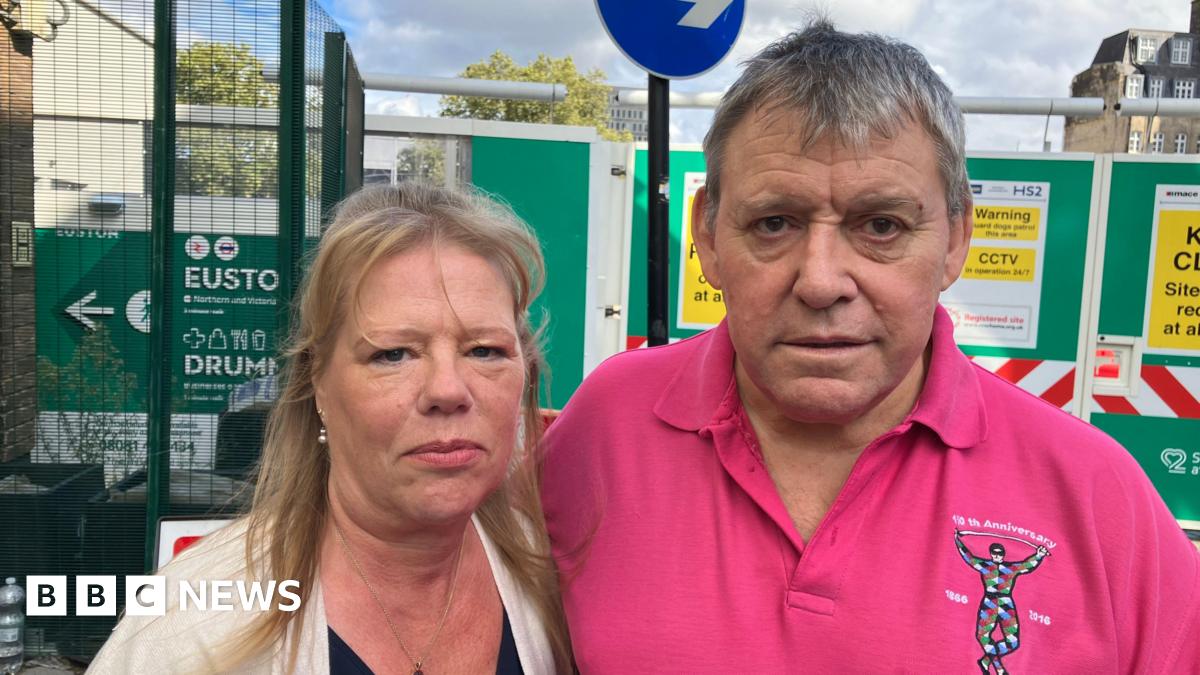
Karen and Craig Douglas ran the Bree Louise pub in Euston until it was demolished for HS2 works.
www.bbc.co.uk
I first met Craig and Karen six years ago when they ran the Bree Louise pub in Euston.
I have followed their journey to get compensation and met them a few times over that period.
When people talk about getting compensation, it is not always clear how difficult and all-consuming it can be. But the impact it has had on Karen and Craig is certainly obvious.
For Craig, he says he finds it wearing and tiring - and still the case has not been settled.
"We're getting there, but next week it will be six years and eight months. With what they have offered us now, if they'd offered us that five years ago we'd have bitten their hands off.
"But after all this time it has been soul-destroying. They have done delaying tactics, they're nasty people to be honest," he says.
And then you have the people in the north of England, who've had this hanging over them for fifteen years only for Phase 2 to be pulled. No compensation for them:
Roly Bardsley said plans for the high speed route through his property created a decade of hell.
www.bbc.co.uk
A man who says he was forced to sell his house by HS2 said the failed project has "destroyed his life".
Roly Bardsley learned his home in Stanthorne, Cheshire, was affected by the planned route when he received a letter containing a map of the line.
After being denied a compulsory purchase order, the 59-year-old said he had "lost everything".
"I tried to sell it and estate agents laughed at me. It was blighted forever," he said.
The BBC has contacted the Department of Transport for comment.
The Prime Minster Rishi Sunak has announced at the Conservative Party conference in Manchester that HS2 will be scrapped. HS2 was a proposed high-speed rail link between London and the north of England.
Mr Sunak told the conference that £36bn allocated to it would be reinvested into other northern rail and road schemes.
Mr Bardsley said the route would have come within 40 yards (37m) of his house and that an additional bypass would have left the place on "an island with no means of access".
"It was unbelievable," he said.
"They refused to compulsorily purchase it because it didn't knock the house down.
"I would have had trains travelling at 240 miles an hour every twelve minutes, 40 yards from my window."
Where is the "appeasement of local communities" here? All I can see is local communities being destroyed by HS2 and the sheer incompetence of the people running it.
The lucky ones had their houses bought. The unlucky ones, well...
A brother and sister who live nearby describe hearing noise at night "that is so abrupt and loud".
www.bbc.co.uk
Construction of HS2's tallest viaduct has been a "living hell" for locals living near the site, who have said noise and disruption has become part of their daily life for the past two years.
The Curzon 2 viaduct is the tallest structure on the route and one of five that will carry trains into Birmingham city centre.
A brother and sister who live close to the site described hearing noise at night "that is so abrupt and loud", while during the daytime it distracts them from work.
Residents near a new HS2 railway bridge have complained that it has plunged their homes into darkness.
The 492ft tall Bellingham Bridge – named after Jude Bellingham, the Real Madrid and England footballer – will be one of the tallest HS2 bridges once it is completed near Birmingham city centre.
The huge structure in the footballer’s home city has left some residents complaining that it is “like having the Forth Bridge plonked in your garden”.
Residents of nearby flats said their lives had been affected by the “metal Godzilla”, claiming the “eyesore” blocked their light. They said they feared noisy high-speed trains would make life unbearable once the rail line was finished.
Others said traffic and parking in the Duddeston area had become increasingly difficult, believing the problems would only get worse.
Still not seeing much appeasement of local communities.
I genuinely don't know how anyone can sit there and think any of this is acceptable. It is a national disgrace. But instead, the government- and many on here- just bleat about "red tape", as though it is somehow unreasonable for the whiny plebs to be upset at a 500ft tall concrete-and-steel monstrosity being dumped in their back yard.
'Wanted', perhaps. Especially by the big construction firms like Robert McAlpine- generous donors to the Conservatives- who have done very nicely indeed out of the whole thing.
HS2 should have been built with the 'easy' bits first, just as the French always did with the LGVs. But where's the money in that? The money is in the over-engineered tunnels and stations and all the other egotistical frippery surrounding the whole project.
The rural bits across farmland should have been easy. HS2 only made it difficult by trying to lowball the landowners affected. If they'd paid out market+20% and paid it quickly, most of those issues would have magically disappeared.
Of course they were trying to lowball people in order to save money, savings that were required because HS2's incompetent management had handed a blank cheque to the likes of Robert McAlpine.
HS2 should have been built with the 'easy' bits first, just as the French always did with the LGVs. But where's the money in that? The money is in the over-engineered tunnels and stations and all the other egotistical frippery surrounding the whole project
The French built the RERs first which gave them the capacity within Paris to run TGVs into the city centre.
Their stations do not generally have the issues with capacity that ours do. They are building primarily for connectivity, hs2 is primarily about capacity. That is why a new station in Birmingham was required. The effects of freeing up New Street are far reaching.
I have absolute sympathy for anyone who has suffered as a result of their claim or money being mishandled. That needs sorting, but is a separate issue from the need/requirement/reason for hs2.
The rural bits across farmland should have been easy. HS2 only made it difficult by trying to lowball the landowners affected. If they'd paid out market+20% and paid it quickly, most of those issues would have magically disappeared.
Of course they were trying to lowball people in order to save money, savings that were required because HS2's incompetent management had handed a blank cheque to the likes of Robert McAlpine.
I wonder how much compensation people got in China. I can guess the actual cost of land and property is less so would be a less significant cost even if generously over paid.
But the impression I get of China is that a lot more "like it or get nothing" would happen. I have seen how complaints get hushed up. You can tow the party line or leave the communist party - not necessarily a big deal in the example I know of.
Hmm. Seems to me that if we'd built it for zero consideration of any local needs at all with regards to aesthetics, safety, the environment, disruption, compensation etc. then it might have all been built by now.
== Doublepost prevention - post automatically merged: ==
Ah, you're philosophically opposed to the idea of cheaper transport and the associated social mobility benefits altogether. I think it's fair to say that this is a somewhat niche position.
I wonder how much compensation people got in China. I can guess the actual cost of land and property is less so would be a less significant cost even if generously over paid.
But the impression I get of China is that a lot more "like it or get nothing" would happen. I have seen how complaints get hushed up. You can tow the party line or leave the communist party - not necessarily a big deal in the example I know of.
When I visited China in 2005, it was to discuss Maglev options beyond the Pudong airport route. It was then a possible alternative to HS2 for the UK (the 500kmh project) as well as for their Beijing route.
Maglev was never really likely to overcome opponents in the heavy rail industry in the UK, and the Transrapid accident in 2006 sealed its fate in both countries. Its chances were only ever slim, especially in the UK, but it was worth consideration.
I was advised by professionals in China that press in the UK was often quite wrong, because they paid a standard 20% over market rate to owners to CPO properties in the way of national projects like this.
The difference was that projects in the national interest didn't waste months and years listening to objections. Decisions were made and they needed to be adhered to, but at least the offers were fair.
Our trip over there was followed by a holiday since we were there anyway. We asked completely independent local people and taxi drivers about this compensation for affected properties, and they confirmed it.
When I visited China in 2005, it was to discuss Maglev options beyond the Pudong airport route. It was then a possible alternative to HS2 for the UK (the 500kmh project) as well as for their Beijing route.
Maglev was never really likely to overcome opponents in the heavy rail industry in the UK, and the Transrapid accident in 2006 sealed its fate in both countries. Its chances were only ever slim, especially in the UK, but it was worth consideration.
I was advised by professionals in China that press in the UK was often quite wrong, because they paid a standard 20% over market rate to owners to CPO properties in the way of national projects like this.
The difference was that projects in the national interest didn't waste months and years listening to objections. Decisions were made and they needed to be adhered to, but at least the offers were fair.
Our trip over there was followed by a holiday since we were there anyway. We asked completely independent local people and taxi drivers about this compensation for affected properties, and they confirmed it.
I'm sure I heard/read a few years back that authorities in China are quite willing to listen to complaints from people as long as they don't feel they're intended to stir up trouble against the Government. I wouldn't know though as I've never been and have no knowledge of how things work there.
We are aware of an issue with emails from the Forum to Microsoft-based email accounts (hotmail/outlook/live.com email addresses). This is being looked into currently, thanks for your patience meanwhile.