

-
Our new ticketing site is now live! Using either this or the original site (both powered by TrainSplit) helps support the running of the forum with every ticket purchase! Find out more and ask any questions/give us feedback in this thread!
You are using an out of date browser. It may not display this or other websites correctly.
You should upgrade or use an alternative browser.
You should upgrade or use an alternative browser.
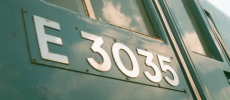
BR Electric Blue numberplate font
- Thread starter Threepea51
- Start date
- Status
- Not open for further replies.
Sponsor Post - registered members do not see these adverts; click here to register, or click here to log in
R
RailUK Forums

Threepea51
Member
Much appreciated!I am sure I have read this somewhere in something I own, so it may be in "The AC Electrics of British Rail" by Brian Webb & John Duncan (David & Charles). I'm away at the moment but I will check at the weekend.
Scanning some railway modelling sites, the cast aluminium number plates were a specific tailored, bold sans-serif typeface that closely matched the standard Gill Sans Medium lettering adopted by British Railways upon nationalisation.Much appreciated!
Modellers simulate this using Arial Narrow or specialised Gill Sans Condensed.
I am sure there's more detail on the plates in the book I have, so I will still check

43096
On Moderation
- Joined
- 23 Nov 2015
- Messages
- 18,847
However, that is a very crude representation - the flat top on the '3' in the OP's photo is nothing like either Arial Narrow or Gill Sans Condensed.Scanning some railway modelling sites, the cast aluminium number plates were a specific tailored, bold sans-serif typeface that closely matched the standard Gill Sans Medium lettering adopted by British Railways upon nationalisation.
Modellers simulate this using Arial Narrow or specialised Gill Sans Condensed.
I am sure there's more detail on the plates in the book I have, so I will still check
Mike Machin
Member
- Joined
- 19 Aug 2017
- Messages
- 382
I’m a graphic designer and I concur, it’s Johnston - the closest font for publishing I have is Semi-Bold. The numerals on the loco look fractionally bolder than this, but not quite as heavy as the bold version.Looks more like Johnson (the London Transport typeface) than Gill Sans due to the shape of the 3 but in a semi bold
Threepea51
Member
Yea that's what I thought as well, but things such as the end of the 3 and the 5 don't match to Johnson. I know it sounds picky, but I really need it to be as accurate as possible for a school project lolLooks more like Johnson (the London Transport typeface) than Gill Sans due to the shape of the 3 but in a semi bold
== Doublepost prevention - post automatically merged: ==
Do you know where I could find a transfer image of this font in a style like the one below? I think they're called transfers, although I don't need the physical transferI’m a graphic designer and I concur, it’s Johnston - the closest font for publishing I have is Semi-Bold. The numerals on the loco look fractionally bolder than this, but not quite as heavy as the bold version.

Looking into this with the help of my assistant, Claude, it seems that the fonts actually varied very slightly according to the class of locomotive, as they were cast in the foundries of each of the individual manufacturers. This suggests that classes 82 and 84 would have shared the same font, but the other 3 of the original classes might have all varied very slightly. AL6, being both EE made (class 83) and BR Donny made (class 85), might have had different fonts according to where they were made, that would have been the same as on the classes in the brackets above.
The plot thickens ......!
The plot thickens ......!

thesignalman
Member
- Joined
- 9 Jan 2012
- Messages
- 162
It is not Johnston:

It might be more like New Johnston (used by the Underground today, but not created until the 1980s), which I don't have installed, but it needs to be remembered that in the days when this typeface was designed computer fonts did not exist. Typefaces we hand-designed and cut, and could therefore be very individual.
John
It might be more like New Johnston (used by the Underground today, but not created until the 1980s), which I don't have installed, but it needs to be remembered that in the days when this typeface was designed computer fonts did not exist. Typefaces we hand-designed and cut, and could therefore be very individual.
John
I think you are right - it might be specially cut and not a recognised typeface although the letter and number shape looks very similar to Dymond but that is based on what is used in the old fashioned Dymo label makersIt is not Johnston:
View attachment 202491
It might be more like New Johnston (used by the Underground today, but not created until the 1980s), which I don't have installed, but it needs to be remembered that in the days when this typeface was designed computer fonts did not exist. Typefaces we hand-designed and cut, and could therefore be very individual.
John
Last edited:
Bear in mind that any non-print lettering of this era may well have been custom designed or taken from a specialist supplier so it's highly unlikely you'll find a match in any currently available font. In an application such as this it may even have come from a BR drawing with only the letter 'E' and digits specified.
Johnston at this period was only available in letterpress format for printing and only within LT; Granby (a very close match) or Gill Sans tended to be used instead when commercial printers did work for LT. For anything heritage, the answer is never Arial, which only became available in the 1980s. It sticks out like a sore thumb when it's used to replicate anything older.
Your best option is to find a high resolution photograph and copy directly from that. This is the best example I could find:

 www.gwra.co.uk
Johnston at this period was only available in letterpress format for printing and only within LT; Granby (a very close match) or Gill Sans tended to be used instead when commercial printers did work for LT. For anything heritage, the answer is never Arial, which only became available in the 1980s. It sticks out like a sore thumb when it's used to replicate anything older.
Your best option is to find a high resolution photograph and copy directly from that. This is the best example I could find:
BR Electric Locomotive Cast Aluminium Cabside - Cabside Numberplates
BR Electric locomotive cast aluminium cabside numbers ex Class 86 E3136. Built in 1965 and renumbered to 86044 in 1973. In lightly cleaned...
Threepea51
Member
It is not Johnston:
View attachment 202491
It might be more like New Johnston (used by the Underground today, but not created until the 1980s), which I don't have installed, but it needs to be remembered that in the days when this typeface was designed computer fonts did not exist. Typefaces we hand-designed and cut, and could therefore be very individual.
John
Looking into this with the help of my assistant, Claude, it seems that the fonts actually varied very slightly according to the class of locomotive, as they were cast in the foundries of each of the individual manufacturers. This suggests that classes 82 and 84 would have shared the same font, but the other 3 of the original classes might have all varied very slightly. AL6, being both EE made (class 83) and BR Donny made (class 85), might have had different fonts according to where they were made, that would have been the same as on the classes in the brackets above.
The plot thickens ......!
I appreciate all of your guys' help so much!Bear in mind that any non-print lettering of this era may well have been custom designed or taken from a specialist supplier so it's highly unlikely you'll find a match in any currently available font. In an application such as this it may even have come from a BR drawing with only the letter 'E' and digits specified.
Johnston at this period was only available in letterpress format for printing and only within LT; Granby (a very close match) or Gill Sans tended to be used instead when commercial printers did work for LT. For anything heritage, the answer is never Arial, which only became available in the 1980s. It sticks out like a sore thumb when it's used to replicate anything older.
Your best option is to find a high resolution photograph and copy directly from that. This is the best example I could find:
BR Electric Locomotive Cast Aluminium Cabside - Cabside Numberplates
BR Electric locomotive cast aluminium cabside numbers ex Class 86 E3136. Built in 1965 and renumbered to 86044 in 1973. In lightly cleaned...
No problem, I quite enjoyed looking into it.I appreciate all of your guys' help so much!
I am now at home and I've checked the book mentioned in my first reply above, but there's no mention of any specific font. I'm sure I've read It somewhere, so I'll check my old MLIs.
Webb & Duncan's book has good contemporary prototypical images of all the AL1-6 classes with decent views of the numbers for scanning purposes.
You can still pick up a good copy for around £15
The AL2/Class 82s were built by Beyer Peacock in Manchester. The AL4/Class 84s were built by North British in Glasgow, so they were not cast in the same foundries.Looking into this with the help of my assistant, Claude, it seems that the fonts actually varied very slightly according to the class of locomotive, as they were cast in the foundries of each of the individual manufacturers. This suggests that classes 82 and 84 would have shared the same font, but the other 3 of the original classes might have all varied very slightly. AL6, being both EE made (class 83) and BR Donny made (class 85), might have had different fonts according to where they were made, that would have been the same as on the classes in the brackets above.
The plot thickens ......!
The cast numbers can be grouped by the material and how they were fixed to the locos:
AL1/Class 81 (E3001-E3023 and E3096-E3097), built by AEI/BRCW - Stainless steel, screwed to the cab side from the front via countersunk screws.
AL2/Class 82 (E3046-E3055), built by Metro-Vickers/Beyer Peackock - Aluminium, screwed to the cab side from the rear.
AL3/Class 83 (E3024-E3035 and E3098-E3100), built by EE Vulcan works - Stainless steel, welded to a plate that was then screwed to the cab side.
AL4/Class 84 (E3036-E3045), built by GEC/North British - Aluminium, screwed from the rear to a plate that was then screwed to the cab side.
AL5/Class 85 (E3056-E3059), built by AEI/BR Doncaster - Aluminium, screwed to the cab side from the rear
AL6/Class 86 (E3101-E3200), built by BR Doncaster & EE Vulcan works - Aluminium, screwed to the cab side from the rear.
Two classes used stainless steel numbers that differed in their mounting methods, though they were probably cast from the same patterns and mounted differently (AL1 drilled through and countersunk, AL3 undrilled and welded to a plate). The other 4 classes used cast aluminium numbers with the same mounting method (though on the AL4s they were mounted onto a plate first rather than directly onto the cab side).
This Facebook post has a picture showing 5 complete plate-mounted examples - EE AL3s E3024, E3035 and E3099 (stainless) and NBL AL4s E3037 & E3045 (aluminium). There is also a further picture of a stainless steel '1' from an BRCW AL1 (with the countersunk holes for front mounting).
This auction lot shows the screw-on stainless numbers from BRCW AL1 E3003.
This auction lot shows the screw-on stainless numbers from BRCW AL1 E3010 (though the listing describes them as aluminium).
This auction lot shows the screw-on stainless numbers and double arrow from BRCW AL1 E3019.
This auction lot shows the aluminium numbers from Beyer Peacock AL2 E3046.
This auction lot shows the aluminium numbers from Beyer Peacock AL2 E3048, including a rear view showing how they were screwed on from the rear, with the screws in the same positions as the holes in the AL1 stainless numbers.
The auction lot for EE AL3 E3024's plate from the FB post above. There is also a rear view that shows they were welded on (no visible screws).
This auction lot shows the plate and stainless numbers from EE AL3 E3025.
This auction lot shows the plate and stainless numbers from EE AL3 E3029.
This auction lot shows the plate and stainless numbers from EE AL3 E3030.
This auction lot shows the plate and stainless numbers from EE AL3 E3031.
This auction lot shows the plate and stainless numbers from EE AL3 E3032.
This auction lot shows the plate and stainless numbers from EE AL3 E3033.
This auction lot shows the plate and stainless numbers from EE AL3 E3034.
This auction lot shows the plate and stainless numbers from EE AL3 E3303 (later renumbered E3098).
This auction lot shows the plate and aluminium numbers for NBL AL4 E3036. There is also a rear view showing the mounting screws, which are in the same positions as those for AL2 E3048 and the holes on the AL1 stainless numbers.
This auction lot shows the plate and aluminium numbers for NBL AL4 E3038.
This auction lot shows the plate and aluminium numbers for NBL AL4 E3040.
This auction lot shows the aluminium numbers for BR Doncaster AL5 E3084.
This auction lot shows the aluminium numbers from BR-built AL6 E3103.
The auction lot linked to earlier shows the aluminium numbers from BR-built AL6 E3136.
This auction lot shows the aluminium numbers from EE-built AL6 E3160.
This auction lot shows the aluminium numbers from EE-built AL6 E3173.
This auction lot shows the alloy 'E3' and double arrow from an AL6.
Comparing all of those examples, I'm pretty confident that all the numbers were cast using the same patterns. The screw mounting positions for the stainless and aluminium numbers (across different locomotive manufacturers) being in the same place is pretty telling.
As for the typeface, I suspect it is a composite - I have looked through my period typeface reference books and cannot find a match that had all of the numbers in the same face. The style of the '1' in particular is not really found alongside a diagonal '3' (the chiselled-off diagonal of the '3' is quite unusual as well). At a guess, I'd say the '3', '6' and '9' (the latter two appear to be the same numeral, just inverted) come from a different typeface from the rest of the numbers.
Last edited:
Or, as I suggested earlier, taken from a designer's drawing and not from any commercially available typeface. Given that Design Research Unit had a considerable involvement in all aspects of the visual design of the AL1-5 electrics, it's almost certain that they specified the design which was interpreted marginally differently by each builder.As for the typeface, I suspect it is a composite - I have looked through my period typeface reference books and cannot find a match that had all of the numbers in the same face. The style of the '1' in particular is not really found alongside a diagonal '3' (the chiselled-off diagonal of the '3' is quite unusual as well). At a guess, I'd say the '3', '6' and '9' (the latter two appear to be the same numeral, just inverted) come from a different typeface from the rest of the numbers.
Look at all the examples I posted, which cover all the builders - there are no appreciable differences in the typeface across them, and common mechanical details like where the mounting screws are located point towards them being cast from the same patterns.Or, as I suggested earlier, taken from a designer's drawing and not from any commercially available typeface. Given that Design Research Unit had a considerable involvement in all aspects of the visual design of the AL1-5 electrics, it's almost certain that they specified the design which was interpreted marginally differently by each builder.
I do wonder if the switch from stainless to aiuminium on the AL2 was related to the weight saving exercise late in the manufacturing process. The AL3 was already well under the 80 ton limit so EE could use the originally-specified stainless numbers. Once the aluminium versions were available they probably became the standand specification, being both cheaper and lighter than stainless.
If someone wanted to recreate the typeface, there's examples of all the numbers from 0-9 in that list they you could trace vectors from.

GRALISTAIR
Established Member
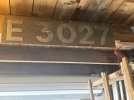
Nice!Wow - I own E3027 - I might well put it up for auction.
I've since found a listing for E3028 and E3304 as well. Of the AL3s, that leaves only the numbers E3026 and E3098 unaccounted for.
A couple of things i'd be interested to know if possible:
1) Can you tell if the numbers are hollow cast, like the aluminium ones are?
2) How exactly are they attached to the backplate - is there a visible weld around the edges, or are they brazed on (which was the old way of attaching stainless to mild steel)?
Last edited:
Back in the 70s my Dad acquired two numbers (maybe from Collectors Corner at Euston?) in order to make up a house number plate, as far as I can remember he just screwed them into the wood. I still have it, it's not really accessible at the moment but I have a photo which I'm attaching.
Attachments

I presume this is why so few complete sets of the AL1 numbers remain - they were sold as individual digits and ended up getting bought for use as house numbers etc. (this is also probably true for the alloy numbers used on the other classes). The AL3's numbers being welded to a plate explains why intact examples from virtually every member of the class still exist.Back in the 70s my Dad acquired two numbers (maybe from Collectors Corner at Euston?) in order to make up a house number plate, as far as I can remember he just screwed them into the wood. I still have it, it's not really accessible at the moment but I have a photo which I'm attaching.
When 81002 was sold into preservation in 1990 it was repainted back into Electric Blue, but was fitted with rear-mounted alloy numbers as presumably the original front-mounted stainless ones could not be obtained. There would be a lot more of the alloy numbers available, having been used on the mass-produced AL5s and AL6s as well as the trial run AL2s and AL4s.
- Status
- Not open for further replies.