• Our new ticketing site is now live! Using either this or the original site (both powered by TrainSplit) helps support the running of the forum with every ticket purchase! Find out more and ask any questions/give us feedback in this thread!

Driver diagram timings

Status
Not open for further replies.

choochoochoo

Established Member
Joined
6 Aug 2013
Messages
1,313
On a driver's diagram, is the arrival time the time the train's front end enters the platform or the expected time the wheels stop rolling once the train is in the platform.

And similarly, what about for the departure time ? Is that the time the train starts rolling away or the time the tail end leaves the platform ?
 
Sponsor Post - registered members do not see these adverts; click here to register, or click here to log in
R

RailUK Forums

357

Established Member
Joined
12 Nov 2018
Messages
2,282
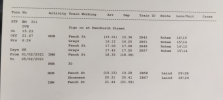
At most companies the driver diagrams don't show arrival and departure times for individual stations. I'll attach an example.

However to answer your question I've always understood it to be wheels stopped to wheels rolling.
 

Attachments

  • Screenshot_20260411-115055.png
    Screenshot_20260411-115055.png
    1.1 MB · Views: 303

Big Jumby 74

Established Member
Joined
12 Feb 2022
Messages
2,219
Location
UK
It will/should be based on wheels stopped/wheels started rolling from the position of the cab being driven from, based upon the Working timetable, not public time, which can differ. Add on all other matters, including but not exclusively, walking time, number of cars in the formation, platform to platform/room allowances to name a few. It is a very complex 'art' especially when higher authority requires limits on the number diagrams that can be created at depots concerned.

BOLD = EDITED FOR CLARITY - I am referring to terminal stations largely, where crew change was a regular part of the plan. As 357 mentions, intermediate station times may not be detailed on the actual diagram, unless the crew member has to change trains and relieve another crew, but on my old patch the timetable detail was included on a drivers schedule card, a printout, that gave all relevant detail for the crew member working Duty xx, without them having to rely on carrying the old school WTT's (ye, I am that old!) or having to rely on checking public screens on the platforms.


== Doublepost prevention - post automatically merged: ==

I'll attach an example.
I'm assuming in your example MOB = Mobilise? or PC (prepare circuits) in S/Reg speak, and IMM = Immobilise? or TC (Trip circuits), both of which in my day were 5 mins. Just curious about Fen Street, as in 15 mins from sign on to wheels roll. At Waterloo we had a 10 min sign on, plus walk (different platforms varied due to length and distance from room, and train length), so a sign on to wheels roll could be something like 25 mins give or take in the extreme cases.

That is why locations/infrastructure have such a wide variety of knock-ons to crew diagramming etc. No two places are the same.
 
Last edited:

357

Established Member
Joined
12 Nov 2018
Messages
2,282
I'm assuming in your example MOB = Mobilise? or PC (prepare circuits) in S/Reg speak, and IMM = Immobilise? or TC (Trip circuits), both of which in my day were 5 mins. Just curious about Fen Street, as in 15 mins from sign on to wheels roll. At Waterloo we had a 10 min sign on, plus walk (different platforms varied due to length and distance from room, and train length), so a sign on to wheels roll could be something like 25 mins give or take in the extreme cases.

That is why locations/infrastructure have such a wide variety of knock-ons to crew diagramming etc. No two places are the same.
It's a long time now since I worked there so I don't remember all the details - but the messroom at FST was tiny and the overflow messroom was a good walk away.

Mobilise or Immobilise is simply putting the key in or taking it out with appropriate cab checks, but also includes setting up the iPad and PIS system. It was rare for mainline drivers to prep or out-stable anything.

I believe in the example it would be 7 mins to check notices + 5 mins walking to the train + 3 mins to set up for departure
 

Big Jumby 74

Established Member
Joined
12 Feb 2022
Messages
2,219
Location
UK
Mobilise or Immobilise is simply putting the key in or taking it out with appropriate cab checks, but also includes setting up the iPad and PIS system. It was rare for mainline drivers to prep or out-stable anything.
PC/TC in our land was essentially as you mention in relation to MOB/IMM, and that was the norm during the day, at Waterloo etc.

A full Prep (PU - Prepare unit(s), walkaround etc etc, took substantially longer depending on unit type/formation length, but this was not possibly at many platformed locations (Waterloo etc) for obvious reasons. For most major depots, we had depot drivers who Prepped trains overnight (24 hour rule) for the next day's starts, thus main line drivers only had the 5 min PC to undertake before wheels roll. There were odd exceptions, at certain places, and certain diagrams (and this was back in the days of EPB and SUB stock), ISTR, where some diagrams often given over to light duty people, were in theory busy all night at eg; Waterloo between PNBs, TC/PC'ing units to allow the relevant main line drivers to be relieved ASAP on arrival, thus maximising their main line duty work potential within shift limitations.

I'm talking from a very distant past, so none of what I say should be associated with todays workings, a lot will likely have changed.
 

choochoochoo

Established Member
Joined
6 Aug 2013
Messages
1,313
At most companies the driver diagrams don't show arrival and departure times for individual stations. I'll attach an example.

However to answer your question I've always understood it to be wheels stopped to wheels rolling.

The diagrams I'm used to show an arrival and departure time at stations the train is expected to stop at.

eg.

Station A - Arr:1215 Dep:1215 1/2
Station B - Arr: 1222 Dep: 1225

So those would be wheels stopped to wheels rolling. That would make sense as otherwise 30 seconds from front end arriving to rear end departing would not be long enough to do any platform duties.
 

357

Established Member
Joined
12 Nov 2018
Messages
2,282
The diagrams I'm used to show an arrival and departure time at stations the train is expected to stop at.

eg.

Station A - Arr:1215 Dep:1215 1/2
Station B - Arr: 1222 Dep: 1225

So those would be wheels stopped to wheels rolling. That would make sense as otherwise 30 seconds from front end arriving to rear end departing would not be long enough to do any platform duties.
I think you're referring to a SHEILA rather than a schedule card? Not all companies issue SHEILA's, however when I was at GA, some drivers wouldn't move the train without one.

Sounds like you've answered your own question in the second part of your post.
 

choochoochoo

Established Member
Joined
6 Aug 2013
Messages
1,313
I think you're referring to a SHEILA rather than a schedule card? Not all companies issue SHEILA's, however when I was at GA, some drivers wouldn't move the train without one.

Sounds like you've answered your own question in the second part of your post.
Without a SHEILA how does a driver know when to depart a station ?
 

dk1

Veteran Member
Joined
2 Oct 2009
Messages
19,804
Location
East Anglia
I think you're referring to a SHEILA rather than a schedule card? Not all companies issue SHEILA's, however when I was at GA, some drivers wouldn't move the train without one.

Sounds like you've answered your own question in the second part of your post.
Yes most GA drivers wouldn’t move an inch without one. I however must admit I was always a bit of a rebel as well as someone who didn’t make a song & a dance and regularly did especially in times of disruption. My many years of service and never having always had them probably had more to do with my laid back attitude.
 

357

Established Member
Joined
12 Nov 2018
Messages
2,282
Without a SHEILA how does a driver know when to depart a station ?
With a diagram such as the one I've posted, combined with a WTT, STN or iPad.

In 15 years, GA is the only TOC I've worked for that issued SHEILA's.
 

172007

Member
Joined
2 Jan 2021
Messages
1,137
Location
West Mids
Our diagrams at the top have exactly the same info as the immage in post 2 but then below that info list every stop with depature times down to half minutes for every station stop we make including working and passenger timetable timings.
 

PudseyBearHST

Member
Joined
28 Sep 2015
Messages
1,107
Location
South West
Could someone explain what a SHEILA is and if possible, post an example? Also, if anyone is happy to post a diagram that their/a company uses, it would be interesting to see the differences. Thanks.
 

NSEWonderer

Established Member
Joined
5 Dec 2020
Messages
2,899
Location
London

== Doublepost prevention - post automatically merged: ==

Practically the same as the drivers. Remarks section would have things like TC, REL, PC etc. Trip circuits and leave secure, REL being relieve and PC being prepare circuits to name a few.

Sheila from what i understand is simply the name of the software system that generates the crew work diagrams. It isn't an acronym as I've understood.
 
Last edited:

RiverDon

On Moderation
Joined
11 Mar 2024
Messages
297
Location
UK
Could someone explain what a SHEILA is and if possible, post an example? Also, if anyone is happy to post a diagram that their/a company uses, it would be interesting to see the differences. Thanks.
I've never heard of Sheila, no idea who she is lol. Here is one of my company's diagrams. This is a black and white photocopy, it would normally have some some of the stations highlighted in red, green and yellow. It is a sheet of A4 with basic info on one side and departure times or occasionally a passing time (in italics) on the other side. This is all we're given and we have to work everything out from that - there's not actually that much information on it! If we want to know when we are booked to arrive we need to hope that the DAS on the unit is working.

Diagram for RailForums back.jpg
Side one
Diagram for RailForums.jpg
Side two

I don't have one to take a photo of but my company's conductor diagrams are basically identical, they don't have arrival times either. Only departure.

According to the old sweats the old diagrams they had until about 20 years ago didn't even tell you the station stops, you had to copy them down yourself out of the timetable!
 

PudseyBearHST

Member
Joined
28 Sep 2015
Messages
1,107
Location
South West

== Doublepost prevention - post automatically merged: ==

Practically the same as the drivers. Remarks section would have things like TC, REL, PC etc. Trip circuits and leave secure, REL being relieve and PC being prepare circuits to name a few.

Sheila from what i understand is simply the name of the software system that generates the crew work diagrams. It isn't an acronym as I've understood.

I've never heard of Sheila, no idea who she is lol. Here is one of my company's diagrams. This is a black and white photocopy, it would normally have some some of the stations highlighted in red, green and yellow. It is a sheet of A4 with basic info on one side and departure times or occasionally a passing time (in italics) on the other side. This is all we're given and we have to work everything out from that - there's not actually that much information on it! If we want to know when we are booked to arrive we need to hope that the DAS on the unit is working.

View attachment 202249
Side one
View attachment 202251
Side two

I don't have one to take a photo of but my company's conductor diagrams are basically identical, they don't have arrival times either. Only departure.

According to the old sweats the old diagrams they had until about 20 years ago didn't even tell you the station stops, you had to copy them down yourself out of the timetable!
Interesting thanks
 

driver9000

Established Member
Joined
13 Jan 2008
Messages
4,556
According to the old sweats the old diagrams they had until about 20 years ago didn't even tell you the station stops, you had to copy them down yourself out of the timetable!

I don't work for your company but that's true and it was pretty much standard across BR at one time. When I joined the railway 20 years ago they had just stopped issuing the Working Timetable to Drivers and a schedule card detailing arrival and departure times plus activities was included with the base diagram. Nowadays the base diagrams are still produced but we are only issued with the schedule card showing arrival and departure from stations plus any activities required (attach/detach, relieved etc) but most passing points are omitted.

I've never heard of SHEILA though which I guess is a regional thing and we tend to call them dockets or schedule card.
 

357

Established Member
Joined
12 Nov 2018
Messages
2,282
I've never heard of SHEILA though which I guess is a regional thing and we tend to call them dockets or schedule card.
I believe it dates back to the software that was used at one time.

Outdated software is used all over the industry. Until I left c2c in 2023, some of our documents still had this gem at the bottom, supposedly issued by a TOC that hadn't existed for almost 20 years!
 

Attachments

  • IMG20220131130532~2.jpg
    IMG20220131130532~2.jpg
    949.2 KB · Views: 101

Big Jumby 74

Established Member
Joined
12 Feb 2022
Messages
2,219
Location
UK
I've never heard of Sheila, no idea who she is lol.
I've heard of her, from Down Under.....:lol:. Only kidding, but as NSEWonderer says, I also believe it was part of the back office systems involved in producing diagrams.

The 158/7 Driver duty posted above is (for me) an interesting comparison to many diagrams I was familiar with on my old patch.

I have no knowledge of the agreed walking times (platform to room etc) applicable to either Inverness or Aberdeen, but there appears to be approx a half hour of flexibility built in to that diagram around (or after to be precise) the PNB, which if applied to my area would have been timed 14.17 to 14.57, so the return walk to the train (1A22) and associated PC/MOM gives a good degree of resilience, should the incoming train the driver was 'Passing' on (1H55), arrive late.

My point here being, is that this example represents good diagramming principles, in so far as contingency has been built in to the diagram, possibly purely as a result of the timetable itself, but none the less good planning.

My own experience in my last few years on the job, was that there was a tendency from some new (senior) kids on the block to require diagrams to be produced in a way that maximised productive driving (or guarding) based on computer generated minimum allowance information alone, so one was left with diagrams that were designed around the bare minimum legal requirements, which left no resilience in the plan.

I have no doubt the individuals concerned were themselves under pressure from further above (DfT etc) at the time, to maximise productive use of resources, but how far does that go before the service falls to bits on a day to day basis?

Feel free to ignore my old school grumpy methodology in these matters :lol:

 

Undaunted

Member
Joined
3 Aug 2022
Messages
82
Location
Wessex
According to the old sweats the old diagrams they had until about 20 years ago didn't even tell you the station stops, you had to copy them down yourself out of the timetable!
OK, ancient history alert. I had experience of the Southern in the 70s and the Western in the 80s and, for at least some of the depots I was familiar with, the Drivers' representatives (the Local Departmental Committee (LDC)) would write on the back of a paper copy of the diagram the stopping points of each service (or part service) worked, obtained from the working timetable. This spared every driver from having to do the same thing.

Mostly this was accomplished accurately, but any mistakes in translation would be flushed out at the beginning of each new timetable, and sometimes in a slightly embarrassing manner.

The 16:42 Waterloo-Bournemouth was a good case in point. The xx:42 departures from Waterloo to Bournemouth were normally first stop Surbiton, then Woking and on to Bournemouth. However, the 16:42 was an exception; it stopped additionally at Wimbledon specifically to allow the good folk from the Divisional Manager's Office who lived at Surbiton, Woking and west to achieve a smart getaway from work. Anything slightly untoward with the operation of this train would thus be subject to a disproportionately large amount of scrutiny. And so it was that on the first Monday of a new timetable in the late 1970s, there was general surprise when the train stopped at Esher as well. It caused some muttering too amongst those members of staff who relied on this train running smartly to time to make a tight connection at Woking onto the semi-fast to Bournemouth.

However, it appears that most people were prepared to let it go...until it happened on Tuesday as well. At this point, working timetables were scrutinised and it was realised that on the line of entry for this service at Esher was a double dagger and a time, which if I remember rightly alluded to the publicly advertised time of the train at Surbiton (which was earlier than the working time of this particular train because of its additional stop at Wimbledon). The transcriber had simply taken it as a calling time. A swift call to the depot working that train (Bournemouth if I remember rightly) and it didn't happen again.
 

Horizon22

Established Member
Associate Staff
Jobs & Careers
Joined
8 Sep 2019
Messages
10,946
Location
London
With a diagram such as the one I've posted, combined with a WTT, STN or iPad.

In 15 years, GA is the only TOC I've worked for that issued SHEILA's.

That would still be viewed as a "diagram" or "schedule card" at TOCs I've worked, which still showed all stops. Guess the terms are used interchangably at certain places.

The option to print as just origin / destinations is also available from resources, and some do both (as show in Scotrail example). Those are more common for stock diagrams though.

== Doublepost prevention - post automatically merged: ==

I believe it dates back to the software that was used at one time.

Still used.
 
Last edited:

dk1

Veteran Member
Joined
2 Oct 2009
Messages
19,804
Location
East Anglia
Was issued with SHEILAs from the mid 2000s at NXEA as ‘Workplace’ was brought in for train crew diagrams, rostering & payroll right through and after ‘Dimmensions’ replaced it around five years ago. Throughout all that time I never knew what it actually stood for.
 
Last edited:

357

Established Member
Joined
12 Nov 2018
Messages
2,282
That would still be viewed as a "diagram" or "schedule card" at TOCs I've worked, which still showed all stops. Guess the terms are used interchangably at certain places.
I certainly wouldn't describe a WTT or STN book as a diagram, it shows everyone's trains and not just my own!
 
Status
Not open for further replies.

Top