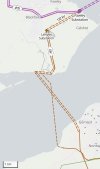
As someone with relatives on the island and who has travelled constantly backwards and forwards regularly since the 1960s, a rail tunnel would be a complete non-starter.
Hundreds of HGVs need to make the crossing daily, most of these being large trucks travelling to the supermarkets virtually every hour of the day with essential supplies. Add to this the fuel tankers for replenishing the filling stations, brewery supplies for the pubs/hotels, stock for the DIY stores, car transporters delivering to the car dealerships and other general logistics, all of this traffic could not easily be carried by rail without prohibitively expensive transshipment for final delivery.
About half the islanders are not receptive to the idea of a fixed link, but if it were to happen only a road link could be useful and viable.
The issue with a road link is the billions it would cost in getting to and from the actual cruising point.
Yes a rail link would be harder to deliver freight, however with the current high cost of getting to the island the normal complications which typically stop rail being viable potentially go out the window.
As I said you could, for not much more than getting into and out of Portsmouth, get a High Speed rail link to the Isle of Wight.
Yes you'd need a strain box (which is costly) however you could make it one track wider than needed and run a freight train into that "platform". It should be possible to load/unload 3 trains a day.
Once there it could sit there whilst it's unloaded. There would be options as to to how that could work, however doing containers could be a fairly simple way of doing it. Where there's a need for smaller loads there's the potential to use cages loaded into a coach (see the sort of mail trains which have been used recently), this could be part of the freight train or a section behind the drivers cab on a passenger train.
Ferries would likely still exist, just fewer of them. However, you could run a Eurotunnel (car only) type service on an hourly basis times a day if you wanted to be able to totally replace a lot of the need for the ferries.
An hourly service carrying 75 cars at a time (single deck trucks) would give you about 1/3 (circa 1,100) of the peak summer capacity of the ferries (3,000 cars) compared with a road which could more than easily transport 8,000 cars a day. As such, you wouldn't materially change the capacity to get to/from the island and so the island wouldn't see a massive uplift in traffic congestion. Especially as such a car crossing wouldn't likely be much different from the ferry crossing (Eurotunnel return starts at £120 and whilst it could be cheaper, as the cost to build the Channel Tunnel was significant, it's not going to start a price war with very cheap tickets).
The thing which could alter significantly is the number of people, however just because a train with hundreds of seats calls at a station doesn't mean that many people will have to get on or off when the train is serving other places.
As it would be between Southampton and Portsmouth it would make getting to/from there much easier (and far, far easier to/from a load of other places) however other than next to the station, most of the rest of the island probably wouldn't really change that much.
The capacity on the trains would mostly be used to by people travelling between London and the various towns and cities along the south coast rather than each train taking 1,000 people to/from the island (most likely each train would be less than 50) and so wouldn't actually alter the numbers by very much.
However, rather than it costing £15 plus the train ticket to get to London (in round numbers an anytime return appears to be £53 to Portsmouth and £58 to Southampton) it could be basically included within the train ticket.
Based on the above, that would mean an anytime ticket could be £55 to London. That's likely to be enough to stop too many people from using the service, however does then mean that someone doing a day trip could have an extra £15 each to spend when they're on the island without changing their total costs.
The need to take a car on/off the island for residents reduces significantly, as the time saving from driving to (say) Andover (random town without a direct train from Southampton) which is 2 hours by train from Southampton compared to 45 minutes by car. However, by the time you're allowed for the ferry crossing (45 minutes) and loading and unloading (30 minutes) you're already at the same journey time.
Cost wise, station to station the train would likely be around £30 per person for anytime travel. At £80 for a return crossing on the car ferry, basically that's likely to be a comparable cost for up to 3 people.
If you're not saving time (and Andover is awkward to get to from Southampton, so for most other places the train would likely be much faster) and the cost is similar (unless you're a group of more than 3 and/or going a fairly long way and/or going somewhere some distance from a public transport hub) the need to take your car on or off the island reduces (for clarification, I'm not saying no one will, just that the need to do so reduces).
Yes you'd get more people commuting to/from the island, however mostly that's going to be limited to those fairly close to the station (in the same way that is the case for those who use the ferries currently).
The thing is, even if that were to be proposed tomorrow, it would likely be at least 30 years away from actually happening and so not that many people living on the island (basically only those under 40) would see an impact even within their working lifetime (as change beyond when you're working tends to have a lower impact on you) with many of them likely not to be significantly impacted (especially if they more away from the island) and quite a few wouldn't even see it within their actual lifetime (change tends to impact you the most whilst you're alive).