• Our new ticketing site is now live! Using either this or the original site (both powered by TrainSplit) helps support the running of the forum with every ticket purchase! Find out more and ask any questions/give us feedback in this thread!

The term "Idlers" used on historical rail warning signs.

Status
Not open for further replies.
Sponsor Post - registered members do not see these adverts; click here to register, or click here to log in
R

RailUK Forums

Merle Haggard

Established Member
Joined
20 Oct 2019
Messages
3,850
Location
Northampton
There are modern signs giving the impression of being aged - one I've seen is on plastic but headed 'L&NWR'. They use terms like 'idlers' and other pejorative terms and presumably are intended as amusing signs around the house.

Although I collect, to a limited extent, cast-iron signs from the L.N.W.R. and as a result go to auctions and sales where a great variety of pre-group signs are on display I have never seen a genuine, old, cast iron sign with the wording portrayed on these spoof signs. Certainly never 'idlers'.
 

Gloster

Veteran Member
Joined
4 Sep 2020
Messages
12,940
Location
Up the creek
I think that it generally referred to a tramp, vagrant or similar, but in the railway sense meant someone who had no reason to be on railway premises. The obvious suspicion to the Victorian mind was that such a person would be likely to commit a crime and therefore the railway ensured that it had powers to deal with such people even before they did anything that was actually illegal.
 

alxndr

Established Member
Joined
3 Apr 2015
Messages
1,672
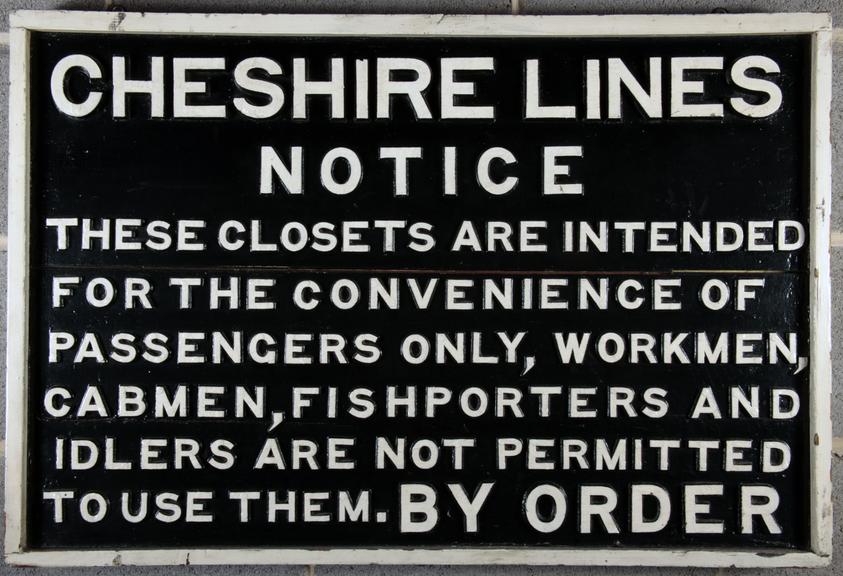
There is one such sign apparently at the National Railway Museum, according to the Science Museum Group website, which suggests it might be a genuine article.

medium_df110030.jpg

[Sign reads: Cheshire Lines. Notice. These closets are intended for the convenience of passengers only, workmen, cabmen, fishporters and idlers are not permitted to use them. By order.]
 

John Luxton

Established Member
Joined
23 Nov 2014
Messages
2,035
Location
Liverpool
There is one such sign apparently at the National Railway Museum, according to the Science Museum Group website, which suggests it might be a genuine article.

medium_df110030.jpg

[Sign reads: Cheshire Lines. Notice. These closets are intended for the convenience of passengers only, workmen, cabmen, fishporters and idlers are not permitted to use them. By order.]
There is a slight problem with that sign particularly is if the the workman has travelled to work by train - at what point might he cease to be a passenger? :D
 

Mcr Warrior

Veteran Member
Joined
8 Jan 2009
Messages
17,151
I think that it generally referred to a tramp, vagrant or similar, but in the railway sense meant someone who had no reason to be on railway premises.
Had always thought that an 'idler' was more likely to have just been a loafer or slacker, i.e. someone who avoids work, passing their time away in a generally unproductive and 'do nothing' way.
 

Gloster

Veteran Member
Joined
4 Sep 2020
Messages
12,940
Location
Up the creek
Had always thought than an 'idler' was more likely to have just been a loafer or slacker, i.e. someone who avoids work, passing their time away in a generally unproductive and 'do nothing' way.

That seems to be the most common meaning of the word, both now and in the past, but it had other meanings. One now archaic use was a member of a ship’s crew who did not stand night watches as they worked right through the day.
 

Oxfordblues

Member
Joined
22 Dec 2013
Messages
1,114
A similar term is "loitering" which can be a criminal offence. Or it could be a resident of the Yorkshire town of Idle, near Shipley.
 

Merle Haggard

Established Member
Joined
20 Oct 2019
Messages
3,850
Location
Northampton
There is one such sign apparently at the National Railway Museum, according to the Science Museum Group website, which suggests it might be a genuine article.

medium_df110030.jpg

[Sign reads: Cheshire Lines. Notice. These closets are intended for the convenience of passengers only, workmen, cabmen, fishporters and idlers are not permitted to use them. By order.]

An interesting sign, and on the face of it unlikely that NRM would exhibit a replica. It seems to be made of wood, looking at the corner joints in the border, and no visible screw holes for mounting to a wall or post.

However, the usual heading for CLC notices was either CHESHIRE LINES RLY - 'LY' underlined, or CHESHIRE LINES CEE. - 'EE' underlined. 'CEE ' being an abbreviation of 'Committee'. Other CLC cast-iron notices had rounded corners. Fishporters - against, say, parcels porters, is also an interesting possibility on the CLC..
 

Snow1964

Established Member
Joined
7 Oct 2019
Messages
11,015
Location
West Wiltshire
Idlers as a navy term, was completely different to common use term, where it generally meant a person without working shifts, so would be hanging around or loitering.

Seems town squares, markets, etc were generally where they would hang out. I suppose those who hang around town shopping centres without looking for work are modern equivalent
 

6Gman

Established Member
Joined
1 May 2012
Messages
9,183
An interesting sign, and on the face of it unlikely that NRM would exhibit a replica. It seems to be made of wood, looking at the corner joints in the border, and no visible screw holes for mounting to a wall or post.

However, the usual heading for CLC notices was either CHESHIRE LINES RLY - 'LY' underlined, or CHESHIRE LINES CEE. - 'EE' underlined. 'CEE ' being an abbreviation of 'Committee'. Other CLC cast-iron notices had rounded corners. Fishporters - against, say, parcels porters, is also an interesting possibility on the CLC..
And the punctuation seems incorrect (which would be noticed then in a way it probably wouldn't in 2026). Shouldn't there be a full stop after the "only"?
 

DelW

Established Member
Joined
15 Jan 2015
Messages
5,934
These notices remind me of 1960's school reports: "This boy will likely turn out a wastrel and ne'er-do-well".

I remember a school song, from many decades ago, which included the line "here's no place for fop or idler".

I have no idea whether such a line still features in these more 'inclusive' times, or even whether such a thing as a school song still exists. It seems to have a flavour of the Molesworth era to me (older readers will hopefully recognise the reference).
 

D1537

Established Member
Joined
11 Jul 2019
Messages
2,027
Location
North Yorkshire
I believe "idler" in this context at that time always had a negative connotation, as in being a person of ill repute.
 

Gloster

Veteran Member
Joined
4 Sep 2020
Messages
12,940
Location
Up the creek
And the punctuation seems incorrect (which would be noticed then in a way it probably wouldn't in 2026). Shouldn't there be a full stop after the "only"?

A full stop or a semi-colon could be used after ’only’ as a comma is a bit too vague. I suspect that the Victorians would have preferred the peremptory full stop rather than the more nuanced semi-colon.
 

urbophile

Established Member
Joined
26 Nov 2015
Messages
2,472
Location
Liverpool
An interesting sign, and on the face of it unlikely that NRM would exhibit a replica. It seems to be made of wood, looking at the corner joints in the border, and no visible screw holes for mounting to a wall or post.

However, the usual heading for CLC notices was either CHESHIRE LINES RLY - 'LY' underlined, or CHESHIRE LINES CEE. - 'EE' underlined. 'CEE ' being an abbreviation of 'Committee'. Other CLC cast-iron notices had rounded corners. Fishporters - against, say, parcels porters, is also an interesting possibility on the CLC..
I suspect that 19th century railway companies had not adopted a standardised house style, or corporate graphics identity, unlike today. (Even now there are many examples of non-standard styling).
 

Spartacus

Established Member
Joined
25 Aug 2009
Messages
3,806
As well as the typical slackers, layabouts, beggars etc it would encompass peddlers of various goods as well as prostitutes and their touts. if the closets were of the water variety, i.e. WCs, i imagine keeping the latter out, as well as any potential robbers or even molesters would have been a high priority.
 

Merle Haggard

Established Member
Joined
20 Oct 2019
Messages
3,850
Location
Northampton
I suspect that 19th century railway companies had not adopted a standardised house style, or corporate graphics identity, unlike today. (Even now there are many examples of non-standard styling).

The 'By Order' suggests that the notice is intended to have legal force and this would require the legal or registered name of the organisation being the one quoted. The railway companies in Victorian times were very keen, when giving notice or warning, to quote the relevant statute (8 VIC CAP 20, SEC 75 or the LNWR Consolidation Act 1883 being used by the LNWR and, in the first case, others) which required the name used in legislation to be quoted. As an aside, it was a bit of a bluff - the Acts concerned merely aggregated together all the individual Acts that had accumulated over the years since the start of the railways. But I would be interested to hear of any Acts that included the word 'Idlers' - or, indeed 'skylarking' which also appears on some signs of interesting origin.

I am glad that Hebden Bridge railway station is a very good example of where old Lancashire and Yorkshire Railway wooden platform signs can still be seen.

I've noticed those. Around here, the London Midland Region very efficiently removed all station signage dating back to before 1946 (including the then recent LMS 'Hawkseye' signs) and replaced them with maroon enamel. Similarly, the Eastern Region invaded Northamptonshire and for instance similarly replaced with dark blue enamel all the station signs on the Kettering - Cambridge line, such as the optimistically named 'Raunds' station, about 2 miles from the village of that name.
None escaped enamel - not even the ones (like Raunds) closed years before Beeching. So Hebden Bridge was very lucky.
 

WesternLancer

Veteran Member
Joined
12 Apr 2019
Messages
14,944
An interesting sign, and on the face of it unlikely that NRM would exhibit a replica. It seems to be made of wood, looking at the corner joints in the border, and no visible screw holes for mounting to a wall or post.

However, the usual heading for CLC notices was either CHESHIRE LINES RLY - 'LY' underlined, or CHESHIRE LINES CEE. - 'EE' underlined. 'CEE ' being an abbreviation of 'Committee'. Other CLC cast-iron notices had rounded corners. Fishporters - against, say, parcels porters, is also an interesting possibility on the CLC..
I’m pretty sure a replica or fake sign can be ruled out on this occasion.
 
Status
Not open for further replies.

Top