There would never have been money for it like that in the next spending review. Right now there is this fairly vague plan. There would still be multiple feasibility studies and design work before anything could be properly funded.Not much is guaranteed with current political and economic events!
Two weeks ago I'd have said that I'd expect there to be money for Oxford in the next spending review, in the same way that projects like Portishead and Collumpton/Wellington are going ahead in this spending review.
The Oxford Growth Commission and a Heyford New Town Development Corporation should be able to leverage in private sector funding too.

-
Our new ticketing site is now live! Using either this or the original site (both powered by TrainSplit) helps support the running of the forum with every ticket purchase! Find out more and ask any questions/give us feedback in this thread!
You are using an out of date browser. It may not display this or other websites correctly.
You should upgrade or use an alternative browser.
You should upgrade or use an alternative browser.
OxRail 2040 - plan from Oxfordshire County Council
- Thread starter 67018
- Start date
Sponsor Post - registered members do not see these adverts; click here to register, or click here to log in
R
RailUK Forums
https://www.modernrailways.com/article/extra-platform-oxford Is from before the work started, but talks about improving the crossovers to make it faster to get from P4 to the Marylebone line, and:I think it’ll be western pair and eastern pair - with some bidi services.
P5 for all through northbound Cotswolds / Banbury services
P4 will be for turning Padd fasts, maybe Bristol. Possibly A/B permissive for Banbury locals.
P3 XC South, Cotswolds through South, Chiltern to London
P2 Chiltern to Cowley (or both ways)
P1 all EWR
Or similar
The latter option would have Marylebone-bound trains using P4.A review of plans for restoration of a passenger service to Cowley is looking at four-tracking from Oxford to Kennington Junction, where the Cowley branch diverges from the main line. ‘We’re trying to identify the minimum that is required to get to Cowley’ says Mr Nash. ‘It might be a third track with Cowley trains running along the east side of the formation, or it might be four tracks with northbound trains crossing over the layout at Kennington Junction.
I don’t see that you’d add another platform face to add capacity, then try and cram another 4tph onto P3 which moves the bottleneck there.
Falcon1200
Established Member
just because it's not happening, doesn't mean it can't be policy at the same time!!
They can have all the policies they like, and great of course for politicians (of all hues and at all levels) to spout off about, but until backed up with finance, and spades are in the ground, they are basically hot air!
(As was my 'policy' to be a progressive rock guitar god 45 years ago.....having some musical talent would have helped with that)
67018
Member
On the other hand, everything that does get done usually starts as a policy. If you don't have the policy, the money and the action don't happen. You've got to start somewhere.They can have all the policies they like, and great of course for politicians (of all hues and at all levels) to spout off about, but until backed up with finance, and spades are in the ground, they are basically hot air!
(As was my 'policy' to be a progressive rock guitar god 45 years ago.....having some musical talent would have helped with that)
Does it make sense for a local authority to have a policy if they typically don’t have the powers or finances to ever actually deliver it?On the other hand, everything that does get done usually starts as a policy. If you don't have the policy, the money and the action don't happen. You've got to start somewhere.
But fair enough, everything needs to be heading towards a stated agreed vision that they can point to for a rationale.
Yes, they can ask central government for funding.Does it make sense for a local authority to have a policy if they typically don’t have the powers or finances to ever actually deliver it?
Falcon1200
Established Member
Yes, they can ask central government for funding.
We await with interest the response!
I have been fortunate to see the Down Relief between Oxford North and Wolvercote Junction reinstated, having watched this line being lifted (with the aid of one of the PWM shunters) in the early 1970s, but I'm not sure I will be around to see 4 tracks between Oxford and Didcot, or Oxford and Radley.
Historically, in two tier local authority areas, the upper tier authority is responsible for transport. In this case that's Oxfordshire, so they need a local transport policy. Where that has included rail, it has historically been a shopping list where they can negotiate with central government either at spending reviews or with departments for shares of pots of money that those departments have been allocated.
However, things are changing. The Oxford Cambridge growth corridor and housebuilding (including new towns) are key parts of central government policy. Oxford has a Growth Commission and Heyford is on the New Towns Taskforce list of recommended sites. Both of these offer new funding options, including third party finance.
Local government reorganisation is also happening and, once established, local transport strategy will be a mayor's responsibility.
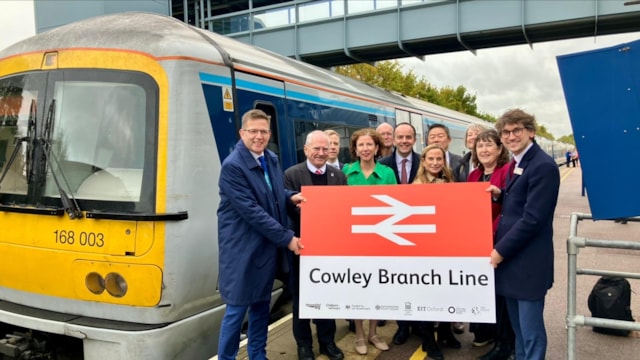
Things are happening. The Cowley branch is part of phase 1 of the policy. It already has a business case and detailed design is about to start, see here:
 www.networkrailmediacentre.co.uk
Given its potential impact on economic growth in Oxford, I'd be very surprised if this does not get funded.
Looking at the proposed new stations, if Begbroke is a "plain vanilla" new station, with no alterations to track or signalling, then it should be possible to get that started as part of the next spending review allocations. I'd expect Ardley to be tied up in New Towns policy and at the mercy of the timetable for that.
However, things are changing. The Oxford Cambridge growth corridor and housebuilding (including new towns) are key parts of central government policy. Oxford has a Growth Commission and Heyford is on the New Towns Taskforce list of recommended sites. Both of these offer new funding options, including third party finance.
Local government reorganisation is also happening and, once established, local transport strategy will be a mayor's responsibility.
Things are happening. The Cowley branch is part of phase 1 of the policy. It already has a business case and detailed design is about to start, see here:
Major boost for Oxford as Cowley rail line to reopen for passengers after more than 60 years
Oxford is set to benefit as the Cowley Branch Line is brought back into use for passenger trains, connecting Cowley and Littlemore with the rail network for the first time since 1963 to offer faster, greener travel options for thousands of residents and workers across the city.
www.networkrailmediacentre.co.uk
Oxford is set to benefit as the Cowley Branch Line is brought back into use for passenger trains, connecting Cowley and Littlemore with the rail network for the first time since 1963 to offer faster, greener travel options for thousands of residents and workers across the city.
Network Rail’s Western route managing director Marcus Jones was joined today (Thursday 23rd October) by James Murray MP, Chief Secretary to HM Treasury, and Lord Hendy, Minister of State for Rail, to announce funding for the much-anticipated return of passenger trains to the Cowley Branch Line.
When services resume, journeys from Cowley to Oxford station will take just nine minutes, opening up direct access to London, the south west and beyond. Two brand-new stations at Oxford Cowley and Oxford Littlemore will put employers at Oxford Science Park and Oxford Business Park directly on the rail map.
The line, which currently operates for freight, will undergo a range of upgrades to prepare it for passenger use. These include significant improvements to the single-track section, enhancements to the wider network south of Oxford and modernisation of existing level crossings.
The Full Business Case, which was completed in July 2025, determined that the branch line could be reopened in 2029, pending commencement of the detailed design in early 2026. Network Rail is working closely with the DfT and funding partners to recommence development work and confirm key project milestones.
Given its potential impact on economic growth in Oxford, I'd be very surprised if this does not get funded.
Looking at the proposed new stations, if Begbroke is a "plain vanilla" new station, with no alterations to track or signalling, then it should be possible to get that started as part of the next spending review allocations. I'd expect Ardley to be tied up in New Towns policy and at the mercy of the timetable for that.

Or at the very least start the ball rolling - and even if only a fraction of what you want gets done, it’s usually better than nothingYes, they can ask central government for funding.
fishwomp
Established Member
To be honest, government(s) need to do a better job at saying "no", and in particular avoid the current response which is "yes and {here's chump change to go and do another study}/{keep funding someone to do more work on the proposal}"We await with interest the response!
It's just free easy good press coverage to say 'yes', to projects that you know you don't need to fund the 'big ticket' bit of until after the next election.
That’s all very well, but it presupposes that the people being told “no” take “no” for an answer.To be honest, government(s) need to do a better job at saying "no", and in particular avoid the current response which is "yes and {here's chump change to go and do another study}/{keep funding someone to do more work on the proposal}"
It's just free easy good press coverage to say 'yes', to projects that you know you don't need to fund the 'big ticket' bit of until after the next election.
There seems to be a lot of 'activity' in producing unfunded 'plans' in the hope that the 'magic money tree' might be shaken.
And there's a lot of 'vanity projects 'bidding for votes whenever the next election hoves into view.
Government doesn't help by periodically seeking 'bids' for this or that great sounding 'initiative'.
Where has the 'pipeline' of 'committed' projects got to?
Magdalia's recent post (#218) shows something of the 'complexity' of changes, clients, controls, etc to be wrestled with, worked through, whatever. Who actually decides anything? A lot of digital pens and paper to be pushed ...
And there's a lot of 'vanity projects 'bidding for votes whenever the next election hoves into view.
Government doesn't help by periodically seeking 'bids' for this or that great sounding 'initiative'.
Where has the 'pipeline' of 'committed' projects got to?
Magdalia's recent post (#218) shows something of the 'complexity' of changes, clients, controls, etc to be wrestled with, worked through, whatever. Who actually decides anything? A lot of digital pens and paper to be pushed ...

AlastairFraser
Established Member
- Joined
- 12 Aug 2018
- Messages
- 4,160
Perhaps a tram train would be better, continuing past central Abingdon to a Drayton P&R near the A34 and a tram leaving the railway near Oxford station to serve the city centre and maybe through to JR Hospital.I don't see a line to Abingdon ever being restored - For a start, how would a train service operate, ie where would the capacity between Radley and (presumably) Oxford come from? Unless passengers were forced to change at Radley, as in the Good Old Days. There are multiple bus services between Abingdon and Oxford, via different routes serving the town and its various suburbs, and which run into Oxford city centre and in some cases beyond to the JR Hospital. I cannot see how a train from one location somewhere (where?) in Abingdon, at a lower frequency than the buses, and in Oxford (if they could even get there) only able to serve another single location, can be thought viable and better than the current public transport provision.
The biggest issue with buses is that the congestion into central Oxford makes them a slow and unreliable option, ditto with driving. A 3/4 track railway Abingdon junction into Oxford wouldn't be terribly hard to deliver either.
Falcon1200
Established Member
A 3/4 track railway Abingdon junction into Oxford wouldn't be terribly hard to deliver either.
At what cost?!! And to what real benefit?
It would be hard to deliver. Getting 4 tracks between Cambridge and Shepreth Branch Junction was proposed as part of Cambridge South, but dropped on cost grounds. Now East West Rail are having another go. Have a look at their consultations to get some idea of what would be required.A 3/4 track railway Abingdon junction into Oxford wouldn't be terribly hard to deliver either.
fishwomp
Established Member
Well.. it could be really hard - or even impossible as Brunel shuffled off this mortal coil too long ago.. [https://culhamticketoffice.co.uk/bits/lost1.html][on the 3/4 track from Abingdon Jct to Oxford]
At what cost?!! And to what real benefit?
Now, arguably, one of the bridges only lasted 175 years (Culham viaduct) but it's holding up well. Also, as originally a broad gauge line, a 3rd line wouldn't need quite as much land take as if it were not..In 1842 approval was given to the Oxford Railway Company for a branch line between Didcot and Oxford. Finance was provided by the GWR which absorbed the company by amalgamation enacted by the Great Western Railway Act of 10th May 1844. This line, built to the broad gauge of 7' 0¼", was opened after just nine months of construction on 12th June 1844. It was converted to standard gauge (4' 8½") in November 1872. The engineer in charge of the Didcot to Oxford branch was Isambard Kingdom Brunel and many of the bridges and station buildings were designed by him, including Culham. Interestingly, with the notable exception of those at Culham, all the original station buildings on the line (Didcot, Appleford and Oxford) were of timber construction. The contractor for the line was William Chadwick who had been responsible for the building of the famous railway bridge at Maidenhead.
More seriously though, the case for 4 tracks south of Oxford is weaker now that there are 4 tracks heading north with the Port Meadow loops. Shame they didn't extend quite as far as the single lead junction from the Worcester line
Falcon1200
Established Member
Shame they didn't extend quite as far as the single lead junction from the Worcester line
I agree! The Down Relief connecting into the Worcester Single Line would have allowed trains to wait there, and proceed, while the Down Banbury direction ran unimpeded.
On what planet would Heyford station be of any value in this, considering what is planned for the completed version of Heyford Park? It is at the bottom of a road that winds down through the western end of Lower Heyford village and is wedged in next to the canal, with a couple of dozen parking spaces, so not exactly Parkway material.The proposed Ardley station will be a good one to fast track. It is situated close to Heyford Park where there will be 1000s of new houses and being on Chiltern line to Bicester and London gives passengers plenty of destinations. It's a shame the current Heyford station which is a few miles away on the Banbury to Oxford line has so few services and hasn't been factored some how to serve the new development.
Oh, I don't know, perhaps get all the Southampton container trains out of the way of passenger trains for a rather longer distance than just between Oxford station and Wolvercote.At what cost?!! And to what real benefit?
As I'm sure you know, the quadruple track formation from the 1940s (created to offer an urgent capacity boost in the area without the cost of new Thames bridges in Oxford and alongside Nuneham/Culham viaduct) is in place all the way from Hinksey North to Radley - plus a widened formation on the west side between Radley and the old Abingdon branch junction. It's not like you would be starting from scratch and needing to get consents, buy land, etc.
Swindon to Kemble redoubling was an unfunded plan that had been worked up by Network Rail with support from FGW. Then some money became available from the Government and the plan became a reality.There seems to be a lot of 'activity' in producing unfunded 'plans' in the hope that the 'magic money tree' might be shaken.
No plan = no chance of funding.
AlastairFraser
Established Member
- Joined
- 12 Aug 2018
- Messages
- 4,160
As someone else has mentioned, you get a lot of goods services out of the way of passenger services for a long way, and you could take thousands of cars off the A34 that don't really have a viable option into Oxford at the current time (Didcot Parkway is a trek from most of Abingdon, and there's a lot of large villages out to the west that could reach a tram-train park and ride somewhere close to Drayton).At what cost?!! And to what real benefit?
The formation is already mostly there as discussed below, and unlike Cambridge, there's still quite a bit of land available close to the city as well; the pattern of urban development in the Oxford metropolitan area is quite odd (I think the former county boundary around Grandpont and then Botley/Cumnor plays a part).It would be hard to deliver. Getting 4 tracks between Cambridge and Shepreth Branch Junction was proposed as part of Cambridge South, but dropped on cost grounds. Now East West Rail are having another go. Have a look at their consultations to get some idea of what would be required.
Precisely, you'd make fitting the Cowley services in much easier too (which could be part of a second tram train route eventually that heads for Eynsham and Witney, it's not all that far at all and the old Witney alignment doesn't really need high speed running on the branch).Oh, I don't know, perhaps get all the Southampton container trains out of the way of passenger trains for a rather longer distance than just between Oxford station and Wolvercote.
As I'm sure you know, the quadruple track formation from the 1940s (created to offer an urgent capacity boost in the area without the cost of new Thames bridges in Oxford and alongside Nuneham/Culham viaduct) is in place all the way from Hinksey North to Radley - plus a widened formation on the west side between Radley and the old Abingdon branch junction. It's not like you would be starting from scratch and needing to get consents, buy land, etc.
Land is not an issue for Shepreth Branch Junction-Cambridge. Through Cambridge South station is already 4 tacks, Cambridge side of Long Road bridge is 3 tracks and was 4 tracks until the 1970s. Any new land take south of Long Road is almost all agricultural land. Getting the land is only a small part of widening to 4 tracks. As I said before, look at some Cambridge South and East West Rail consultation documents to see that widening to 4 tracks is not simple.unlike Cambridge, there's still quite a bit of land available close to the city
Last edited:
Falcon1200
Established Member
Interesting points being made! The formation between Radley (north of the overbridge at the station) and Hinksey North was indeed once quadruple track, although not for long; 4-tracked during WW2 but mostly back to 2, certainly before 1971 when my Oxford area trainspotting started.
I question how beneficial 'goods services would be got out of the way of passenger services' would actually be; The days of 25mph unfitted freights, and 55mph MGR coal trains, have gone, the majority now being 75 mph freightliners. Would being shunted to the Relief line between Radley North and Wolvercote Junction while an express or two overtook really be worth the huge expense? Although improvements certainly could be made, and in some cases are, ie Platform 5 at Oxford.
I question how beneficial 'goods services would be got out of the way of passenger services' would actually be; The days of 25mph unfitted freights, and 55mph MGR coal trains, have gone, the majority now being 75 mph freightliners. Would being shunted to the Relief line between Radley North and Wolvercote Junction while an express or two overtook really be worth the huge expense? Although improvements certainly could be made, and in some cases are, ie Platform 5 at Oxford.
fishwomp
Established Member
Without the 4-track of a bridge over the Isis south of the station, it'd be a waste. The separation enables fasts and slows of passengers, not just freight. Who hasn't sat behind an ex-Didcot stopper all the way to Oxford. Indeed, the freights and the non-stop passengers might be more likely to share the fast lines - as you say, 75 mph freightliners!I question how beneficial 'goods services would be got out of the way of passenger services' would actually be; The days of 25mph unfitted freights, and 55mph MGR coal trains, have gone, the majority now being 75 mph freightliners. Would being shunted to the Relief line between Radley North and Wolvercote Junction while an express or two overtook really be worth the huge expense? Although improvements certainly could be made, and in some cases are, ie Platform 5 at Oxford.
The current relief north of Oxford does help to path that long stretch north to Banbury - where the next (northbound) looping opportunity is frequently taken - but beyond Wolvercote Junction and as far as Aynho Jct there are only two - occasionally three - passenger services per hour, compared to south of Oxford that has two stoppers and four fasts.
In the real world (I sign the route) that is incredibly optimistic. Driving the way GWR insist we drive, I reckon 6 minutes minimum with a 2 minute stop for station work. Of course on paper it may be possible in 5 minutes, just not realistic in practice. Whether or not the extra minute or so I'd add on makes any difference I don't know, though I fear we are set for a lot of extra stations on the Western, Wantage, Corsham, Wellington, Cullompton etc, and this is inevitably going to further slow down intercity services to the west for a rather negligible benefit.
Does seem to be a huge penalty for stopping at a relatively minor station (which wouldn't need 2 minutes anyway - even busy stations like Woking got away with one-minute stops in the high peak). I always thought 3-4 mins was standard on an InterCity-type line (1 min penalty for deceleration, 1-2 mins stop, 1 min penalty for acceleration). Contrast much of the Southern Region seems to get away with a penalty of around 1.5 mins (at least they did in late BR days, going by old timetables).
I'm sure I've seen a 4-min penalty mentioned for the WCML in previous discussions (different stock admittedly).
I presume the IETs don't decelerate or accelerate particularly rapidly?
Compared with anything else GWR has / has had they certainly accelerate fast. Station approaches are crawls but that’s company policy rather than traction performance, I’m sure.I presume the IETs don't decelerate or accelerate particularly rapidly?
I think the poster you were replying to was being a bit pessimistic. The penalty for stopping at Didcot on the Bristol trains is 4 minutes. That said even that penalty and the important interchange for the North was not seen as worthwhile to retain 2tphDoes seem to be a huge penalty for stopping at a relatively minor station (which wouldn't need 2 minutes anyway - even busy stations like Woking got away with one-minute stops in the high peak). I always thought 3-4 mins was standard on an InterCity-type line (1 min penalty for deceleration, 1-2 mins stop, 1 min penalty for acceleration). Contrast much of the Southern Region seems to get away with a penalty of around 1.5 mins (at least they did in late BR days, going by old timetables).
I'm sure I've seen a 4-min penalty mentioned for the WCML in previous discussions (different stock admittedly).
I presume the IETs don't decelerate or accelerate particularly rapidly?
The Chancellor of the Exchequer delivered the Mais Lecture on Tuesday 17 March.

 www.gov.uk
Although the speech was quite widely covered in the media, it has only just come to my attention that it included an announcement that there will be a consultation on establishing a Greater Oxford Development Corporation.
A Greater Oxford Development Corporation transport strategy is likely to start with the OxRail2040 document.
Mais Lecture 2026
On 17 March 2026, the Chancellor Rachel Reeves gave the Mais lecture at Bayes Business School.
Speech
Mais Lecture 2026
On 17 March 2026, the Chancellor Rachel Reeves gave the Mais lecture at Bayes Business School.
Although the speech was quite widely covered in the media, it has only just come to my attention that it included an announcement that there will be a consultation on establishing a Greater Oxford Development Corporation.
But at the centre of our plans for regional growth are two critical regional growth corridors, already home to world-leading research institutions and dynamic firms.
First, we are backing the Oxford-to-Cambridge Growth Corridor to unleash the potential of our science and technology powerhouses, and the towns and cities between them:
Investing £2.5 billion in East-West Rail;
Fast-tracking new reservoirs, in Oxfordshire and Cambridgeshire;
Backing the expansion of Luton Airport…
And providing over £500 million for transport in Oxford, housing in Cambridge, and in a new Cambridge Innovation Hub.
We have already announced a consultation on a Development Corporation for Greater Cambridge – and I can today announce that we will consult on a Development Corporation for Greater Oxford too.
I am doubling the government’s initial £400 million commitment in Cambridge, making over £800 million available for upfront land acquisition and infrastructure to support these cities to grow.
In both corridors, I want to see deals done quickly,
But where landowners are intransigent, or insist on unreasonable demands, we are ready to acquire land using compulsory powers – either directly, or by standing by local leaders – and I have asked the Housing Secretary to crack on with the work needed to deploy these powers in parallel, so no time is wasted.
That’s a crucial pillar in our plan for investment and growth.
A Greater Oxford Development Corporation transport strategy is likely to start with the OxRail2040 document.
Does seem to be a huge penalty for stopping at a relatively minor station (which wouldn't need 2 minutes anyway - even busy stations like Woking got away with one-minute stops in the high peak). I always thought 3-4 mins was standard on an InterCity-type line (1 min penalty for deceleration, 1-2 mins stop, 1 min penalty for acceleration). Contrast much of the Southern Region seems to get away with a penalty of around 1.5 mins (at least they did in late BR days, going by old timetables).
I'm sure I've seen a 4-min penalty mentioned for the WCML in previous discussions (different stock admittedly).
I presume the IETs don't decelerate or accelerate particularly rapidly?
<Irish Rail> spoke of trains being slowed and calling for 'negigible benefit'. Fortunately (?) we elect politicians to represent us in deciding priorities, partly in response to those elected locally, eg Wellington, Reston, etc. How New Towns and residents arounf Oxford are right to expect their 'needs' to be responed to and respected. It's not all 'penalty' and not all 'gains' are negligible. Bring back the Wantage tramway?
AlastairFraser
Established Member
- Joined
- 12 Aug 2018
- Messages
- 4,160
Agricultural land in the railway's hands, or private? The situation is also different in Oxford because of the existing railway land at Hinksey yard in active railway useLand is not an issue for Shepreth Branch Junction-Cambridge. Through Cambridge South station is already 4 tacks, Cambridge side of Long Road bridge is 3 tracks and was 4 tracks until the 1970s. Any new land take south of Long Road is almost all agricultural land. Getting the land is only a small part of widening to 4 tracks. As I said before, look at some Cambridge South and East West Rail consultation documents to see that widening to 4 tracks is not simple.
Going to 4 tracks is a major construction project of which land required (both permanent and temporary) is only a part.Agricultural land in the railway's hands, or private? The situation is also different in Oxford because of the existing railway land at Hinksey yard in active railway use
Any 4 tracks construction project is still going to have to go through various planning hoops, including methods of construction, access to sites for bringing in raw materials and taking out waste, signalling changes, environmental impacts such as drainage and biodiversity etc.
It is those that make going to 4 tracks a challenge to deliver, not land.
AlastairFraser
Established Member
- Joined
- 12 Aug 2018
- Messages
- 4,160
It would certainly be a major undertaking, but an Oxford to Abingdon junction 4 tracking would have a far lesser impact than a Cambridge to Shepreth 4 tracking.Going to 4 tracks is a major construction project of which land required (both permanent and temporary) is only a part.
Any 4 tracks construction project is still going to have to go through various planning hoops, including methods of construction, access to sites for bringing in raw materials and taking out waste, signalling changes, environmental impacts such as drainage and biodiversity etc.
It is those that make going to 4 tracks a challenge to deliver, not land.
That is because there is existing track on a lot of the route, relevant access points already exist from major roads etc.
There's also a large currently unserved population in south Oxford and the Vale of White Horse district that would benefit from this upgrade, while the benefits with EWR are more distant, both in terms of areas benefitting and entry into service of new lines.