• Our new ticketing site is now live! Using either this or the original site (both powered by TrainSplit) helps support the running of the forum with every ticket purchase! Find out more and ask any questions/give us feedback in this thread!

Future of the 350/2s

Status
Not open for further replies.

Mamorin

Member
Joined
21 Sep 2020
Messages
469
Location
Cheshire
Rail Magazine is correct regarding 350/2 seating capacity being lower than 323s.

350/2s have 270 seats (246 Standard Class, 24 First Class)
323s have 277 seats.

Most of the Northern Network is set up as a 6 car Railway, so without SDO/ASDO the 350/2s can’t lengthen any services with Northern.
 
Sponsor Post - registered members do not see these adverts; click here to register, or click here to log in
R

RailUK Forums

amahy

Member
Joined
9 Dec 2024
Messages
497
Location
West Dunbartonshire
Rail Magazine is correct regarding 350/2 seating capacity being lower than 323s.

350/2s have 270 seats (246 Standard Class, 24 First Class)
323s have 277 seats.

Most of the Northern Network is set up as a 6 car Railway, so without SDO/ASDO the 350/2s can’t lengthen any services with Northern.
I disagree. There is easily demand for 8 cars on some Blackpool to Manchester Airport services. Also, many services currently operating as 3 or 6 cars woud be better suited as 4, such as Liverpool to Manchester Airport/Victoria, and Manchester Piccadilly to Stoke/Hadfield/Crewe (unless, in the case of Stoke and Hadfield, the service frequency was increased). In my opinion, it would also be better if all Leeds area electric services reverted to 4 car, as the 6 car diagrams are often short formed, and are overloaded at 3 car, but there is not demand for 6. It has been said by Northern guards in this forum before, that the busiest services on Airedale/Wharfedale seem busier than they actually are, and 4 cars is the perfect length, as everyone gets on at the front to get through the ticket barriers first at Leeds.
 

YorkshireBear

Established Member
Joined
23 Jul 2010
Messages
9,661
I disagree. There is easily demand for 8 cars on some Blackpool to Manchester Airport services. Also, many services currently operating as 3 or 6 cars woud be better suited as 4, such as Liverpool to Manchester Airport/Victoria, and Manchester Piccadilly to Stoke/Hadfield/Crewe (unless, in the case of Stoke and Hadfield, the service frequency was increased). In my opinion, it would also be better if all Leeds area electric services reverted to 4 car, as the 6 car diagrams are often short formed, and are overloaded at 3 car, but there is not demand for 6. It has been said by Northern guards in this forum before, that the busiest services on Airedale/Wharfedale seem busier than they actually are, and 4 cars is the perfect length, as everyone gets on at the front to get through the ticket barriers first at Leeds.
Mamorin wasn't talking about demand, he was talking about set up, i.e. platform lengths etc..
 

CJ

Member
Joined
18 May 2009
Messages
214
Location
Stockport
I personally don't see these 350s ever getting batteries, I think we have seen that changing old trains and adding new tech as far as battery traction goes with out it being installed from the start mostly leads to daily failures at least as far as the 769 saga goes.

The internal rumours at Northern still persist, Hadfield line releasing 323s for the all day Vic to Wigan via the WCML but whether this would be a micro fleet I don't know. The bonus of the Hadfield line is it has a Siemens depot attached to it directly already with 350 experience even if it was only a small number of units it could work.

If we look at which routes these units (/2 variants) have been tested on, they were:

- Manchester Airport - Liverpool Lime Street via Chat Moss
- Manchester - Stoke-on-Trent via Macclesfield
- Manchester - Crewe via Manchester Airport & Stockport
- Manchester - Hadfield via Guide Bridge/Glossop
- Manchester (Picc & Vic) - Bolton via Salford Crescent/Central

This should give us a clue/picture on which routes Northern maybe interested in deploying them on, should they indeed actually take them.

The question mark is, as you say, whether it would be a microfleet for just one of these routes or some/all. If all the above, then I don't imagine they would take the whole sub-fleet, perhaps maybe half at most, enough to cover the South Manchester services at least (like when Northern had 17 323s for South Manchester).
 

Halifaxlad

Established Member
Joined
5 Apr 2018
Messages
1,791
Location
The White Rose County
In the latest RAIL magazine I noted an article said 350/2s have fewer seats than 323s, despite having one extra carriage, so if they do move to Northern ideally they should be to lengthen/add services, rather than replace anything like 323s.
Dont forget that 323s have the controversial 3 +2 seating arrangement whilst the 350s have the more common 2+2
 

Geeves

Established Member
Joined
6 Jan 2009
Messages
2,615
Location
Rochdale
The 769s with Northern don't even have batteries...and they're still really unreliable!

Apologies I had batteries on the brain!

On the 8 car front...

There's quite a few issues with 8 cars locally around Manchester. I'm not 100 percent sure if Salford Crescent can fit them for example. All the recent platform extensions in the NW were for 6 cars so you'd have to go out again and extend them unfortunately
 

JonathanH

Veteran Member
Joined
29 May 2011
Messages
23,250
There's quite a few issues with 8 cars locally around Manchester. I'm not 100 percent sure if Salford Crescent can fit them for example. All the recent platform extensions in the NW were for 6 cars so you'd have to go out again and extend them unfortunately
I think that this should really be measured in metres rather than number of cars - eg extensions were made for 144m trains, rather than 160m ones. Whether those further 16 metres can be accommodated is the question.
 

Snow1964

Established Member
Joined
7 Oct 2019
Messages
11,015
Location
West Wiltshire
On the 8 car front...

There's quite a few issues with 8 cars locally around Manchester. I'm not 100 percent sure if Salford Crescent can fit them for example. All the recent platform extensions in the NW were for 6 cars so you'd have to go out again and extend them unfortunately
Be careful when comparing 6 x 23m =138m with 8 x 20m =160m, it is normal when specifying platform extensions to have minimum extra 5m length.

So almost certainly 7cars of 20m trains will fit in. But 8th will be too long.
 

Geeves

Established Member
Joined
6 Jan 2009
Messages
2,615
Location
Rochdale
Of course apologies gents. I should rephrase to simply say that 2x350 (160m thank you :)) will definitely not fit at various stations without some additional works.
 

Grumpy

Established Member
Joined
8 Nov 2010
Messages
1,311
Of course apologies gents. I should rephrase to simply say that 2x350 (160m thank you :)) will definitely not fit at various stations without some additional works.
Perhaps they should take the trailers out and insert these into 185’s and solve 2 problems
 

D365

Veteran Member
Joined
29 Jun 2012
Messages
13,155
Perhaps they should take the trailers out and insert these into 185’s and solve 2 problems
Who is 'they'? Porterbrook owns the Class 350/2s; Beacon Rail (Eversholt as was) owns the Class 185s.
 

Grumpy

Established Member
Joined
8 Nov 2010
Messages
1,311
Who is 'they'? Porterbrook owns the Class 350/2s; Beacon Rail (Eversholt as was) owns the Class 185s.
Both managements are probably incentivised to get the best returns on their investment. Porterbrook aren’t making any thing at present but taking a trailer out (if of course feasible) might make the 350s more nimble and able to achieve 323 timings. Sticking the trailer into some 185s (if feasible) might make the units more appealing to operators eg by reducing overcrowding on some services or by running a 4 car train if 2*3 cars is excessive.

== Doublepost prevention - post automatically merged: ==

Would it be unhelpful to point out that 185 (23.xx m) and 350 (20.xx m) have different carriage lengths?
Why would this be a problem?
 

WTT Gremlin

Member
Joined
1 Apr 2025
Messages
139
Location
Northampton
Why would this be a problem?
Because the resulting hybrid concoction would require completely new gauging and testing, the costs and complexity of both would render it dead long before any real consideration.

If one wanted a more logical (though equally unlikely to occur) option regarding 350 carriages, create 6 coach 350s/450s in the spirit of 458/460.

5 (possibly 6) coach 360s could have been an interesting prospect balancing service capacity, with utilisation of St Pancras (MML). Though now even more dead with the deletion of fizzy knitting (and other work in the Leicester Area - Wigston Triangle to Syston Triangle)

For the most left field of West of England Mainline take, there is the following logic rabbit warren (regarded as genius/nonsense/insanity; please delete as appropriate):
The 444s and 185s have similar 23.xx metre carriage lengths.
The 444s have Driving Motors sandwiching 3 Trailers.
185 have 3 carriages with individual power units.
So conduct a historically inspired reusing of traction equipment through a below the solebar transplant from 185 to the 444 Trailer carriages.
This would create a DC + Diesel Hydrokinetic Multiple Unit which we shall call a 771 to be vaguely correct, 7xx a multi-mode multiple unit, 47x being absent (spare) from the 4xx series and 4x1 as they would be express units. (Class 666 would feel more appropriate).
They would have ratings of 2000hp on DC, or 2250hp on Diesel, or 4250hp if One really wanted to escape Pizza Express in Woking.
Due to the added weight of 3 power packs the acceleration would be dented on DC, but acceleration isn't what the 444s are built for, demonstrated by being ~50% longer than a 450 with the same power.
Comparing our 771 to the current stalwarts of the West of England 'Main' Line (feels wrong calling it a 'Main' Line with single line stretches) the 159, (taking the more potent 1200hp 159/0).
On DC power/carriage is an equal 400hp, whilst on diesel the 771 is a 50hp boost. This should somewhat offset the higher overall mass, and would be a 100mph unit rather than 90mph.
This would increase the minimum train length (ignoring the 2-carriage 158s to be kind) by 75% from 68m to 119m.
The reduction from 750hp/carriage to 450hp/carriage mitigates the 'overpowered' nature of 158s when not climbing mountains.
Should minimise the amount of regauging required if the transplanted motive power fit within the envelope of a Driving Motor et scrabble tiles.
If the acceleration rate on DC is felt to be too great then Pizza Express in Woking mode could be used to compensate, whilst liberating fillings and perforating eardrums.
This would allow 159s to be cascaded onto other routes to strengthen/replace less Sprinters (those that are not a 158 or 159, which should already be razor blades).
The 'loss' of 444s from some Weymouth diagrams could be replaced with shoe equipped 350/2s as we know how much Portsmouth Direct Line passengers loved the 450s, lets not enable the passengers of Southampton, Bournemouth, Poole or Weymouth miss out on this 'much loved' experience.
Would remove the use of diesel over ~50.5 miles from Worting Jn.
A twin set would be 238 between London and Exeter which is decidedly comparable in length to a 236m 9 coach IET.
Should be more fuel efficient due to fewer engines (being optimistic that it is the one day all of the IETs engines are working).
Especially per/seat with twin 771 having around 10% higher seating capacity compared to a 9 carriage IET.
Unlike twin 5 carriage IETs twin 771 would have gangways between units enabling passengers to access working toilet facilities, find a seat, and be bothered by someone unaware trying to hide from a revenue team.

 

InTheEastMids

Established Member
Joined
31 Jan 2016
Messages
1,382
5 (possibly 6) coach 360s could have been an interesting prospect balancing service capacity, with utilisation of St Pancras (MML). Though now even more dead with the deletion of fizzy knitting (and other work in the Leicester Area - Wigston Triangle to Syston Triangle)
EMR have enough Cl360 to make every Connect service to Corby up to 240m so there's no need.

It's been done to death on here but if the idea is to have Connect services terminate at Leicester, my understanding it's quite a lot of faff and the only benefit is for a relatively small number of people that are put off by what is already a very efficient Connect <-> IC change at Kettering.

I think I've seen it said that you might have to delete one of if the IC services to Notts/Shef to free up capacity to do this, given current constraints between Kettering and Leicester
 

WTT Gremlin

Member
Joined
1 Apr 2025
Messages
139
Location
Northampton
EMR have enough Cl360 to make every Connect service to Corby up to 240m so there's no need.

It's been done to death on here but if the idea is to have Connect services terminate at Leicester, my understanding it's quite a lot of faff and the only benefit is for a relatively small number of people that are put off by what is already a very efficient Connect <-> IC change at Kettering.

I think I've seen it said that you might have to delete one of if the IC services to Notts/Shef to free up capacity to do this, given current constraints between Kettering and Leicester
Ignoring the matter of electrification, the current constraints between Kettering are Leicester are almost entirely in the Leicester area, and whilst many different concepts have been proposed and some receiving levels of development, as I am currently aware non have a realistic chance of delivery, hence that I referenced it.

On the matter of changing, whilst I happy changing, a significant passenger volume are not.

The main reason behind the idea was nothing to do with running 240m services to Corby, but much like the 810s to maximise occupation efficiency of half platforms at St Pancras given the 4 platforms are currently the least likely bottle neck to be resolved.

The MML (non-TL) for much of the next 40 years would likely see the best realisation of capacity by running as a 120m railway, with 240m when required. Whether that view ends up being close to the mark or not, the answer obviously isn't adding 350/2 carriages into the 360s.

Regarding removing services that would fundamentally depend on the desired service pattern, calling points, and balance between clockface and quantum. And lets not even go near the subject of Bedford.


PS. None of those options has more than a 0 chance of happening. The fate of the 350/2s is the razor blade factory if any of the railway scrap firms are still in business to dismantle them.
 

Grumpy

Established Member
Joined
8 Nov 2010
Messages
1,311
Because the resulting hybrid concoction would require completely new gauging and testing, the costs and complexity of both would render it dead long before any real consideration.
My recollection is that Siemens specifically designed the 350 to pass wherever the 319s could go. The 319s and 769s seem to be able to pass around the NW with no great restrictions . 350's were used extensively by TPE in the north, and still are by WMT. So whilst I am happy to concede that your knowledge of current regulations is better than mine, it seems barmy that completely new and costly gauging and testing would be necessary.
 

The Ham

Veteran Member
Joined
6 Jul 2012
Messages
12,021
Because the resulting hybrid concoction would require completely new gauging and testing, the costs and complexity of both would render it dead long before any real consideration.

If one wanted a more logical (though equally unlikely to occur) option regarding 350 carriages, create 6 coach 350s/450s in the spirit of 458/460.

5 (possibly 6) coach 360s could have been an interesting prospect balancing service capacity, with utilisation of St Pancras (MML). Though now even more dead with the deletion of fizzy knitting (and other work in the Leicester Area - Wigston Triangle to Syston Triangle)

For the most left field of West of England Mainline take, there is the following logic rabbit warren (regarded as genius/nonsense/insanity; please delete as appropriate):
The 444s and 185s have similar 23.xx metre carriage lengths.
The 444s have Driving Motors sandwiching 3 Trailers.
185 have 3 carriages with individual power units.
So conduct a historically inspired reusing of traction equipment through a below the solebar transplant from 185 to the 444 Trailer carriages.
This would create a DC + Diesel Hydrokinetic Multiple Unit which we shall call a 771 to be vaguely correct, 7xx a multi-mode multiple unit, 47x being absent (spare) from the 4xx series and 4x1 as they would be express units. (Class 666 would feel more appropriate).
They would have ratings of 2000hp on DC, or 2250hp on Diesel, or 4250hp if One really wanted to escape Pizza Express in Woking.
Due to the added weight of 3 power packs the acceleration would be dented on DC, but acceleration isn't what the 444s are built for, demonstrated by being ~50% longer than a 450 with the same power.
Comparing our 771 to the current stalwarts of the West of England 'Main' Line (feels wrong calling it a 'Main' Line with single line stretches) the 159, (taking the more potent 1200hp 159/0).
On DC power/carriage is an equal 400hp, whilst on diesel the 771 is a 50hp boost. This should somewhat offset the higher overall mass, and would be a 100mph unit rather than 90mph.
This would increase the minimum train length (ignoring the 2-carriage 158s to be kind) by 75% from 68m to 119m.
The reduction from 750hp/carriage to 450hp/carriage mitigates the 'overpowered' nature of 158s when not climbing mountains.
Should minimise the amount of regauging required if the transplanted motive power fit within the envelope of a Driving Motor et scrabble tiles.
If the acceleration rate on DC is felt to be too great then Pizza Express in Woking mode could be used to compensate, whilst liberating fillings and perforating eardrums.
This would allow 159s to be cascaded onto other routes to strengthen/replace less Sprinters (those that are not a 158 or 159, which should already be razor blades).
The 'loss' of 444s from some Weymouth diagrams could be replaced with shoe equipped 350/2s as we know how much Portsmouth Direct Line passengers loved the 450s, lets not enable the passengers of Southampton, Bournemouth, Poole or Weymouth miss out on this 'much loved' experience.
Would remove the use of diesel over ~50.5 miles from Worting Jn.
A twin set would be 238 between London and Exeter which is decidedly comparable in length to a 236m 9 coach IET.
Should be more fuel efficient due to fewer engines (being optimistic that it is the one day all of the IETs engines are working).
Especially per/seat with twin 771 having around 10% higher seating capacity compared to a 9 carriage IET.
Unlike twin 5 carriage IETs twin 771 would have gangways between units enabling passengers to access working toilet facilities, find a seat, and be bothered by someone unaware trying to hide from a revenue team.

I do wonder if you could add batteries to the 771's so they could have extra power draw when in 3rd rail to provide a bit more acceleration.

It would also (especially with regenerative braking) give the option of a bit of an electric boost when away from the third rail.

If you went for a fairly large battery, you could reduce the overall need for the use of diesel further when away from the third rail (for insurance you could get out of the platform on electric and then only fire up the diesel to get to line speed, so there's less diesel use where it's most likely to cause harm).
 

Harpo

Established Member
Joined
21 Aug 2024
Messages
3,731
Location
Newport
a relatively small number of people that are put off by what is already a very efficient Connect <-> IC change at Kettering.
Only efficient if you want Nottingham. If you want Derby/Sheffield, add a 2nd change, Leeds add a 3rd, start at a local MML station, add another. So rubbish in fact that journey planner often suggests Bedford passengers do an extra 100 mile detour via London and back (non-stop)!

A Leicester Connect would seriously help, not least by making the change at a connectional hub rather than a random junction.

All doubtless helping suppress demand on small IC trains though.
 

WTT Gremlin

Member
Joined
1 Apr 2025
Messages
139
Location
Northampton
I do wonder if you could add batteries to the 771's so they could have extra power draw when in 3rd rail to provide a bit more acceleration.

It would also (especially with regenerative braking) give the option of a bit of an electric boost when away from the third rail.

If you went for a fairly large battery, you could reduce the overall need for the use of diesel further when away from the third rail (for insurance you could get out of the platform on electric and then only fire up the diesel to get to line speed, so there's less diesel use where it's most likely to cause harm).
As a ‘plus’ option beyond the base recycled premise then absolutely.

In such an instance I think the best choice would be smaller batteries fundamentally there as receptacle for electrical energy generated under breaking. This would then be used to provide a boost during acceleration which is the most fuel hungry phase, therefore realising savings from a shorter time reaching steady state.

I think there would be a lack of space for, and limited value benefit from aiming too high re batteries this use case.
 

D365

Veteran Member
Joined
29 Jun 2012
Messages
13,155
Comparing our 771 to the current stalwarts of the West of England 'Main' Line (feels wrong calling it a 'Main' Line with single line stretches) the 159, (taking the more potent 1200hp 159/0).
On DC power/carriage is an equal 400hp, whilst on diesel the 771 is a 50hp boost. This should somewhat offset the higher overall mass, and would be a 100mph unit rather than 90mph.
This would increase the minimum train length (ignoring the 2-carriage 158s to be kind) by 75% from 68m to 119m.
The reduction from 750hp/carriage to 450hp/carriage mitigates the 'overpowered' nature of 158s when not climbing mountains.
Should minimise the amount of regauging required if the transplanted motive power fit within the envelope of a Driving Motor et scrabble tiles.
If the acceleration rate on DC is felt to be too great then Pizza Express in Woking mode could be used to compensate, whilst liberating fillings and perforating eardrums.
This would allow 159s to be cascaded onto other routes to strengthen/replace less Sprinters (those that are not a 158 or 159, which should already be razor blades).
The 'loss' of 444s from some Weymouth diagrams could be replaced with shoe equipped 350/2s as we know how much Portsmouth Direct Line passengers loved the 450s, lets not enable the passengers of Southampton, Bournemouth, Poole or Weymouth miss out on this 'much loved' experience.
Would remove the use of diesel over ~50.5 miles from Worting Jn.
A twin set would be 238 between London and Exeter which is decidedly comparable in length to a 236m 9 coach IET.
Should be more fuel efficient due to fewer engines (being optimistic that it is the one day all of the IETs engines are working).
Especially per/seat with twin 771 having around 10% higher seating capacity compared to a 9 carriage IET.
Unlike twin 5 carriage IETs twin 771 would have gangways between units enabling passengers to access working toilet facilities, find a seat, and be bothered by someone unaware trying to hide from a revenue team.
I do wonder if you could add batteries to the 771's so they could have extra power draw when in 3rd rail to provide a bit more acceleration.
What is a 771 and how is this applicable to the 37 Class 350/2 units?
 

WTT Gremlin

Member
Joined
1 Apr 2025
Messages
139
Location
Northampton
What is a 771 and how is this applicable to the 37 Class 350/2 units?
Well... if you read the post of mine which you have quoted... and you follow back up the quotation chain... you'd have the answer to both... indeed you only need step one of this, to answer part one of your question.
 

The Ham

Veteran Member
Joined
6 Jul 2012
Messages
12,021
What is a 771 and how is this applicable to the 37 Class 350/2 units?

The 771 is from here:
This would create a DC + Diesel Hydrokinetic Multiple Unit which we shall call a 771 to be vaguely correct, 7xx a multi-mode multiple unit, 47x being absent (spare) from the 4xx series and 4x1 as they would be express units.

From the same post, it suggests the 771's are a merging of the 185's into the 444's to run the WofE line services, that would mean that there would be a shortage of rolling stock and so the 350's would backfill for the 444's.

You'd likely need 20 class 444's for WofE services, and you'd ideally need slightly more than 1:1 to replace them, but even 20 would likely be enough (especially if other units could cover some 350/450 services).
 

XCTurbostar

Established Member
Joined
13 Sep 2014
Messages
2,467
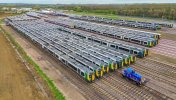
Saw this photo by Daniel Sandow on Facebook showing most of the fleet at Long Marston.

It certainly is sad seeing these sitting around these days.
 

Attachments

  • IMG_4974.jpeg
    IMG_4974.jpeg
    985.9 KB · Views: 309

InTheEastMids

Established Member
Joined
31 Jan 2016
Messages
1,382
Saw this photo by Daniel Sandow on Facebook showing most of the fleet at Long Marston.

It certainly is sad seeing these sitting around these days.
It certainly feels like quite an unusual situation for an entire fleet of (this number of) trains to all be visible in the same photo - I did count 37 units, which I think is all of them?
Looking on the bright side, it certainly makes trainspotting straightforward as you wouldn't need to worry about actually seeing any numbers, can just tick them all off ;)
 

Agent_Squash

Established Member
Joined
22 Jul 2016
Messages
1,271
String up some wires to Windermere, some tactical platform extensions between there and Manchester, and then run them via Wigan so you don't have to extend platforms at Bolton?

I'll get my coat...
 
Status
Not open for further replies.

Top