
-
Our new ticketing site is now live! Using either this or the original site (both powered by TrainSplit) helps support the running of the forum with every ticket purchase! Find out more and ask any questions/give us feedback in this thread!
You are using an out of date browser. It may not display this or other websites correctly.
You should upgrade or use an alternative browser.
You should upgrade or use an alternative browser.
Caledonian Sleeper
- Thread starter Essexman
- Start date
Sponsor Post - registered members do not see these adverts; click here to register, or click here to log in
R
RailUK Forums
Was over the bogie in the end of the cabins. Was pretty rough.Ride quality was appalling, far worse than I recall from previous trips.
Same for the cabin. Very difficult to maintain a consistent temperature through the night.The onboard temperature was too cold.
Just think ourselves lucky he stopped at five.At Edinburgh they appeared to be doing some (very loud) tests for the speakers on the platforms. Good luck sleeping through that!
What made it slightly more disconcerting was they bumped hard but continued going, to set back into the platform i believe (from the talk I gleaned on the radio). Didn't even really stop, I don't recall, after initial contact.The shunting on this particular occasion was... Not gentle. The Inverness portion announced its arrival with the biggest jolt I've ever had during any shunting move - and I was expecting it. I dread to think what "normal" passengers thought had happened...
For what it's worth i was very nearly in land of nod shortly after arriving at Edinburgh.
Falcon1200
Established Member
I'm pretty sure I read somewhere in a previous post (or maybe it was on the news), that re-timing a train ultra-last minute doesn't wash as far as consumer rights are concerned, and this wouldn't negate compensation rules?
The timetable has to be amended by 2200 the previous day for it to become the next day's booked service, and therefore presumably avoid Delay Repay claims. Personally I was never happy with this and always thought the cut-off should be 2200 two days before, ie Monday night for Wednesday's service, not Tuesday's, therefore ensuring that all passengers were fully aware of the change. This was regardless of whether I requested the change due to a Network Rail issue, or it was the Train Operator.
The timetable has to be amended by 2200 the previous day for it to become the next day's booked service, and therefore presumably avoid Delay Repay claims. Personally I was never happy with this and always thought the cut-off should be 2200 two days before, ie Monday night for Wednesday's service, not Tuesday's, therefore ensuring that all passengers were fully aware of the change. This was regardless of whether I requested the change due to a Network Rail issue, or it was the Train Operator.
The operator should still honour the original times to a certain extent (see below). I think this changed when the railways became covered by the consumer rights act - though the reality of this is very much blurred. The 72 hour threshold seems reasonable, but as none of this is written in policy, it all exists in a bit of a grey area.
Proof of the pudding below, where the contributor claimed against a re-timed arrival:
Twice.
Delay Repay claimed and paid in full on one occasion.
On the other, if I recall correctly, CS emailed to apologise for the delay vs the originally-booked arrival time and advise that compensation would be credited to the original payment method before I’d had chance to claim.
Both occasions Highlander arriving Fort William with amended schedule loaded the previous evening.
Others’ experiences may of course be different.
I know the engines in the neo range are meant to be a bit more efficient, but these numbers seem a bit low compared to the research that the BBC highlighted a few years ago:

Climate change: Should you fly, drive or take the train?
How should you travel to reduce your carbon footprint?www.bbc.co.uk
You've got 47 kg per passenger, for a 694 km flight -> 70 g / passenger km, which is half of what the research shows is emitted in domestic flights, and that's before the secondary emissions are included, which the train won't have any of.
Not saying you're wrong, but if you had any equivalent research to give some backing to your numbers I'd be interested in seeing it. I totally accept that the neo engines might have made a massive jump in efficiency
I used a fuel burn calculator for jet fuel for the flight concerned with an A320neo. Clearly it is an estimate and there will be a range.
The story you linked to is quite helpful to explain further, and supports my educated guesses. It is describing averages for domestic aviation 7 years ago. There is much higher use of more efficient aircraft since then, especially by easyjet who have many more of the efficient A320neos, and retiring the much less efficient per psssenger A319s. Also a flight from Luton to Inverness (or Aberdeen) will be more efficient than almost any other domestic flight in fuel burn per passenger km due to it’s length, meaning that the ‘fixed’ fuel for a flight (essentially that on the ground, the ascent and any holding before landing) is a) smaller than a flight involving Heathrow or Gatwick and b) spread over more km.
If you go into the article there is a link to an older BBC piece which compares airlines, and shows that easyjet were ‘on track’ to have the lowest emissions per passenger km in Europe in 2020 at around 80g/ passenger km. Since then, as above, they have deployed more efficient aircraft (on average).
Luton to Inverness will be shorter than easyjet’s average flight, increasing the average emissions per passenger km, but not a lot. But use of an A320neo - as was used on this morning’s flight - will bring that back down into the region of 70-80g.
In this example I think it is important to use more specific numbers than averages that are spread over many different airlines, aircraft and routes, as the sleeper servces only a very few specific routes.
Hope this helps explain my thinking.
Last edited:

The cut off should be the day tickets go on sale.The timetable has to be amended by 2200 the previous day for it to become the next day's booked service, and therefore presumably avoid Delay Repay claims. Personally I was never happy with this and always thought the cut-off should be 2200 two days before, ie Monday night for Wednesday's service, not Tuesday's, therefore ensuring that all passengers were fully aware of the change. This was regardless of whether I requested the change due to a Network Rail issue, or it was the Train Operator.
SuspectUsual
Established Member
- Joined
- 11 Jul 2018
- Messages
- 6,858
The cut off should be the day tickets go on sale.
Well that’s just unreasonable isn’t it? CS have a ticket selling horizon of over a year don’t they?
Bletchleyite
Veteran Member
Well that’s just unreasonable isn’t it? CS have a ticket selling horizon of over a year don’t they?
New thread:
How far ahead should trains be on sale?
From the Caledonian Sleeper thread: Well that’s just unreasonable isn’t it? CS have a ticket selling horizon of over a year don’t they? It's one problem with having such a nonsensically long sales horizon. Trains (whether Sleeper or not) are not planes, there is no need to have them on...
 www.railforums.co.uk
I’m sorry, but if I book a ticket for a specific train that is due to arrive in London at (say) 06.30, I expect it to arrive for 06.30. I accept tfat there will be times when it won’t but also that I will be recompensed for being provided with something other than what I paid for. It makes no difference whether I bought that ticket 5 minutes before boarding the train or five months. If CS want some buffer here, then they can advertise the time up till which people can remain in their berths on arrival (if that’s still a thing) as the arrival time.Well that’s just unreasonable isn’t it? CS have a ticket selling horizon of over a year don’t they?

VT 390
Established Member
- Joined
- 7 Dec 2018
- Messages
- 1,755
The cut off should be the day tickets go on sale.
Well that’s just unreasonable isn’t it? CS have a ticket selling horizon of over a year don’t they?
For Caledonian Sleeper specifically I think its reasonable for amendments to be made up to the usual timescale for confirmation of things like planned engineering works, provided they notify you at the time of booking this may happen.I’m sorry, but if I book a ticket for a specific train that is due to arrive in London at (say) 06.30, I expect it to arrive for 06.30. I accept tfat there will be times when it won’t but also that I will be recompensed for being provided with something other than what I paid for. It makes no difference whether I bought that ticket 5 minutes before boarding the train or five months. If CS want some buffer here, then they can advertise the time up till which people can remain in their berths on arrival (if that’s still a thing) as the arrival time.
However I agree that once the timetable has been confirmed based on planned works any changes should not be made to the public timetable. In cases where they must change the timetable it still should not affect delay repay, missed connections... liability.
For Caledonian Sleeper specifically I think its reasonable for amendments to be made up to the usual timescale for confirmation of things like planned engineering works, provided they notify you at the time of booking this may happen.
However I agree that once the timetable has been confirmed based on planned works any changes should not be made to the public timetable. In cases where they must change the timetable it still should not affect delay repay, missed connections... liability.
So typically ticket sales are 12-13 weeks out, which co-incides with the threshold for STP timetables to account for planned engineering - which comes together nicely for all other operators.
Standard conditions are that you are entitled to a full refund without admin fee if your train is delayed (even by a minute) against the timetable you booked. Notification of such a change 3 months out seems perfectly reasonable and gives customers chance to amend.
Notification 3 hours before departure, however, is a very different matter.
VT 390
Established Member
- Joined
- 7 Dec 2018
- Messages
- 1,755
I was referring to Caledonian Sleeper specifically for which you can usually book 1 year ahead.So typically ticket sales are 12-13 weeks out, which co-incides with the threshold for STP timetables to account for planned engineering - which comes together nicely for all other operators.
Completely agree with this as it lines with with most National Rail services for when you can usually be relatively certain of the confirmed timetable.Standard conditions are that you are entitled to a full refund without admin fee if your train is delayed (even by a minute) against the timetable you booked. Notification of such a change 3 months out seems perfectly reasonable and gives customers chance to amend.
As long as there is a message at the time of booking noting the times may change up to the 3 months ahead date, so those less familiar with the railway timescales know there may be changes, I don't see a problem with Caledonian Sleeper amending the schedule this far ahead.
I woukd agree that this is perfectly reasonable in terms of a minor amendment of deoarture or arrival time (especially on the sleeper) but not (for example) for a complete withdrawal of the service without reasonable alternative (that’s reasonable for the customer, by the way - possible for the operator).So typically ticket sales are 12-13 weeks out, which co-incides with the threshold for STP timetables to account for planned engineering - which comes together nicely for all other operators.
Standard conditions are that you are entitled to a full refund without admin fee if your train is delayed (even by a minute) against the timetable you booked. Notification of such a change 3 months out seems perfectly reasonable and gives customers chance to amend.
Notification 3 hours before departure, however, is a very different matter.
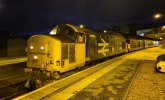
That isn’t going the help the CO2 emission figuresToday's (Wed 18th Feb) northbound Aberdeen portion has 37403 in charge

norbitonflyer
Established Member
If the FW service is becoming more popular than the Aberdeen, is there scope for having the through coach run on the West Highland and make the Aberdeen passengers change? More of an issue for seated passengers of course, but there may also be more berth travellers with cycles going to the Highlands than Aberdeen.I travelled from Dundee to Birmingham on Sunday evening in the seats. A few comments:
- The coach I was in was around half full arriving at Edinburgh, but once the Fort William passengers had boarded it was completely full
VT 390
Established Member
- Joined
- 7 Dec 2018
- Messages
- 1,755
I usually travel in a room but when I have used the seats on occasion the Aberdeen portion appears to have more stable year route seated passengers, of course this is just my experience but I have been on services where as few as 3 people appeared to switch carriages at Edinburgh going to Fort William where as I have noticed Aberdeen has similar numbers throughout the year.If the FW service is becoming more popular than the Aberdeen, is there scope for having the through coach run on the West Highland and make the Aberdeen passengers change? More of an issue for seated passengers of course, but there may also be more berth travellers with cycles going to the Highlands than Aberdeen.
They could alter the arrangement seasonally, like how the formation is reduced from 16 to 14 carriages in the winter but this is likely to be more confusing for passengers.
It is expensive, and I really wish the UK had more affordable sleeper services, especially to/from Scotland, but I don't think it's extortionate, it's just a luxury offering really.
Compared to car from Fort William it's not. By car is 500 miles each way, 10 hours driving each way assuming 50mph with stops, and two overnights in London. The lower Inland Revenue claim rate is 25p / mile so for the round trip which is £250. Then there is the small matter of where to park - I imagine a P&R somewhere in North London.
However a Zoom (etc.) meeting trumps all ways of getting to London.

Or the often-used rate of 45p/mi, meaning £450 round trip. Plus the potential parking costs etc yeah.Compared to car from Fort William it's not. By car is 500 miles each way, 10 hours driving each way assuming 50mph with stops, and two overnights in London. The lower Inland Revenue claim rate is 25p / mile so for the round trip which is £250. Then there is the small matter of where to park - I imagine a P&R somewhere in North London.
Yes I generally have reduced my work travel, both domestically and internationally, because we have finally got used to Teams calls etc.However a Zoom (etc.) meeting trumps all ways of getting to London.
There are however still some times where meeting in person is far better. With clients I tend to try and schedule all-day visits where the frequency of the visits is low, but we use the time wisely. I have run an 'e-conference' during COVID and it was nowhere near as impactful as an in-person conference run the year before.
With some of my clients, time spent face-to-face can increase productivity quite significantly. A lot of employers and clients are going from a WFH to a hybrid or a hybrid to a full-time onsite approach, so while Zoom/Teams meetings will always exist, I do think a large bit of business is returning to face-to-face. I would not have my current client if I insisted on remote-only and didn't see them in person for example, and it accounts for my full-time income.
Falcon1200
Established Member
The cut off should be the day tickets go on sale.
Which would mean that for any incidents lasting any length of time, which can be months as per the Lamington Viaduct and Dawlish sea wall, for example, timetables could not be amended and massive amounts of delay and cancellation would result, not to mention passengers being utterly misled.
No, the timetable can be amended - and the rights of those who have booked travel in good faith protected. I've some sympathy for NR in the case of Dawlish, but the RAIB report on Lamington didn't exactly make me think how hard done by NR were.Which would mean that for any incidents lasting any length of time, which can be months as per the Lamington Viaduct and Dawlish sea wall, for example, timetables could not be amended and massive amounts of delay and cancellation would result, not to mention passengers being utterly misled.

Tetragon213
Member
As a general rule where I worked, it was considered a bad idea to arrange an in-person 9am meeting unless you knew the other fellow was booking a hotel in town, or lived reasonably close by that getting in for 9 was manageable. 9:30 or 10am meetings were relatively standard.Realistically though hardly anyone does 9am meetings for people who are travelling a long way. 10:30 would get you there on day trains from most of the UK south of and including the Central Belt (the first day train to London from Edinburgh is slightly later than I thought it was), and most people will be reasonable in response to what is a very reasonable request or not even make the unreasonable request for a 9am meeting for someone with a four hour journey to start with!
If of course you're north of the Central Belt things are different, but most people aren't. That to be fair is why I've always felt the Highlander much more secure in the face of stuff like HS2 and electric aviation than the Lowlander. Like the Night Riviera, the Lowlander is only just a long enough journey to justify a Sleeper.
== Doublepost prevention - post automatically merged: ==
I think I've had 8am meetings probably single figures numbers of times in my whole career. Because most London based office workers commute, nobody likes getting in that early (and those that do tend to have a coffee and maybe breakfast in the office before wanting to have meetings). The culture is not like New York.
Booking an 8am meeting was typically considered poor form; it was something you just did not do unless it was desperately important. Similarly, booking a meeting after 3pm was considered unwise as a few people did 7-3, booking at 4 was guaranteed to make people angry as most people did 8-4, and anything even close to 5 o clock was likely to at best result in a lot of "Declined" messages, or at worst a very unhappy, very unproductive meeting wasting everyone's time.
Falcon1200
Established Member
No, the timetable can be amended
Not in the case of Lamington if the policy proposed in Post #18757 was adopted!
I read that post as referring to customer rights, not the ability to respond to an emergency.Not in the case of Lamington if the policy proposed in Post #18757 was adopted!
My company's travel booking site handily gives the CO2 emissions for alternative forms of travel, as we are incentivised to reduce carbon as well as cost:Those which numbers look suspiciously average for trains between Scotland and London, and not sleeper specific.
What follows is something I’ve done before, so forgive me for repeating myself and/or if the numbers are different this time.
An A320neo flying Luton to Inverness will burn about 3.5t of Kerosene from engines start up to engines shut down, producing around 8,000kg of CO2. On typical easyjet load factors that is split between around 170 passengers, so 47kg each.
The sleeper between Inverness and Edinburgh will burn, at an educated guess, around 500 gallons of diesel across both locos during the diagrammed duty (including any light loco runs, running round, shunting, trips to the sidings, and idling awaiting movement). That seems a lot of diesel but remember it is hauling a lot of train (including over 200t of loco!) away from multiple stops, and up two big climbs (plus a tiddler) which can’t be recovered in braking, plus have a big ‘hotel load’. 500 gallons of diesel is 5,765kg of CO2. On typical load factors on the Inverness portion of the sleeper, that is split between about 75 people in beds, plus another 20-30 in the seats. That’s 58kg each.
But if you take the view that one of the 8 coaches is carrying a quarter of the people, and weight the beds accordingly, that 58kg goes up to 67kg per passenger, and reduces the seats contribution to 29kg per passenger.
Of course there’s lots of assumptions in there, not least fuel consumption of a 66+73 combo, but it does seem plausible. And it doesn’t count the carbon emissions of the electric leg south of Edinburgh, which will be about another 1000kg CO2 based on average grid emissions, albeit split over more passengers for the complete train. Nor does it allow for shorter formations as and when they run.
London - Glasgow (Avanti) - 26.5kg
London - Glasgow (CS) -
The carbon calculator that my company uses for work trips says that Luton to Inverness is 121 kg of CO2 per passenger. We use this for all our sustainability reporting so I imagine there is some auditable science behind it.I know the engines in the neo range are meant to be a bit more efficient, but these numbers seem a bit low compared to the research that the BBC highlighted a few years ago:
Climate change: Should you fly, drive or take the train?
How should you travel to reduce your carbon footprint?
You've got 47 kg per passenger, for a 694 km flight -> 70 g / passenger km, which is half of what the research shows is emitted in domestic flights, and that's before the secondary emissions are included, which the train won't have any of.
Not saying you're wrong, but if you had any equivalent research to give some backing to your numbers I'd be interested in seeing it. I totally accept that the neo engines might have made a massive jump in efficiency
The carbon calculator that my company uses for work trips says that Luton to Inverness is 121 kg of CO2 per passenger. We use this for all our sustainability reporting so I imagine there is some auditable science behind it.
I would bet a handsome sum that the science behind it uses fairly broad averages for several factors. What i have attempted to do is unpick those averages to make it specific to the actual circumstances for London to Inverness.
philthetube
Established Member
- Joined
- 5 Jan 2016
- Messages
- 4,200
If this was the case, it would not take long before the booking window was reduced.I’m sorry, but if I book a ticket for a specific train that is due to arrive in London at (say) 06.30, I expect it to arrive for 06.30. I accept tfat there will be times when it won’t but also that I will be recompensed for being provided with something other than what I paid for. It makes no difference whether I bought that ticket 5 minutes before boarding the train or five months. If CS want some buffer here, then they can advertise the time up till which people can remain in their berths on arrival (if that’s still a thing) as the arrival time.
Falcon1200
Established Member
I read that post as referring to customer rights, not the ability to respond to an emergency.
I read it differently, but no worry.
this carbon calculator includes aircraft type (and has A320neo as an option):An A320neo flying Luton to Inverness will burn about 3.5t of Kerosene from engines start up to engines shut down, producing around 8,000kg of CO2. On typical easyjet load factors that is split between around 170 passengers, so 47kg each.
Offset your flight - atmosfair
 www.atmosfair.de
they say 145kg of carbon per passenger for Luton to Inverness (admittedly it's not clear if they assume full or "average" loading).
I can't find a free online calculator that allows you to specify all of
- aircraft type
- specific start/end airports (although even distance is probably good enough)
- loading

JohnMcL7
Member
- Joined
- 18 Apr 2018
- Messages
- 1,057
I'd also wonder if the calculators include the diesel locomotives idling at the station all day which I don't know if it's still happening but I noticed when passing through you can often hear the rumble of the 66 even well after they're rearranged the locos on the front. Aside from CO2 it's not a very clean engine either so it's constantly pumping out diesel particulates in the centre of Inverness.I would bet a handsome sum that the science behind it uses fairly broad averages for several factors. What i have attempted to do is unpick those averages to make it specific to the actual circumstances for London to Inverness.
norbitonflyer
Established Member
Just seen in RAIL magazine that it was welcomed into Birmingham International with a bagpiper. Bet that went down well with the people aleady on board who'd been asleep in bed for the past couple of hours!Looks like the northbound highlander was an hour late into Birmingham last night. Not a great start for its big day!
== Doublepost prevention - post automatically merged: ==
Still showing as 2130. It does make a difference as we will need to book an earlier ferry4th September will shortly move back to West Coast running leaving at 23.45 and arriving at 07.30 (give or take a few minutes)