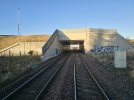
As can be seen, the clearances are good - as the bridge was only built just over 10 years ago. If there's an issue it's the fence protecting the drop, if that can be compliant let alone the height requirement.Is it an issue with clearance where the line passes under the city bypass?

-
Our new ticketing site is now live! Using either this or the original site (both powered by TrainSplit) helps support the running of the forum with every ticket purchase! Find out more and ask any questions/give us feedback in this thread!
You are using an out of date browser. It may not display this or other websites correctly.
You should upgrade or use an alternative browser.
You should upgrade or use an alternative browser.
Borders line (Scotland) electrification news and updates
- Thread starter snowball
- Start date
Sponsor Post - registered members do not see these adverts; click here to register, or click here to log in
R
RailUK Forums

The line was built on the cheap because lots of naysayers proclaimed it would be a white elephant, and for some reason they were listened to. The sections that were supposed to be double track were cut back significantly to single track.
As a prominent campaigner described it at the time, penny wise pound foolish. Construction costs never come down in the future.....
As a prominent campaigner described it at the time, penny wise pound foolish. Construction costs never come down in the future.....
Nicholas Lewis
Established Member
Given there paying for a full fat feeder station at Galshiels they might as well electrify the whole line and be done with. Then if they would take a some of the English EMUs that are stored they could have that service turned over to leccy before end od 2028.The borders railway was built with full electrification in mind, and there isn't any clearances that require intervention. Which is why it seems a bit stupid to not fully electrify down to the last station before the big desolate gap until Stow and Galashiels.

BorderCollie
Member
Never a truer word said.
But there's also a level boarding aspiration?
But there's also a level boarding aspiration?
The borders railway was built with full electrification in mind, and there isn't any clearances that require intervention. Which is why it seems a bit stupid to not fully electrify down to the last station before the big desolate gap until Stow and Galashiels.
Battery units perform best where there are short gaps between stations. Frequent acceleration / braking is perfect for them.
NotATrainspott
Established Member
- Joined
- 2 Feb 2013
- Messages
- 3,304
Given there paying for a full fat feeder station at Galshiels they might as well electrify the whole line and be done with. Then if they would take a some of the English EMUs that are stored they could have that service turned over to leccy before end od 2028.
There's not much point when extra EMUs around Edinburgh will need to run to Fife. If they did wire all of the way, then they'd probably end up using BEMUs totally under the wires. It's much more useful to keep adding new wired sections further north so that the BEMU fleet can get further, e.g. to Perth and Dundee.
Kingston Dan
Member
The issue with that is the single lead junction at Portobello east and two track approach to Waverley.Which'd also open up the possibility for having a 2tph Edinburgh-Gorebridge service operated with EMUs in addition to the existing 2tph Edinburgh-Tweedbank service which is planned to be operated by BEMUs

Presumably they have solved the problem with Galafoot Viaduct/Red Bridge (SBO/104). Also: there is a 132kV powerline that runs close to/by/under Tweedbank Station. Can we assume that this has been taken into consideration regarding the location of masts?

This is a detail taken from a screengrab of a video (not mine: my pictures were too indistinct/too far away) of a sign not far from the points at Tweedbank.
It reads
Danger
Location:
Tweedbank 520 points
Mileage: 35m 309yds
Service: Electrical & Telecoms
Number of Service Ducts: [illegible]
Depth below Rail Level 3090mm [?]
Emergency Contact Details … [etc]
I hope they don't bore a hole in the wrong place.
This is a detail taken from a screengrab of a video (not mine: my pictures were too indistinct/too far away) of a sign not far from the points at Tweedbank.
It reads
Danger
Location:
Tweedbank 520 points
Mileage: 35m 309yds
Service: Electrical & Telecoms
Number of Service Ducts: [illegible]
Depth below Rail Level 3090mm [?]
Emergency Contact Details … [etc]
I hope they don't bore a hole in the wrong place.
waverley47
Member
- Joined
- 17 Apr 2015
- Messages
- 857
The line was built on the cheap because lots of naysayers proclaimed it would be a white elephant, and for some reason they were listened to. The sections that were supposed to be double track were cut back significantly to single track.
As a prominent campaigner described it at the time, penny wise pound foolish. Construction costs never come down in the future.....
No, the line was built on the cheap because the BCR was basically a basket case. Even with optimism bias, we had to strip back a couple of elements from the project to get it through a change of government.
Remember that this was the test case, there wasn't any project before this to reference it against. The bill passed in 2008, and there had been several years of studies before that; I first got involved officially in 2003.
Larkhall was still being built when we were doing the final business case in 2005 for the bill, and that was a short electrified stub of a suburban network; the business case for that one was obvious. Same with the Paisley Canal line. It took over a year of negotiations after the Borders Line bill was passed before Airdrie to Bathgate even began building. It took four years after the bill was passed before a single spade hit the ground.
There wasn't another test case, nobody had any idea how the numbers would play out. No big new railway line had really been opened in the UK since the Robin Hood line in the 90s, although there had been the odd reintroduction of short stubs such as Bicester to Oxford. Nobody had decided to go and build anything more than 20 miles, especially not into the deepest darkest countryside.
When I did the original BCRs for the Borders line, we looked at everything. Thoroughly we looked at everything. We spent six months doing option shifting to see if we could figure out a way to justify anything beyond Galashiels. Even the half mile extension to Tweedbank had to be fought for tooth and nail, and that was basically justified on the basis of having space for a second terminating platform which could be used to hide a crippled unit in; the thought of charters was miles away.
We had to get everything through two changes of government, through different councils and through the absolutely awful relationship at the end with a couple of senior Edinburgh city councillors.
The deal we got was that every new piece of infrastructure could be built to double track width or with clearance for wires. But that meant payoffs in other ways, to keep the cost down and the BCR high enough that it didn't just get cancelled. There was a phenomenal amount of goodwill and political support behind it, but politicians are still politicians, and they're answerable to taxpayers.
There were economies, such as a lack of intermediate signal sections on the loops, and the same severe speed restrictions on the bridges down the Gala Valley. It was justified on the basis of 2tph all stops, and so the specification was the bare minimum needed to run that efficiently. Bits were chopped to save money to keep the project moving.
If we had argued for a double tracked, electrified line throughout, the thing would never have been built, or it would have been cancelled halfway. There were economies, and there were a lot of tradeoffs to get it over the line, but it's there, it's getting electrified, and it serves 2tph.
In retrospect, maybe we could have spent more money on it, but we didn't. But without spending the money that we spent, and saving the money we didn't, then it wouldn't have been built, and a decade and a half later, we wouldn't be able to use the line to justify further reopenings.
Last edited:
Good work by you and your team. Getting a line reopened with the bare minimum is the way to do it. Once open, improvements can follow later.
Okehampton is just a long siding from Crediton but, it was reopened. Now a new station is being added and there may be other improvements to come.
Get it open, that's the first priority.
Okehampton is just a long siding from Crediton but, it was reopened. Now a new station is being added and there may be other improvements to come.
Get it open, that's the first priority.
Falcon1200
Established Member
No, the line was built on the cheap because the BCR was basically a basket case. Even with optimism bias, we had to strip back a couple of elements from the project to get it through a change of government.
Yes indeed.
In retrospect, maybe we could have spent more money on it, but we didn't. But without spending the money that we spent, and saving the money we didn't, then it wouldn't have been built
We should be thankful that a line of such length was rebuilt at all, and what we have is suitable for a half-hourly train service; Will more than that ever be needed? For the reasons discussed at length, elsewhere, and many times over, the line is never going to be extended to Carlisle and become a diversionary route for the WCML.
zwk500
Veteran Member
Do they perform better than units under OLE where there are short gaps between stations?Battery units perform best where there are short gaps between stations. Frequent acceleration / braking is perfect for them.
philthetube
Established Member
- Joined
- 5 Jan 2016
- Messages
- 4,195
Change locations and most of this is also true of the docklands light railway, and probably many other projects throughout the world.No, the line was built on the cheap because the BCR was basically a basket case. Even with optimism bias, we had to strip back a couple of elements from the project to get it through a change of government.
Remember that this was the test case, there wasn't any project before this to reference it against. The bill passed in 2008, and there had been several years of studies before that; I first got involved officially in 2003.
Larkhall was still being built when we were doing the final business case in 2005 for the bill, and that was a short electrified stub of a suburban network; the business case for that one was obvious. Same with the Paisley Canal line. It took over a year of negotiations after the Borders Line bill was passed before Airdrie to Bathgate even began building. It took four years after the bill was passed before a single spade hit the ground.
There wasn't another test case, nobody had any idea how the numbers would play out. No big new railway line had really been opened in the UK since the Robin Hood line in the 90s, although there had been the odd reintroduction of short stubs such as Bicester to Oxford. Nobody had decided to go and build anything more than 20 miles, especially not into the deepest darkest countryside.
When I did the original BCRs for the Borders line, we looked at everything. Thoroughly we looked at everything. We spent six months doing option shifting to see if we could figure out a way to justify anything beyond Galashiels. Even the half mile extension to Tweedbank had to be fought for tooth and nail, and that was basically justified on the basis of having space for a second terminating platform which could be used to hide a crippled unit in; the thought of charters was miles away.
We had to get everything through two changes of government, through different councils and through the absolutely awful relationship at the end with a couple of senior Edinburgh city councillors.
The deal we got was that every new piece of infrastructure could be built to double track width and with clearance for wires. But that meant payoffs in other ways, to keep the cost down and the BCR high enough that it didn't just get cancelled. There was a phenomenal amount of goodwill and political support behind it, but politicians are still politicians, and they're answerable to taxpayers.
There were economies, such as a lack of intermediate signal sections on the loops, and the same severe speed restrictions on the bridges down the Gala Valley. It was justified on the basis of 2tph all stops, and so the specification was the bare minimum needed to run that efficiently. Bits were chopped to save money to keep the project moving.
If we had argued for a double tracked, electrified line throughout, the thing would never have been built, or it would have been cancelled halfway. There were economies, and there were a lot of tradeoffs to get it over the line, but it's there, it's getting electrified, and it serves 2tph.
In retrospect, maybe we could have spent more money on it, but we didn't. But without spending the money that we spent, and saving the money we didn't, then it wouldn't have been built, and a decade and a half later, we wouldn't be able to use the line to justify further reopenings.
Good work by you and your team. Getting a line reopened with the bare minimum is the way to do it. Once open, improvements can follow later.
Absolutely but it's important to make sure that doing that "bare minimum" doesn't then make it difficult to come back later and invest in upgrades/improvements (like electrification or double-tracking extra sections). Thankfully people like @waverley47 were able to save money in smart ways that got the project over the line and delivering something that is a massive boon to the area but without preventing future engineers from coming along and upgrading it further now that demand is proven and there is a case to spend more money on it.
waverley47
Member
- Joined
- 17 Apr 2015
- Messages
- 857
Do they perform better than units under OLE where there are short gaps between stations?
No, but they perform infinitely better than diesel stock does, especially on that long climb up to Falahill.
It's also important to reiterate; every new or altered structure was built to electrification clearances, but existing structures that were deemed to be fine were not, to save money. Remember the line speed is higher than it was in the 60s, the single track has been slewed to ease out some of the sharper curves.
@waverley47 Thanks for the in-depth reply. My initial response wasn't intended to be glib. I just recall some particular details that seemed to be penny pinching like longer single-track sections than originally planned and a number of overbridges and underbridges built to single-track width rather than allowing provision for easier double-tracking in future. But now that I think back, I do also remember people saying "it's better if it gets built like this rather than not at all."
I keep seeing mention of BEMUs - are we close to seeing any introduction of these on the UK network? I read some Class 777s on the Merseyrail network are going to be configured as BEMUs but is that it?
Probably not, but surely extending it to Hawick isn't an unreasonable aim?We should be thankful that a line of such length was rebuilt at all, and what we have is suitable for a half-hourly train service; Will more than that ever be needed? For the reasons discussed at length, elsewhere, and many times over, the line is never going to be extended to Carlisle and become a diversionary route for the WCML.
I keep seeing mention of BEMUs - are we close to seeing any introduction of these on the UK network? I read some Class 777s on the Merseyrail network are going to be configured as BEMUs but is that it?
Last edited:

They already are (777/1, IIRC). So far, other than GWR’s fast-charge testbed 230, that’s it.@waverley47 Thanks for the in-depth reply. My initial response wasn't intended to be glib. I just recall some particular details that seemed to be penny pinching like longer single-track sections than originally planned and a number of overbridges and underbridges built to single-track width rather than allowing provision for easier double-tracking in future. But now that I think back, I do also remember people saying "it's better if it gets built like this rather than not at all."
Probably not, but surely extending it to Hawick isn't an unreasonable aim?
I keep seeing mention of BEMUs - are we close to seeing any introduction of these on the UK network? I read some Class 777s on the Merseyrail network are going to be configured as BEMUs but is that it?
zwk500
Veteran Member
777s and 555s (Tyne and Wear Metro) are in service as BEMUs.I keep seeing mention of BEMUs - are we close to seeing any introduction of these on the UK network? I read some Class 777s on the Merseyrail network are going to be configured as BEMUs but is that it?
LNER and at least one other ECML toc have ordered BEMUs. Scotrail have ordered BEMUs.
Several other TOCs have talked about BEMUs as part of their future plans but not ordered yet I think.
Falcon1200
Established Member
Probably not, but surely extending it to Hawick isn't an unreasonable aim?
Yes, IMHO Hawick is at least worth examining. But no further!
Trainbike46
Established Member
Don't forget class 756 at TfW, which are also BEMUs if you're including trimodes (like the lner 897s and the new grand Central stock are)777s and 555s (Tyne and Wear Metro) are in service as BEMUs.
LNER and at least one other ECML toc have ordered BEMUs. Scotrail have ordered BEMUs.
Several other TOCs have talked about BEMUs as part of their future plans but not ordered yet I think.
ScotRail is currently going through the procurement process but hasn't, as far as I'm aware, placed the order yet
They already are (777/1, IIRC). So far, other than GWR’s fast-charge testbed 230, that’s it.
And the TfW 756s.
Do they perform better than units under OLE where there are short gaps between stations?
Depends what you mean by ‘perfrom’, but they are more efficient electricity-wise, as the battery is more likely to be receptive to charging during braking than the wires for regen, and there is less electrical gubbins to go through to make use of that recovered energy.

QueensCurve
Established Member
- Joined
- 22 Dec 2014
- Messages
- 2,203
I imagine asbestos from brakes might be an issue too.The new pollution from road vehicles is rubber from tyres
https://www.theguardian.com/environ...e-particle-pollution-than-exhausts-tests-show
I'm fairly certain that modern brake pads don't contain asbestos and anyway EVs largely use regenerative braking.I imagine asbestos from brakes might be an issue too.
I imagine asbestos from brakes might be an issue too.
Can you provide evidence of this?

GRALISTAIR
Established Member
The longest journeys start with the first step. I am so glad the railway got built. Add ons can come later.

Macwomble
Member
I imagine asbestos from brakes might be an issue too.
Asbestos hasn't been used for vehicle brake pads/shoes for many many years......it was banned a long time back (can't remember when though).
GRALISTAIR
Established Member
Well that would be nice also.Add ons like the Hawick extension.....

Hagbard Celine
Member
- Joined
- 30 Oct 2016
- Messages
- 100
None of the new or replacement bridges on single track sections were actually built to double track width.The deal we got was that every new piece of infrastructure could be built to double track width and with clearance for wires.
waverley47
Member
- Joined
- 17 Apr 2015
- Messages
- 857
None of the new or replacement bridges on single track sections were actually built to double track width.
Yep, that is my mistake, that was supposed to be or, not and. I've updated to reflect this.
Serves me right for typing that out at midnight.