
• Our new ticketing site is now live! Using either this or the original site (both powered by TrainSplit) helps support the running of the forum with every ticket purchase! Find out more and ask any questions/give us feedback in this thread!

Scottish ‘Red pebbles’

Status
Not open for further replies.

zackhally

Member
Joined
10 Aug 2015
Messages
23
Location
Glasgow
Hi all,
A very dull question today, however it’s something I’ve wondered about for quite a while now and have never sourced a full or factual answer!

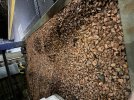
Across many, many stations in Scotland, including the WHL and the Central Belt, I have noticed that platforms always seem to incorporate these red pebbles/stones somewhere. Some platforms are made out of them entirely, and some, such as pictured at Alexandra Parade, are just “behind the scenes”. Does anyone know if there’s a reason for these red pebbles, and why they’re only present at Scotland. Is it anything to do with SPT being orange?

Thanks in advance, sorry it’s so dull!
 

Attachments

  • IMG_3584.jpeg
    IMG_3584.jpeg
    3.4 MB · Views: 504
Sponsor Post - registered members do not see these adverts; click here to register, or click here to log in
R

RailUK Forums

Carntyne

Member
Joined
8 Jul 2015
Messages
1,026
It's just the 'local' red granite from Cloburn quarry is it not? Same for the red ballast.
 

Steve Harris

Established Member
Joined
11 Dec 2016
Messages
1,204
Location
ECML
At a guess I would say it's something similar to why ballest is red in Sotland. (Which was a questioned asked on this very forum, the answer given IIRC was that it came from a quarry in Scotland and was a slightly different material to that found in England, hence the red colour).

I'm sure someone will correct me if I'm mis remembering the reason given.
 

RiverDon

On Moderation
Joined
11 Mar 2024
Messages
297
Location
UK
I think it's a general Scottish thing rather than specifically a railway thing. You don't see orange/pink chuckies very much down south in England but loads of houses, driveways, landscaping areas, parks etc... have them all over the country.
 

The exile

Established Member
Joined
31 Mar 2010
Messages
9,470
Location
Somerset
I think it's a general Scottish thing rather than specifically a railway thing. You don't see orange/pink chuckies very much down south in England but loads of houses, driveways, landscaping areas, parks etc... have them all over the country.
The shale mining in West Lothian left its legacy in lots of pinkish stone which ended up as chippings in pavements / road surfaces (IIRC). It was usually obvious when you crossed into West Lothian.
 

ajwffc

Member
Joined
30 Sep 2023
Messages
82
Location
Scotland
It definitely looks like red/pink ballast from Cloburn quarry just outside Lanark.

== Doublepost prevention - post automatically merged: ==

The shale mining in West Lothian left its legacy in lots of pinkish stone which ended up as chippings in pavements / road surfaces (IIRC). It was usually obvious when you crossed into West Lothian.
A lot of the footpaths in the refinery at Grangemouth was made using them when it was first made.
 

james73

Member
Joined
7 Jul 2009
Messages
85
Location
Glasgow
It's largely a West of Scotland thing. Walk around Glasgow and you'll see tons of red sandstone buildings. Walk around Edinburgh and you'll hardly see any. The hotel building of the former Princes Street station had the sandstone transported in from the West.
 

thejuggler

Established Member
Joined
8 Jan 2016
Messages
1,654
There isn't much limestone in Scotland, so they use what is readily available.
 

cats_five

Member
Joined
19 Sep 2021
Messages
276
Location
Scotland
It's largely a West of Scotland thing. Walk around Glasgow and you'll see tons of red sandstone buildings. Walk around Edinburgh and you'll hardly see any. The hotel building of the former Princes Street station had the sandstone transported in from the West.

Red granite chippings all over the place round here in East Scotland
 

norbitonflyer

Established Member
Joined
24 Mar 2020
Messages
5,831
Location
SW London
I read recently that many Scittish ststion platforms have gravel surfaces because they do not need gritting in icy weather.
 

Bletchleyite

Veteran Member
Joined
20 Oct 2014
Messages
113,805
Location
"Marston Vale mafia"
Still visible in terms of the ballast often being red too though.

It's curious that that isn't the case in other sandstone/red brick areas like Merseyside and south Lancashire, though. I guess the stone is sourced less locally there?

(You do get "ballast" on platforms elsewhere, albeit not in areas wheelchair users need to go, but I'd agree standard grey is a bit less visible!)
 

cats_five

Member
Joined
19 Sep 2021
Messages
276
Location
Scotland
It's largely a West of Scotland thing. Walk around Glasgow and you'll see tons of red sandstone buildings. Walk around Edinburgh and you'll hardly see any. The hotel building of the former Princes Street station had the sandstone transported in from the West.

Wouldn't sandstone be too soft for ballast?
 

AndrewE

Established Member
Joined
9 Nov 2015
Messages
7,365
[At least] 2 things are getting mixed up here.
As has been said, ballast in S Scotland is often the red igneous rock from Cloburn quarry, and very attractive it is too - and hard-wearing. It is not granite (whatever they claim) which has to contain quartz, feldspar and mica.
Building stones in the SW are mostly red sandstones, often from quarries west of Gretna jct. Edinburgh has sandstones of smilar age but in that area they are a pale yellow or buff.

Then there are the bings, mounds of oil shale waste which has been put through a still to get the paraffin from it. It might be sterile and relatively inert, but I imagine that it would be hopeless for anything other than compacting as a sub-base layer.
 

cats_five

Member
Joined
19 Sep 2021
Messages
276
Location
Scotland
[At least] 2 things are getting mixed up here.
As has been said, ballast in S Scotland is often the red igneous rock from Cloburn quarry, and very attractive it is too - and hard-wearing. It is not granite (whatever they claim) which has to contain quartz, feldspar and mica.
Building stones in the SW are mostly red sandstones, often from quarries west of Gretna jct. Edinburgh has sandstones of smilar age but in that area they are a pale yellow or buff.

Then there are the bings, mounds of oil shale waste which has been put through a still to get the paraffin from it. It might be sterile and relatively inert, but I imagine that it would be hopeless for anything other than compacting as a sub-base layer.

Most of the Cloburn products on it's website are called granite, but it was so badly behaved I couldn't click the link to something about railway ballast. Tried in another browser as well. However Google took me to a page of theirs which said:

"If you’ve travelled by train in the UK, there’s a good chance you’ve come across the red-coloured stone on the railroad tracks upon which the sleepers are nestled. That’s our famous Red granite rail ballast!"
 

Deepgreen

Established Member
Joined
12 Jun 2013
Messages
7,490
Location
Gomshall, Surrey
Now being replaced because they are unsuitable for persons with reduced mobility
Indeed - not much fun with a pushchair or wheeled suitcase! WHL stations have/had red granite ballast surfaces and are very non-slip as a result, but there are disadvantages!
 
Joined
28 Nov 2021
Messages
373
Location
Leith
[At least] 2 things are getting mixed up here.
As has been said, ballast in S Scotland is often the red igneous rock from Cloburn quarry, and very attractive it is too - and hard-wearing. It is not granite (whatever they claim) which has to contain quartz, feldspar and mica.
Building stones in the SW are mostly red sandstones, often from quarries west of Gretna jct. Edinburgh has sandstones of smilar age but in that area they are a pale yellow or buff.

Then there are the bings, mounds of oil shale waste which has been put through a still to get the paraffin from it. It might be sterile and relatively inert, but I imagine that it would be hopeless for anything other than compacting as a sub-base layer.

The latter is known as "red blaes", and may be what the OP has seen on platforms or walkways - not suitable as ballast. Traditional material for "all-weather" football pitches, but not good to fall on! See https://www.brewsterbros.com/products/shale-blaes/
 

BigB

Member
Joined
20 Dec 2018
Messages
344
Location
Scotland
Then there are the bings, mounds of oil shale waste which has been put through a still to get the paraffin from it. It might be sterile and relatively inert, but I imagine that it would be hopeless for anything other than compacting as a sub-base layer.
It’s not quite inert, it’s actually quite acidic when used as backfill where metal structures have been placed.
it was used to backfill several pipelines during the 60s/70s with the resulting corrosion being a major issue.

That said, most of the M8 and M9 was built on a bed of it, as it’s has almost no use other than substrate.
 

AndrewE

Established Member
Joined
9 Nov 2015
Messages
7,365
I would have thought that salt would not be a good idea around an electric layout.

I read somewhere that even at 12" to the foot, road salt on level crossings can interfere with track circuits.
BR once tried to get rock salt traffic from Winsford to Scotland. The trial run in wooden wagons (maybe ex-china clay wagons but not sheeted) was through very wet weather, and the drainage from the wagons shorted out the track circuits the whole length of the journey! It was never repeated...
 

route101

Veteran Member
Joined
16 May 2010
Messages
12,316
The shale mining in West Lothian left its legacy in lots of pinkish stone which ended up as chippings in pavements / road surfaces (IIRC). It was usually obvious when you crossed into West Lothian.
I notice some minor roads had or still have this red colour in South Lanarkshire.
 

QueensCurve

Established Member
Joined
22 Dec 2014
Messages
2,203
BR once tried to get rock salt traffic from Winsford to Scotland. The trial run in wooden wagons (maybe ex-china clay wagons but not sheeted) was through very wet weather, and the drainage from the wagons shorted out the track circuits the whole length of the journey! It was never repeated...
That rock salt train was my late father's contract. The railway didn't want to carry salt because it was so corrosive. The old man came up with the idea that it could be carried in old wagons which were already well corroded. The train left the Over and Wharton branch on a wet day. As each signal dropped back to danger behind the train it stopped that way. I think the train got as far as Carlisle before it was identified as the culprit.

A ruling came down that, if any further rock salt trains were to operated every wagon had to be sheeted. There may also have been a weather constraint. I went with the old man to Over and Wharton one Saturday to check the train was properly sheeted.
 
Status
Not open for further replies.

Top