Our new ticketing site is now live! Using either this or the original site (both powered by TrainSplit) helps support the running of the forum with every ticket purchase! Find out more and ask any questions/give us feedback in this thread!
We don’t know what the driver thought, all we know is the train was going faster than the PSR over the crossover.
If I had to speculate, I’d suggest that the driver has approached Hitchin on caution aspects, the signal has cleared to Green with the junction indicator roughly when the train was a couple of hundred yards away, and the driver has simply accelerated on “autopilot” seeing the green signal and “seeing but not seeing” the junction indicator, subconsciously assuming he was going the normal route. But that’s just my guess, it could be several other things.
It was established in earlier posts that this signal has a preliminary routeing indicator but is approach controlled from red for this particular route. So the PRI would never illuminate for this route. Seeing the PRI not illuminated doesn't really tell the driver anything, as it could also mean that one of the other routes is intended but hasn't been set yet.
Isn't the easier "different colour" approach to have the signal with the junction indicator show single yellow instead of green?
It's the same as the Peterborough incident, a sharp and unexpected 25mph turnout and the signal showing full green. In semaphore days, if such a starter had a distant on the post as well, would the distant be pulled off for a route over the twisting crossovers ...?
Having the train pass the signal to single yellow does create a hazard that the driver is accustomed to seeing it and then finding the next signal showing a proceed aspect.
A root cause of this and similar incidents is the vastly better acceleration of modern trains compared with those that existed when this signalling was designed. Clearly it's often possible for a driver to approach the signal at a speed appropriate to the approach control but then accelerate to an excessive speed once a less restrictive aspect is displayed. ETCS will address this for most of the places with recent incidents, but there must be other similar situations on other routes.
Having the train pass the signal to single yellow does create a hazard that the driver is accustomed to seeing it and then finding the next signal showing a proceed aspect.
Yes, that would be an anticipation hazard. I was going to say the same thing. The next branch signal protects a crossover for access from the up yard so there's a junction risk to consider.
A root cause of this and similar incidents is the vastly better acceleration of modern trains compared with those that existed when this signalling was designed. Clearly it's often possible for a driver to approach the signal at a speed appropriate to the approach control but then accelerate to an excessive speed once a less restrictive aspect is displayed. ETCS will address this for most of the places with recent incidents, but there must be other similar situations on other routes.
Fully agree. The 2012 Bletchley light engine derailment was also a case of stellar acceleration after seeing all the correct aspects and receiving the expected protection and warning system interactions.
The Hitchin incident also demonstrates the confusing implications of a fast train catching up a stopper and likely seeing previous signals clearing up or stepping up to a better aspect on approach. It may have felt to the driver like the train in front had merely cleared the forward block from the platform starter, as per all the previous signals from Stevenage after switching to the slow. Perhaps it would have been safer to divert 9S14 via the flat junction, keeping 1T20 on its scheduled path across the flyover, though the original line is actually shorter and faster than the flyover, once you get past the junction, that is. Looking at the real-time playback from Vail Data, see my previous post, there was a decent margin across the fasts at 9S14s departure.
Edit: We don't know how far ahead the route was set for 1B82 however, either by the signaller or ARS. The path may have already been locked for the fast across the junction at time of 9S14s departure, with the signaller unsure of how long the delay to the express would be. Sending the stopper via the flyover would still have been possible in this scenario, so may have been the swiftest way of clearing the down slow platform for the closely following 1T20, rather than cancelling the route, and perhaps waiting for approach locking to time out before being able to move the points (dependent on where exactly 1B82 had got to by that time). If ARS was active at the time, cancelling a signal manually would have switched off automation in the sub-area, with one such entity likely defined for all routes in the junction or station vicinity. A signaller may want to avoid that as it suddenly presents them with a lot more workload, manually setting routes for everything within the sub area until they are satisfied operations are back to normal and automation can be reenabled safely.
Further thought: If the route for 1B82 had been set across the junction, clearly that and the route from the previous down fast signal, whose overlap locks the junction too, were replaced before the route from slow to branch on the flat could have been set. The playback also shows that at the time 1T20 was passing through the junction, 1B82 was already on the move again and is seen pausing briefly at the signal south of Hitchin station, due to the overlap conflict.
== Doublepost prevention - post automatically merged: ==
On 11/11/25:
1B82 arrived 11L at Peterborough, 4L late by destination Lincoln.
This historic performance data site doesn't include passing times at intermediate places, so it isn't easy to pinpoint exactly where the extra minutes were accrued, especially for limited stop services. 1T20 must have made an unplanned stop somewhere soon after the speed incident, but it eventually arrived at its destination. Delays to the other trains were minimal.
All in all, a good real-time regulating response to the initial problems with 1B82, I think. ARS (if used) might have a built-in alternative routing strategy for overtaking via the slow at Stevenage, but it never cancels a set route automatically except after the train passes the signal normally, so if the path for 1B82 had been set across the junction at Hitchin and was cancelled to allow 1T20 across, the signaller must have done that manually.
That is certainly done on occasion - I've been on a fast Kings Lynn train which was caught on the Down Slow behind a stopping Cambridge train, steadily losing time; this was rectified by being sent over the flyover while the slower train was sent over the flat junction and was held at the next signal. I think I mentioned it somewhere on the forum as an example of good practice
That signal would originally have been a 3 aspect colour light with G - Y - R from top down and the route indicator directly above .. What we now appear to have is a search light type LED signal with the Aspect positioned where the old Red was and the route indicator at the same height as where the old route indicator was ..this creating a gap between Aspect and indicator so in some way breaking up the coordination ... This seems to be typical of how NR replace 3 or 4 Aspect signals with LED when a route indicator is involved ... I am not saying it is wrong but that is what they do .
As this was not a "ding ding" and away type incident then it would seem that the approach to the signal is not Fitted with TPWS which could be suppressed dependant on the route having been called at the signal ..
That signal would originally have been a 3 aspect colour light with G - Y - R from top down and the route indicator directly above .. What we now appear to have is a search light type LED signal with the Aspect positioned where the old Red was and the route indicator at the same height as where the old route indicator was ..this creating a gap between Aspect and indicator so in some way breaking up the coordination ... This seems to be typical of how NR replace 3 or 4 Aspect signals with LED when a route indicator is involved ... I am not saying it is wrong but that is what they do .
As this was not a "ding ding" and away type incident then it would seem that the approach to the signal is not Fitted with TPWS which could be suppressed dependant on the route having been called at the signal ..
There you go .. Seems when the 3 aspect colour light signal was replaced with single aspect LED search light the route indicator was repositioned .. Wonder if this was ever risk assessed taking into consideration the new height of the route indicator and station lighting under the canopy ?
As this was not a "ding ding" and away type incident then it would seem that the approach to the signal is not Fitted with TPWS which could be suppressed dependant on the route having been called at the signal ..
I am not sure how practical this would be for a route that is approach released from red. You would need to intermix the loops for the speed restriction with those for the signal.
It was always recognised that TPWS isn't a 100% solution, and can't catch all cases of over speeding.
== Doublepost prevention - post automatically merged: ==
Seems when the 3 aspect colour light signal was replaced with single aspect LED search light the route indicator was repositioned .. Wonder if this was ever risk assessed taking into consideration the new height of the route indicator and station lighting under the canopy ?
Any such change of profile should have been subject to signal sighting committee. However, any change to the platform lighting, such as changing them from bulbs to strip lights, may not have been considered unless someone (usually a driver) raised it as a problem.
I am not sure how practical this would be for a route that is approach released from red. You would need to intermix the loops for the speed restriction with those for the signal.
It was always recognised that TPWS isn't a 100% solution, and can't catch all cases of over speeding.
== Doublepost prevention - post automatically merged: ==
Except it isn't what you said.
Any such change of profile should have been subject to signal sighting committee. However, any change to the platform lighting, such as changing them from bulbs to strip lights, may not have been considered unless someone (usually a driver) raised it as a problem.
The whole situation has actually got quite complicated now at that signal on the Dn slow (and also on the Dn fast) for the driver, in that the driver knows they are going to Cambridge so they have to diverge, except now they could diverge to the left some distance past the signal at quite a high turnout speed or they could diverge to the right on a crossover that has a 25mph and is located immediately to the rear of the signal.
The risk here as I see it is not particularly a simple SPAD on that signal at Red as the cross over switches should be normal and locked if any diverging route to the right has not been called at Hitchin North Junction.
The risk as I see it is if the route has been called across Hitchin North Junction to either the Dn Fast or across the complete layout to Cambridge in that the cross over has gone reverse, the signal has approach released but the driver is going to fast for the 25mph cross over. That is why I mentioned TPWS with the distance between the antenna set for a speed thereabouts 25mph and the TPWS suppressed if the route called is not over the 25 mph cross over.
The difficulty is I think where to place the TPWS over speed trap. Place it to early and there is a risk of a TPWS activation despite the driver slowing so as to be at 25mph for the cross over or placed such that the TPWS intervention has not stopped the train in time from attempting to transverse the crossover in excess of the permitted speed.
Perhaps the diverging route to the left might be better served with Flashing Aspects and the approach release distance when the route has been called to the right shortened.
The whole situation has actually got quite complicated now at that signal on the Dn slow (and also on the Dn fast) for the driver, in that the driver knows they are going to Cambridge so they have to diverge, except now they could diverge to the left some distance past the signal at quite a high turnout speed or they could diverge to the right on a crossover that has a 25mph and is located immediately to the rear of the signal.
The risk here as I see it is not particularly a simple SPAD on that signal at Red as the cross over switches should be normal and locked if the route has not been called at Hitchin North Junction. The risk as I see it is if the route has been called across Hitchin North Junction to either the Dn Fast or across the complete layout to Cambridge in that the cross over has gone reverse, the signal has approach released but the driver is going to fast for the 25mph cross over .. That is why I mentioned TPWS with the distance between the antenna set for a speed thereabouts 25mph and the TPWS suppressed if the route called is not over the 25 mph cross over . The difficulty is I think where to place the TPWS over speed trap .. Place it to early and there is a risk of a TPWS activation despite the driver slowing for to be at 25mph for the cross over or place it such that the TPWS intervention has not stopped the train in time from attempting to transverse the crossover in excess of the permitted speed
While this may well be a solution at other places, and could have been a solution at Hitchin if fitted when the flyover opened, the impending implementation of ETCS at this location would render the change obsolete, possibly even before the switchable TPWS could be delivered.
However, as noted there are probably quite a few places where there is a high speed differential in the junctions and there is restricted sighting of the signals, and no immediate prospect of ETCS. Do switchable TPWS grids already exist around the network for this kind of route selection?
The difficulty is I think where to place the TPWS over speed trap .. Place it to early and there is a risk of a TPWS activation despite the driver slowing so as to be at 25mph for the cross over
I think a concern here is the loss of time for trains routed this way. But it must be realised that a train scheduled on the Down Fast line, approaching however on the Down Slow line, but nonstop at the platform, and then going right across the layout to the Cambridge branch, instead of the scheduled flyover route, is extremely unusual. I wonder if the driver had ever done it since the flyover was built. The odd occasions of time loss with more restrictive approach controls seem secondary.
I think a concern here is the loss of time for trains routed this way. But it must be realised that a train scheduled on the Down Fast line, approaching however on the Down Slow line, but nonstop at the platform, and then going right across the layout to the Cambridge branch, instead of the scheduled flyover route, is extremely unusual. I wonder if the driver had ever done it since the flyover was built. The odd occasions of time loss with more restrictive approach controls seem secondary.
A good point. Barring the overspeed incident, this entire episode would likely have been a good realtime regulating tactic given the circumstances and unknowns regarding 1B82.
While this may well be a solution at other places, and could have been a solution at Hitchin if fitted when the flyover opened, the impending implementation of ETCS at this location would render the change obsolete, possibly even before the switchable TPWS could be delivered.
However, as noted there are probably quite a few places where there is a high speed differential in the junctions and there is restricted sighting of the signals, and no immediate prospect of ETCS. Do switchable TPWS grids already exist around the network for this kind of route selection?
This location could be quite unique in that the same protecting signal offers diverging routes both left and right, but both go to the same destination; in this case, the Cambridge Branch.
The real issue could be driver confusion of turnout speed, dependent on if diverging left or right. Which may have been the issue with this overspeed, so flashing aspects to diverge to the left might be the solution...
Moderator note: further discussion on this point can be found at the following thread:
Moderator note: Split from https://www.railforums.co.uk/threads/overspeeding-at-cambridge-junction-hitchin-11-12-25.297268/ Having the train pass the signal to single yellow does create a hazard that the driver is accustomed to seeing it and then finding the next signal showing a proceed...
Edit: We don't know how far ahead the route was set for 1B82 however, either by the signaller or ARS. The path may have already been locked for the fast across the junction at time of 9S14s departure, with the signaller unsure of how long the delay to the express would be. Sending the stopper via the flyover would still have been possible in this scenario, so may have been the swiftest way of clearing the down slow platform for the closely following 1T20, rather than cancelling the route, and perhaps waiting for approach locking to time out before being able to move the points (dependent on where exactly 1B82 had got to by that time). If ARS was active at the time, cancelling a signal manually would have switched off automation in the sub-area, with one such entity likely defined for all routes in the junction or station vicinity. A signaller may want to avoid that as it suddenly presents them with a lot more workload, manually setting routes for everything within the sub area until they are satisfied operations are back to normal and automation can be reenabled safely.
Further thought: If the route for 1B82 had been set across the junction, clearly that and the route from the previous down fast signal, whose overlap locks the junction too, were replaced before the route from slow to branch on the flat could have been set. The playback also shows that at the time 1T20 was passing through the junction, 1B82 was already on the move again and is seen pausing briefly at the signal south of Hitchin station, due to the overlap conflict.
There's probably some other posts I can reply to as well but I've picked this one. Unfortunatly I don't display the aspects or routeing on Vail Data for this section, but looking through the historic signalling data that the Vail Data maps uses (but doesn't display as it's too time consuming to make detailed and accurate maps) I believe the following is true. It makes me strongly belive that ARS was off during these events, possibly it was turned off once 1B82 stopped out of course.
1B82 had it's route set all the way through Cambridge Jn (both 1483 and 1509) when departing Stevenage. The route set at these was cancelled at 10:32:16 and 10:31:59 respectively, after 1B82 came to a stop after leaving Stevenage.
After the passage of 9S14 over the flyover, 1T20 (off route of course on the slow lines instead of fast) had its route set at 10:38:00 for signal 1481 then 10:39:21 for 1507. It passed the signals at 10:38:30 and 10:39:59* respectively. Given these times, I would guess the train was being controlled ready to stop at 1507 until the driver saw it had stepped up. The rest is the acceleration of modern trains.
1B82 then started moving around 10:37 and had its route at 1483 set again at 10:40:30 (due to overlaps 1T20 had to clear Cambridge Jn before the route could be set). At 1509 it was set again at 10:41:35.
Please note the times here are based on when the signal aspect changed in the signalling data. This does not always line up with the actual time a train passes a signal due to first/last wheel repalcement or (some/all) of the signal's overlap being in the same track circuit as the approach to the signal. The 10:39:59 time with a * is particularly relevant as it seems that the signal aspect changes ~10-20 seconds after the berth step occurs for the flyover and remaining on the slow, but it changed at the same time as the berth step in this case. I have no idea if the signalling system can change how soon a signal is replaced (or berth stepped) depending on the route set, but this is the conclusion I've come to! I've checked against two other occasions when a train was routed from the slow avoiding the flyover (2C56 and 1T68 on the 12th December) and both times the berth step occured at the same time as the aspect changed.
Signal 1507 - Hitchin Down Slow
Signal 1509 - Hitchin Down Fast
Signal 1481 - Signal preceeding 1507 on the Down Slow
Signal 1483 - Signal preceeding 1483 on the Down Fast
Image shows an annotated screenshot from Vail Data of the relevant signals numbered
This is a screenshot from SimSig. Assuming the signalling is unchanged since the sim was made, I thought it might be helpful as it shows that the overlap after 1509 (look for the slighrtly larger "bump" to the left along the track line) is the other side of the points that would need to be moved to set a route from 1507 (DS) to Cambridge on the flat junction.
I have no idea if the signalling system can change how soon a signal is replaced (or berth stepped) depending on the route set, but this is the conclusion I've come to!
Different replacement conditions can be defined for each route from a signal, although it would not be usual for two main aspect routes from the same signal to be given different conditions. The condition that requires delayed replacement is commonly the track circuit joint too close to the signal, which obviously applies to all routes from that signal.
Description stepping is usually triggered by occupation of the first track section beyond the signal - different conditions could be specified for each route from a signal, but this is very rarely done.
The RAIB have now published their safety digest of this incident:
1. Important safety messages
This incident demonstrates the importance of:
drivers being aware of the need to maintain alertness when approaching junction signals, so that all the information the signal provides is acted upon
drivers not making assumptions about the route set ahead based on commonly set routes and their previous experience
route risk assessments identifying junctions where there is a significant speed reduction on the diverging route beyond the junction signal and making drivers aware of these locations
infrastructure managers and train operating companies recognising that there is a risk of overspeeding even when the point of divergence at the junction is very close to the junction signal.
2. Summary of the incident
At 10:39 on 11 December 2025, train reporting number 1T20, the 10:12 London King’s Cross to Ely service, operated by Great Northern, travelled at too high a speed across Cambridge Junction. The junction is located immediately north of Hitchin station in Hertfordshire. At this junction, trains travelling north on the East Coast Main Line (ECML) can diverge onto the line towards Cambridge.
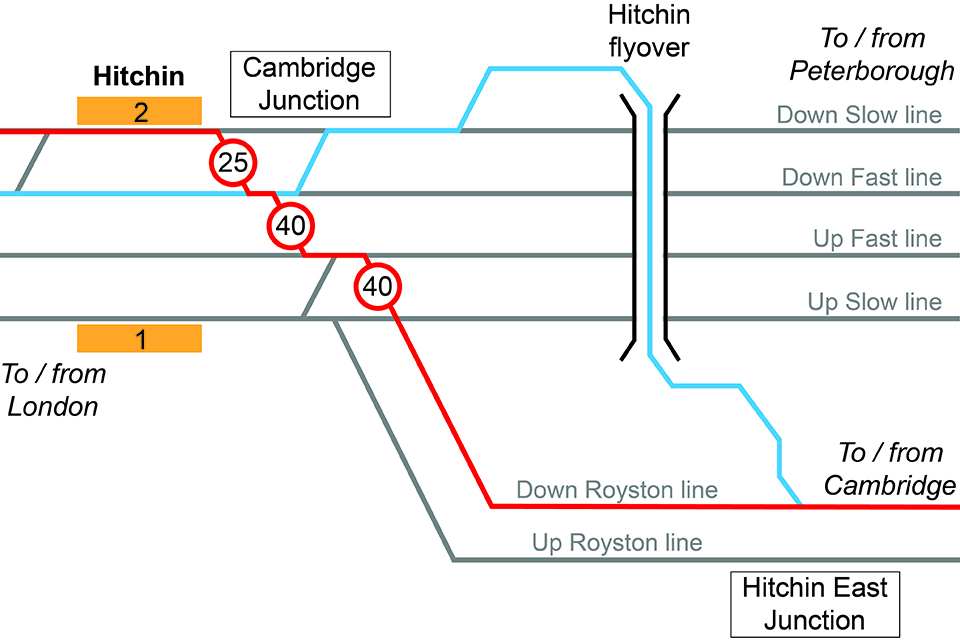
Train 1T20 was routed from the Down Slow line to take the diverging route over the junction towards Cambridge by passing over six sets of points and a switch diamond. For this route, the first two sets of points have a permanent speed restriction of 25 mph (40 km/h). The permanent speed restriction for the remainder of this route, over the other points and the switch diamond, is 40 mph (64 km/h). However, when the train began to traverse the first two sets of points it was travelling at 56 mph (90 km/h) instead of 25 mph (40 km/h).
This caused the train to lurch sideways as it traversed the junction, with several passengers falling from their seats onto the floor and the few passengers who were standing being thrown off balance. No injuries were reported following the incident and there was no damage caused to the train or to railway infrastructure.
Track layout at Cambridge Junction with path taken by train 1T20 shown in red and its timetabled path shown in blue.
The driver realised the train was traversing the junction and applied the train’s brakes causing it to slow. By the time the train’s rear carriage crossed the first two sets of points, the train was still travelling at 44 mph (71 km/h). When the front of the train had started to traverse the rest of the junction, it was travelling at 55 mph (89 km/h) although it had slowed to 42 mph (68 km/h) by the time the rear of the train reached this point.
This location could be quite unique in that the same protecting signal offers diverging routes both left and right, but both go to the same destination; in this case, the Cambridge Branch.
The real issue could be driver confusion of turnout speed, dependent on if diverging left or right. Which may have been the issue with this overspeed, so flashing aspects to diverge to the left might be the solution...
Moderator note: further discussion on this point can be found at the following thread:
Moderator note: Split from https://www.railforums.co.uk/threads/overspeeding-at-cambridge-junction-hitchin-11-12-25.297268/ Having the train pass the signal to single yellow does create a hazard that the driver is accustomed to seeing it and then finding the next signal showing a proceed...
In the briefing material that was provided when the flyover was opened, a flashing single yellow before Hitchin and a number one junction indicator at Hitchin from Down Slow to Down Cambridge Flyover, was stated as the sequence that could be expected.
However, as the set of points from Down Slow to Down Royston Flyover (as it's since been renamed) are 70mph, which is a reduction of only 10mph from the Down Slow linespeed after Hitchin, the signal before the station can show green and the signal at the station a green with number one junction indicator.
To my knowledge, the flashing sequence for this route never happened.
There are similar junctions where it's possible to have 'greens all the way' where the diverging points are 10mph or less difference from the main route. This is the thinking behind the reduction in slow line speeds at Gatwick Airport for instance.
After the set of points, the linespeed on the flyover does drop to 50mph within a short distance.
In the briefing material that was provided when the flyover was opened, a flashing single yellow before Hitchin and a number one junction indicator at Hitchin from Down Slow to Down Cambridge Flyover, was stated as the sequence that could be expected.
However, as the set of points from Down Slow to Down Royston Flyover (as it's since been renamed) are 70mph, which is a reduction of only 10mph from the Down Slow linespeed after Hitchin, the signal before the station can show green and the signal at the station a green with number one junction indicator.
To my knowledge, the flashing sequence for this route never happened.
There are similar junctions where it's possible to have 'greens all the way' where the diverging points are 10mph or less difference from the main route. This is the thinking behind the reduction in slow line speeds at Gatwick Airport for instance.
After the set of points, the linespeed on the flyover does drop to 50mph within a short distance.
You would never get a flashing yellow on the down slow. Thats only on the down fast but the flashing single yellow could mean 1 of 2 things which is either being routed onto the down slow or down Royston flyover. You would have to reduce your speed to be able to stop at the next signal if its a wrong route - thats how I was taught. There is also a preliminary route indicator too.
Doesn't matter. That's like blaming a SPaD on the signal being red.
Could be any number of reasons - trains being regulated (which I believe is the reason here), a points failure (increasingly common these days due to the lack of maintenance)
Doesn't matter. That's like blaming a SPaD on the signal being red.
Could be any number of reasons - trains being regulated (which I believe is the reason here), a points failure (increasingly common these days due to the lack of maintenance)
The report explains it was diverted from the Fast due to a failure on that line, and sent across the flat junction instead of the flyover so it could overtake a stopping train that had got ahead of it. It also notes that the driver was very newly qualified and had only done that route once during training.
So yet again RAIB still dont consider the risk of signals stepping upto a Green with a low speed turnout being in the route selected despite acknowledging that acceleration of modern trains shows how even with approach control trains can achieve high speeds very quickly. Neither do they consider that driving the same route day in day our conditions their behaviour. This isnt to admonish the driver being responsible for observing and responding to signals but there is clearly some deeper issues at play given the amount of events now. Surely signalling standards need an urgent revisit to see if in situations like this a more restrictive aspect should be displayed if overspeed TPWS cant be installed.
The background of the drivers experience was interesting background and have to feel for them only 11 days into being left solo to have this incident.
Only eleven days driving unaccompanied. The only time he'd been over the junction was under supervision and from a standing start at Hitchin. The report also notes that GTR didn't identify the risk of the junction indicator being misread in their assessments for the route, so this possibility likely wasn't brought up on his route learning.
Obviously the drivers know where to expect feathers which mitigates it but why could these new ones not have been designed in a similar style I wonder.
Only eleven days driving unaccompanied. The only time he'd been over the junction was under supervision and from a standing start at Hitchin. The report also notes that GTR didn't identify the risk of the junction indicator being misread in their assessments for the route, so this possibility likely wasn't brought up on his route learning.
Sorry, but if you are out on your own, they you are presumably competent to be so. In other words, you sign the route and know the meaning of signals, where speed limits are etc etc. That’s why training takes so long!
Sorry, but if you are out on your own, they you are presumably competent to be so. In other words, you sign the route and know the meaning of signals, where speed limits are etc etc. That’s why training takes so long!
Maybe the quality of training at GTR could be questioned. I hear stories of trainees given DIs from other depots, and building hours of experience on routes/traction they'll never drive, and then being expected to be ready for assessment on minimum hours on the routes/traction they will be driving.
Sorry, but if you are out on your own, they you are presumably competent to be so. In other words, you sign the route and know the meaning of signals, where speed limits are etc etc. That’s why training takes so long!
Maybe the quality of training at GTR could be questioned. I hear stories of trainees given DIs from other depots, and building hours of experience on routes/traction they'll never drive, and then being expected to be ready for assessment on minimum hours on the routes/traction they will be driving.
It does seem like all the work done after Ladbroke Grove on driver training seems to be, in places at least, now unravelling. After many years where there seemed to be few incidents due to driver errors, we seem to be seeing this creeping in again. As with many things, Covid won’t have helped.
Specifically to GTR, as a regular GN user I’ve noticed a gradual decline in the standard of driving over recent years. Go back 10-15 years to FCC days and pretty much every train was driven the same, now there’s a lot of variability crept back in. Had one driver on an early-morning service a couple of weeks ago who seemed flustered that the PIS wasn’t working (379s), didn’t exactly inspire confidence that she manually announced the list of stations in the wrong order, and on several occasions announced “This is X” station when the train was actually somewhere else!