Our new ticketing site is now live! Using either this or the original site (both powered by TrainSplit) helps support the running of the forum with every ticket purchase! Find out more and ask any questions/give us feedback in this thread!
Funnily enough I just looked back a few posts to the one linking the Mirror’s article in November. (#296). I’d glanced at it before, but am now a bit unsure. Do they actually have their two main exterior views in the wrong places, ie although the captions are right, they‘ve got the pictures in the wrong order?
Do you mean the bits that already have rafts over them? To me, they’re Liv Street’s dark bits. The rest of the existing brick and glass station is very cathedral-like.
Do you mean the bits that already have rafts over them? To me, they’re Liv Street’s dark bits. The rest of the existing brick and glass station is very cathedral-like.
Network Rail has issued an update following consultation
Following public consultation on the new plans which are focused on improving the everyday experience of passengers, nearly 2,000 individual comments were received. The proposals have already attracted significant public support with more than 1,000 people registering their backing on the City of London’s planning portal. This makes the proposals one of the most supported planning applications ever submitted to the City of London.
Last month, Liverpool Street was crowned Britain’s busiest railway station for the third year in a row, recording almost 100 million rail entries and exits in addition to underground customers. With passenger numbers forecast to rise to 158 million by 2041, the proposed redevelopment is designed to ensure the station is future-proofed and ready to accommodate more than 200 million people in the decades ahead.
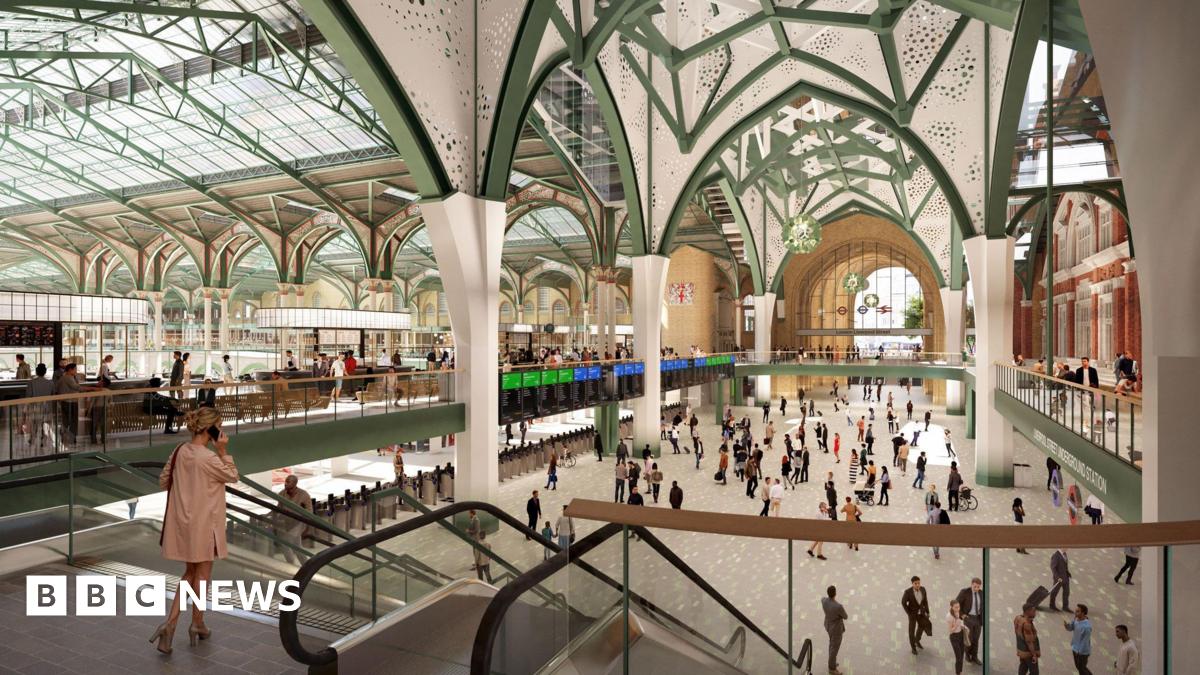
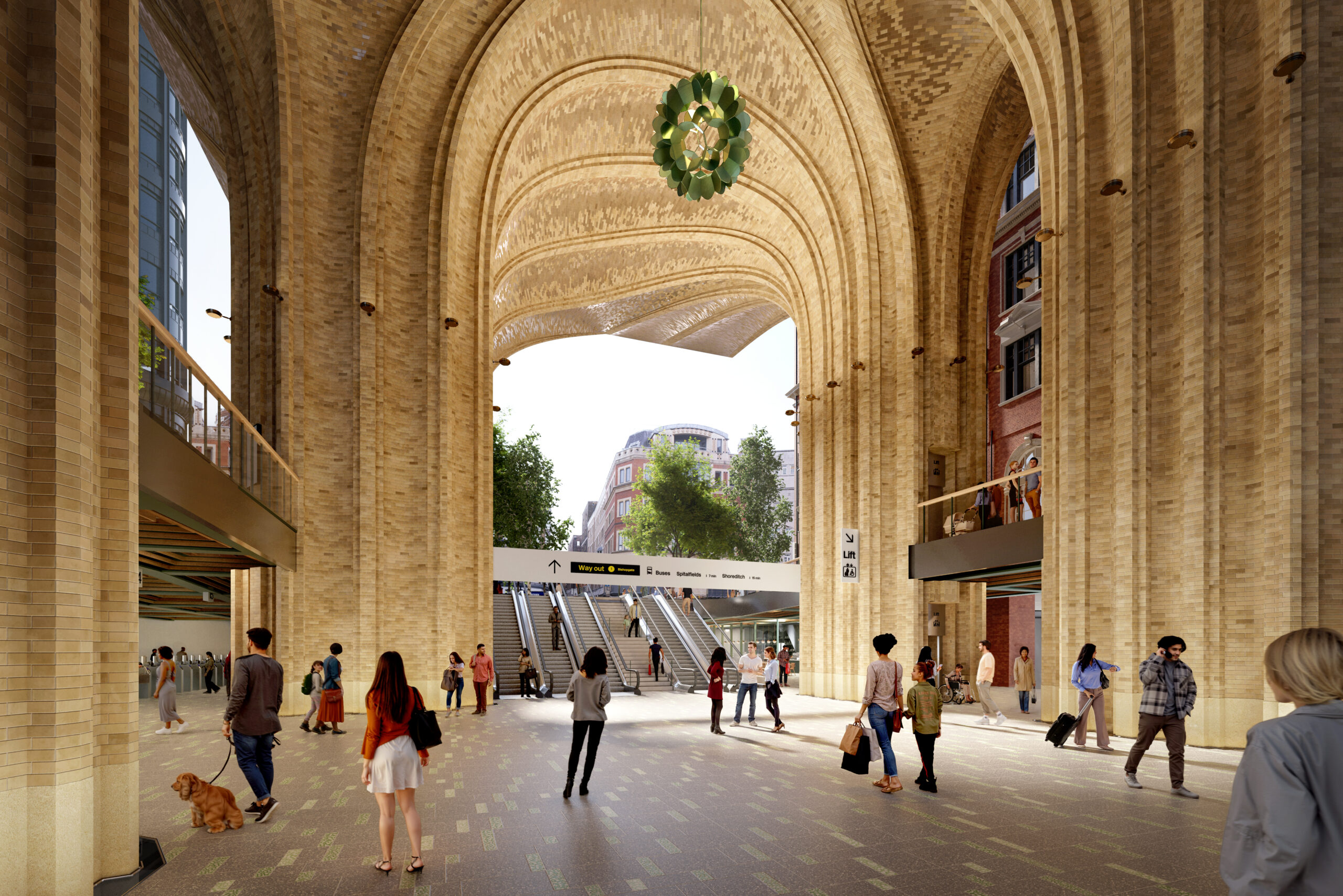
The fly-through brings to life a vision for a more accessible, well-designed and welcoming station, showcasing the proposed enhancements and illustrating how the future Liverpool Street station could be experienced from a passenger perspective.
Feedback from station customers during the design stage was clear, with the top two priorities being step-free access and new lifts and escalators to increase accessibility to both the mainline station and London Underground.
Plans submitted include a significantly enlarged concourse to ease congestion, step-free access across all rail and underground platforms, eight new lifts and an increase in escalators from four to ten. Additional ticket barriers are proposed to reduce queuing, while new toilets and family facilities on all levels, alongside clearer signage, would improve passenger comfort and navigation throughout Britain’s busiest station.
The transport-led scheme, brought forward by Network Rail and its property development business Platform4, focuses on delivering much-needed public infrastructure improvements. These would be supported by a new office building above the station concourse which has been designed to better reveal the Grade II* listed Andaz Hotel and positively respond to the conservation area and protected views.
Working closely with major stakeholders including accessibility advocates, heritage groups and neighbouring businesses, the proposals evolved to enhance the landmark entrances on Liverpool Street, Bishopsgate and Exchange Square to celebrate the historic station architecture. The transformed station will make wayfinding more intuitive with new east-west and north-south connections with the City.
Network Rail releases a new fly-through video showcasing its ambitious plans to transform London Liverpool Street station into a transport hub fit for the future.
Media High resolution images are available for download here. Fly-through video – January 2026 https://timeforliverpoolstreet.co.uk/wp-content/uploads/2026/01/TB_London_Liverpool_St_Edit_B4_4K-compressed.mp4Fly-through illustrating how the future Liverpool Street station could be experienced by...
The fly through video looks great, despite the Swiss train being included at 0:47 - presumably easier to use that model rather than make a brand new one for a 720.
The future looks bright for it. I'll miss the old departure boards though, if they're going to be moved to where Lush and other shops are currently.
They've very cleverly shot the video to remove almost any reference to the demolition of the McDonald's building and the impact that building an enormous office slab on top of the 1991 extension is going to have on light levels in the rest of the station.
Don't they understand? We don't want the station to be redeveloped in this way. If Network Rail wanted to improve circulation and the overall ambience of the current station they could do so.
The whole thing is just greed and an appalling defacing of a major landmark. Why are we having to repeat the mistakes of the 1960s and 1970s in this way?
Possibly because the new scheme finally recognises the need for lift access to all areas, including Underground lines? This needs a £££million input for a start.
The trainshed was also retained in the previous proposal. Nevertheless I do agree that this is a big improvement overall. Looks great and I'd rather Network Rail were able to just crack on and build it, vs endure years more debate.
The trainshed was also retained in the previous proposal. Nevertheless I do agree that this is a big improvement overall. Looks great and I'd rather Network Rail were able to just crack on and build it, vs endure years more debate.
There seem to be very few benefits over what can be achieved by building a huge office block, lifts etc could be fitted in with lifts where the current ticket office is now to the high level and using the piazza where McDonalds is now or the McDonalds site.
This scheme will be 10 years of development and building work. Not something I relish as a user of the station. I also cannot see there is any increase in platform capacity, platforms 16-18 could do with being lengthened to allow 10 car 720's
There seem to be very few benefits over what can be achieved by building a huge office block, lifts etc could be fitted in with lifts where the current ticket office is now to the high level and using the piazza where McDonalds is now or the McDonalds site.
This scheme will be 10 years of development and building work. Not something I relish as a user of the station. I also cannot see there is any increase in platform capacity, platforms 16-18 could do with being lengthened to allow 10 car 720's
Larger capacity concourse and improved access to Exchange Square are the two obvious ones, in addition with improved accessibility (not just to the concourse but also down to the Central Line platforms).
The over-site development helps fund the works to the station and presumably will be sufficient to fund other NR works elsewhere too. In a world of limited public funds it seems a reasonable trade-off.
They've very cleverly shot the video to remove almost any reference to the demolition of the McDonald's building and the impact that building an enormous office slab on top of the 1991 extension is going to have on light levels in the rest of the station.
Don't they understand? We don't want the station to be redeveloped in this way. If Network Rail wanted to improve circulation and the overall ambience of the current station they could do so.
The whole thing is just greed and an appalling defacing of a major landmark. Why are we having to repeat the mistakes of the 1960s and 1970s in this way?
The station needs millions spending on it, if the office block above the concourse is going to pay for it, then so be it, the redevelopment needs to happen and now.
I actually like the look of what they are going for.
If Liverpool Street station was not in the City, in the part of the country with the highest land value prices, Network Rail would not be proposing this kind of redevelopment.
As in the 1970s with the previous attempt to demolish large parts of the station, the listed elements of the station are merely seen as a major inconvenience in the context of the ultimate goal of maximising income from it's location. Any improvements to passengers are an afterthought.
I also don't really see how they can do this. Haven't Historic England clarified that the listing also applies to large elements of the 1987-91 rebuild?
It's possibly difficult to tell from the fly-through, but I get the impression that a lot more of the train shed is retained in this version than the previous (including the 1980's extension, which provides the original with more symmetry).
Correct me if I'm wrong but that appears to plonk offices on top of part of the train shed, which risks the platform area ending up feeling as bright and cheerful as Charing Cross or Cannon Street. I also am not clear how building 700,000sqft of office space on top of the train shed will cause less disruption to passengers and services vs building it on top of the concourse.
Honestly I'd rather they cracked on the with scheme as designed vs more dithering, cost, and delays.
Looks like the planning inspector is set to recommend the scheme is approved.
I imagine there will be significant opposition to this, and hopefully sense will ultimately prevail.
The enormous slab office block will be built on the site of 50 Liverpool Street, which was carefully reconstructed as part of the sensitive redevelopment of the station only just over 30 years ago. Complete disregard in the plans for the impact on the Grade II* listed Great Eastern Hotel, the Grade II listed trainshed extension from the 1985-91 rebuild, and the Bishopsgate conservation area.
I have to say, I'm amazed that these plans which take an axe to our railway heritage, and which would never be permitted in any other European country, are supported by some members of this forum.
Looks like the planning inspector is set to recommend the scheme is approved.
I imagine there will be significant opposition to this, and hopefully sense will ultimately prevail.
The enormous slab office block will be built on the site of 50 Liverpool Street, which was carefully reconstructed as part of the sensitive redevelopment of the station only just over 30 years ago. Complete disregard in the plans for the impact on the Grade II* listed Great Eastern Hotel, the Grade II listed trainshed extension from the 1985-91 rebuild, and the Bishopsgate conservation area.
I have to say, I'm amazed that these plans which take an axe to our railway heritage, and which would never be permitted in any other European country, are supported by some members of this forum.
The 90's addition to the train shed enhanced the whole, so should be considered as part of the heritage aspect. From my understanding, this whole is preserved from seeing the fly through (please correct me if I'm wrong).
50 Liverpool street was a nice touch as part of the original redevelopment, but I suppose could be sacrificed for funds.
I have to say, I'm amazed that these plans which take an axe to our railway heritage, and which would never be permitted in any other European country, are supported by some members of this forum
I think you'll find that most other European countries are just as happy than us (perhaps more so) to "destroy" railway heritage. For example, Anhalter Bahnhof in Berlin
I want a station fit for the number of passengers it handles, not a working museum, I actually like what it being proposed and if the office building is going to pay for the redevelopment, then so be it.
All these petitions will achieve is redesign after redesign which just add to the overall costs and delay the redevelopment.
I want a station fit for the number of passengers it handles, not a working museum, I actually like what it being proposed and if the office building is going to pay for the redevelopment, then so be it.
As a daily user, I agree. The proposals are an improvement & will revitalise an otherwise overcrowded and shabby station.
Whilst I appreciate the concern about turning Liverpool Street into a dungeon, that's not what I took away from the proposal. The overhead development strikes a balance between making good use of the 'air rights' and keeping the station itself pleasant, whilst preserving the historic (listed) features - the trainshed itself.
The development is not out of keeping with the general area (eg. Broadgate).
As a daily user, I agree. The proposals are an improvement & will revitalise an otherwise overcrowded and shabby station.
Whilst I appreciate the concern about turning Liverpool Street into a dungeon, that's not what I took away from the proposal. The overhead development strikes a balance between making good use of the 'air rights' and keeping the station itself pleasant, whilst preserving the historic (listed) features - the trainshed itself.
The development is not out of keeping with the general area (eg. Broadgate).
It's possibly difficult to tell from the fly-through, but I get the impression that a lot more of the train shed is retained in this version than the previous (including the 1980's extension, which provides the original with more symmetry).
50 Liverpool Street was a key part of the 1970s-1980s conservation campaign, being a reconstruction of an original building that sat within the old cab road entrance to Liverpool Street station and the Great Eastern Railway Company offices (which now forms part of the extended concourse). It was deliberately reconstructed to be a marker for what used to be there, and to cohere with the trainshed extension. There seems to be some difference of opinion as to whether it is actually listed; the City of London seem to think it is (see here: https://democracy.cityoflondon.gov.uk/documents/s85955/Liverpool Street Report.pdf), whereas Historic England seems to think it isn't (https://historicengland.org.uk/listing/the-list/list-entry/1286133?section=official-list-entry)
50 Liverpool Street is also part of the Bishopsgate Conservation Area (as is the rest of the station). The whole conservation area is significantly threatened by the proposal - the proposed tower block utterly dwarfs the Grade II* listed Andaz hotel and will block light into the station. This is precisely why the fly-through almost entirely avoids showing the proposed tower block.
I, of course, accept that the station needs some form of development. Network Rail claim that the key problems are a lack of accessiblility (ie lifts), and circulation on the main concourse. I am not sure how these problems will be improved in the curren proposals, the main feature of which is the giant office block they want to build above the station. They could also do what they have shown in the plans - ie remove some of the retail outlets and the furniture from the main concourse - without doing anything else to the station, should they wish to do so.
I also don't buy the argument that selling the 'air rights' is necessary to fund improvements. Other mainline terminus stations, such as Paddington, Waverley and Waterloo, have been improved in recent years without significant additional development. Furthermore, Network Rail complain that the current site is very hemmed in, but this is because existing railway land has previously been sold to development - how is selling more railway land to development going to fix this? In fact, Network Rail have form with this, as they tried to demolish span 4 of Paddington station in the mid-2000s, which they ultimately gave way on after public pressure (https://www.architectsjournal.co.uk/news/paddingtons-fourth-span-saved-from-grimshaw-demolition) - perhaps they feel agrieved by losing that battle and this is why they're determined to send in the buldozers this time around?
I also don't buy the argument that 'if this gets rejected, then it proves we can't build anything as a country and it's a reflection of the economic situation we're in'. Can anyone really see this happening to the Gare du Nord, Milano Centrale, or Antwerpen Centraal? Liverpool Street is equally as historic as all of those stations, if not even more so. It's a destination in its own right and demolishing a chunk of it to build a bland office block will reduce the attractiveness of an area which has already seen significant development and lost a lot of its character (see, for example, the traversty of Old Spitalfields Market...)
This is the worst kind of incrementalism. The 1980s plans were approved on the basis of a sensitive heritage-conscious restoration of the station. Coming back 30 years later with a proposal to tear this up and buldoze large parts of the station doesn't feel like a democratic or even passenger-centred way of operating. What's to stop a further proposal in another few decades from demolishing yet more of the structure?
It would be better if Network Rail were at least honest and they said that the real - and only - reason why they want to do this is to further monetise the railway estate. But to pretend that years of disruption for passengers, a proposal that reduces the atmosphere and amenity of the current station, as well destroying its cultural, architectural and aesthetic importance, somehow has public benefit is utterly deceptive.
I really hope the City of London for once acts in the public interest rather than in-line with its feudal, arcane, unaccountable and undemocratic corpus and rejects the proposal.
== Doublepost prevention - post automatically merged: ==
I think you'll find that most other European countries are just as happy than us (perhaps more so) to "destroy" railway heritage. For example, Anhalter Bahnhof in Berlin
But not since the 1960s or before? I think what remained of the Anhalter Bahnhof (largely destroyed in WW2) was demolished in 1952, unless I am mistaken.
This is why what has been proposed is development policy going backwards.
We are aware of an issue with emails from the Forum to Microsoft-based email accounts (hotmail/outlook/live.com email addresses). This is being looked into currently, thanks for your patience meanwhile.