• Our new ticketing site is now live! Using either this or the original site (both powered by TrainSplit) helps support the running of the forum with every ticket purchase! Find out more and ask any questions/give us feedback in this thread!

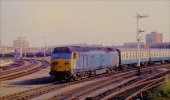
Where is this class 50 in Chester ?

Status
Not open for further replies.

Justin Smith

Established Member
Joined
14 Nov 2009
Messages
1,415
Location
Sheffield
The picture below is out of 70s Spotting Days North West (p17) of a Class 50 in Chester. It is labelled as being on diversion from the WCML due to engineering works. I thought the depot (now the present day DMU depot, ex 6A steam depot ?) is on the left, but that makes no sense as wouldn't that mean the train was coming off the Wales line taking the avoiding line up to Birkenhead ?
So, can anyone confirm where the train is and does the reporting code IP31 back that up ?

The "Seventies Spotting Days" series are great books BTW, I gave half a dozen of them !
 

Attachments

  • Class 50 at Chester 11 July 1971.jpg
    Class 50 at Chester 11 July 1971.jpg
    349.5 KB · Views: 244
Sponsor Post - registered members do not see these adverts; click here to register, or click here to log in
R

RailUK Forums

thesignalman

Member
Joined
9 Jan 2012
Messages
153
It appears to be on the wrong line! I suspect it is being turned on the triangle, hauled by a loco on the other end. No tail light is visible, though.

John
 

midland1

Member
Joined
18 Aug 2019
Messages
445
Location
wigston
The 1P31 Sundays was the 14.20 Euston- Blackpool/Carlisle due of Crewe at 16.52. Passing time given at Crewe Steel Works as 16.55, did not get to Warrington till 18.06 so must have gone via Chester but no times given there in public TT. Hope this helps.
 

CW2

Established Member
Joined
7 May 2020
Messages
2,217
Location
Crewe
Diversions via Chester used to be a regular occurrence when Crewe - Warrington was closed for engineering work. If I remember correctly, regardless of running northbound or southbound, the train would run through Chester station (non-stop middle road) then take the route towards Birkenhead. After coming to a stand the train would reverse and propel around the Chester avoiding line, into the tunnel. After coming to a halt it would reverse again and head back through Chester station (again non-stop middle road).

Note that there was no top-and-tail working involved, just propelling a passenger train round a curve and into a tunnel.

It was usual for the booked AC electric loco to be hauled dead in train, producing the unusual sight of an AC loco at Chester. I once saw a train middle road at Chester with a class 86 on the front. The diesel dragging loco had failed, so it was unhooked and retired to the depot for replacement, leaving the 86+train stranded middle road.
 

Gloster

Veteran Member
Joined
4 Sep 2020
Messages
12,940
Location
Up the creek
It does seem to be taken from just south of Chester North Junction, probably from near the bridge carrying the old Cheshire Lines Committee line across the Birkenhead Joint. A streetview image from the bridge can be found and that has what I presume are the same flats in the background.

EdIT: ‘on or’ deleted from ‘…from on or near the bridge…’ as the angle is too low to be from the bridge.
 
Last edited:

hexagon789

Veteran Member
Joined
2 Sep 2016
Messages
18,284
Location
Glasgow
1P31 was the 1025 Euston to Carlisle in the 1971 timetable, if that's of any use/interest.
 

Justin Smith

Established Member
Joined
14 Nov 2009
Messages
1,415
Location
Sheffield
Diversions via Chester used to be a regular occurrence when Crewe - Warrington was closed for engineering work. If I remember correctly, regardless of running northbound or southbound, the train would run through Chester station (non-stop middle road) then take the route towards Birkenhead. After coming to a stand the train would reverse and propel around the Chester avoiding line, into the tunnel. After coming to a halt it would reverse again and head back through Chester station (again non-stop middle road).

Note that there was no top-and-tail working involved, just propelling a passenger train round a curve and into a tunnel.

It was usual for the booked AC electric loco to be hauled dead in train, producing the unusual sight of an AC loco at Chester. I once saw a train middle road at Chester with a class 86 on the front. The diesel dragging loco had failed, so it was unhooked and retired to the depot for replacement, leaving the 86+train stranded middle road.
Very interesting...

Could the train in the pic actually be reversing then ? ! ?

Your explanation fits in with a second picture in the aforementioned book (on p20, though it may actually have been taken 5 minutes earlier than the pic on p17 ! ) where the same train is coming round the line past the depot (i.e. from Chester to Birkenhead), another I could not work out. But your theory explains all !
 

thesignalman

Member
Joined
9 Jan 2012
Messages
153
Very interesting...

Could the train in the pic actually be reversing then ? ! ?
That's what I was suggesting in my previous post. But it is worrying the driver is showing no interest in where his train is going if there is no locomotive at the other end, as CW2 says.

John
 

Springs Branch

Established Member
Joined
7 Nov 2013
Messages
1,680
Location
Where my keyboard has no £ key
Diversions via Chester used to be a regular occurrence when Crewe - Warrington was closed for engineering work. If I remember correctly, regardless of running northbound or southbound, the train would run through Chester station (non-stop middle road) then take the route towards Birkenhead. After coming to a stand the train would reverse and propel around the Chester avoiding line, into the tunnel. After coming to a halt it would reverse again and head back through Chester station (again non-stop middle road).

Note that there was no top-and-tail working involved, just propelling a passenger train round a curve and into a tunnel.

It was usual for the booked AC electric loco to be hauled dead in train, producing the unusual sight of an AC loco at Chester. I once saw a train middle road at Chester with a class 86 on the front. The diesel dragging loco had failed, so it was unhooked and retired to the depot for replacement, leaving the 86+train stranded middle road.
Diversion of WCML trains via Chester was particularly common in 1971-73, while the main line north from Weaver Junction was being firstly remodelled, resignalled and then had overhead electrification infrastructure installed.

A common occurrence to the extent that diversions on some late nights and Sunday trains were 'cast in stone' in the annual Working Timetable.

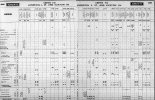
Attached is one extract from the May 1971 - May 1972 WTT, covering Sunday trains between Crewe & Euxton Jn.

There are several Euston - Blackpool trains shown as "via Chester" re-appearing onto the WCML at Acton Grange Jn. Note "the other 1P31" on Sunday was the 14:20 Euston - Blackpool N. (The photo is dated 11 July 1971 - this was a Sunday)

In 1971, Sunday Euston - Lime St expresses also went via a Chester reversal and Frodsham & Halton Jns (these would have been the ones seen at Chester with an 86 in tow), while Scottish trains were routinely diverted via Stockport, Denton & Manchester Vic to either Euxton Jn or even further off piste via Bolton, Blackburn, Hellifield & the S&C.

Certainly, Sunday long-distance trains could be few and far between back then, but considering Blackpool and Lime Street trains did the Chester reversal in both up and down directions, there would be quite a few propelling moves with full-length passenger trains to be seen on any given Sunday.


[EDIT] Slight correction on my statement about electric locos being dragged through Chester. . . This most likely did not occur during the 1971 period.

The diverted Liverpool expresses in the 1971 WTT are timed as D455 though to Lime St, and the station stop at Runcorn doesn't allow enough time for any loco on/off malarkey (I had wondered if diesel haulage was only between Crewe & Runcorn for the Liverpool trains, until I checked)

It makes sense, as electric/diesel loco changes were common and quite slick at Crewe before electrification went north of Weaver Jn. There was no point in dragging a dead electric loco to and from Lime Street. But
after introduction of the Electric Scots - yes, perfectly logical for northern WCML trains. </pedant>

 

Attachments

  • CreweEuxton_1971.jpg
    CreweEuxton_1971.jpg
    457.6 KB · Views: 25
Last edited:

Justin Smith

Established Member
Joined
14 Nov 2009
Messages
1,415
Location
Sheffield
I would only say that this thread, more accurately the replies, has shown how internet forums really should be !
 

Harpo

Established Member
Joined
21 Aug 2024
Messages
3,734
Location
Newport
It was usual for the booked AC electric loco to be hauled dead in train, producing the unusual sight of an AC loco at Chester.
The list of unwired routes that AC locos got dragged over would be very extensive. A couple were even regular (ie non-diversionary) WTT moves such as Yarmouth and the Harwich - Glasgow across North London.
A common occurrence to the extent that diversions on some late nights and Sunday trains were 'cast in stone' in the annual Working Timetable.
And elsewhere too continuing throughout the 1980s, putting diversion timings such as Tondu, Oxford to Bletchley etc. into the GBTT and permanent diagrams

Timetabling principles probably ruled on WTT vs STN inclusion with a minimum period to get into WTT. I’ve got a nagging recollection that it had a link to traincrew roster cycles too, so needed maybe 6 or 8 weeks minimum (continuously) to become WTT?? Maybe it varied between regions? (Everything else did!)
 

alan71

Member
Joined
13 Jul 2010
Messages
53
Does anyone know when these stopped? I went around the triangle on 47449 to WBQ, then back with 47522 on 7/8/88
 

Wandering Pom

Member
Joined
23 Mar 2024
Messages
163
Location
Cambridge
This diversion, with the propelling move, was still used as late as summer 1992. On Sunday 19th July that year, I did the 0819 Crewe - Blackpool North, hauled by 31442, which went this way.
 

SW Rover

Member
Joined
30 Jan 2025
Messages
104
Location
E Mids
On Sunday 12th September 1993 the 0753 Crewe - Blackpool North hauled by 37 414+37 408 was diverted via the Chester triangle reversal move.
 

thesignalman

Member
Joined
9 Jan 2012
Messages
153
Photo could have been taken as the driver glanced round for a couple of seconds
That's possible, but it is extremely worrying from a safety point of view. The whole concept of propelling trains is dangerous, even more so in an area of tight curves and complex old-fashioned signalling. Today, these issues are barely considered with the use of radio communicaton yet it is still rarely done with passenger trains - instead coupling another engine to the other end which makes things so much safer. Or, as is the case these days, most trains have a cab each end anyway.

Going back to those days, the guard would be required to travel in the leading end, continuously signalling by hand to the driver. Any driver not watching these continuously would be a fool. That is why I assumed from the photograph that a locomotive was attached to the other end, but we are assured not.

John
 

Harpo

Established Member
Joined
21 Aug 2024
Messages
3,734
Location
Newport
Going back to those days, the guard would be required to travel in the leading end, continuously signalling by hand to the driver. Any driver not watching these continuously would be a fool.
Depends. If you had the road to where you need to stop and your guard is keeping a continuous lookout from a brake at the far end (so can stop the job with the setter), a driver looking back continuously from the rear of a 1970s length train (12+ vehicles?) won’t add much beyond beating the guard to the brake, assuming that curves or structures mean you can always see the guard.
 

thesignalman

Member
Joined
9 Jan 2012
Messages
153
Depends. If you had the road to where you need to stop and your guard is keeping a continuous lookout from a brake at the far end (so can stop the job with the setter), a driver looking back continuously from the rear of a 1970s length train (12+ vehicles?) won’t add much beyond beating the guard to the brake, assuming that curves or structures mean you can always see the guard.
Exactly why I am saying it is an dangerous operation. "Rules is rules". You don't vary them by interpretation according to location or conditions.

John
 

Justin Smith

Established Member
Joined
14 Nov 2009
Messages
1,415
Location
Sheffield
Exactly why I am saying it is an dangerous operation. "Rules is rules". You don't vary them by interpretation according to location or conditions.

John
You say it was "dangerous operation" ? How many accidents were as a result of carefully reversing a train ? And I mean serious accidents.
The problem is having to run around twice, or provide a second loco just for the manoeuvre, is very expensive and also time consuming.
 

Harpo

Established Member
Joined
21 Aug 2024
Messages
3,734
Location
Newport
You say it was "dangerous operation" ? How many accidents were as a result of carefully reversing a train ? And I mean serious accidents.
The problem is having to run around twice, or provide a second loco just for the manoeuvre, is very expensive and also time consuming.

How it was done half a century ago was what was considered safe at that time.

Top & tail working wasn't a regular way of working back then and needed published special instructions, with one-off dispensations appearing in the WON, although a station limits draw-back with the station pilot wouldn't as it was part of regular ops.
 

thesignalman

Member
Joined
9 Jan 2012
Messages
153
I was in the industry half a century ago.

Obviously there were many accidents caused by propelled trains, asking me to quantify the number is a pathetic question because everybody knows it can't be answered. Fortunately, all such incidents that I know of involved non-passenger trains - authorisation to propel loaded passenger trains is extremely rare.

If you all want to brush off this operation as perfectly safe and normal then please do so. But you should put yourself into the real world and not pretend this kind of thing was normal and safe, then or now. In any railwayman's mind, such a movement is fraught with risk and needs to be managed carefully indeed.

"Top and tail" (an unofficial term which by definition actually refers to cutting each end off something) was indeed in use then, it came under the heading of "Assisting Locomotive In Rear" even if not powering - I first came across that in the early 1970s. But as this is apparently not what was done here, it doesn't apply.

Somebody at Divisional Level authorised this, and as I dealt with them in those days I am rather surprised they did, for they seemed incrediby awkward to deal with although they did, of course, have their reasons. The obvious solution would surely have been an engine change in the station area. There were plenty of non-platform lines they could have done that on. "Expensive and time consuming"? - it wouldn't take longer than reversals around a triangle and the provision of one extra engine would not have been considered an unacceptable financial burden in those days.

Anyway, I have said quite enough on the subject, I will leave those so anxious to argue regardless to it.

John
 

43096

On Moderation
Joined
23 Nov 2015
Messages
18,728
If you all want to brush off this operation as perfectly safe and normal then please do so. But you should put yourself into the real world and not pretend this kind of thing was normal and safe, then or now. In any railwayman's mind, such a movement is fraught with risk and needs to be managed carefully indeed.
Yet in the last 10 years I have been in Zürich and Vienna (to name but two) and watched propelling moves for reasonable distances (particularly in Zürich) over layouts at least as complicated - if not more so - than in Britain. Indeed in Vienna it still happens daily as sleeper formations are propelled into the Hbf from Matzleinsdorf depot.
 

35B

Established Member
Joined
19 Dec 2011
Messages
5,362
I did this sometime in the early 90s. The train was diverted via Middlewich, ran through Chester station towards Saltney, then reversed round the west side of the triangle before the diesel continued. At that time, it was simultaneously an unusual movement, and entirely regular for handling those diversions at Chester - when I picked up on the planned diversion, the fact of a propelling reversal was not commented on, but just the movement round the west curve.

In January 1990, I did the Anniversary Aggregate railtour. We ran the section from Ashford to Hastings and back top & tailed. I forget the precise reasons (late running?), but my abiding memory was the excitement and surprise from participants that the move was being considered and allowed - it was definitely unusual and, from memory, not planned
 

Bevan Price

Established Member
Joined
22 Apr 2010
Messages
8,317
I travelled on several diversions of Liverpool services via Chester to Crewe. A few actually had booked passenger stops at Chester. Most went onto the Birkenhead line, reversed at Chester North Jn, backed round the curve to the tunnel, then forward to the station, but at least once, we did the triangle in the opposite direction (tunnel first). The diesel loco worked thoughout between Liverpool & Crewe.
 

Harpo

Established Member
Joined
21 Aug 2024
Messages
3,734
Location
Newport
In January 1990, I did the Anniversary Aggregate railtour. We ran the section from Ashford to Hastings and back top & tailed. I forget the precise reasons (late running?), but my abiding memory was the excitement and surprise from participants that the move was being considered and allowed - it was definitely unusual and, from memory, not planned
All sorts of possible scenarios there. First and most legally, the presence of a traction inspector to agree and supervise a method of working. Otherwise, maybe keen crews getting a job done without modern day fears around using initiative?

Around the same year as your tour, I was on a T’N’T freight branch railtour where, on the steepest bits, the trailing 37 driver kept 15 pounds on the straight air brake to make sure his mate on the front 37 didn’t have it too easy. Different times and culture. And an interesting beer with them later.
 

alan71

Member
Joined
13 Jul 2010
Messages
53
Yet in the last 10 years I have been in Zürich and Vienna (to name but two) and watched propelling moves for reasonable distances (particularly in Zürich) over layouts at least as complicated - if not more so - than in Britain. Indeed in Vienna it still happens daily as sleeper formations are propelled into the Hbf from Matzleinsdorf depot.
…and there was a regular propelling move at Inverness when the last arrival from Wick went past the TMD and propelled back into the platforms usually used by the services heading south. At least I think it did, otherwise I missed out on a few chains of gronkage :).
Would reversing into a dead end platform be any more/less risky than heading around the curve in Chester?
 

Acathater

Member
Joined
11 Dec 2025
Messages
660
Location
NorthWest
propelling passenger trains was accepted as normal at Dorchester for many years, and then there's Killarney as well
 

Rescars

Established Member
Joined
25 May 2021
Messages
2,517
Location
Surrey
Risk appetites change over time. This was the 70s. Until it closed in 1966, the normal method of running round at Cowes involved propelling the ecs out of the station up a gradient, then uncoupling and releasing the loco, before running the stock back towards the stops by gravity with the guard controlling the movement with the handbrake.

== Doublepost prevention - post automatically merged: ==

The question of cost is an interesting one. Others will know much more about how these used to be calculated and allocated in the BR era, but I recall Travellers Fare being presented with an invoice of well over £100 for the use of an 08 to shunt a restaurant car from the carriage sidings to a loading dock for victualling and back again. That equates to a lot of Maxpax coffee sales! :)
 
Last edited:

KevinTurvey

Member
Joined
9 Oct 2016
Messages
261
The Euston-Liverpool Sunday services were sometimes diverted this way until about early 90s. I recall a chap designated with a "pilotman" armband supervising the reversal on board, seemingly with a handheld radio, but cant be sure.
 

6Gman

Established Member
Joined
1 May 2012
Messages
9,185
A couple of observations:

It is, of course, possible that the train was stationary when the photograph was taken and the driver looked across at the photographer.

Running round in the station would have meant the stock arriving at its destination with the stock reversed.
 
Status
Not open for further replies.

Top