• Our new ticketing site is now live! Using either this or the original site (both powered by TrainSplit) helps support the running of the forum with every ticket purchase! Find out more and ask any questions/give us feedback in this thread!

SSR resignalling

Belperpete

Established Member
Joined
17 Aug 2018
Messages
3,584
If a train enters service from Parsons Green or Lillie Bridge/Olympia, Earl’s Court would be the first place fitted with tripcock testers. Thus would prove it is in place for the running in legacy signalling later. (eastbound from Ealing/Richmond/Wimbledon)

The eastbound description feed
from Wimbledon is still at Fulham Broadway, thus longer predictions are unlikely until East Putney-Fulham Broadway is migrated to CBTC
So they wait until the train has left the legacy signalling to prove the trip cocks are working, in case it is going to go back? Wouldn't it make more sense to prove the trip cocks when entering service at Parsons Green or Lillie Bridge/Olympia?

I am aware of the late description feed causing descriptions to only appear a few minutes before the train arrives at Earls Court. What I was describing was something different. The Edgeware Rd train from Wimbledon had appeared on the display at Earls Court, but the platform it was leaving from at Earls Court kept changing, leading to the two platform displays to keep going through continuous "Information Update" cycles for several minutes. This was also affecting multiple Upminster trains, which kept disappearing and reappearing from the displays.
 
Sponsor Post - registered members do not see these adverts; click here to register, or click here to log in
R

RailUK Forums

MaidaVale

Member
Joined
18 Jun 2021
Messages
218
Location
Reading / SW London
Wouldn't it make more sense to prove the trip cocks when entering service at Parsons Green or Lillie Bridge/Olympia?

Providing a train goes through a tripcock test at least once per trip when running (even partially) with legacy signalling, the semantics over the exact location don't technically matter. There are tripcock testers on the branches with legacy signalling themselves.

Even on lines with full legacy signalling like the Picc, train's aren't necessarily tested immediately upon exiting the depot or sidings and may end up travelling the majority of the line before reaching a tripcock tester, However providing they're tested at least once per trip and pass, then that's fine.
 

Belperpete

Established Member
Joined
17 Aug 2018
Messages
3,584
I am aware of the late description feed causing descriptions to only appear a few minutes before the train arrives at Earls Court. What I was describing was something different. The Edgeware Rd train from Wimbledon had appeared on the display at Earls Court, but the platform it was leaving from at Earls Court kept changing, leading to the two platform displays to keep going through continuous "Information Update" cycles for several minutes. This was also affecting multiple Upminster trains, which kept disappearing and reappearing from the displays.
Okay, so something different at Earls Court today. While waiting for an Edgeware Road train, eventually a train popped up "Not in Service" at 6 minutes away. After about a minute, it morphed into an Upminster. It then proceeded to morph between Upminster and Edgeware Rd, several times, before it then settled down to Edgware Rd. But then it kept flipping between platforms 1 and 2. And finally, it had another go at morphing into an Upminster and back to an Edgeware Rd. Needless to say, by this time I had lost all faith in the platform displays, and carefully checked the display on the train.

Any idea what is causing this instability? Last time I had assumed it was operator intervention, but this surely can't have been.
 

MCR247

Established Member
Joined
7 Nov 2008
Messages
10,290
Okay, so something different at Earls Court today. While waiting for an Edgeware Road train, eventually a train popped up "Not in Service" at 6 minutes away. After about a minute, it morphed into an Upminster. It then proceeded to morph between Upminster and Edgeware Rd, several times, before it then settled down to Edgware Rd. But then it kept flipping between platforms 1 and 2. And finally, it had another go at morphing into an Upminster and back to an Edgeware Rd. Needless to say, by this time I had lost all faith in the platform displays, and carefully checked the display on the train.

Any idea what is causing this instability? Last time I had assumed it was operator intervention, but this surely can't have been.
Which train did it end up being? :lol:
 

Dstock7080

Established Member
Joined
17 Feb 2010
Messages
3,508
Location
West London
SMA10/12 Barons Court-Stamford Brook, Fulham Bdwy-East Putney postponed until June 2026.
significant issues exposed during system testing early-October 2025.
Tripcock tester at Barons Court to be relocated to Turnham Green WB December 2025.
Traction current railgap on Putney bridge to be relocated to Disraeli Road bridge near East Putney October 2025.

SMA9 Preston Road-Moor Park/West Harrow postponed until August 2026, software rewrite required.

Aldgate track renewal/replacement/rationalisation, now scheduled for summer-2027 blockade.
Trains will no longer able to depart NB from pfm.1 as now.
Liverpool Street crossover to be removed.
 

Kay_M

Member
Joined
18 Apr 2019
Messages
251
SMA10/12 Barons Court-Stamford Brook, Fulham Bdwy-East Putney postponed until June 2026.
significant issues exposed during system testing early-October 2025.
Tripcock tester at Barons Court to be relocated to Turnham Green WB December 2025.
Traction current railgap on Putney bridge to be relocated to Disraeli Road bridge near East Putney October 2025.

SMA9 Preston Road-Moor Park/West Harrow postponed until August 2026, software rewrite required.

Aldgate track renewal/replacement/rationalisation, now scheduled for summer-2027 blockade.
Trains will no longer able to depart NB from pfm.1 as now.
Liverpool Street crossover to be removed.
As always much appreciated for this information
 

eastrail

Member
Joined
25 Mar 2025
Messages
20
Location
London
SMA10/12 Barons Court-Stamford Brook, Fulham Bdwy-East Putney postponed until June 2026.
significant issues exposed during system testing early-October 2025.
Tripcock tester at Barons Court to be relocated to Turnham Green WB December 2025.
Traction current railgap on Putney bridge to be relocated to Disraeli Road bridge near East Putney October 2025.

SMA9 Preston Road-Moor Park/West Harrow postponed until August 2026, software rewrite required.

Aldgate track renewal/replacement/rationalisation, now scheduled for summer-2027 blockade.
Trains will no longer able to depart NB from pfm.1 as now.
Liverpool Street crossover to be removed.
Which station’s platform 1 are you referring to with regards to the Aldgate track remodelling?
 

Kay_M

Member
Joined
18 Apr 2019
Messages
251
Am I right in saying that the whole of the Met line will run automatically. Including the Uxbridge branch
 

Kay_M

Member
Joined
18 Apr 2019
Messages
251
Apologies if this has been explained but how would that work with the Piccadilly line running manually on that stretch unless the control centre when looking at the trains has a different colour so the system could tell how far apart it is. Would that be the same on the Chiltern ran sections too?
 

Dstock7080

Established Member
Joined
17 Feb 2010
Messages
3,508
Location
West London
MET trains would operate under CBTC automatic/manual, with lineside beacons determining primary position and axle counters.
PICC trains would still use track circuits/axel counters for position location, thus a wider gap between any other train.
 
Last edited:

starlight73

Member
Joined
1 May 2024
Messages
167
Location
London
I believe it's been explained somewhere that the signals will show different coloured lights too. Met trains will see blue or red signals, and Piccadilly line trains will see green or red ones. (The system can detect which train is approaching the signal)
 
Last edited:

Kay_M

Member
Joined
18 Apr 2019
Messages
251
MET trains would operate under CBTC automatic/manual, with lineside beacons determining primary position and axle counters.
PICC trains would still use track circuits/axel counters for position location, thus a wider gap between any other train.
Now it makes sense. Much appreciated for that

== Doublepost prevention - post automatically merged: ==

I believe it's been explained somewhere that the signals will show different coloured lights too. Met trains will see blue or red signals, and Piccadilly line trains will see green or red ones. (The system can detect which train is approaching the signal)
It does make me think why they couldn't do that on the network rail section of the district line. *sighs* politics galore ay
 
Last edited:

ChristopherJ

Repeatedly returning banned member
Joined
8 Aug 2005
Messages
494
Location
London, UK
I mustache you a question about this new, fangled CBTC wonder signalling on the Uxbridge branch.

I asked a Thales employee about the arrangement and got told "I wish you didn't ask that" because it was too complex to explain.

The Uxbridge branch will use both in-cab for CBTC (Met) and retain colour light for non-CBTC (Picc) trains between Rayners Lane and Uxbridge.

When the 'system' detects a train coming from the Harrow direction, it guesses Met and prioritises CBTC control, but when it detects a route from Acton, it guesses Picc and prioritises colour light control.

My question was this - how does the 'system' detect trains coming in the opppsite direction from Uxbridge? How would it know the differnce between a Met and Picc train starting from the terminal platforms? They both begin from the same route!
 

74A

Member
Joined
27 Aug 2015
Messages
770
My question was this - how does the 'system' detect trains coming in the opppsite direction from Uxbridge? How would it know the differnce between a Met and Picc train starting from the terminal platforms? They both begin from the same route!

It knows what the train was on the previous journey so it will know what the train will be on the next journey.
 

Pakenhamtrain

Established Member
Joined
26 Jan 2014
Messages
1,201
Location
Melbourne, Australia
MET trains would operate under CBTC automatic/manual, with lineside beacons determining primary position and axle counters.
PICC trains would still use track circuits/axel counters for position location, thus a wider gap between any other train.
Sounds similar like we have it for Clayton - West Footscray via the Metro Tunnel in our mixed mode bits between Clayton-South Yarra and South Kensington to West Footscray.

Once the driver sets the mode at the change over point the signals will extinguish and the train will be in Supervised Manual or Automatic Mode.

V/Line, Freight and other non CBTC trains just follow the conventional signalling.

CBTC following non CBTC trains the movement authority goes as far as the axle counter at the entrance of the block the non CBTC train is in.
 

Belperpete

Established Member
Joined
17 Aug 2018
Messages
3,584
Sounds similar like we have it for Clayton - West Footscray via the Metro Tunnel in our mixed mode bits between Clayton-South Yarra and South Kensington to West Footscray.

Once the driver sets the mode at the change over point the signals will extinguish and the train will be in Supervised Manual or Automatic Mode.

V/Line, Freight and other non CBTC trains just follow the conventional signalling.

CBTC following non CBTC trains the movement authority goes as far as the axle counter at the entrance of the block the non CBTC train is in.

Do the signals extinguish, or display a special CBTC aspect?

Back in the days when I was involved in ETCS, the authorities refused to accept signals going out for ETCS trains. It is a long standing rule that an extinguished signal is treated as stop. It was felt that training drivers to ignore an extinguished signal would be bad, particularly if they also have to drive over lines with conventional signalling where they can't ignore an extinguished signal.

Where you get alternating CBTC and non-CBTC trains, the trains will run to the headway set by the conventional non-CBTC signalling. The CBTC train will only be able to proceed as far as the conventional axle counter or track circuit section is clear of the preceding non-CBTC train. And the non-CBTC train following the CBTC train will only be able to proceed as far as the conventional signalling allows.

Where you get a small number of non-CBTC trains intermixed with a largely CBTC metro service, this probably doesn't matter much. But on a line such as the Uxbridge branch, it means that there is likely to be little performance benefit from fitting CBTC. Other than Met drivers not having to switch between systems.
 

Pakenhamtrain

Established Member
Joined
26 Jan 2014
Messages
1,201
Location
Melbourne, Australia
Do the signals extinguish, or display a special CBTC aspect?

Back in the days when I was involved in ETCS, the authorities refused to accept signals going out for ETCS trains. It is a long standing rule that an extinguished signal is treated as stop. It was felt that training drivers to ignore an extinguished signal would be bad, particularly if they also have to drive over lines with conventional signalling where they can't ignore an extinguished signal.

Where you get alternating CBTC and non-CBTC trains, the trains will run to the headway set by the conventional non-CBTC signalling. The CBTC train will only be able to proceed as far as the conventional axle counter or track circuit section is clear of the preceding non-CBTC train. And the non-CBTC train following the CBTC train will only be able to proceed as far as the conventional signalling allows.

Where you get a small number of non-CBTC trains intermixed with a largely CBTC metro service, this probably doesn't matter much. But on a line such as the Uxbridge branch, it means that there is likely to be little performance benefit from fitting CBTC. Other than Met drivers not having to switch between systems.
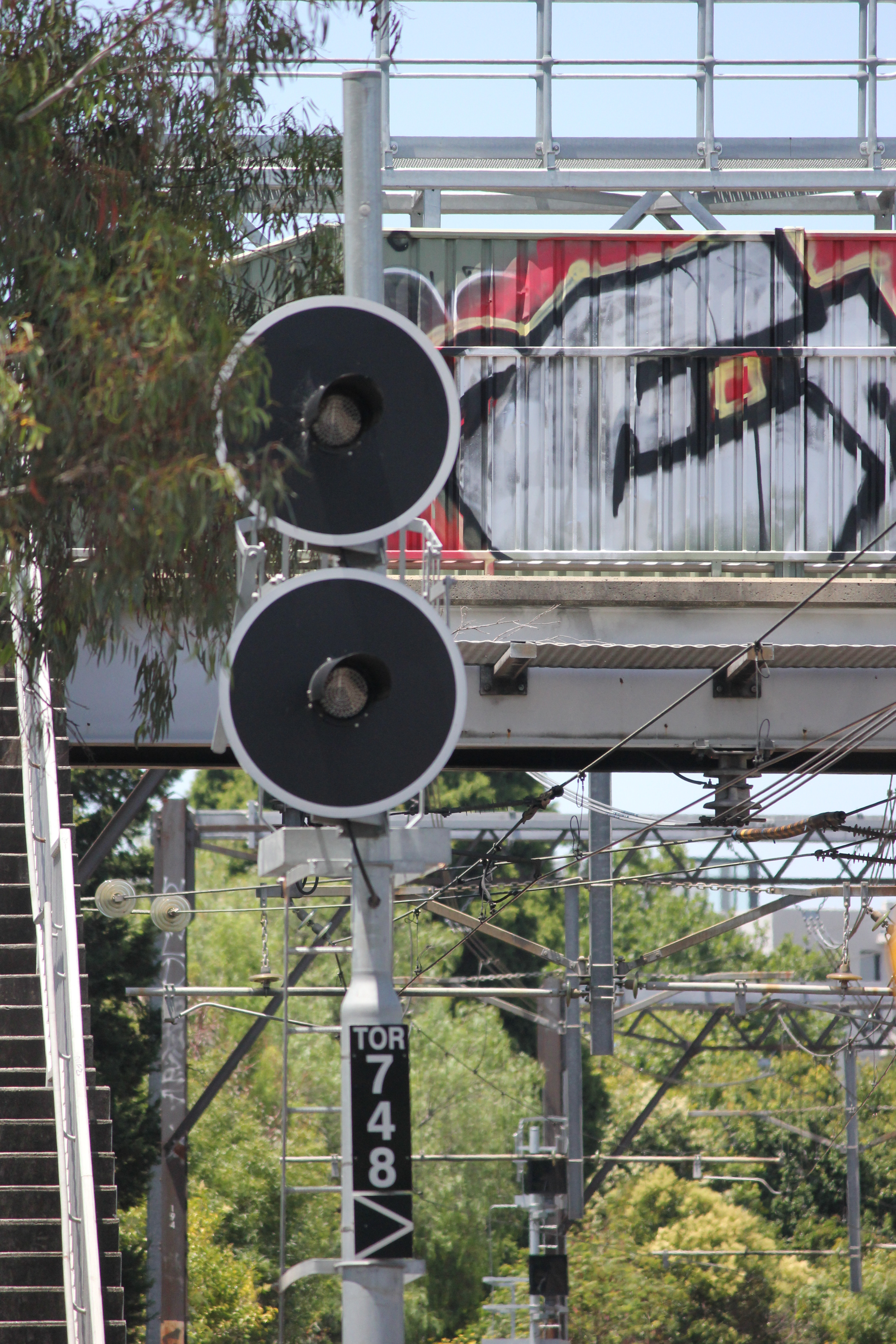
For CBTC trains the signals extinguish. They will light back up to danger once the train has passed if there is nothing following or the train behind is non CBTC.

Signals that extinguish have a Dark Aspect Identification Board. A white arrow pointing to the track it applies next to the signal number:

Non CBTC trains are still required to treat a dark aspect as an irregular aspect.
If a non CBTC train passed a dark aspect they're going to get tripped by the trip stop or the TWPS.
When the signals are extinguished the trip arms raise and TWPS grids stay active. On the HCMT in a CBTC mode(Automatic Mode, Supervised Manual and Restricted Manual) The trip cock raises when it transitions into CBTC.
 

bluegoblin7

Established Member
Joined
10 May 2011
Messages
2,109
Location
JB
It is worth highlighting that ‘CBTC’ is a generic name for the type of signalling, and not all CBTC systems function in the same way. Even different installations of the same product will (rightly) have differences - London’s Seltrac installations are very different to the majority of others.

Any comment (or speculation, which is largely what a lot of this is) about the Uxbridge branch should bear this in mind, and use other Thales/Hitachi Seltrac installations as their yard stick.
 

GFE

Member
Joined
6 Jun 2024
Messages
131
Location
HA4


I think you are getting into the scope for a full book or lecture about "CBTC" :lol:
What Trackside - Train Comms medium/freq range does it have to be? - Wifi, Radiating cable, GSMR, 5G?
What is definition of moving block - what limits to block boundary definition?

My thoughts on why LUL have a variant of the suppliers normal CBTC product:
Normal CBTC signalling control seems to rely on the Trains own communicated "position" when making signalling supervisory decisions ie calling routes and giving trains authority to move/safe speeds).
LUL historically introduced secondary methods of train position detection for higher risk situations eg Berth Track diversity, Deltas/position detectors for route holding.
So in the case of Seltrac CBTC, the use of axle counters and additional local logic for secondary train detection and Points track locking may be the "extra"?

In the case of the areas of the SSL where non CBTC compatible trains operate regularly (Harrow on the Hill - Amersham & Rayners Lane - Uxbridge) the Trackside Seltrac Signaling system has to adequately ascertain the position of all trains (so will rely on a higher than normal provision of axle counter blocks particularly for the non CBTC equipped trains). So the density/positioning of the associated axle detector heads will be critical for headways. Similarly the number and positioning of signal heads/trainstops will limit the headway for a non CBTC equipped trains
 
Last edited:

JustPassingBy

Member
Joined
17 Oct 2018
Messages
73
I see there is a 4-day closure of the Met between Harrow and Amersham between 19-22 Feb. Just wondering what work specifically is planned? Will any new signalling be going live? Thanks
 

Tester

Established Member
Joined
5 Jul 2020
Messages
1,654
Location
Watford
For CBTC trains the signals extinguish. They will light back up to danger once the train has passed if there is nothing following or the train behind is non CBTC.

Signals that extinguish have a Dark Aspect Identification Board. A white arrow pointing to the track it applies next to the signal number:

Non CBTC trains are still required to treat a dark aspect as an irregular aspect.
If a non CBTC train passed a dark aspect they're going to get tripped by the trip stop or the TWPS.
When the signals are extinguished the trip arms raise and TWPS grids stay active. On the HCMT in a CBTC mode(Automatic Mode, Supervised Manual and Restricted Manual) The trip cock raises when it transitions into CBTC.

Worth highlighting for the GB audience that the conventional signalling in the area under discussion has fully braked overlaps. In other words the consequences of a signal passed at danger are massively reduced compared with National Rail overlaps.
 

Nym

Established Member
Joined
2 Mar 2007
Messages
9,778
Location
Somewhere, not in London
Nor is CBTC Seltrac, as the balises are simply like-for-like substitutions for the loop ends.
So one has to wonder, since this is yet another "not moving block but small fixed blocks" signalling system, what was the advantage over DTG-R again? (Other than project politics).

For context to the younger ones among us, DTG-R is what is used on the Victoria Line and is what was supposed to be used on the Sub Surface Railway until someone decided it was a bad idea and wanted to re-let the contract. Twice.

(Is also fully able to integrate with basically any interlocking system, so would have been able to have lights on sticks simply enough (as well as AWS, TPS, Trainstops, etc.) as well as block markers for DTG-R protected equipment.
 

Top