
-
Our new ticketing site is now live! Using either this or the original site (both powered by TrainSplit) helps support the running of the forum with every ticket purchase! Find out more and ask any questions/give us feedback in this thread!
You are using an out of date browser. It may not display this or other websites correctly.
You should upgrade or use an alternative browser.
You should upgrade or use an alternative browser.
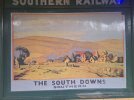
Southern - The South Downs
- Thread starter Jan Mayen
- Start date
- Status
- Not open for further replies.
Sponsor Post - registered members do not see these adverts; click here to register, or click here to log in
R
RailUK Forums
anothertyke
Member
Probably very much idealised but if I had to guess, I'd say based on Ditchling and the Beacon.
I am thinking that Alfriston could be it. They have a church that looks just like that with the very distinctive roof. Also it is in the heart of the South Downs with hills in the background.This painting is at Horsted Keynes. Does anyone know whereabouts on the South Downs it is?
Many thanks
Gloster
Veteran Member
I don’t think it is Alfriston as the church does not have the wing in two parts.
Now you have mentioned that i think it is Berwick where that painting is from. They have a church with a very similar spire but the wing of the roof is in two parts. So i reckon that could be a strong possibility.I don’t think it is Alfriston as the church does not have the wing in two parts.
Gloster
Veteran Member
Now you have mentioned that i think it is Berwick where that painting is from. They have a church with a very similar spire but the wing of the roof is in two parts. So i reckon that could be a strong possibility.
Could be, but Alciston a short way further west might be an alternative.

I think that’s Alciston, but it will be quite hard to tell between Alciston and Berwick as they both have very similar buildings.This painting is at Horsted Keynes. Does anyone know whereabouts on the South Downs it is?
Many thanks
It does still look very idyllic - this was taken two years ago looking over towards Berwick village. The church spire can be seen poking out towards the left of the image.It probably doesn't look so idyllic now would like to see a modern day equivalent.


Mcr Warrior
Veteran Member
- Joined
- 8 Jan 2009
- Messages
- 17,168
Might it possibly be Berwick church (= St. Michael and All Saints), as viewed from the Cuckmere valley, with the South Downs / Bostal Hill in the middle/far distance?

WesternLancer
Veteran Member
- Joined
- 12 Apr 2019
- Messages
- 14,962
I was thinking Berwick / Alfriston / Alciston / Selmeston area but this image makes me think Berwick is probably correct. Maybe with an element of artistic license. It's an area I know well.It does still look very idyllic - this was taken two years ago looking over towards Berwick village. The church spire can be seen poking out towards the left of the image.
View attachment 195165
The NRM archive holds the poster and there is at least one other by the same artist Walter Spradberry in their collection which looks like it was painted in a similar area
They don't give a location but state
Poster, Southern Railway, The South Downs by Walter E Spradbery, 1946. Depicts a pastoral scene on the downs with a stream, cows grazing in a field near a church and the hills of the Downs in the background. Printed by Waterlow & Sons Ltd., London. Ref AD 5484 4000/1946. Format: quad royal. Dimensions: 40 x 50 inches, 1016 x 1270 mm
This being the other poster from 1934 - might be more tricky to find the location! Though I bet its nearby too
Poster, Southern Railway, The South Downs, I'm tired of crowded places, by Walter E Spradbery, 1934. Coloured lithograph depicting the view across fields towards wooden farm buildings, with a stream running across a valley and hills in the background
More specifically:
Berwick Church is the church with significant Bloomsbury Group murals done by artists who lived nearby at Charleston Farmhouse (now open to the public). Its the local village to Berwick Station
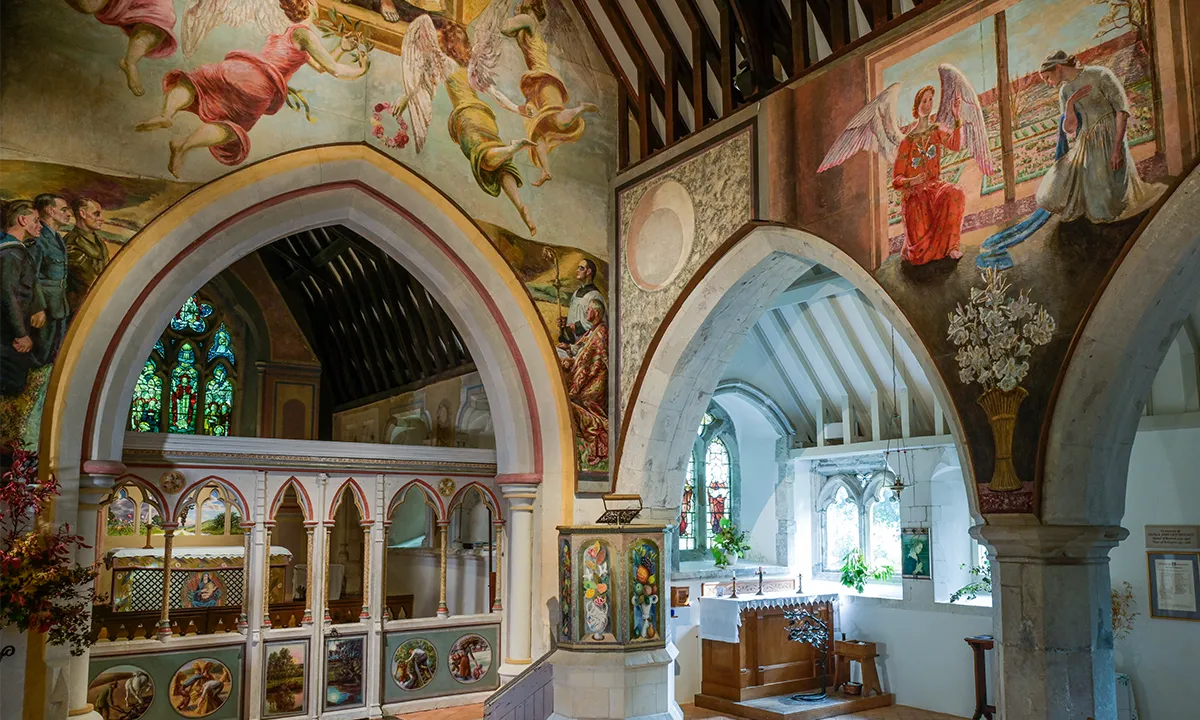
Bloomsbury in Berwick – Berwick Church
Berwick church, East Sussex is famous for its Bloomsbury paintings by the artists Duncan Grant, Vanessa Bell and Quentin Bell.
 www.berwickchurch.org.uk
In 1941, during the Second World War, Bishop Bell of Chichester commissioned the Bloomsbury artists Duncan Grant, Vanessa Bell and her son Quentin Bell, to decorate the interior of the small rural church of St Michael & All Angels, Berwick. This was the first time that contemporary artists of repute had been allowed to completely decorate the interior of an historic country church. Bishop Bell hoped it would bring about a revival of the commissioning of artists by churches.
For a more detailed guide on the Bloomsbury artists and the Berwick commission, see The Bloomsbury Group in Berwick
I always understood that local people provided the models for all or some the people painted in the murals - and this is verified in the entry linked below about the murals
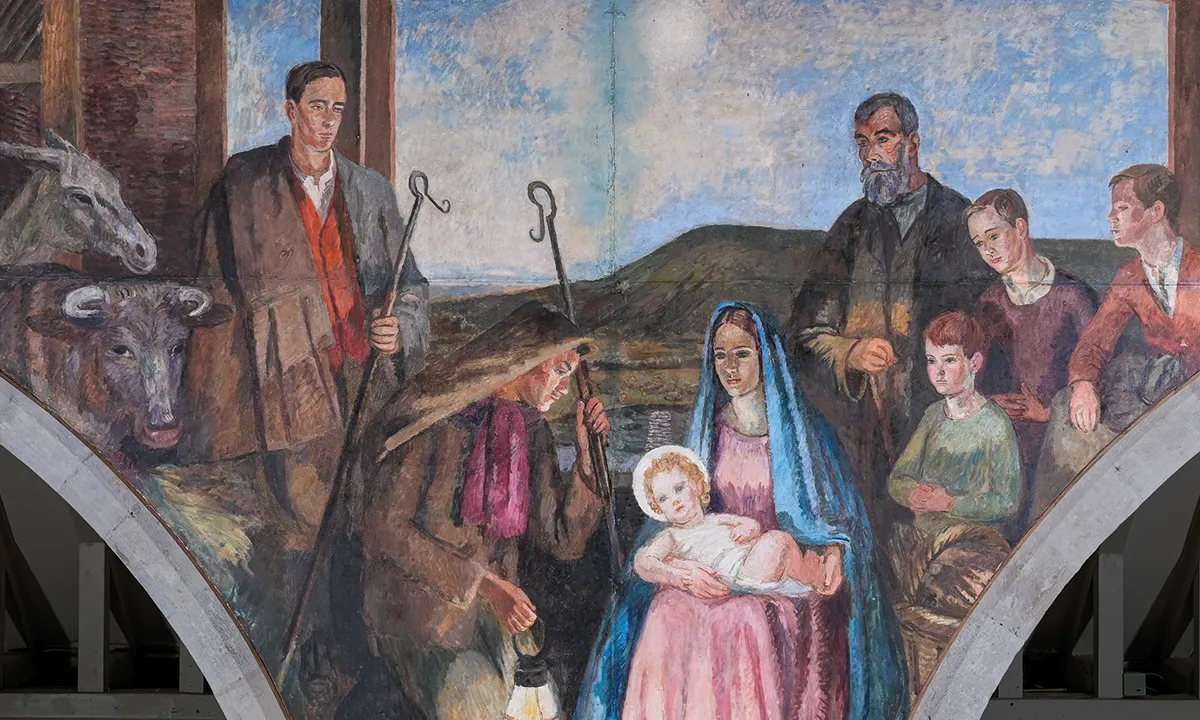
The Nativity by Vanessa Bell – Berwick Church
Berwick church, East Sussex is famous for its Bloomsbury paintings by the artists Duncan Grant, Vanessa Bell and Quentin Bell.
www.berwickchurch.org.uk
extract
Vanessa painted her daughter Angelica as Mary and behind her she painted a farm worker, Mr Peter Durrant, as Joseph. He had fallen off a wagon on his way down from the Downs and damaged his shoulder and had to have his left shoulder and arm amputated. To the right of Joseph are three children, Ray and Bill West, sons of the gardener and John Higgens, son of Grace, the housekeeper. They remember being dressed in their school uniforms, their one smart set of clothes, and having a comb dragged through their hair by their mother before being sent into the studio for Vanessa to draw them. The shepherd to the rear left of the painting was also a farm worker, Stanley Standen (nicknamed ‘Beckett’), who had also lost one of his arms as a child in an accident.
One of the children who modelled for this went on to become the local taxi driver who served Berwick railway station and who as a family we used to use frequently. This would be in the 1980s. A very nice chap indeed, with a lot of local knowledge about the area that interested me greatly. He didn't mention being in the painting to me but somehow we knew about it.
I don't know of any connection between the group of artists and Walter Spradberry who completed these posters for the SR so it may just be a co-incidence but interesting nevertheless.
The village is a little way from the station but it's an easy and pleasant walk along footpaths that would allow this view to be checked out today and loop in other possible churches close by to compare with the poster.
== Doublepost prevention - post automatically merged: ==
If it's one of the churches suspected it's in the South Downs National Park area so a reasonable level of protection.It probably doesn't look so idyllic now would like to see a modern day equivalent.
- Status
- Not open for further replies.