• Our new ticketing site is now live! Using either this or the original site (both powered by TrainSplit) helps support the running of the forum with every ticket purchase! Find out more and ask any questions/give us feedback in this thread!

Why were so many Class 317s ordered for the BedPan electrification?

Status
Not open for further replies.

Mr. SW

Member
Joined
13 Sep 2023
Messages
544
Location
Armchair
The only suggestion I could come up with - and this is speculation not fact - is from the Widened Lines built cut and cover - not bored - tunnels. The height restriction seems to be along and either side of the centre line of vehicle roofs i.e. where todays OLE wire is and where yesterdays carriage roof ventilators were. Tunnels bored with TBMs are circular, tunnels dug manually seem to me to not have flat ceilings but arched. Those with a circular or arched cross section are naturally higher above the centre line, room to squeeze in OLE for example. A cut and cover tunnel may have just been roofed over to clear vehicle height, but leaving it without that little bit extra clearance than an arched or circular tunnel would have. But this is all guess.
At the time of construction, trains had a somewhat smaller profile than to day. Engines were not much more than 12 feet (3.6 metres) over chimney and 8 feet (2.5 metres) wide. Carriages were rigid four or six wheelers, 25 - 30 feet (8 - 9 metres) long, 8 - 8 foot 6 inches (2.5 to 2.6 metres) wide, and about 11 foot 6 inches (3.5 metres) over the tops of the oil lamp cowls. Freight wagons were tiny, just 6, 8 or 10 ton capacity. So it would never occurred to the railway company, its engineers and the construction companies of the period to build anything larger. They weren't clairvoyants. But the railway today has to live with the consequences of the decisions made 130+ years ago. Or make (very) expensive modifications.

Take a look at this Met Carriage from 1892
It's tiny.
 
Sponsor Post - registered members do not see these adverts; click here to register, or click here to log in
R

RailUK Forums

35B

Established Member
Joined
19 Dec 2011
Messages
5,493
At the time of construction, trains had a somewhat smaller profile than to day. Engines were not much more than 12 feet (3.6 metres) over chimney and 8 feet (2.5 metres) wide. Carriages were rigid four or six wheelers, 25 - 30 feet (8 - 9 metres) long, 8 - 8 foot 6 inches (2.5 to 2.6 metres) wide, and about 11 foot 6 inches (3.5 metres) over the tops of the oil lamp cowls. Freight wagons were tiny, just 6, 8 or 10 ton capacity. So it would never occurred to the railway company, its engineers and the construction companies of the period to build anything larger. They weren't clairvoyants. But the railway today has to live with the consequences of the decisions made 130+ years ago. Or make (very) expensive modifications.

Take a look at this Met Carriage from 1892
It's tiny.
The only problem with that view is that, by the time this section was built, most of what we now consider the “standard” loading gauge lines had been built - which do support electrification with much less compromise. That leaves the question of why this line was particularly small.

If we’d been discussing Tyler’s Hill, or Glenfield, I’d absolutely agree. But 35 - 40 years into the railway age?

The least implausible speculation I’ve seen is that of @D7666, over the impact of cut & cover tunnelling. But even that isn’t more than speculation to me.
 

Taunton

Veteran Member
Joined
1 Aug 2013
Messages
12,301
Someone mentioned upthread that the tight section was created at the time of the re-alignment and building the Barbican, which if correct is surprising as it would be expected that something built relatively recently would have had enough clearance for evacuation via side doors..
The restrictions weren't created then, and in fact that's likely the only bit of the route which is to standard dimensions, from Moorgate to Barbican. Having read there were different restrictions to the GN and to the Midland lines, I suspect the tunnels connecting to those were the issue. The restricted Mk1 non-corridor suburban stock was built in the mid-1950s, 10 years before the Barbican diversion was built.

Bear in mind the Widened Lines belonged to the Metropolitan Railway, they must have got minimal revenue from the services run there by other companies, so would spend minimal amounts on any capital improvements.
 

Nicholas Lewis

Established Member
Joined
9 Aug 2019
Messages
8,016
Location
Surrey
The only problem with that view is that, by the time this section was built, most of what we now consider the “standard” loading gauge lines had been built - which do support electrification with much less compromise. That leaves the question of why this line was particularly small.

If we’d been discussing Tyler’s Hill, or Glenfield, I’d absolutely agree. But 35 - 40 years into the railway age?

The least implausible speculation I’ve seen is that of @D7666, over the impact of cut & cover tunnelling. But even that isn’t more than speculation to me.
It was already dual gauge (std+broad) when the line was first opened to Farringdon with only three rails common being adjacent to platform and tunnel side so would that have had a bearing on the profile adopted?
 

edwin_m

Veteran Member
Joined
21 Apr 2013
Messages
28,691
Location
Nottingham
The restrictions weren't created then, and in fact that's likely the only bit of the route which is to standard dimensions, from Moorgate to Barbican. Having read there were different restrictions to the GN and to the Midland lines, I suspect the tunnels connecting to those were the issue. The restricted Mk1 non-corridor suburban stock was built in the mid-1950s, 10 years before the Barbican diversion was built.

Bear in mind the Widened Lines belonged to the Metropolitan Railway, they must have got minimal revenue from the services run there by other companies, so would spend minimal amounts on any capital improvements.
A double track tunnel is unlikely to require stock with end evacuation doors because people can evacuate onto the other track (yes this is a live railway but you would want to stop all trains and cut the power before evacuating via an end door too). Given that the 319s had an emergency end door there must have been a clearance problem somewhere other than the single-track GN connecting tunnels, which went out of use before they came along. If Barbican to Moorgate was totally re-built to standard clearances then the problem must have been the single line tunnels between Farringdon and Barbican.
 

Taunton

Veteran Member
Joined
1 Aug 2013
Messages
12,301
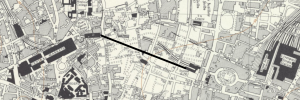
Just to expand, the area of The City which was completely destroyed in WW2 was that between Barbican (then Aldersgate station) and Moorgate, which can be seen on this 1950s map. The Circle Line/Widened Lines were quickly restored as was, but all around was rubble, and eventually the Barbican redevelopment. A new rail route between the stations was built to synchronise with the redevelopment, and of course to modern standards, shown here on the attachment by the thick black line, almost wholly cut-and-cover passing under the centre of the Barbican redevelopment. This was done in the mid-1960s, one track at a time, starting with the westbound Widened Line and finishing with the eastbound Circle Line. The map shows the original alignment; to its south had been the onetime Midland Railway goods depot at Whitecross Street, which was totally lost.

A considerable length of the new route is under the central water feature of The Barbican, which I would have thought was the last thing you wanted over a cut-and-cover railway tunnel. Here's the top of the tunnel and the old map with the diversion route


Attachments

  • Barb.png
    Barb.png
    1.2 MB · Views: 98
Last edited:

ChiefPlanner

Established Member
Joined
6 Sep 2011
Messages
8,331
Location
Herts
Back to the number of 317's ordered - there would have been some consideration of the extension of OLE to Corby for the much vaunted concept

//noah-news.com/the-rise-and-fall-of-wonderworld-corbys-lost-british-theme-park-dream/ "Wonderworld" on the derelict steel works site


(which of course , never happened)
 

Dr Hoo

Established Member
Joined
10 Nov 2015
Messages
5,682
Location
Hope Valley
Back to the number of 317's ordered - there would have been some consideration of the extension of OLE to Corby for the much vaunted concept

//noah-news.com/the-rise-and-fall-of-wonderworld-corbys-lost-british-theme-park-dream/ "Wonderworld" on the derelict steel works site


(which of course , never happened)
Happy to help @ChiefPlanner . My first job was on the Midland Suburban Electrification and the units were ordered in the late 1970s before Corby Wonderworld was even a thing (it got its first planning consent in 1981).
 

D7666

Member
Joined
12 Aug 2013
Messages
998
units were ordered in the late 1970s before Corby Wonderworld was even a thing (it got its first planning consent in 1981).

You beat me to it. Corby - both the town development and possible railway links - was way after MSE authorisation.

Corby steelworks closure was announced in 1979 - and, until then, it had been thought to be /relatively/ safe as it was not down for closure under the 1975 steelworks plan.

I'm pretty sure MSE was Bedford and Bedford only. Anything further north would - at that time - have been part of whatever MML electrification plan BR might have had, which didn't happen anyway as MML got HSTs instead (and they did not serve Corby either).

Corby Wonderworld was a reaction to the steelworks closure and, as stated, only got consent in 1981, after MSE authorisation, indeed after MSE works was under way.

Wonderworld got a recent BBC write up (when this other complex south of Bedford was annoucned earlier his year) :


On a point of order, Wonderworld was not to have been on the steelworks site, but on one of the former ore quarry sites, which were seperate (although rail connected). The link between Corby steelworks and Wonderworld was more or less unemployment (10000+ jobs lost) relief (and no doubt backhanders to do that).
 
Last edited:

Pigeon

Member
Joined
8 Apr 2015
Messages
1,123
The only suggestion I could come up with - and this is speculation not fact - is from the Widened Lines built cut and cover - not bored - tunnels. The height restriction seems to be along and either side of the centre line of vehicle roofs i.e. where todays OLE wire is and where yesterdays carriage roof ventilators were. Tunnels bored with TBMs are circular, tunnels dug manually seem to me to not have flat ceilings but arched. Those with a circular or arched cross section are naturally higher above the centre line, room to squeeze in OLE for example. A cut and cover tunnel may have just been roofed over to clear vehicle height, but leaving it without that little bit extra clearance than an arched or circular tunnel would have. But this is all guess.

"Cut and cover" does not mean "flat-roofed". A conventional arched tunnel structure would be built in the trench and the trench then backfilled. See old pictures of the Met under construction. An arched roof is stronger than a flat one, and is a purely compressive structure so you can build it out of brick. The odd bits of flat-roofed tunnel that do occur, such as may be found along the Embankment stretch of the District line, are where the tunnel roof is the underside of a building or a beam bridge or some similar structure.

What was in the way? Was there bits of st pan station above.

The Midland connection was built as an earlier stage of the whole St Pancras station project; they just dug a great big hole and did what they liked before the station went on top. (There are quite a lot of old pictures floating around that are labelled as "construction of the Met" but are actually the construction of the Midland connection in the big hole that turned into the St Pancras forecourt.)

The GN connections have to squeeze underneath the Fleet sewer, which was diverted into a big cast iron pipe running just above the top of the tunnels and IIRC even interfering with the crown of the arch at one point; it creates an asphyxiation hazard in the blocked-off end of the Maiden Lane curve tunnel by leaking fumes into it.
 

nw1

Established Member
Joined
9 Aug 2013
Messages
9,430
There was also an increase of service with the 317s. Off-peak pre electrification there was 1 tph Bedford to St.Pancras calling all stations to Elstree, then St.Pancras and 1 tph Luton to St.Pancras calling at all stations. With the July 1983 service off-peak was 2 tph Bedford to St.Pancras calling all stations to St.Albans, then non-stop and 2 tph Luton to Moorgate, alternately all stations throughout and all station to Mill Hill Broadway then Kings Cross Midland, Farringdon, Barbican, Moorgate.

Interesting, that differs from what is shown in the 1982 timetable, Table 52 (marked with a caveat "introduction of this service may be delayed", which it evidently was) which shows all 4tph off-peak coming from Moorgate, though otherwise the same stopping pattern as above. Indeed it seemed to be Moorgate for everything Mon-Sat, and (as was) Kings Cross Midland City on Sun.

Presumably this original plan got altered for the 1983 timetable?
 

Snow1964

Established Member
Joined
7 Oct 2019
Messages
11,164
Location
West Wiltshire
Back to the number of 317's ordered - there would have been some consideration of the extension of OLE to Corby for the much vaunted concept

//noah-news.com/the-rise-and-fall-of-wonderworld-corbys-lost-british-theme-park-dream/ "Wonderworld" on the derelict steel works site


(which of course , never happened)
When new they had some extra destinations on the blinds, not sure if Corby was there, but Milton Ernest definitely was. What I can't remember now is if it was 317 or early 319 (or both) that had extra places.

Milton Ernest is about 5 miles north of Bedford, so must have been provision for extension of the electrification and a new station with reversing facilities.

I can only guess that when things were being ordered (around 1979-80) was expectation of an extension to a new station to be opened in a then proposed 'new town'. So might have rounded up the number by couple of units to cover these proposals.

EDIT :
RAF Thurleigh and RAF Twinwood Farm near Milton Ernest was one of the sites for proposed third London airport, along with Maplin Sands, before it was decided to expand the former military airfield at Stansted. So possibly there was to have been an airport spur and extension of electric services too, as the proposal would have seen a big airport linking Thurleigh and Twinwood sites
 
Last edited:

62484GlenLyon

Member
Joined
30 May 2021
Messages
295
Location
Royston
Interesting, that differs from what is shown in the 1982 timetable, Table 52 (marked with a caveat "introduction of this service may be delayed", which it evidently was) which shows all 4tph off-peak coming from Moorgate, though otherwise the same stopping pattern as above. Indeed it seemed to be Moorgate for everything Mon-Sat, and (as was) Kings Cross Midland City on Sun.

Presumably this original plan got altered for the 1983 timetable?
I do not know anything about why the service pattern shown for 1982 was changed for the 1983 timetable. The 1982 timetable could not have applied until at least August as the route wasn't ready. There was a possession over the weekend of 3/4 July when the old signal box at St.Pancras was closed with West Hampstead PSB taking over. This was the last major infrastructure work to be completed on the scheme although some minor works continued for a while afterwards.

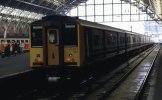
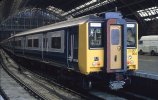
The introduction of electric working was still delayed as there was an industrial relations issue regarding Driver Only Operation that wasn't resolved until March 1983. From 1981 siding space at the southern end of the Midland Main Line was chocker-block full of 317 units that stood forlornly out of use awaiting that resolution.

Training on the 317s started as soon as BR and the unions reached agreemnt out to Churchyard Sidings (pretty much where the country end of the MML platforms are today) for use by the training staff. By the beginning of May the 317s were being drip-fed more widely into service working to the DMU schedule. The full electric service started on 11th July.

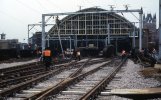
The hazards of working with these new trains that had a contraption on the roof that could be raised and retracted as necessary to collect power was brought home one afternoon in April 1983. The old signal box at St.Pancras, located adjacent to the country end of the one time platforms 1 and 2, was being demolished. Scaffold had been erected which fouled the OLE but didn't block access for diesel trains. The wires were isolated and a Blocked to Electric Traction (BTET) notice was in force. However, this didn't prevent a route being set for an 8 car 317 formation, 317302 leading 317308 (latterly 317502 and 317708). The mounts of 317302's pantograph were sheared off and the heads of both units pans were left hanging ignominiously from the scaffolding poles. I didn't have my camera with me that day unfortunately. I am able, though, to attach a photo taken in July 1982 (after I had been to a site meeting) showing where the signal box was located - it is to the right of the view, partly obscuring the lower right of the train shed roof.

== Doublepost prevention - post automatically merged: ==
 

Attachments

  • 1982.07.14 St.Pancras view from ground level of station throat during modernisation work.jpg
    1982.07.14 St.Pancras view from ground level of station throat during modernisation work.jpg
    516.9 KB · Views: 68
  • 1983.03.29  St.Pancras 317321 09.35 from Bedford.jpg
    1983.03.29 St.Pancras 317321 09.35 from Bedford.jpg
    384.8 KB · Views: 67
  • 1983.03.29 St.Pancras 317304 with 317321.jpg
    1983.03.29 St.Pancras 317304 with 317321.jpg
    399.4 KB · Views: 67

Magdalia

Established Member
Joined
1 Jan 2022
Messages
7,397
Location
The Fens
EDIT :
RAF Thurleigh and RAF Twinwood Farm near Milton Ernest was one of the sites for proposed third London airport, along with Maplin Sands, before it was decided to expand the former military airfield at Stansted.
The Roskill Commission, which reported in 1971, examined sites for London's third airport. There was a short list of 4 sites, including Thurleigh and Maplin, but the recommendation was for Cublington, which is near Leighton Buzzard and occasionally makes cameo appearances in discussions about HS2 and East West Rail. The fourth short list site was Nuthampstead near Royston.

The government rejected the Roskill Commission recommendation, opting for Maplin, which then got cancelled.

It was all a long time before the BedPan electrification was approved.
 

station_road

Member
Joined
3 Mar 2021
Messages
338
Location
By the sea
The introduction of electric working was still delayed as there was an industrial relations issue regarding Driver Only Operation that wasn't resolved until March 1983. From 1981 siding space at the southern end of the Midland Main Line was chocker-block full of 317 units that stood forlornly out of use awaiting that resolution.
Not just the southern end - there were also a number of 317s parked in sidings near Nottingham that you passed when arriving from Derby, although I can't remember exactly where
 

Harvester

Established Member
Joined
9 Nov 2020
Messages
1,768
Location
Notts
Not just the southern end - there were also a number of 317s parked in sidings near Nottingham that you passed when arriving from Derby, although I can't remember exactly where
I can remember these 317 units stored at Nottingham in early 1983. They were parked in the west yard near Lenton north junction. The sidings have long gone, but back then they were easily visible from passing Derby-Nottingham trains.
 
Status
Not open for further replies.

Top