• Our new ticketing site is now live! Using either this or the original site (both powered by TrainSplit) helps support the running of the forum with every ticket purchase! Find out more and ask any questions/give us feedback in this thread!

UK switching to electric vehicles discussion

mike57

Established Member
Joined
13 Mar 2015
Messages
2,369
Location
East coast of Yorkshire
If your drier can dry a full load in 90 mins at 2kW, it’s much better than mine)

In 2024, average mileage per car was 6,500 miles.
Ours actually has two heat settings, 1.2kW and 2.4kW, we actually find the lower heat for longer is slightly more efficent. On high heat it takes about 75-80 mins, but on low heat it will take around 110 minutes, we discovered this almost by accident, as 1 of the two heating elements failed a few years ago, and we found that it didnt take twice as long, so we now always use the lower setting. I dont know if it makes any difference, but dryer is in a dry outbuilding and properly vented with a short vent.

Average milage includes everyone, including city/town dwellers who probably use public transport or walking for quite a lot of journeys, in a rural area such as ours I suspect our 8500 pa is pretty much the minimum, with other people locally racking up 12,000+ if they commute 20-30 miles a day, which is not untypical.
 
Sponsor Post - registered members do not see these adverts; click here to register, or click here to log in
R

RailUK Forums

bspahh

Established Member
Joined
5 Jan 2017
Messages
2,414
Average milage includes everyone, including city/town dwellers who probably use public transport or walking for quite a lot of journeys, in a rural area such as ours I suspect our 8500 pa is pretty much the minimum, with other people locally racking up 12,000+ if they commute 20-30 miles a day, which is not untypical.
https://www.gov.uk/government/statistical-data-sets/nts09-vehicle-mileage-and-occupancy links to the spreadsheet NTS0901 with the annual mileage by fuel type:

Year Petrol Diesel Hybrid Battery All 2002 8,600 12,900 [x] [x] 9,200 2003 8,500 13,300 [x] [x] 9,200 2004 8,300 13,300 [x] [x] 9,100 2005 8,100 12,900 [x] [x] 9,000 2006 7,800 12,800 [x] [x] 8,800 2007 7,800 12,800 [x] [x] 8,900 2008 7,600 12,000 [x] [x] 8,600 2009 7,200 11,500 [x] [x] 8,400 2010 7,100 11,400 [x] [x] 8,300 2011 7,000 10,900 [x] [x] 8,200 2012 6,800 11,000 [x] [x] 8,100 2013 6,700 10,600 [x] [x] 8,000 2014 6,700 10,600 [x] [x] 8,000 2015 6,500 10,600 [x] [x] 8,000 2016 6,500 10,200 [x] [x] 7,900 2017 6,500 10,100 [x] [x] 7,900 2018 6,600 9,400 [x] [x] 7,800 2019 6,400 9,500 [x] [x] 7,600 2020 5,900 8,500 [x] [x] 6,900 2021 4,700 6,600 [x] [x] 5,400 2022 6,000 8,000 [x] [x] 6,800 2023 6,100 8,300 8,300 [u] 7,000 2024 6,200 8,300 8,000 8,900 7,100
 
Last edited:

Harpers Tate

Established Member
Joined
10 May 2013
Messages
2,035
...tyres and brakes. Which EVs have, and are more likely to wear through due to their shear weight
Half of that is patently wrong, and the other half is not my experience.
EVs do NOT use brakes to anything like the same extent as ICEs as a large proportion of the retard effort is obtained not through friction (brakes) but through regeneration. I'd guess (without measuring it) they probably last ~10x as long as those in an ICE.
And my EV tyres are lasting for about as many miles as any of the various ICEs I had previously.
 

Trainman40083

Established Member
Joined
29 Jan 2024
Messages
4,524
Location
Derby
At Sainsbury's Kingsway in Derby, all the cables on the charging reports got stolen according to the local news.
 

Harpers Tate

Established Member
Joined
10 May 2013
Messages
2,035
In this YouTube video,
the host reports on the state of his MG5 EV (estate) which is 3 years old and has covered >143k miles. Salient points to note:

1: First (factory) tyres lasted 43k miles
2: Original brake components still in use and the pads are almost as new
3: Battery State of Health 91%
 

AM9

Veteran Member
Joined
13 May 2014
Messages
16,012
Location
St Albans
At Sainsbury's Kingsway in Derby, all the cables on the charging reports got stolen according to the local news.
What has that to do with this thread on switching to EVs in the UK. Have you never heard of petrol theft, stolen catalytic converters etc.?
 

Peter Sarf

Established Member
Joined
12 Oct 2010
Messages
9,580
Location
Croydon
https://www.gov.uk/government/statistical-data-sets/nts09-vehicle-mileage-and-occupancy links to the spreadsheet NTS0901 with the annual mileage by fuel type:

Year Petrol Diesel Hybrid Battery All 2002 8,600 12,900 [x] [x] 9,200 2003 8,500 13,300 [x] [x] 9,200 2004 8,300 13,300 [x] [x] 9,100 2005 8,100 12,900 [x] [x] 9,000 2006 7,800 12,800 [x] [x] 8,800 2007 7,800 12,800 [x] [x] 8,900 2008 7,600 12,000 [x] [x] 8,600 2009 7,200 11,500 [x] [x] 8,400 2010 7,100 11,400 [x] [x] 8,300 2011 7,000 10,900 [x] [x] 8,200 2012 6,800 11,000 [x] [x] 8,100 2013 6,700 10,600 [x] [x] 8,000 2014 6,700 10,600 [x] [x] 8,000 2015 6,500 10,600 [x] [x] 8,000 2016 6,500 10,200 [x] [x] 7,900 2017 6,500 10,100 [x] [x] 7,900 2018 6,600 9,400 [x] [x] 7,800 2019 6,400 9,500 [x] [x] 7,600 2020 5,900 8,500 [x] [x] 6,900 2021 4,700 6,600 [x] [x] 5,400 2022 6,000 8,000 [x] [x] 6,800 2023 6,100 8,300 8,300 [u] 7,000 2024 6,200 8,300 8,000 8,900 7,100
Interesting.
I see diesel mileage has gone down by 33% and Petrol by about 25% even before Hybrid or EVs took effect.
Everyone seems to be driving less ?.
 

JamesT

Established Member
Joined
25 Feb 2015
Messages
4,827
Interesting.
I see diesel mileage has gone down by 33% and Petrol by about 25% even before Hybrid or EVs took effect.
Everyone seems to be driving less ?.
Reading the notes in the spreadsheet [x] means question not asked. The overall mileage hasn’t dropped as quickly as the ICE columns, so there will be some EV ramping up.
 

bspahh

Established Member
Joined
5 Jan 2017
Messages
2,414
Interesting.
I see diesel mileage has gone down by 33% and Petrol by about 25% even before Hybrid or EVs took effect.
Everyone seems to be driving less ?.
There is another tab in the spreadsheet with a breakdown of mileage as business/commuting/private mileage.

Year Business Commuting Private Total 2002 1,300 2,700 5,100 9,200 2003 1,200 2,800 5,100 9,200 2004 1,100 2,800 5,200 9,100 2005 1,100 2,800 5,100 9,000 2006 1,100 2,800 4,900 8,800 2007 1,100 2,700 5,000 8,900 2008 1,100 2,700 4,900 8,600 2009 1,000 2,500 4,900 8,400 2010 900 2,700 4,800 8,300 2011 900 2,500 4,700 8,200 2012 900 2,500 4,700 8,100 2013 700 2,800 4,500 8,000 2014 700 2,800 4,500 8,000 2015 600 2,900 4,500 8,000 2016 700 2,700 4,500 7,900 2017 500 2,800 4,500 7,900 2018 500 2,700 4,600 7,800 2019 400 2,700 4,500 7,600 2020 200 2,500 4,200 6,900 2021 200 1,800 3,400 5,400 2022 400 2,200 4,200 6,800 2023 400 2,300 4,400 7,000 2024 400 2,200 4,500 7,100

Lots of business miles and some of the commuting miles have been replaced by Zoom/Teams. Most of the business miles will be in a hybrid or electric car, for the tax savings.

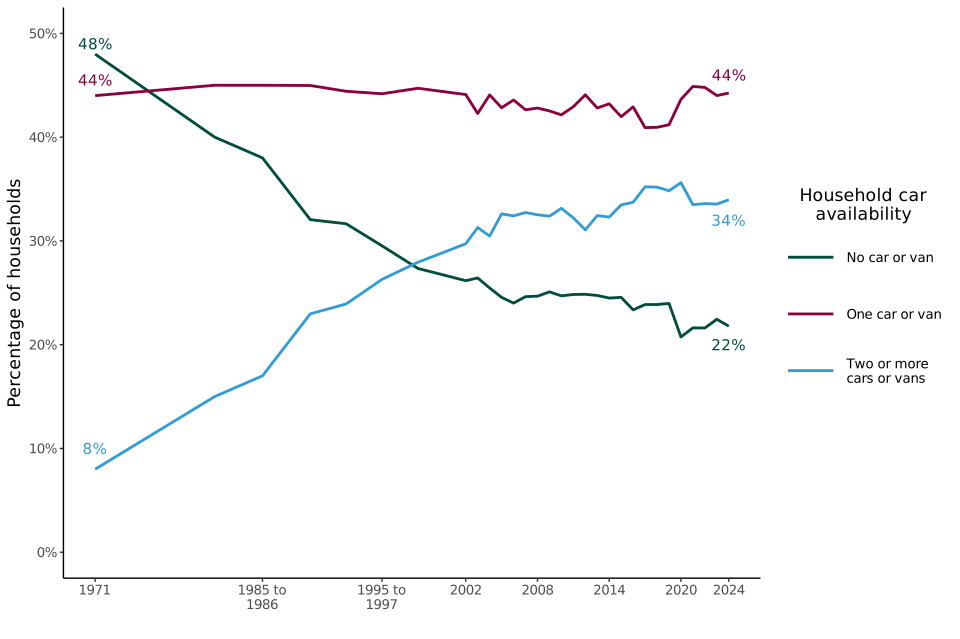
Some of the decrease in the average mileage for each car, could be from an increase in number of cars per head of population.

https://www.gov.uk/government/stati...hold-car-availability-and-trends-in-car-trips has this plot
Plot of the percentage of cars in each UK household between 1971 and 2024
 

Mawkie

Established Member
Joined
17 Feb 2016
Messages
1,242
R Symons has uploaded an interesting video today based on the running costs of 'Miles', their 238k, 4yr old Tesla Model 3.

Hopefully it finally puts to bed the idea that electric cars can't do high mileages, can't be used for long distance travel (they recently took it on a tour of Scotland), but I think the biggest surprise for a lot of people will be the savings comparison figures on total fuel costs - it's eyewatering! I'm not being click-baity, just don't want to spoil anything for someone watching.

For me personally, I was surprised that regen braking had provided 30% of their total vehicle charging.
Screenshot_2025-12-23-12-06-55-48_64ef5fc2000c1caa954c114bb372e1d5.jpg
(Image shows charging percentages as AC 56%, DC 14%, and Regen 30%)


jon0844

Veteran Member
Joined
1 Feb 2009
Messages
30,841
Location
UK
On social media, there are so many people who keep telling us all that we need to buy a diesel so we can do 400-600 miles on a single fill up. I am yet to work out if they think they're going to make EV owners realise their mistake and go back.

Most, if not all, EV owners had a petrol or diesel car before.. probably many. Most remember what it was like to fill up having done it thousands of times. They don't miss it.

They don't miss waiting for a diesel car to warm up on a cold morning, the tractor-like noise and the potentially high running costs if you keep one for many years. In fact, the quick fill up time is pretty much the ONLY thing you could see as a positive.

And in any case, sales of diesel cars is constantly moving towards 0% so I wonder how long it will be until these 'diesel is best' people will give up and move on to ranting about something else.

(I've owned multiple diesel cars. They served a purpose at the time, and anyone who still has one - great - but I would never buy one today. If I wasn't going to get an EV, I'd have just got a regular petrol car).
 

61653 HTAFC

Veteran Member
Joined
18 Dec 2012
Messages
19,347
Location
Yorkshire
What has that to do with this thread on switching to EVs in the UK. Have you never heard of petrol theft, stolen catalytic converters etc.?
If you were planning to use those chargers, you now can't do so and will have to find an alternative. If such thefts become common it'll become a factor for EV users. How much of a factor will depend on the circumstances of an individual, but it isn't an irrelevance.

If someone "bilks" fuel from a filling station, it doesn't take that filling station out of action for other users (though it may temporarily render the specific pump or nozzle unusable for a short period, for evidential reasons). Likewise having your catalytic converter stolen is a pain in the proverbial for you as a victim of that theft, but doesn't affect other vehicles or drivers.
 

AM9

Veteran Member
Joined
13 May 2014
Messages
16,012
Location
St Albans
If you were planning to use those chargers, you now can't do so and will have to find an alternative. If such thefts become common it'll become a factor for EV users. How much of a factor will depend on the circumstances of an individual, but it isn't an irrelevance.

If someone "bilks" fuel from a filling station, it doesn't take that filling station out of action for other users (though it may temporarily render the specific pump or nozzle unusable for a short period, for evidential reasons). Likewise having your catalytic converter stolen is a pain in the proverbial for you as a victim of that theft, but doesn't affect other vehicles or drivers.
1) if cables on charging stations are stolen, they will replaced and additional security measures taken to reduce or eradicate a repeat event. Chargers are revenue generating (or in the case of a supermarket location, a facility supplied for customers) installations. Your response indicates that you think simple isolated examples of cable theft will make public chargers abandoned for good.
2) I was referring to fuel theft from vehicles, not filling stations. Although manufacturers have added features that make syphoning fuel more difficult, it is by no means impossible for an accomplished thief.
3) At times in some areas, catalytic converter thefts can be fairly widespread, - I know at least two people who in the past three years have had theirs stolen.

So theft of charger cables at one Sainsbury site in Derby is going to paralyse the whole area for EV drivers, - except for those who:
charge at home​
charge at their employers' premises​
charge at Tesco/Asda/Morrison/et al​
take a one off trip to Nottingham/Burton on Trent to charge​
or don't need to charge in the few days before the Sainsbury installation is back in service.

To me, claiming that the isolated theft of unsecured cables from a Sainsbury site in Derby threatens the UK's transition to EVs is really clutching at straws.
 

bspahh

Established Member
Joined
5 Jan 2017
Messages
2,414
Most, if not all, EV owners had a petrol or diesel car before.. probably many. Most remember what it was like to fill up having done it thousands of times. They don't miss it.
To use a diesel pump, I never had to install an app, validate my email address, mobile phone and credit card before it will sell me diesel. I have had to do that for several chargers. I could have driven to another charger, that took an Electroverse or contactless card, but I wanted to use one that was convenient for where I was.

There have been times when I have left a filling station without being able to fill up with fuel, but has been pretty rare, much less frequent than once a year. I've had my electric car for 5 months, and it has happened about 10 times.

It has been for a variety of reasons: once I couldn't find the charger. Several times the chargers have been working, but used by someone else. Several times they has been out of action for everyone. Several times I have been able to log in, plug in and failed to get any charge. A couple of times the only available charger has been a 7kW one, so I gave up.

There are good things about electric cars. Charging it on a holiday or long journey isn't one of them.
 

Harpers Tate

Established Member
Joined
10 May 2013
Messages
2,035
All new DC rapid charger installations are contactless. Legacy units (of which there are relatively few) may not be but are incrementally being converted. No app nor account nor other formality needed. Pay at the pump.

It's not the case generally with AC (slow) chargers ("destination" chargers). These typically do require some sort of activation using a smartphone.

As to the rest of your described experience, you appear to have been very unlucky.
 

jon0844

Veteran Member
Joined
1 Feb 2009
Messages
30,841
Location
UK
To use a diesel pump, I never had to install an app, validate my email address, mobile phone and credit card before it will sell me diesel. I have had to do that for several chargers. I could have driven to another charger, that took an Electroverse or contactless card, but I wanted to use one that was convenient for where I was.

There have been times when I have left a filling station without being able to fill up with fuel, but has been pretty rare, much less frequent than once a year. I've had my electric car for 5 months, and it has happened about 10 times.

It has been for a variety of reasons: once I couldn't find the charger. Several times the chargers have been working, but used by someone else. Several times they has been out of action for everyone. Several times I have been able to log in, plug in and failed to get any charge. A couple of times the only available charger has been a 7kW one, so I gave up.

There are good things about electric cars. Charging it on a holiday or long journey isn't one of them.

There are over 120,000 chargers out there, and many app show where they all are and how many bays are free - so finding a charger without a queue (and one that is working) is easy. I initially feared it might be hard to find a charger in a large car park/retail park, but they're always shown clearly on the screen and the navigation takes you right to the bays.

You absolutely do not have to give any details to charge, as all chargers (well above 50kWh anyway) MUST accept contactless, and I think it now applies to older ones. In some cases I've heard of places reducing the power output to 49kWh to avoid the rules, but I'd avoid those out of principle.

If you get a discount card for petrol or diesel you need to give details, so what's the difference between that and an app? The company that seems to want the most information (including age verification.. needing a passport photo or something) is Shell, which has an incentive to make charging an EV an unpleasant experience so you will stick with fossil fuels. I avoided Shell for petrol, and will gladly avoid for electricity.
 

Mawkie

Established Member
Joined
17 Feb 2016
Messages
1,242
You absolutely do not have to give any details to charge, as all chargers (well above 50kWh anyway) MUST accept contactless, and I think it now applies to older ones.
The Tesla V4 Supercharger cabinets have a tiny screen and contactless payments terminal, no app required. However, if you use the app, you get a much better rate. ;) The older ones don't, so not sure how they are getting around the new law.

One way the various charge point operators are upgrading older arrays without contactless terminals is to provide a single contactless point for the whole array - often difficult to see!
 

jon0844

Veteran Member
Joined
1 Feb 2009
Messages
30,841
Location
UK
The Tesla V4 Supercharger cabinets have a tiny screen and contactless payments terminal, no app required. However, if you use the app, you get a much better rate. ;) The older ones don't, so not sure how they are getting around the new law.

One way the various charge point operators are upgrading older arrays without contactless terminals is to provide a single contactless point for the whole array - often difficult to see!

The ones without card readers most likely aren't open to all. I am sure Tesla can avoid the rules if they have their own private network for Tesla owners only?

I haven't been to a site without a card reader yet, but that's probably because I mostly charge at home and really don't use fast chargers that much. When I had issues with my home charger, I did use a local site with an Octopus Electroverse card. I can either use a physical card, the app on my phone or even on Android Auto (not tried the latter, and forgot all about it). As I'm an Octopus customer, I could just have it added to my energy bill and provide no more information than what they already have.

More and more sites are getting Electroverse acceptance, and that's apparently another part of legislation - every site must support at least one of these card schemes.

Going forward, I'd argue that the app price should be the same as the contactless price. Not that I want the app price going up, rather I think it unfair to penalise people who don't want to register on an app. What an app could and should do is allow you to subscribe for discounts, which seems fair - although I guess they'd just do a subscription for £0 per month that reduces the price.

I am sure the idea of requiring contactless support wasn't so that as time goes on, it can be far more expensive than using an app... but that's up to the Government to regulate....
 

Mawkie

Established Member
Joined
17 Feb 2016
Messages
1,242
More and more sites are getting Electroverse acceptance, and that's apparently another part of legislation - every site must support at least one of these card schemes.
One of the benefits of Electroverse over contactless is the avoidance of the terrible "pre-authorisation" charges. They can really add up if you don't get connected on the first attempt.
The older ones are Tesla only, not open to all so are a private, not public network.
Thanks.
 

bspahh

Established Member
Joined
5 Jan 2017
Messages
2,414
There are over 120,000 chargers out there, and many app show where they all are and how many bays are free - so finding a charger without a queue (and one that is working) is easy. I initially feared it might be hard to find a charger in a large car park/retail park, but they're always shown clearly on the screen and the navigation takes you right to the bays.

You absolutely do not have to give any details to charge, as all chargers (well above 50kWh anyway) MUST accept contactless, and I think it now applies to older ones. In some cases I've heard of places reducing the power output to 49kWh to avoid the rules, but I'd avoid those out of principle.
Petrol stations are bigger than most charging stations. They have lights, canopies and are easier to spot, than a charger in the corner of a car park. I've just had a look online for the charger that I failed to find. Its in the corner of an Aldi car park behind some bushes.

Fast chargers might all take a contactless card, but they cost more, and they tend to be ones where you can't leave the car for hours at a time. I want the car to fit around me, and not make me plan around it.

I went from Cambridgeshire to Bath for a couple of days.
  1. When I set off from home, my home charger had stopped when there was about 75% charge. It was cold, so I would have had about 210 miles range with a full charge, but I would now need to top up en-route to be safe.
  2. I stopped in Welwyn Garden City for a 150kW charger with a contactless card. It worked, but meant sitting for 15 minutes in an empty pub car park.
  3. 7kW chargers at Bath University needed the Podpoint app, which I had to install.
  4. In the evening, I used the 150kW BP Pulse chargers next to the Travelodge where I was staying. I used a contactless card. It worked.
  5. A 22kW charger in Frome whilst I had dinner needed a blink app, which I had already installed, but it didn't work.
  6. Later I tried the BP Pulse charger next to the Travelodge. The first time I went out, both chargers were busy. The second time, one was available, but using a contactless card failed. I installed the BP Pulse app, but that failed too. I tried another contactless card. By that time, the other charger was available. I tried that but it also failed. I gave up.
  7. The next day, I parked at a Bath Park and Ride, and used a 7kW charger with my Electroverse card.
I used 6 chargers, 2 of which would only work with their app. 2 of the chargers failed, including one that had worked for me the day before.

The difference with a diesel car is that I would have been able to do fill up at home, done the whole trip and still had a third of a tank of fuel when I got home.

If you get a discount card for petrol or diesel you need to give details, so what's the difference between that and an app? The company that seems to want the most information (including age verification.. needing a passport photo or something) is Shell, which has an incentive to make charging an EV an unpleasant experience so you will stick with fossil fuels. I avoided Shell for petrol, and will gladly avoid for electricity.
I have a Nectar card, and a BP card, but they get me a saving of percent or so. Without the Podpoint and blink apps, you don't get any power.

 

jon0844

Veteran Member
Joined
1 Feb 2009
Messages
30,841
Location
UK
I used to find petrol stations through a navigation app, so what's the difference between finding a petrol station and a public EV charger?

I'm yet to visit an EV charging site that's dark or hidden. Some are quiet, yes, if charging at night - which isn't really something I would do. My days of driving through the night are long over, and I suspect most people plan to get to their destination, or a hotel, if it gets really late. Of course, charging after 7pm can often be a lot cheaper these days.

I never just drove until I saw a petrol station as I've always checked prices. Before it was TomTom telling me and now I use an app like A Better Route Planner, which will solve all of the problems you mention because you choose the sites you prefer, and those you don't want to use. It will only pick sites that are working and have bays available, and you can even say you want toilet facilities, food/coffee or other things (e.g. a play area for kids, or a picnic area etc).

Even if I still had my petrol car, I'd be using technology to improve and optimise my journey and doing some basic planning ahead of time.
 

bspahh

Established Member
Joined
5 Jan 2017
Messages
2,414
I used to find petrol stations through a navigation app, so what's the difference between finding a petrol station and a public EV charger?

I'm yet to visit an EV charging site that's dark or hidden.
The one I failed to find is linked to Google Maps if you click the image below. The ones at the top show the charger from extra images. The image at the bottom is from Google Streetview, from before the installation of the charger. I highlighted the position of the charger in magenta. It was dark and wet when I was looking for it.
1766529701140.png
That charger is smaller than any petrol station I have ever used.

I never just drove until I saw a petrol station as I've always checked prices.
My diesel has 3 times the range of my electric car. If I drove past somewhere with particularly cheap fuel, I might stop before I had to. When I had less than 100 miles range left, or on a long trip I might plan to stop at a supermarket with cheap fuel. The difference between cheap diesel and expensive diesel is a few percent (ignoring motorway service stations and places in the middle of nowhere). With an electric car, there is a much wider range of costs for charging.

Before it was TomTom telling me and now I use an app like A Better Route Planner, which will solve all of the problems you mention because you choose the sites you prefer, and those you don't want to use. It will only pick sites that are working and have bays available, and you can even say you want toilet facilities, food/coffee or other things (e.g. a play area for kids, or a picnic area etc).

Even if I still had my petrol car, I'd be using technology to improve and optimise my journey and doing some basic planning ahead of time.

I use A Better Route Planner to suggest fast chargers for a long journey, but I use Waze for navigation. There is a limit to how much attention I can put into picking stops whilst I'm driving. I used Zapmap to see if the BP pulse chargers were free when I was in my hotel room 50m away.

Charging an electric car is adequate at the moment, but it could and should be much better.
 

Mawkie

Established Member
Joined
17 Feb 2016
Messages
1,242
Charging an electric car is adequate at the moment, but it could and should be much better.
No, charging your electric car is adequate with the choices you made.

There are other cars and drivers that have a wholly different experience. I have yet to have a failed charge, yet to not be able to find a charger, yet to queue, yet to faff around with a dozen apps. My inbuilt sat nav guides me to available chargers only when necessary, and charges at up to 250 kW - that shows as 1000mph on my entertainment screen - and charged at 40p per unit or less, last time it was 22p

Here is a map of the Tesla Superchargers that are "open to all", Swindon is currently 55p peak, 37p off peak for non members (41p/23p for members).

Screenshot_2025-12-24-00-04-01-80_40deb401b9ffe8e1df2f1cc5ba480b12.jpg
 

bspahh

Established Member
Joined
5 Jan 2017
Messages
2,414
No, charging your electric car is adequate with the choices you made.
I choose not to spend my money with Tesla because of
  • Their CEO
  • I want a car with physical controls for settings like the heating, indicators etc.
These are the Tesla chargers near Bath - a fast charger at a motorway service station and slow chargers elsewhere, not where I wanted to be.
Map showing Tesla chargers within ~20 miles of Bath
 

jon0844

Veteran Member
Joined
1 Feb 2009
Messages
30,841
Location
UK
The one I failed to find is linked to Google Maps if you click the image below. The ones at the top show the charger from extra images. The image at the bottom is from Google Streetview, from before the installation of the charger. I highlighted the position of the charger in magenta. It was dark and wet when I was looking for it.
View attachment 194668
That charger is smaller than any petrol station I have ever used.

What the heck is that charger you posted photos of? That's a destination charger surely?

If you weren't staying there or visiting something then surely you wouldn't be using what I assume is a 7 or maybe 11kWh AC charger? It would take hours to charge.

Destination chargers are often not even on all apps.

== Doublepost prevention - post automatically merged: ==

I choose not to spend my money with Tesla because of
  • Their CEO
  • I want a car with physical controls for settings like the heating, indicators etc.
These are the Tesla chargers near Bath - a fast charger at a motorway service station and slow chargers elsewhere, not where I wanted to be.
View attachment 194670

I respect that. I chose not to buy a Tesla Powerwall battery for my home and wouldn't buy a car, but I am using the EV chargers. Perhaps that makes me a sellout, but they're cheap and convenient.
 

Noddy

Established Member
Joined
11 Oct 2014
Messages
1,631
Location
UK
Petrol stations are bigger than most charging stations. They have lights, canopies and are easier to spot, than a charger in the corner of a car park. I've just had a look online for the charger that I failed to find. Its in the corner of an Aldi car park behind some bushes.

Fast chargers might all take a contactless card, but they cost more, and they tend to be ones where you can't leave the car for hours at a time. I want the car to fit around me, and not make me plan around it.

I went from Cambridgeshire to Bath for a couple of days.
  1. When I set off from home, my home charger had stopped when there was about 75% charge. It was cold, so I would have had about 210 miles range with a full charge, but I would now need to top up en-route to be safe.
  2. I stopped in Welwyn Garden City for a 150kW charger with a contactless card. It worked, but meant sitting for 15 minutes in an empty pub car park.
  3. 7kW chargers at Bath University needed the Podpoint app, which I had to install.
  4. In the evening, I used the 150kW BP Pulse chargers next to the Travelodge where I was staying. I used a contactless card. It worked.
  5. A 22kW charger in Frome whilst I had dinner needed a blink app, which I had already installed, but it didn't work.
  6. Later I tried the BP Pulse charger next to the Travelodge. The first time I went out, both chargers were busy. The second time, one was available, but using a contactless card failed. I installed the BP Pulse app, but that failed too. I tried another contactless card. By that time, the other charger was available. I tried that but it also failed. I gave up.
  7. The next day, I parked at a Bath Park and Ride, and used a 7kW charger with my Electroverse card.
I used 6 chargers, 2 of which would only work with their app. 2 of the chargers failed, including one that had worked for me the day before.

The difference with a diesel car is that I would have been able to do fill up at home, done the whole trip and still had a third of a tank of fuel when I got home.


I have a Nectar card, and a BP card, but they get me a saving of percent or so. Without the Podpoint and blink apps, you don't get any power.

I don’t understand why you needed to charge the car so much if you were only there a couple of days.

If you left Cambridgeshire at 75% why stop at Welwyn Garden City when it’s just down the road? You still would have been at well over 50-60% and unless you preheated it had a cold battery so would have had poor charging session even at a 150kw charger, which would have only added a small amount of charge in this time. Why not go a bit further and use one of the chargers along the M4, which would have given you a much better charging session, would have added a lot more energy in the same time, and meant you would have arrived in the bath area with a much higher state of charge.

Why charge at both 3 and 4? And after the working BP rapids (4)* your car should have been at 80-100% which would have been enough for all your local journeys for the rest of the trip (such as to Frome) and a chunk/all the way home.

The blink chargers in Frome are on Electroverse (Blink have been an Electroverse partner since the year dot) so no need to install another app.

*There are no BP pulse chargers in bath near any of the Travelodges so I assume you mean another network or were at not at a travelodge.
 
Last edited:

Harpers Tate

Established Member
Joined
10 May 2013
Messages
2,035
The older ones are Tesla only, not open to all so are a private, not public network.
And just for the information of anyone watching who doesn't know - Tesla chargers, used by Tesla cars, have never needed any intervention by the user/driver at the point of use; no card, no app. Just plug in and go. The system identifies and bills using the car's VIN.
 

Mawkie

Established Member
Joined
17 Feb 2016
Messages
1,242
I choose not to spend my money with Tesla because of
  • Their CEO
  • I want a car with physical controls for settings like the heating, indicators etc.
I respect that and understand your concerns over physical controls (I had exactly the same concerns, but I haven't touched the heating as it's automatic, as are the heated seats and steering wheel. So it became a non issue.)
These are the Tesla chargers near Bath - a fast charger at a motorway service station and slow chargers elsewhere, not where I wanted to be.
Unfortunately Leigh Delamere is a Tesla only site, so wouldn't have been available to you - which goes further in proving your point (and mine I suppose). Central Bath does seem a little restricted when it comes to charging sites.
What the heck is that charger you posted photos of? That's a destination charger surely?
It was one of those 1st gen Aldi chargers maybe run by Newmotion or something, got taken over by Shell Recharge I think.
I don’t understand why you needed to charge the car so much if you were only there a couple of days.
I didn't either, but I didn't want to give @bspahh too much of a hard time because he's commenting in good faith and is answering the question "Do you think that the UK switching to electric vehicles is realistic?" from his point of view. He certainly doesn't have to justify his decision making to me. We are all here to learn from each other and should feel able to express our own viewpoints.
 

Top