• Our new ticketing site is now live! Using either this or the original site (both powered by TrainSplit) helps support the running of the forum with every ticket purchase! Find out more and ask any questions/give us feedback in this thread!

North Downs line service history

Status
Not open for further replies.

Class 317

Member
Joined
7 Jul 2020
Messages
568
Location
Cotswolds
I'm interested in what the service levels on the North downs line was like from the 1970's through to the early 2000's.

I'm only really aware of more recent service levels.

Also what worked the route before the Turbos were introduced?

Thanks
 
Sponsor Post - registered members do not see these adverts; click here to register, or click here to log in
R

RailUK Forums

D6130

Established Member
Joined
12 Jan 2021
Messages
9,109
Location
West Yorkshire/Tuscany
During the early 1970s there was a roughly hourly stopping service from Reading to Tonbridge worked by class 206 'Tadpole' diesel-electric multiple units....plus - on Mondays to Fridays - a couple of peak-hour loco-hauled workings between Reading and Redhill consisting of three air-braked mark 1 carriages hauled by a class 33 locomotive.
 
Last edited:

Gloster

Veteran Member
Joined
4 Sep 2020
Messages
13,024
Location
Up the creek
In the 1970s most trains could were worked by the Class 206 Tadpole DEMUs, with occasional substitution by other DEMUs, mostly from the South Western Division; Uckfields were rare. There were also three coach sets hauled by Class 33 locos on some of the fill in trains; the coaches were SR allocated and I can remember them having very distinctive light woodwork in the opens.
 

JonathanH

Veteran Member
Joined
29 May 2011
Messages
23,364
Also what worked the route before the Turbos were introduced?
Class 119s were the mainstay of the route from 1979 through to around 1992. Class 101s displaced from elsewhere in the country removed the worst of the 119s in the late 1980s. As Class 117s became available from Turbos being introduced on other Thames services in 1992 they became more common on the line.

The final year was a mix of the best Class 101, 117 and 119s, with the final workings in December 1993.

If you look here - https://railcar.co.uk/ - and search by set number, the 119s were L571-L596, 101s were L830-L842 and 117s were L401-L425. The dates many of the 119 sets were withdrawn and replaced by 101 sets seems to be around 1987/88.
 

DelW

Established Member
Joined
15 Jan 2015
Messages
6,022
The Tadpoles (3R, or class 206) were very inefficient, having only 72 seats in a three car unit - the 66 seats in the driving trailer (DTS) were virtually never available as the coach was always locked OOU.

Their replacement by first-generation WR DMUs was a substantial improvement.
 

JonathanH

Veteran Member
Joined
29 May 2011
Messages
23,364
I'm interested in what the service levels on the North downs line was like from the 1970's through to the early 2000's.
Once the Gatwick Airport service was introduced in 1980, it was one stopper (Reading to Tonbridge), one semi-fast (Reading to Gatwick) per hour. At some point in the early 1980s, the service levels at the local stations between Guildford and Reigate were cut back, with off-peak stoppers terminating at Guildford at off-peak times.

The Gatwick trains gained a Blackwater stop in 1992. Extension of Guildford stopping services to Shalford, with the first all Turbo timetable in 1994, which also saw the journey times improve by about 7 minutes for a Gatwick train, and tightening up of the schedules.
 

frankmoh

On Moderation
Joined
7 May 2025
Messages
825
Location
London
In the 1970s most trains could were worked by the Class 206 Tadpole DEMUs, with occasional substitution by other DEMUs, mostly from the South Western Division; Uckfields were rare. There were also three coach sets hauled by Class 33 locos on some of the fill in trains; the coaches were SR allocated and I can remember them having very distinctive light woodwork in the opens.
On a related note, were the "Thames Trains" services considered part of the Southwestern division prior to Network Southeast and "Thames & Chiltern"? Given the Tadpole units (and of course the location) the line seemed to fit more into the Southern Region.
 

izvor

Member
Joined
11 Jun 2014
Messages
594
Location
on the SER
The Tadpoles (3R, or class 206) were very inefficient, having only 72 seats in a three car unit - the 66 seats in the driving trailer (DTS) were virtually never available as the coach was always locked OOU.
The "Tadpoles" were introduced c.1965 and operated an hourly (almost) all-stations Tonbridge - Reading. This was a response by Southern to the Beeching proposal to withdraw all stopping passenger trains: the "basic" service on the Paytrain principle, with most stations de-staffed and buildings demolished, and guards issuing tickets, most likely averted this and saved the service.

For a few years in the late 1970s I commuted between Reading and Redhill. The Tadpoles were certainly "interesting"! Whether the driving trailer was unlocked or not, when required, seemed to depend on whether the guard could be bothered; I would say about 50/50. There were (probably still are) heavy school movements between Reigate and Deepdene, and Crowthorne and Wokingham which totally wedged out the 2 cars if the third was not available. The DTSs were almost always locked out off-peak, as they were compartment seats with no corridor connection to the other two cars, so fares could not be collected. As @Gloster says above, other DEMU types were rare at this time, so the Tadpoles must have been pretty reliable. Several peak extras were Class 33 hauled, which must have been inefficient. The morning school train from Redhill to Tonbridge was a 6-car Hastings DEMU which continued to Hastings.

Their replacement by first-generation WR DMUs was a substantial improvement.
Well - the first lot (117s? suburban units) were only better in offering more seats. With doors to every bay they were draughty, seats were basic bus, and they also struggled to keep to the timings designed for DEMUs. (Of course to Tonbridge and Redhill drivers they were quite alien!) The later Met-Cams (101) were better and more comfortable and the Cross-Countrys (119? - sorry, not good on class nos.) were nicer all round.

There was, I recall, a year or two in the (?) early 90s when the line came under the South Western division who seemed to have no interest in it (nasty old diesels!) and service quality went downhill. They also slashed the Redhill - Tonbridge line to 2-hourly, even in the peak, and lost a lot of school traffic, some never recovered: to this day there are still 3 school buses each day between South Nutfield and Redhill schools that had to be provided at short notice.

With the move over to the Western (Redhill - Tonbridge went to South Eastern, then was electrified around 1993, ostensibly for Chunnel freights), and then the semi-fast Reading - Gatwicks the situation improved and traffic started to recover.

Hope all this piffle is of some interest - please correct any errors of memory - they were certainly interesting times for me and almost made my boring job worthwhile!

 

DelW

Established Member
Joined
15 Jan 2015
Messages
6,022
Well - the first lot (117s? suburban units) were only better in offering more seats. With doors to every bay they were draughty, seats were basic bus, and they also struggled to keep to the timings designed for DEMUs. (Of course to Tonbridge and Redhill drivers they were quite alien!) The later Met-Cams (101) were better and more comfortable and the Cross-Countrys (119? - sorry, not good on class nos.) were nicer all round.
Yes, I was just referring to the capacity as being an improvement, I do remember the Tadpoles as having been reasonably comfortable when not overcrowded. The trailer was also fairly quiet, unlike the motor coach.

I missed the early DMU era - I used Reading <> Guildford in the early and middle 1970s, almost always off-peak. I don't remember ever seeing the DTS in use, but that may have been because I didn't use peak time trains much. I have a dim memory of arguments between passengers and guard when the two narrow coaches were full and standing but the guard refused to unlock the DTS.

After that I moved away and only returned to the area in the late 1980s. Even then I don't think I used the NDL much until after the Turbos had arrived.
 

rf_ioliver

Member
Joined
17 Apr 2011
Messages
1,028
I used the line regularly in the mid 90s (1994-1995) living in Guildford. As I remember everything was 2 or 3 car 165/166s. Basically hourly service, alternating on the hour between Reading-Redhill (all stations) and Reading-Gatwick Airport (fast). There were some services which ran Reading-Shalford only too.

The line also had the occasional Cross Country service consisting of a 47 + Mk2s. I believe Voyagers also ran on the route after their introduction - saw my first one passing though North Camp in the early 2000s.

IIRC I just missed the 1st gen DMUs and running through the Tonbridge.
 

Siemens Staines

Established Member
Joined
30 Jul 2015
Messages
1,530
Around the time the 119s were being withdrawn in the late 1980s, Reading had a few Class 104s (L7xx) and they occasionally got involved with North Downs services. In the mid 1980s there was a Saturday train, 0603 Redhill - Portsmouth Harbour via Reading, which was usually a Selhurst 205 but sometimes a Selhurst 207. I assume there was a balancing working, but I do not recall now what that was.
 

JonathanH

Veteran Member
Joined
29 May 2011
Messages
23,364
I used the line regularly in the mid 90s (1994-1995) living in Guildford. As I remember everything was 2 or 3 car 165/166s. Basically hourly service, alternating on the hour between Reading-Redhill (all stations) and Reading-Gatwick Airport (fast). There were some services which ran Reading-Shalford only too.
Most off peak stopping services in that era only went as far as Shalford, it being possible to do Reading - Shalford - Reading in two hours. In broad terms the local stops between Guildford and Redhill were served every two hours.

The allocation of rolling stock in 1999 was three 166s for the Reading to Gatwick cycles which could be done in three hours, one 3-car 165 which worked the busiest of the stopping diagrams, and three 2-car 165s, including one that was peak only at the Reading to Guildford end.

Thames Trains did also ran some Saturday morning "fasts" that called only at Reading, Guildford, Redhill and Gatwick, running ahead of the stoppers.
 

Gloster

Veteran Member
Joined
4 Sep 2020
Messages
13,024
Location
Up the creek
Recollection, and I am fairly sure on this, is that some of the driving-trailers had the seats removed from either the single compartment next to the cab or the larger one at the other end so that they could still be used for postal traffic, of which some trains carried quite a lot. On one occasion when the train was being loaded from both 6 and 7 at Guildford a large pile had built up in the single compartment and I over enthusiastically threw one mailbag so that it sailed over the top, out of the other door and hit the Chargeman: he was not amused.

== Doublepost prevention - post automatically merged: ==

On a related note, were the "Thames Trains" services considered part of the Southwestern division prior to Network Southeast and "Thames & Chiltern"? Given the Tadpole units (and of course the location) the line seemed to fit more into the Southern Region.

It was definitely a Southern Operation (the Western had a little to do with it as possible), but was a bit of ‘nobody’s child’. I think it may have been mostly a Central Division responsibility, although the Tadpoles were allocated to St Leonard’s.
 

D6130

Established Member
Joined
12 Jan 2021
Messages
9,109
Location
West Yorkshire/Tuscany
Recollection, and I am fairly sure on this, is that some of the driving-trailers had the seats removed from either the single compartment next to the cab or the larger one at the other end so that they could still be used for postal traffic, of which some trains carried quite a lot. On one occasion when the train was being loaded from both 6 and 7 at Guildford a large pile had built up in the single compartment and I over enthusiastically threw one mailbag so that it sailed over the top, out of the other door and hit the Chargeman: he was not amused.
My recollection of the 'Tadpole' units in the mid-1970s was that one half of the ex-2-EPB driving trailers had had the seats removed for the carriage of mailbags and parcels....but I can't remember which half. Therefore there was no way that they - even on the rate occasions that they were unlocked - could seat 66 passengers....more like 30, I would have thought.
 

DelW

Established Member
Joined
15 Jan 2015
Messages
6,022
The line also had the occasional Cross Country service consisting of a 47 + Mk2s. I believe Voyagers also ran on the route after their introduction - saw my first one passing though North Camp in the early 2000s.
Cross Country ran one train a day each way between Guildford and Reading until around five years ago - IIRC it was a casualty of Covid that never returned. Northbound ran at around 0600 from Guildford and the return was mid evening. At different times the northern terminus was York or Newcastle. South of Guildford it ran ECS from/to Eastleigh, and was mainly to help crews retain route knowledge of the Reading - Guildford - Havant - Southampton diversionary route, used by XC when the main line is shut anywhere between Basingstoke and Southampton.

I used it a few times in the early 2000s, always on Voyagers, to travel between Guildford and Birmingham, the non stop run to/from Reading and lack of a connection delay at Reading made it a quick journey if the times were suitable. I had a hankering to do it throughout as a day return to either York or Newcastle, but I found it impossible to work out a ticket price - journey planners always found quicker alternatives, and the "via" points I tried weren't enough to force use of the through train each way. Too late now!
 

Big Jumby 74

Established Member
Joined
12 Feb 2022
Messages
2,244
Location
UK
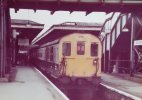
Photo'd at Guildford having arrived from Reading, sometime between 9th and 19th April 1981, 3R, 1206.
 

Attachments

  • BJ-3R 1206 at Guildford, April 1981.jpg
    BJ-3R 1206 at Guildford, April 1981.jpg
    970.8 KB · Views: 55

Rescars

Established Member
Joined
25 May 2021
Messages
2,564
Location
Surrey
It was definitely a Southern Operation (the Western had a little to do with it as possible), but was a bit of ‘nobody’s child’.

"Nobody's child" had some historical basis as it was a bit of an interloper. It was remarkable that the line was operated from the outset and then acquired by the SER although it transversed LBSC and LSWR territory.
 

frankmoh

On Moderation
Joined
7 May 2025
Messages
825
Location
London
"Nobody's child" had some historical basis as it was a bit of an interloper. It was remarkable that the line was operated from the outset and then acquired by the SER although it transversed LBSC and LSWR territory.
So it managed to be involved in the 3 of the Southern Railway companies but now it's owned by the (First) Great Western!
 

izvor

Member
Joined
11 Jun 2014
Messages
594
Location
on the SER
I missed the early DMU era - I used Reading <> Guildford in the early and middle 1970s, almost always off-peak. I don't remember ever seeing the DTS in use, but that may have been because I didn't use peak time trains much. I have a dim memory of arguments between passengers and guard when the two narrow coaches were full and standing but the guard refused to unlock the DTS.
Were there any loco-hauled jobs on that section at that time, do you recall? I don't remember seeing any, and presumably Reading weren't allocated 33s?

I'm sure you are right about the arguments. To be fair it must have been a pain to unlock every door on both sides, then check and lock up again, when the train was only full for a couple of stops.

Recollection, and I am fairly sure on this, is that some of the driving-trailers had the seats removed from either the single compartment next to the cab or the larger one at the other end so that they could still be used for postal traffic, of which some trains carried quite a lot. On one occasion when the train was being loaded from both 6 and 7 at Guildford a large pile had built up in the single compartment and I over enthusiastically threw one mailbag so that it sailed over the top, out of the other door and hit the Chargeman: he was not amused.
Nice one! Yes I remember some empty compartments on the DTSs for mail bags. Also, at least in later DMU days, the last train from Reading was "parcels only" beyond Guildford, non-stop to Redhill, but a friendly driver/guard would usually let you on. Driver even stopped at Reigate once to drop my mate off!

There were also mail compartments on the Thameslinks when first introduced, used to fill up quickly at Redhill. And there was even a TPO (Travelling Post Office) from (I think) Dover in the 60s/70s that loaded up at Tonbridge and Redhill late evening, and went on towards Reading and beyond, possibly with a live return working too, coming through later in the night?
 

D6130

Established Member
Joined
12 Jan 2021
Messages
9,109
Location
West Yorkshire/Tuscany
Were there any loco-hauled jobs on that section at that time, do you recall? I don't remember seeing any, and presumably Reading weren't allocated 33s?
The loco-hauled peak hour workings were diagrammed for Hither Green-allocated class 33s, crewed by Redhill-based drivers and guards.
 

DelW

Established Member
Joined
15 Jan 2015
Messages
6,022
Were there any loco-hauled jobs on that section at that time, do you recall? I don't remember seeing any, and presumably Reading weren't allocated 33s?
I think there were still peak hour loco hauled trains, but I have no memory of ever catching one myself. If they were hauled by 33s as mentioned above, I assume they'd have come from somewhere on Southern Region, possibly Selhurst?* At that time the line was definitely SR territory, only allowed into a little corner of Reading General. I assume that it was when the first-gen DMUs from the WR fleet replaced the Tadpoles that Reading took over the operation.

Presumably there must have been some sort of loco run-round loop at Reading, unless push-pull stock was used, or the loco hauled trains ran via the exchange tracks into the main station. I have no idea how that would have worked.

*Edit, Hither Green per D6130's post above.
 

Gloster

Veteran Member
Joined
4 Sep 2020
Messages
13,024
Location
Up the creek
Presumably there must have been some sort of loco run-round loop at Reading, unless push-pull stock was used, or the loco hauled trains ran via the exchange tracks into the main station. I have no idea how that would have worked.

There wasn’t a runaround at Platform 4A, the single platform that was shared by the Tonbridge and Waterloo train (I told you that the Western had as little to with the line as possible), but it might have been possible to run round on the running line at the Junction (where the line went off to the Goods Lines). However, I expect that the Western had to bite the bullet and let loco-hauled trains go from main station and use the Spur.

EDIT: 4 corrected to 4A.
 
Last edited:

Big Jumby 74

Established Member
Joined
12 Feb 2022
Messages
2,244
Location
UK
It was remarkable that the line was operated from the outset and then acquired by the SER although it transversed LBSC and LSWR territory.
At risk of veering OT slightly, the existence of what I believe was (and is still there) a loco shed at Ash has me wondering about the early operational days of the line. Not a route that I have much info on tbh?
There wasn’t a runaround at Platform 4, the single platform that was shared by the Tonbridge and Waterloo train
The old four platform face (SR) station and track was still in place at end of 1964 and probably later, but by 1972 the SR CWN's are quoting berthing in platform 4A with shunts to the (elec) sidings (etc), which was how I knew the place, but I am unclear on the exact rebuild date(s) and what facilities were available during that period.
 

Gloster

Veteran Member
Joined
4 Sep 2020
Messages
13,024
Location
Up the creek
At risk of veering OT slightly, the existence of what I believe was (and is still there) a loco shed at Ash has me wondering about the early operational days of the line. Not a route that I have much info on tbh?

The old four platform face (SR) station and track was still in place at end of 1964 and probably later, but by 1972 the SR CWN's are quoting berthing in platform 4A with shunts to the (elec) sidings (etc), which was how I knew the place, but I am unclear on the exact rebuild date(s) and what facilities were available during that period.

I think that the shed at Ash was for SER shuttles to Aldershot.

Reading South station closed on 6 September 1965 and 4A would have come into use then or shortly afterwards; 4B came into use on 4 May 1975. There was a short section of single track at the platform throat and a trailing crossover between the Huntley & Palmer‘s and the gas works siding: this would probably have made running round possible, but inconvenient (but that wasn’t really the Western’s problem). The crossover, the connection to the Goods Lines and their Ground Frames were taken out of use on 30 April 1979.

Source: Pryer’s Track Layout. Diagrams, Section 8 of October 1984.
 

Big Jumby 74

Established Member
Joined
12 Feb 2022
Messages
2,244
Location
UK
I think that the shed at Ash was for SER shuttles to Aldershot.

Reading South station closed on 6 September 1965 and 4A would have come into use then or shortly afterwards; 4B came into use on 4 May 1975. There was a short section of single track at the platform throat
Thanks for the first, every day's a school day as they say, and p4A/4B and the single lead approach over the bridge and two elec sidings accessed off the DL was how it was in my days.
Thank you.
 

eastwestdivide

Established Member
Joined
17 Aug 2009
Messages
3,416
Location
S Yorks, usually
The 33+3Mk1 coaches rush hour workings also reached Tonbridge. In around 1979(?), I and a friend once took one from Redhill in the evening. When we got to Tonbridge I lost him on the platform. He eventually appeared climbing down from the cab of the 33 after it had run round the coaches. “Cabbed it” he said. Cheeky!
 

30907

Veteran Member
Joined
30 Sep 2012
Messages
21,970
Location
Airedale
The LH workings had to use the WR side of General - initially P4 had to serve both Waterloo and Redhill trains which needed to double up (fortunately the Ascot split was standard so Waterloos were 4-BIL); that was too inflexible, hence an extra platform was added.
The LH sets normally had a van (typically a BR blue bogie GUV) because of the large amount of parcels and mail traffic; IIRC the 33s worked full parcels trains as well, at least at first.
 

Undaunted

Member
Joined
3 Aug 2022
Messages
82
Location
Wessex
The loco-hauled peak hour workings were diagrammed for Hither Green-allocated class 33s, crewed by Redhill-based drivers and guards.

I was involved in the production of traincrew diagrams for the South Western Division of the Southern Region between 1973 and 1979, and at that time I recall it being a Woking driver who worked the Class 33+Mk1 afternoon peak service from Reading, or one of them (I can’t remember if there was one or two).

In the steam era, Guildford depot had many duties working over the Reading-Redhill route. After steam working ceased, Guildford became an electric multiple unit depot only, but Woking became a mixed traction (electric and diesel) depot. If there was a perceived need for South Western drivers to retain route knowledge between Guildford and Reading, Woking would have been the obvious depot to allocate it to. There was no issue with route knowledge retention between Guildford and Redhill as they had diagrammed work on stone trains and engineers’ traffic.

I hope my memory is not playing tricks on me!
 

izvor

Member
Joined
11 Jun 2014
Messages
594
Location
on the SER
Reading South station closed on 6 September 1965 and 4A would have come into use then or shortly afterwards; 4B came into use on 4 May 1975.
Those 10 years must have been an operating nightmare. Fine if everything was normal, but in the event of delays - or if a diesel broke down in 4A, trapping the electric and stopping anything else coming in... Looking at a 1969 timetable the electrics had a 20-minute turn round, and every hour the Tadpole would come and go from the far end with a 9-minute turnround. All well and good in theory!

IIRC the 33s worked full parcels trains as well, at least at first.
Definitely remember these! Nearly got run over by them twice while taking a short cut from the pub along the track late at night...

I was involved in the production of traincrew diagrams for the South Western Division of the Southern Region between 1973 and 1979, and at that time I recall it being a Woking driver who worked the Class 33+Mk1 afternoon peak service from Reading, or one of them (I can’t remember if there was one or two).
Interesting, thanks. I remember being on a Tadpole that failed near Chilworth one night, and the rescue 33 came out from Woking - quite quickly IIRC.
 
Status
Not open for further replies.

Top