which ran ecs from Glasgow with a Glasgow crew.Last regularly scheduled 156 turn in Edinburgh I can recall was the summer Sunday through service to/from Oban, which ended in September 2024

-
Our new ticketing site is now live! Using either this or the original site (both powered by TrainSplit) helps support the running of the forum with every ticket purchase! Find out more and ask any questions/give us feedback in this thread!
You are using an out of date browser. It may not display this or other websites correctly.
You should upgrade or use an alternative browser.
You should upgrade or use an alternative browser.
ScotRail Suburban Fleet (EMU and BEMU) Market Engagement
- Thread starter diamond chap
- Start date
Sponsor Post - registered members do not see these adverts; click here to register, or click here to log in
R
RailUK Forums
I’d imagine the follow up order would include 334 replacements as they’ll be coming up on 35. Lanark I can kind of see if the new trains ran in parallel with 385s as there’s still 318/20s on it now and with the Carstairs services. I’d struggle to see them running on the Shotts line unless the whole line gets swapped over. I think it runs mostly as 3 car 385s though so could be an easy capacity boost.
Scotrail have 82 DMUs (2 car) 156s and 158s to replace built 1987-1991 and 55 EMUs (3 car) 318s and 320s built 1985-1990 which would need replacing first.
334s are the same age as the 170s. Both are a decade newer so less of a priority.
Ben Conlin
Member
- Joined
- 19 Aug 2018
- Messages
- 74
Yeah most of the 80s and 90s stuff will be replaced in the initial order except maybe the 158s that covers 69 units. The 334s I assume will be in a follow up if they decided to exercise the options.Scotrail have 82 DMUs (2 car) 156s and 158s to replace built 1987-1991 and 55 EMUs (3 car) 318s and 320s built 1985-1990 which would need replacing first.
334s are the same age as the 170s. Both are a decade newer so less of a priority.
snookertam
Member
- Joined
- 22 Sep 2018
- Messages
- 934
Why do they need a diesel replacement?
Here's a picture of Amazon's new Mercedes HGV Fleet that can haul a 22 tonne load for 310 miles on a single charge.

Here's a picture of the Ember all electric Coaches that cruise between Fort William and Edinburgh 3-5 times a day.
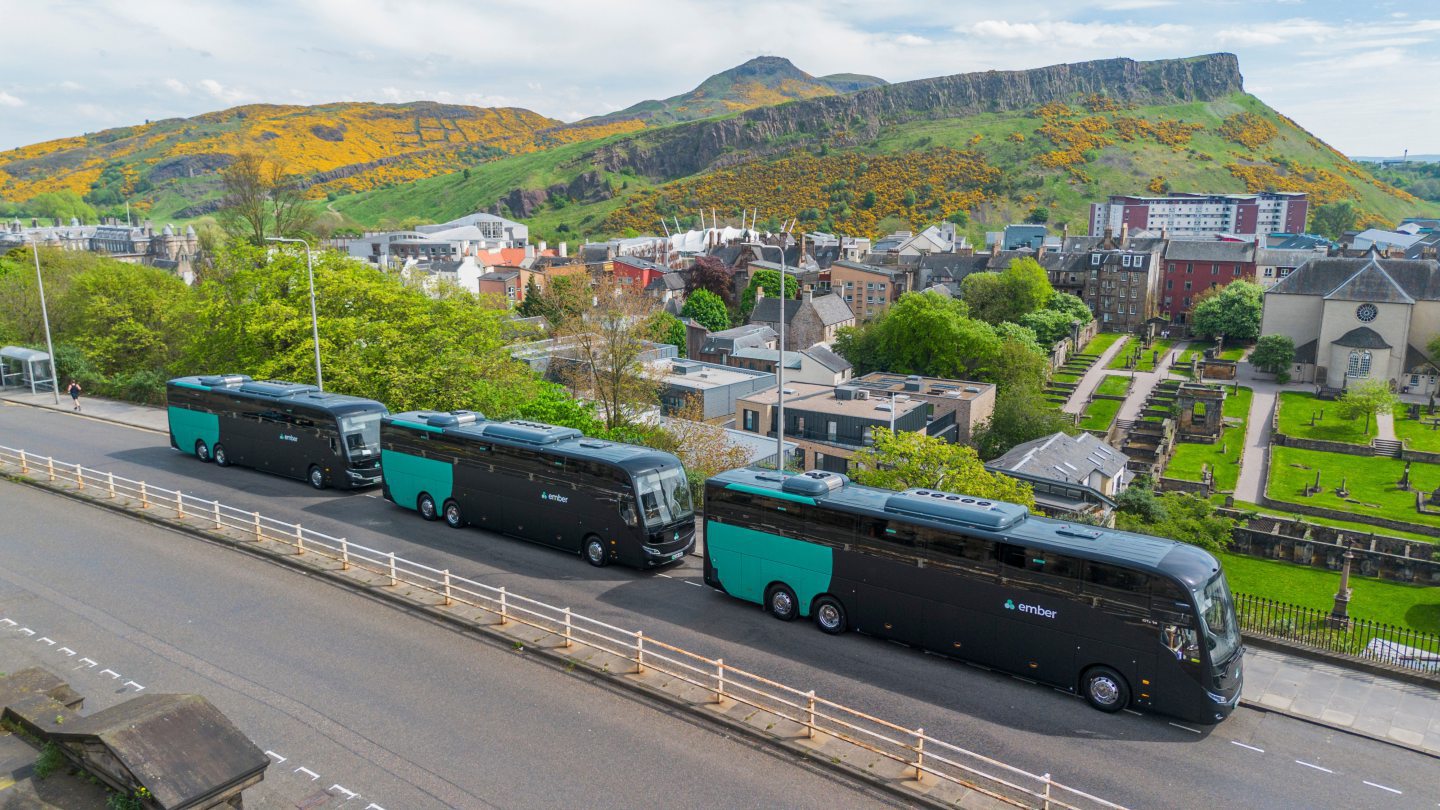
The world is moving on. Whilst rail enthusiasts are wringing their hands and claiming that it's impossible for battery trains to work in Scotland, the road haulage and coach industry are just getting on with it.
I think the key people are the people who work in the railway sector. If it was so straight forward they might have begun doing so.
I think the last time you said all this it was pointed out that your comparisons weren’t like for like. Each time you came back and claimed the same thing, even though people kept telling you that you weren’t comparing like for like.
Returning any 170s to the two ROSCOs is madness in my view given the time it will take to progress as much on decarbonisation on some of the other routes and the 158s won't last forever.Some 170s will head to Aberdeen to beef up capacity up there. The remainder will go to the Glasgow - Carlisle diagrams, or sent back to the lessor, and thence most likely EMR/Northern
Given 158 aren't cleared on the WHL there will need to be some clearance work done there and potentially going for clearing for both 158 and 170 would provided plenty of breathing space and also probably ensure future WHL stock might be capable of commonality with other Scotrail stock.
That said the 170s could probably benefit from fitting a ZF transmission to improve lower and mid-speed fuel consumption and hill climbing performance.
BlueLeanie
On Moderation
I think the key people are the people who work in the railway sector. If it was so straight forward they might have begun doing so.
I think the last time you said all this it was pointed out that your comparisons weren’t like for like. Each time you came back and claimed the same thing, even though people kept telling you that you weren’t comparing like for like.
Essentially the the consensus was that diesel on the West Highland Line had some form of magical properties that meant that a kWh of diesel had more energy that a kWh of battery and there was a massive risk that a unit would be stuck in snow drifts for days and passengers left frozen.
When in reality the 156s that currently run from Oban are barely managing to warm up the passenger cabin above freezing by the time they reach Glasgow.
waverley47
Member
- Joined
- 17 Apr 2015
- Messages
- 868
Returning any 170s to the two ROSCOs is madness in my view given the time it will take to progress as much on decarbonisation on some of the other routes and the 158s won't last forever.
Given 158 aren't cleared on the WHL there will need to be some clearance work done there and potentially going for clearing for both 158 and 170 would provided plenty of breathing space and also probably ensure future WHL stock might be capable of commonality with other Scotrail stock.
That said the 170s could probably benefit from fitting a ZF transmission to improve lower and mid-speed fuel consumption and hill climbing performance.
The 170s returning will depend on the exact numbers of what is cascaded, and what is binned. I agree that it's unlikely, but it is still a very real possibility. Remember the number of coaches will increase, even if the number of units doesn't, and there will need to be some DMUs "falling out the bottom" to make room for the new units coming in at the top.
There are enough BEMUs to bin 32 or so DMU diagrams, which is enough to replace the 156s, depending on the exact split of diagrams at Haymarket and Eastfield between 158/170s. Basically, if there are enough 170s cascaded, you could definitely end up binning all 45 156s, and having some left over.
Regarding the 170s on the West Highland; it won't happen, it can't happen, it's not a matter of shaving the edges off platforms like the 158s. The 170 has a bogie wheelbase that's too long for the line, so they don't fit.
I didn't know what the precise clearance issues were on the WHL. Bogie Wheel base = pivot centres to far apart? Which could easily end up being an issue on some new stock too making it uncascadeable to WHL in the future too.The 170s returning will depend on the exact numbers of what is cascaded, and what is binned. I agree that it's unlikely, but it is still a very real possibility. Remember the number of coaches will increase, even if the number of units doesn't, and there will need to be some DMUs "falling out the bottom" to make room for the new units coming in at the top.
There are enough BEMUs to bin 32 or so DMU diagrams, which is enough to replace the 156s, depending on the exact split of diagrams at Haymarket and Eastfield between 158/170s. Basically, if there are enough 170s cascaded, you could definitely end up binning all 45 156s, and having some left over.
Regarding the 170s on the West Highland; it won't happen, it can't happen, it's not a matter of shaving the edges off platforms like the 158s. The 170 has a bogie wheelbase that's too long for the line, so they don't fit.
That sounds like a good number of 158s will have to be carefully looked after to max out the life span!
JumpinTrainz
Established Member
- Joined
- 30 Jul 2018
- Messages
- 1,932
The original announcement included the 334s but this seems to have been altered. I’d have thought it would have made sense to replace all the stock on the Argyle and North Clyde lines considering they heavily interwork and share a fleet. The 334s still have life in them but that hasn’t stopped fleet of a similar age from the scrapyard down South. Albeit, the 334s would be some of the last of the batch to be replaced when the time comes.Scotrail have 82 DMUs (2 car) 156s and 158s to replace built 1987-1991 and 55 EMUs (3 car) 318s and 320s built 1985-1990 which would need replacing first.
334s are the same age as the 170s. Both are a decade newer so less of a priority.
Neither 158s nor 170s are cleared for Kilmarnock - Dumfries (other than ECS) or Ayr - Stranraer either, so some work would be required there too.Returning any 170s to the two ROSCOs is madness in my view given the time it will take to progress as much on decarbonisation on some of the other routes and the 158s won't last forever.
Given 158 aren't cleared on the WHL there will need to be some clearance work done there and potentially going for clearing for both 158 and 170 would provided plenty of breathing space and also probably ensure future WHL stock might be capable of commonality with other Scotrail stock.
That said the 170s could probably benefit from fitting a ZF transmission to improve lower and mid-speed fuel consumption and hill climbing performance.
Clearance aside, in my opinion 158s in particular would fit the use West Highland and Glasgow South Western use cases pretty well, as other than Kilmarnock - Glasgow the station stops are reasonably far apart, though the existing 156s are of course also end-door and single leaf at that.
Snow1964
Established Member
If they can work ECS then it is not a structure problem (won't hit any bridges or platforms etc)Neither 158s nor 170s are cleared for Kilmarnock - Dumfries (other than ECS) or Ayr - Stranraer either, so some work would be required there too.
It is just a platform edge discrepancy, causing big stepping distance, which needs to be fixed (and it might need to be fixed for the new stock anyway). I suspect with a couple of short bits of wiring (maybe just in Kilmarnock station area) these lines could be operated by the proposed new BEMUs.
As the new stock is designed with level boarding of 915mm platforms, there might be a rolling program of platform works anyway to accommodate new trains (which as a byproduct will also allow 158s and 170s to operate). In reality it might be a non-problem as fix will happen anyway.
Agreed. The lengthy BEMU procurement time lines may also helpfully include time to get other routes ready for cascaded 158/170s otherwise if it going to be hard to meet the 156 replacement objective) and making life easier for new stock a decade later.If they can work ECS then it is not a structure problem (won't hit any bridges or platforms etc)
It is just a platform edge discrepancy, causing big stepping distance, which needs to be fixed (and it might need to be fixed for the new stock anyway). I suspect with a couple of short bits of wiring (maybe just in Kilmarnock station area) these lines could be operated by the proposed new BEMUs.
As the new stock is designed with level boarding of 915mm platforms, there might be a rolling program of platform works anyway to accommodate new trains (which as a byproduct will also allow 158s and 170s to operate). In reality it might be a non-problem as fix will happen anyway.
Ayrshire Roy
Member
- Joined
- 8 Feb 2019
- Messages
- 114
Unless the Internet is wrong (quite possibly) a quick Google shows the 156, 158 and 170 as all having pivot centres 16m apart.I didn't know what the precise clearance issues were on the WHL. Bogie Wheel base = pivot centres to far apart? Which could easily end up being an issue on some new stock too making it uncascadeable to WHL in the future too.
That sounds like a good number of 158s will have to be carefully looked after to max out the life span!
The 170 is about 1m longer though so the vehicle end overhangs will be slightly bigger.
Falcon1200
Established Member
It is just a platform edge discrepancy, causing big stepping distance, which needs to be fixed
Or possibly opened doors scraping platforms when the air suspension is deflated, which IIRC was why Class 158 was banned from the Shotts route for a while (and just a handful of stations were problematic).
waverley47
Member
- Joined
- 17 Apr 2015
- Messages
- 868
Bogie wheelbase is the actual length of the bogies, as far as I'm aware. There is the issue of the 170s are too long to get around some of the tight curves, but I'm pretty sure that the specific bogie issue is to do with check rails more than anything.

CEN60
Member
- Joined
- 17 Dec 2018
- Messages
- 299
Does that apply to 170’s on the Kyle line also - that has some tight curves and check rails. The 158’s scream in the check rail sections between Kyle and Plockton (quite deafening in the rock cuttings)?Bogie wheelbase is the actual length of the bogies, as far as I'm aware. There is the issue of the 170s are too long to get around some of the tight curves, but I'm pretty sure that the specific bogie issue is to do with check rails more than anything.
Ayrshire Roy
Member
- Joined
- 8 Feb 2019
- Messages
- 114
It must be something else as class 37s ran the line for years with a much longer bogie wheelbase then. I'll not count the 66s as their bogies steer.Bogie wheelbase is the actual length of the bogies, as far as I'm aware. There is the issue of the 170s are too long to get around some of the tight curves, but I'm pretty sure that the specific bogie issue is to do with check rails more than anything.
I'd recon the vehicle length would make more sense as even the mk5s are not as long as a 170.
Also is it possible that they are not cleared as they have never had a reason to clear them for that route?
Just to add that again I'm only getting info from the net so accuracy cannot be guaranteed.

FlybeDash8Q400
Established Member
The evening/morning Motherwell is now a 385 but there’s still 2 each way full route that are booked 158’s. These run Monday to Saturday only and are 2Y56 and 2Y89 eastbound and 2Y87 and 2Y69 westbound. It is fairly common for any of these to be switched to 385’s though or for the 158 that comes from Glasgow as 2Y89 to go back as 2Y87.Do any Class 158s still work the Shotts services?
If the line is shut at the Glasgow end for engineering work on Sundays, you might see a 158 do one of the short workings. This is fairly rare though.
 Noted in the minutes of the Scottish Rail Holdings Limited board meeting of 18th September 2025:
6. The Chair said that there is information on the suburban new fleet procurement on social media which should not be in the public domain. He said that he has raised this matter with Transport Scotland and said that SRH should closely monitor this.
Davester50
Member
Other than commercially sensitive information, what information isn't FoIable and can be in the public domain anyway?
Well there was some info about one expression of interest which was rapidly kicked out that could well be regarded as commercially sensitive.Other than commercially sensitive information, what information isn't FoIable and can be in the public domain anyway?
Eg As it could have easily have been a more competitive bid, I’d have thought it wouldn’t be in Scotrail’s interest for that info to get out.
Vectron383
Member
Was this in relation to the battery 350s or something else?
waverley47
Member
- Joined
- 17 Apr 2015
- Messages
- 868
Was this in relation to the battery 350s or something else?
I believe that there was also other information in the public domain that wasn't referenced here. I was willing to post what I did because it was about where the thinking was, and because the specific offer I referenced was rejected instantly.
Ah yes, they can't have the public knowing what they plan to do, or said public will complain when they fail to do it. Or when its 6 years late......
TS obviously doesn't want information about an ongoing bid process in the public domain, that's commercially sensitive information about a procurement costing upwards of half a billion, and we've seen how litigious the builders can be when they don't win.
Morayshire
Member
- Joined
- 6 Feb 2019
- Messages
- 305
There is a "new strategy" out apparently.
Rail Recharged: Scotland's Fleet Transition Strategy - Delivering a modern fleet...
Rail Recharged: Scotland's Fleet Transition Strategy - Delivering a modern fleet...
Just from that opening paragraph I get the impression that there is going to be a lot of guff / political waffle to wade throughOur bold strategy sets out the steps we are taking to replace ScotRail trains that are reaching the end of their useable-life through the procurement of a new InterCity and Suburban fleet. This action will sustain the long-term resilience and reliability of our passenger services, which will encourage more people to make sustainable travel choices.
Snow1964
Established Member
There is a "new strategy" out apparently.
Rail Recharged: Scotland's Fleet Transition Strategy - Delivering a modern fleet...
Just from that opening paragraph I get the impression that there is going to be a lot of guff / political waffle to wade through
Splits into Intercity, suburban and rural
Page 24 of pdf: for intercity routes, full electrification is preferred end state
Page 28 seem to be considering either a transition newer diesel fleet from elsewhere, or new bimodes for Intercity routes
page 30 six new power feeders : Tweedbank, Thornton, Portobello, Newton with 2 recently completed at Ferguslie and Currie. There will be some more electrification to allow BEMU operation on suburban
page 33 mentions 158s and 170s will be cascaded from suburban to replace older diesel trains on rural

TrainViation
Member
From what I read, the end goal was to have both suburban and intercity routes fully electrified in the end-state, but intercity routes would be a higher priority.Splits into Intercity, suburban and rural
Page 24 of pdf: for intercity routes, full electrification is preferred end state
Page 28 seem to be considering either a transition newer diesel fleet from elsewhere, or new bimodes for Intercity routes
And given the ordeal with the Class 222s we are 99% sure we're getting, it'll definitely be the first option AND the second afterwards.
waverley47
Member
- Joined
- 17 Apr 2015
- Messages
- 868
Indeed, now that its public, I can say that this, along with other documents that will remain internal, have been around for a while.
This is why I was able to write my post number 40 with such confidence. The plan is still full electrification, and there are plans in place for purchasing additional feeder stations for Aberdeen which will be made out pic at some point in the new year.
The BEMUs will be able to fully decarbonise the Central Belt suburban services; 170s will be off to Aberdeen and the GSW, the 158s to the West Highland and Inverness.
== Doublepost prevention - post automatically merged: ==
Also, note for the mods; it might be worth butchering half of this threat to create a "ScotRail new fleet updates thread" that can be non-speculative.
This is why I was able to write my post number 40 with such confidence. The plan is still full electrification, and there are plans in place for purchasing additional feeder stations for Aberdeen which will be made out pic at some point in the new year.
The BEMUs will be able to fully decarbonise the Central Belt suburban services; 170s will be off to Aberdeen and the GSW, the 158s to the West Highland and Inverness.
== Doublepost prevention - post automatically merged: ==
Also, note for the mods; it might be worth butchering half of this threat to create a "ScotRail new fleet updates thread" that can be non-speculative.
Last edited:
TrainViation
Member
Not sure if you would know the answer to this, or be able to share even if you did.The plan is still full electrification, and there are plans in place for purchasing additional feeder stations for Aberdeen which will be made out pic at some point in the new year.
What is the plan for the full electrification of the mainline(s)? Does it include electrifying bubbles of the line (e.g. Edinburgh - Dalmeny, Kirkcaldy - Ladybank, Dundee - Montrose etc...) up to Aberdeen, THEN fully electrify afterwards. Or will the currently unelectrified Fife sections be filled in before going any further north than Ladybank (or Dundee)?
Still however unsure about the line between Dunblane - Perth - Dundee, and Ladybank - Perth sections and how they will be tackled. To not wander off topic or not speculate, it is best that I say it seems likely that those will come at a much later date.