• Our new ticketing site is now live! Using either this or the original site (both powered by TrainSplit) helps support the running of the forum with every ticket purchase! Find out more and ask any questions/give us feedback in this thread!

Comparison of UK and German Interlocking Systems

Status
Not open for further replies.

The_bazm

New Member
Joined
21 Oct 2025
Messages
2
Location
Germany
Hello,
I am currently writing my bachelor thesis at the Technical University Berlin. My topic is the interlocking system landscape in Germany. My goal is to create an overview of the various relevant and active interlocking designs and types, particularly focusing on computer based-, digital and relay interlocking systems. I aim to develop comparison criteria and classify the different designs. The focus will be on functions relevant to railway operations and their effects on the operational process. The relevant system architecture will also be analyzed.

As part of my thesis, I would like to compare the German interlocking landscape with Great Britain. In this context, I am interested in learning about the systematic differences in interlocking systems in the UK compared to Germany, as well as the most important designs and manufacturers in the market.

It would be a great help if you could answer (some of) the following questions or if you could provide me with relevant sources/contacts.
  1. Which manufacturers are active in the field of interlocking systems in Great Britain, and which are the biggest players?
  2. Which model of interlocking systems (especially computer based interlocking and digital interlocking) and from which manufacturers are most widespread in the UK?
  3. What are the fundamental differences in the interlocking philosophy compared to German systems
    • system architecture
    • compatibility with other interlocking types
    • integration of train protection systems
    • capacity
    • degree of standardization of components
    • standardized ports and interfaces
    • centralization or decentralization of operation
  4. How do the project planning and approval processes for interlocking systems differ?
I look forward to hearing from you.

Kind regards,


Nikolai Bochynek
 
Sponsor Post - registered members do not see these adverts; click here to register, or click here to log in
R

RailUK Forums

godfreycomplex

Established Member
Joined
23 Jun 2016
Messages
1,751
Hello,
I am currently writing my bachelor thesis at the Technical University Berlin. My topic is the interlocking system landscape in Germany. My goal is to create an overview of the various relevant and active interlocking designs and types, particularly focusing on computer based-, digital and relay interlocking systems. I aim to develop comparison criteria and classify the different designs. The focus will be on functions relevant to railway operations and their effects on the operational process. The relevant system architecture will also be analyzed.

As part of my thesis, I would like to compare the German interlocking landscape with Great Britain. In this context, I am interested in learning about the systematic differences in interlocking systems in the UK compared to Germany, as well as the most important designs and manufacturers in the market.

It would be a great help if you could answer (some of) the following questions or if you could provide me with relevant sources/contacts.
  1. Which manufacturers are active in the field of interlocking systems in Great Britain, and which are the biggest players?
  2. Which model of interlocking systems (especially computer based interlocking and digital interlocking) and from which manufacturers are most widespread in the UK?
  3. What are the fundamental differences in the interlocking philosophy compared to German systems
    • system architecture
    • compatibility with other interlocking types
    • integration of train protection systems
    • capacity
    • degree of standardization of components
    • standardized ports and interfaces
    • centralization or decentralization of operation
  4. How do the project planning and approval processes for interlocking systems differ?
I look forward to hearing from you.

Kind regards,


Nikolai Bochynek
Hello

You may well have already heard of this organisation, but the Institute of Railway Signalling Engineers is the professional body for signalling maintainers, installers and engineers in the UK. They have a great deal of knowledge within their ranks of the history and operation of all types of interlocking

https://www.irse.org/ - here’s their website, there’s a “contact” page on there
 

The_bazm

New Member
Joined
21 Oct 2025
Messages
2
Location
Germany
Hello

You may well have already heard of this organisation, but the Institute of Railway Signalling Engineers is the professional body for signalling maintainers, installers and engineers in the UK. They have a great deal of knowledge within their ranks of the history and operation of all types of interlocking

https://www.irse.org/ - here’s their website, there’s a “contact” page on there
Thank you. I have already tried to contact them, but unfortunatly have not gotten a response. It has been weeks at this point and I am running out of time, since my deadline is soon
 

MarkyT

Established Member
Joined
20 May 2012
Messages
7,574
Location
Torbay
Hello,
I am currently writing my bachelor thesis at the Technical University Berlin. My topic is the interlocking system landscape in Germany. My goal is to create an overview of the various relevant and active interlocking designs and types, particularly focusing on computer based-, digital and relay interlocking systems. I aim to develop comparison criteria and classify the different designs. The focus will be on functions relevant to railway operations and their effects on the operational process. The relevant system architecture will also be analyzed.

As part of my thesis, I would like to compare the German interlocking landscape with Great Britain. In this context, I am interested in learning about the systematic differences in interlocking systems in the UK compared to Germany, as well as the most important designs and manufacturers in the market.

It would be a great help if you could answer (some of) the following questions or if you could provide me with relevant sources/contacts.
  1. Which manufacturers are active in the field of interlocking systems in Great Britain, and which are the biggest players?
  2. Which model of interlocking systems (especially computer based interlocking and digital interlocking) and from which manufacturers are most widespread in the UK?
  3. What are the fundamental differences in the interlocking philosophy compared to German systems
    • system architecture
    • compatibility with other interlocking types
    • integration of train protection systems
    • capacity
    • degree of standardization of components
    • standardized ports and interfaces
    • centralization or decentralization of operation
  4. How do the project planning and approval processes for interlocking systems differ?
I look forward to hearing from you.

Kind regards,


Nikolai Bochynek
Something you may find useful is the British Power Signalling Register. In the form of a downloadable spreadsheet, this lists all UK interlockings, historic and current, for areas with electric signalling. Entries are classified by type, manufacturer, dates commissioned and retired (where applicable). The control interfaces are also included ranging from early power lever frames through mid-20th century panels to modern control screens.

The British Power Signalling Register is a free listing and historical analysis of all power signalling equipment installations ever commissioned in Britain from 1883 to the present day, excluding London Underground and metro networks. Aimed at both the signalling enthusiast and the professional engineer the documents present, for the first time in one place –

a complete spreadsheet listing of all signalbox, local control and ground switch panels of any kind utilising button or switch control, and VDU systems
a complete spreadsheet listing of all power frames
a complete spreadsheet listing of all associated interlockings

Most processor-based interlockings in the UK are various versions of SSI (solid state interlocking) and its later developments using more modern hardware by Siemens and Alstom, but retaining the same trackside comms protocols and the interlocking configuration language. This was originally a custom system developed by British Rail in the 1980s along with principal suppliers, Westinghouse and GEC.

In the 1990s, newly privatised Railtrack tried to broaden the supply base by purchasing technology from other European manufacturers. This saw Siemens SIMIS W commissioned on the south coast at Bournemouth and in the Portsmouth area, while Ansaldo products were employed in South Manchester, and there was an abortive attempt to use Ebilock at Horsham. There were also some US products used in Norfolk.

Further planned projects were not pursued and Siemens decided to re-enter the UK market by taking over Westinghouse when it was put up for sale by Invensys, and they now offer SSI family 'Westlock' products for central interlockings in the UK and the 'Westrace' distributed interlocking technology, all now well established in UK. Siemens gained a comprehensive UK design capability in taking over Westinghouse, as they had two of the UKs former BR regional design and project management offices under their control after earlier privatisation. Alstom (successor to GEC) also still sells an SSI family product with modern hardware, known as 'Smartlock'.
 
Last edited:

godfreycomplex

Established Member
Joined
23 Jun 2016
Messages
1,751
Something you may find useful is the British Power Signalling Register. In the form of a downloadable spreadsheet, this lists all UK interlockings, historic and current, for areas with electric signalling. Entries are classified by type, manufacturer, dates commissioned and retired (where applicable). The control interfaces are also included ranging from early power lever frames through mid-20th century panels to modern control screens.


Most processor-based interlockings in the UK are various versions of SSI (solid state interlocking) and its later developments using more modern hardware by Siemens and Alstom, but retaining the same trackside comms protocols and the interlocking configuration language. This was originally a custom system developed by British Rail in the 1980s along with principal suppliers, Westinghouse and GEC. In the 1990s, newly privatised Railtrack tried to broaden the supply base by purchasing technology from other European manufacturers. This saw Siemens SIMIS W commissioned on the south coast at Bournemouth and in the Portsmouth area, while Ansaldo products were employed in South Manchester, and there was an abortive attempt to use Ebilock at Horsham. There were also some US products used in Norfolk. Further planned projects were not pursued and Siemens decided to re-enter the UK market by taking over Westinghouse when it was put up for sale by Invensys, and they now offer SSI family 'Westlock' products for central interlockings in the UK and the 'Westrace' distributed interlocking technology, all now well established in UK They acquired a large UK design capability in taking over this supplier as Westinghouse had two of the UKs former BR regional design and project management offices under their control after privatisation with their detailed local knowledge.
Indeed. To add to this some of the most advanced interlocking in use in Britain is the BomElectrologIXS (pronounced electrologics) in use in the Feltham area amongst other places, which uses ladder logic and other equipment alterations to substantially reduce track side equipment, and therefore interlocking complexity. This was the first all new technology interlocking installation in the UK since the ones MarkyT listed above. This might be worth a look as it was the first use of this kind of interlocking on a major passenger railway in the world, off the top of my head.
 

Annetts key

Established Member
Joined
13 Feb 2021
Messages
3,809
Location
West is best
The situation within the mainland Great Britain railway network is complex. Until the railways were privatised, the different regions of British Rail (BR) operated semi-independently. Often continuing using practices and design principles carried over from before nationalisation. And hence buying interlocking systems of their choosing or creating their own interlocking systems.

Hence some route relay interlocking systems came from signalling equipment companies and others were built by a region's own design and installation staff. For example, BR Western Region used their own design of "free-wired" route relay interlocking based mainly on relays to the BR930 series of specifications (one supplier, Westinghouse Signals called these Q style). P style were also sometimes used. The BR Western Region design of "free-wired" route relay interlocking is documented by "standard" drawings in the E10000 series of drawings, hence it is sometimes referred to as the E10K type. A web site with some more information on this is here: Swindon Panel - Interlockings. Note that this site manly covers the area of control of the former Swindon PSB. But this was typical of the other BR WR PSBs (if one of the smaller PSBs).

A freedom of information request to Network Rail is here: PDF listing interlockings used across the network

BR also developed it's own free-wired interlocking design.

A link to a current BR930 relay supplier is here: Mors Smitt.

The RSSB has some BR930 specification documents (e.g. at this link).

Some large route relay interlocking schemes were designed and built over the years. For example, during the 1960s through to the 1980s, BR Western Region built various power signal boxes (PSB) with NX panels. "NX" (Entrance-eXit) meaning, turn a switch or push a button to define the start of the route, then push a second button to define the end of the wanted route for each signal section. More details in the PDF at this link. These PSBs covered large parts of the region, hundreds of route miles. Gloucester is an example of one of these that is still in use. If you search this forum, there is a topic on here about the rewiring of Gloucester PSB interlocking.

However, some parts of signalling were developed as national systems. BR developed a computer based interlocking called SSI. SSI standing for Solid State Interlocking. Since the first practical conventional installation at Leamington Spa, SSI has been used all across the country. Although mostly designed by BR, there were two suppliers of production equipment: GEC-General Signal and Westinghouse Signals Ltd. The equipment from both of these could be mainly mixed with no problems. So you may find some from each supplier in a practical scheme.

SSI can be used with conventional switch / button / indication "NX" panels or other panel designs. And some examples of this exist and are In still In operation today.

But BR also developed a computer based control system. Called Integrated Electronic Control Centre (IECC). This was designed to connect to and control one or more SSI systems.

Since then various systems have been developed and used, including Smartlock and Westlock that MarkyT mentioned.

In terms of suppliers, during BR, there were many signalling equipment manufacturers. But over the years the number of suppliers has reduced as companies have merged, taken over others or have closed. Hence Railtrack and Network Rail looking to other countries to see what other systems are available.

Train protection systems
The BR AWS (Automatic Warning System) is integrated and standard for relay and computer based interlockings.
TPWS (Train Protection & Warning System) has been retro fitted to existing interlocking systems and is now standard (where required) in new interlockings.
ATP (Automatic Train Protection) now only used on parts of the Great Western main line, hence GWML ATP, is a computer based system overlaid on an existing interlocking system. It can (and was) used with the relay interlocking system and is currently used with SSI TFM (Trackside Functional Modules).

ERTMS is now in use in some parts of the country on some lines.

Compatibility with other interlocking types
Until recently, relays (BR930 series) were used to interface adjacent interlockings of different types, or of the same type, but controlled from a different signal box / PSB / Signalling Centre.
But more modern computer based interlockings are intended to have interconnecting data links.

Capacity
Very much depends on (a) what do you mean, train capacity or (b) system capacity?

The design of Route Relay Interlockings by their design use parallel logic so train (route/line) capacity is limited to the number of signals specified and the length of each signal (block) section at the design stage. The interlocking can handle all train movements within these limits.

The design and computing power of a SSI central interlocking is sufficient to handle up to 63 TFMs per interlocking. Bigger schemes just add additional central interlockings, each with their own (up to) 63 TFMs.

The more modern systems use much faster and more modern hardware. Hence have greater capacity.

Degree of standardisation of components
As time has progressed, attempts at increased standardisation has been attempted. Hence the BR930 series of relays has largely replaced most other types.
As I said earlier, SSI modules are interchangeable between the two manufacturers. And are used for existing SSI schemes and some of the more modern systems use SSI TFMs as well.

But as different systems have been used over the years, there are still plenty of modules or parts that are not interchangeable.
 
Last edited:

MarkyT

Established Member
Joined
20 May 2012
Messages
7,574
Location
Torbay
Indeed. To add to this some of the most advanced interlocking in use in Britain is the BomElectrologIXS (pronounced electrologics) in use in the Feltham area amongst other places, which uses ladder logic and other equipment alterations to substantially reduce track side equipment, and therefore interlocking complexity. This was the first all new technology interlocking installation in the UK since the ones MarkyT listed above. This might be worth a look as it was the first use of this kind of interlocking on a major passenger railway in the world, off the top of my head.
I think the hardware is closely related to the Vaughan Harmon equipment used in Norfolk on the Cromer line. USA-based Harmon was taken over by General Electric, then the rail control division was eventually sold to Alstom.

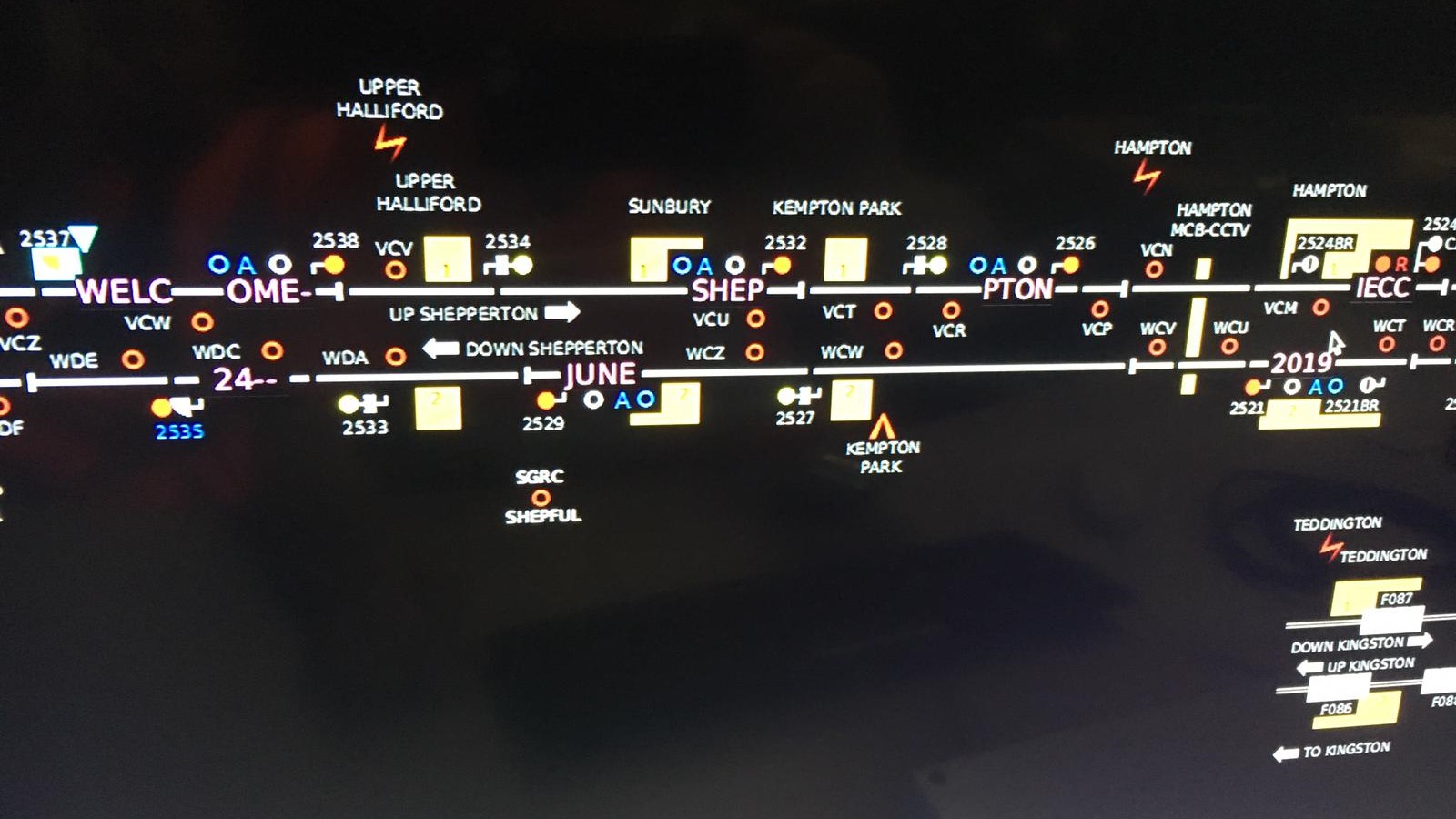
An interesting article about Feltham here:
New main-line interlocking enters service
...
Feltham signal box is a large route relay-interlocking system dating from 1974 and it was high-time that it was replaced – resignalling had already been deferred and the asset condition was such that further deferment was not an option. The Shepperton branch was selected as the first stage of the renewal of Feltham signal box, with full renewal taking place in six stages over several years, such is the complexity of the Feltham signalling area.

The task of resignalling was to be delivered using ‘future signalling systems by Atkins’- a strategic programme to change the way signalling projects are delivered in the UK. The system involves 11 separate product acceptance approvals and uses a wide range of products and components to deliver a full train control, signalling and power system – from interlockings to level crossings, barrier arms, power supplies and cables.
 

edwin_m

Veteran Member
Joined
21 Apr 2013
Messages
28,665
Location
Nottingham
Worth looking out for the September-October edition of Rail Engineer, which isn't on the website https://www.railengineer.co.uk/ yet but should appear at some point. It has articles on 40 years of SSI and of Radio Electronic Token Block - both world leading systems in their time - and an update on ETCS in the UK.
 

Belperpete

Established Member
Joined
17 Aug 2018
Messages
3,642
As Annette key has said, although British Rail attempted to standardise practices that had often been very different under the previous constituent companies, such as by standardising locomotive designs, it was much less successful in standardising signalling practices. Although BR standardized on the types of relays to be used (BR Spec 930 series), the way in which they were used (the design of the interlocking circuits) was more or less left up to the individual regions (who had taken over from the old companies). Although BR issued Standard Signalling Principles, in many cases the regions didn't always fully implement them.

True standardisation only really arrived with Solid State Interlocking, which could only be implemented in the way specified in the SSI Design Manuals. SSI was jointly developed by BR and the two major UK signalling contractors of the time, Westinghouse and GEC. BR developed the software language and tools, while the two manufacturers developed the hardware modules. Generally speaking, modules produced by the two manufacturers were interchangeable.

Over time, SSI was upgraded, for larger memory and higher processor speeds. A means of linking SSIs together was quickly developed, so that large interlocking areas could be controlled by linking multiple SSIs together. However, when BR was privatised and Railtrack took over, Railtrack washed their hands of SSI. They were not prepared to finance further upgrades, considering SSI to be obsolete, and they could get better value for money by buying from overseas suppliers. However, their attempts at doing so proved unsatisfactory.

The two main UK manufacturers then developed processor systems that could run SSI software, and could interface with SSI trackside hardware: Smartlock (produced by Alstom, successors to GEC) and Westlock (produced by Siemens, successors to Westinghouse). Each Smartlock and Westlock interlocking can replace many SSI central processors. Both manufacturers have now developed their own totally different trackside hardware, so new systems are no longer using the old Ssi trackside hardware, but they are still running the old SSI software language (with variations). Also, WSAtkins have recently introduced their own type of totally different processor interlocking using ladder logic, using Electrologix hardware. So unfortunately we have now lost the hardware standardisation that we once achieved with SSI. I don't believe that Smartlock and Westlock can be directly connected. In fact, as far as I am aware, it is only possible to connect different interlocking types together with a relay interface.

I have no experience of German interlocking systems, but I am aware of some of the major differences between UK practice and some continental practice.

The first major difference is that the SSI data language was heavily based on previous free-wired interlocking practice. Although BR did use modular relay interlockings (called geographical interlockings) with standard prepackaged relay units, these fell out of favour as they can be quite complex. BR generally preferred relay interlockings that were designed for each specific site. The interlockings were therefore almost infinitely configurable, and this philosophy was carried forward into SSI. Although SSI has a lot of inbuilt standard data structures, they are highly adaptable, and if needs be you can write something longhand for a specific signal or set of points. It has allowed SSI to adapt fairly easily to some fairly substantial changes to UK signalling practice. For example, the SSI language has some data structures for AWS train protection built-in, but more complex cases need freehand data. TPWS train protection was developed after SSI, so there are no inbuilt data structures for TPWS and all the data has to be written longhand.

Some continental suppliers of "rules based" interlockings have had trouble coping with this level of flexibility. In particular, some continental interlocking systems are similar to geographical relay interlockings, in that you can specify some parameter variables for each particular point or signal, but everything else is built-in to the software and can only be changed by changing the software. Making the interlockings sufficiently adaptable to cope with all the variations and complexities of UK practice (such as swinging overlaps) ate up a lot of memory and processing capacity.

Another big difference is that SSI and it's successors are distributed systems: as well as the central interlocking processors, there are object controllers (called Trackside Functional Modules) along the trackside. These trackside processors carry out some of the basic control functionality, such as proving signals alight and turning off point drives after the points have made detection, relieving the central processor of these more mundane tasks. More importantly, it means that all the cabling along the trackside is done by relatively cheap data cables. Each SSI uses just two single -pair data cables, onto which all its TFMs are connected. At least one of the continental systems that Railtrack trialled only had a central processor, and relied on direct wiring from that processor to each individual point and signal - which meant a lot of highly expensive trackside cabling, particularly for those points and signals located a long way from the central processor.


As regards your last question, project planning and approval processes should in general be the same for all interlocking types. The operating requirements and functionality should be specified before the contract is put out to tender, and therefore before the supplier and the type of interlocking is known. Network Rail (succesors to BR and Railtrack) have a type approval process for all new types of equipment, or significant alteration to an existing type of equipment. Projects are only allowed to use equipment that has already been through the type approval process (unless they are the trial site for the new equipment). So it should not be necessary for a project to get approval for a particular interlocking. It will of course be necessary to validate that the finished implementation has met the project requirements and applicable standards.

Getting products or changes type-approved can take a long time and cost a significant amount of money, and can be a big disincentive to making upgrades or improvements. It is one of the reasons that having very flexible data structures is so important in the UK, as getting approval for any change to the underlying software would require significant costs and delays.
 
Last edited:

MarkyT

Established Member
Joined
20 May 2012
Messages
7,574
Location
Torbay
The first major difference is that the SSI data language was heavily based on previous free-wired interlocking practice. Although BR did use modular relay interlockings (called geographical interlockings) with standard prepackaged relay units, these fell out of favour as they can be quite complex. BR generally preferred relay interlockings that were designed for each specific site. The interlockings were therefore almost infinitely configurable, and this philosophy was carried forward into SSI. Although SSI has a lot of inbuilt standard data structures, they are highly adaptable, and if needs be you can write something longhand for a specific signal or set of points. It has allowed SSI to adapt fairly easily to some fairly substantial changes to UK signalling practice. For example, the SSI language has some data structures for AWS train protection built-in, but more complex cases need freehand data. TPWS train protection was developed after SSI, so there are no inbuilt data structures for TPWS and all the data has to be written longhand.

Some continental suppliers of "rules based" interlockings have had trouble coping with this level of flexibility. In particular, some continental interlocking systems are similar to geographical relay interlockings, in that you can specify some parameter variables for each particular point or signal, but everything else is built-in to the software and can only be changed by changing the software. Making the interlockings sufficiently adaptable to cope with all the variations and complexities of UK practice (such as swinging overlaps) ate up a lot of memory and processing capacity.
Early relay-based geographical systems were quite basic, requiring much additional free-wired circuitry outside the geographical sets to cope with complex UK requirements like swinging overlaps, usually only required at selected signals. Later versions attempted to cope with every layout possibility without (so much) external wiring, but that resulted in very complex, fully-featured sets that were often complete overkill for simpler parts of the layout. By contrast, free-wired interlockings only provided the specific relays required for the particular functionality necessary. That usually made significant savings in the total number of relays required, and in the physical size of the rooms to house the equipment. Geographical was used widely on some very large schemes, particularly in the Midland and Southern Regions, primarily for speed of design and construction. Point and signal units came fully pretested from the factory and could be combined quickly, connected by plugging in multicore cabling between them in a pattern resembling the track layout. An example of the sizing issue is Clapham Junction . When Victoria Signalling Centre was built there, a spare equipment room was provided in the building for the future Waterloo Area Resignalling Scheme interlocking to be controlled from Wimbledon. The room was sized for geographical, in favour at the time, but when WARS was finally progressed some years later, a freewired interlocking was installed instead, which sits on a few racks in one part of a large, fairly empty room.
Another big difference is that SSI and it's successors are distributed systems: as well as the central interlocking processors, there are object controllers (called Trackside Functional Modules) along the trackside. These trackside processors carry out some of the basic control functionality, such as proving signals alight and turning off point drives after the points have made detection, relieving the central processor of these more mundane tasks. More importantly, it means that all the cabling along the trackside is done by relatively cheap data cables. Each SSI uses just two single -pair data cables, onto which all its TFMs are connected. At least one of the continental systems that Railtrack trialled only had a central processor, and relied on direct wiring from that processor to each individual point and signal - which meant a lot of highly expensive trackside cabling, particularly for those points and signals located a long way from the central processor.
That was a major drawback to the SIMIS W system employed on the south coast. All the input/output was concentrated into large trackside buildings in scale not unlike old remote relay interlockings, with vast numbers of individual cable cores routed out to the equipment. Thus the huge cable savings of SSI, with its distributed i/o, could not be achieved. Siemens went on to develop a more distributed i/o architecture for its SIMIS product series, but this was not offered in the UK as by then the company was already in the process of taking over Westinghouse from Invensys.
 

Belperpete

Established Member
Joined
17 Aug 2018
Messages
3,642
Early relay-based geographical systems were quite basic, requiring much additional free-wired circuitry outside the geographical sets to cope with complex UK requirements like swinging overlaps, usually only required at selected signals. Later versions attempted to cope with every layout possibility without (so much) external wiring, but that resulted in very complex, fully-featured sets that were often complete overkill for simpler parts of the layout.
Every type of geographical relay interlocking used in the UK has had provision for adding freewired circuits to cater for site peculiarities and the like. When I was involved with Ebilock, I found it used geographically written data, but without any provision for the equivalent of freewiring: if something wasn't catered for in the inbuilt software, you didn't get it.
 

MarkyT

Established Member
Joined
20 May 2012
Messages
7,574
Location
Torbay
Every type of geographical relay interlocking used in the UK has had provision for adding freewired circuits to cater for site peculiarities and the like. When I was involved with Ebilock, I found it used geographically written data, but without any provision for the equivalent of freewiring: if something wasn't catered for in the inbuilt software, you didn't get it.
I believe SIMIS is also configured using a geographically-based editor, though I have no experience of the process, so don't know if it can incorporate 'special circuits' on an ad hoc basis. For both systems, teams of consultants worked for months, possibly years, mapping the functionality to UK standards requirements. The proof was intended to show how the system met every detailed requirement of the principles and other documents.

I think a good way forward is to expose the full functionality for each object in ladder logic, as in the Atkins method for Feltham, especially for old relay guys like me who have an irrational aversion to code! Generate a standard set of rungs for a function. Auto-populate according to a geographical analysis of the layout topology. Then edit manually if required and simulate.

This book is useful in describing underlying interlocking principles common to all systems and noting some of the differences between countries' practices.
Railway Signalling Principles
Prof. Dr.-Ing. Jörn Pachl, FIRSE
Professor of railway systems engineering at Technische Universität Braunschweig
 
Last edited:

Belperpete

Established Member
Joined
17 Aug 2018
Messages
3,642
I believe SIMIS is also configured using a geographically-based editor, though I have no experience of the process, so don't know if it can incorporate 'special circuits' on an ad hoc basis. For both systems, teams of consultants worked for months, possibly years, mapping the functionality to UK standards requirements. The proof was intended to show how the system met every detailed requirement of the principles and other documents.
The problem with UK signalling principles is that they often aren't written in a form that is compatible with interlocking rules requirements. They increasingly rely on risk assesments to determine that something needs to be prevented from happening, but without explicitly stating how you do so. I know that some of those consultants that were supposedly developing UK interlocking rules from scratch ended up having to ask "how do you do this in SSI"!
I think a good way forward is to expose the full functionality for each object in ladder logic, as in the Atkins method for Feltham, especially for old relay guys like me who have an irrational aversion to code! Generate a standard set of rungs for a function. Auto-populate according to a geographical analysis of the layout topology. Then edit manually if required and simulate.
Hmm. Having worked on ladder logic for implementing level crossing controls, I am not convinced that they make the functionality very clear in complex cases. I found the circuits much easier to understand.

One of the things that I liked about Smartlock is that because it is effectively an SSI emulator, the first thing that the compiler does is to convert the standard SSI data constructs into raw logic. Although you don't usually need to refer to this, you can look at it if the data appears to be doing something unexpected, to see exactly what is happening.

Data preparation has developed in leaps and bounds. Data can be automatically generated for both Smartlock and Westlock, which is then manually edited and simulated. In addition, data validation tools are available to check the data for illegal constructs, and that can automatically simulate the data and warn of any undesirable results. Doesn't replace manual validation and testing, but does significantly increase confidence in the data.
 

MarkyT

Established Member
Joined
20 May 2012
Messages
7,574
Location
Torbay
The problem with UK signalling principles is that they often aren't written in a form that is compatible with interlocking rules requirements. They increasingly rely on risk assesments to determine that something needs to be prevented from happening, but without explicitly stating how you do so.
Extra flank point movements that junction risk assessments ask for. Unusual aspect sequence variations requested by sighting committees.

The way swinging overlaps work in some complex cases is a dark art. Throw the overlap locking away for seven seconds while every point in the junction is moved in the hope they all reestablish a valid overlap before any aspects are replaced. Then there's time of operation locking for points very close to the destination signal to prevent them swinging if a train is approaching very close that might overrun before the point movement was complete, but that times off before the overlap itself time releases...
I know that some of those consultants that were supposedly developing UK interlocking rules from scratch ended up having to ask "how do you do this in SSI"!
Not surprised.
Hmm. Having worked on ladder logic for implementing level crossing controls, I am not convinced that they make the functionality very clear in complex cases. I found the circuits much easier to understand.
I suggest ladder logic styled in the editor to look exactly like traditional relay circuits!
One of the things that I liked about Smartlock is that because it is effectively an SSI emulator, the first thing that the compiler does is to convert the standard SSI data constructs into raw logic. Although you don't usually need to refer to this, you can look at it if the data appears to be doing something unexpected, to see exactly what is happening.
Interesting.
Data preparation has developed in leaps and bounds. Data can be automatically generated for both Smartlock and Westlock, which is then manually edited and simulated. In addition, data validation tools are available to check the data for illegal constructs, and that can automatically simulate the data and warn of any undesirable results. Doesn't replace manual validation and testing, but does significantly increase confidence in the data.
All good to hear.
 

Tester

Established Member
Joined
5 Jul 2020
Messages
1,703
Location
Watford
I suggest ladder logic styled in the editor to look exactly like traditional relay circuits!
I remember seeing exactly this demonstrated, with a toggle from ladder logic to written circuits for the same data - I was very impressed!

This was by an Australian designer when I was working in Bangkok, which puts it in the 1990s.
 
Status
Not open for further replies.

Top