• Our new ticketing site is now live! Using either this or the original site (both powered by TrainSplit) helps support the running of the forum with every ticket purchase! Find out more and ask any questions/give us feedback in this thread!

Guided buses: not enough regard for safety?

Haywain

Veteran Member
Joined
3 Feb 2013
Messages
24,693
The objective is to make the risks as low as reasonably practical (ALARP).
Pedant alert: it's practicable, not practical.

== Doublepost prevention - post automatically merged: ==

Roads without fences do not have faulty design if the risk is as low as reasonably practical.
It also has to be borne in mind that installing fences could then cause significant inconvenience to pedestrians (as they already do at many road junctions).
 
Sponsor Post - registered members do not see these adverts; click here to register, or click here to log in
R

RailUK Forums

edwin_m

Veteran Member
Joined
21 Apr 2013
Messages
28,668
Location
Nottingham
How have we got the situation in Luton where there are multiple operators offering their own tickets? This might as well be fully deregulated.
Was Luton built under a TWA order. If so, did it include a provision to exclude operators except those with a contract?
 

Trainbike46

Established Member
Joined
18 Sep 2021
Messages
4,374
Location
belfast
I do think it is undeniably true that the busway is being held to a higher safety standard than roads are (no-one can reasonably argue that a 60-mph country road with a massive pothole after a blind corner meets the ALARP standard).

However, placing a fence between the busway and the pedestrian and cycle track next to it on the section south of Cambridge station, seems like a very sensible safety improvement.
It would still be a very busy path that isn't really big enough for the numbers of pedestrians and cyclists using it, but the major safety issue would be addressed.
 

johncrossley

Established Member
Joined
30 Mar 2021
Messages
4,417
Location
London
Was Luton built under a TWA order. If so, did it include a provision to exclude operators except those with a contract?

This might be it:


Statutory Instruments

2006 No. 3118​

TRANSPORT AND WORKS, ENGLAND

TRANSPORT, ENGLAND

The Luton Dunstable Translink Order 2006​

Made
22nd November 2006
Coming into force
13th December 2006

I can't see anything in here regarding registration of services, but even in Cambridgeshire the council have adopted a cavalier attitude, allowing both Whippet and Stagecoach to have their own separate tickets. Obviously allowing Stagecoach to deliberately implement slow boarding processes is gross incompetence from the council.
 

Trainbike46

Established Member
Joined
18 Sep 2021
Messages
4,374
Location
belfast
This might be it:


I can't see anything in here regarding registration of services, but even in Cambridgeshire the council have adopted a cavalier attitude, allowing both Whippet and Stagecoach to have their own separate tickets. Obviously allowing Stagecoach to deliberately implement slow boarding processes is gross incompetence from the council.
Cambridgeshire used to have shared tickets between Whippet and Stagecoach; these were withdrawn around the time route C disappeared, though I couldn't tell you why that happened.
 

johncrossley

Established Member
Joined
30 Mar 2021
Messages
4,417
Location
London
Cambridgeshire used to have shared tickets between Whippet and Stagecoach; these were withdrawn around the time route C disappeared, though I couldn't tell you why that happened.

Didn't they also have their own cheaper tickets as well?
 

Magdalia

Established Member
Joined
1 Jan 2022
Messages
7,389
Location
The Fens
The risks we are talking about on normal roads is magnitudes more severe than anything to do with guided busways. The risk of an accident on a normal road with zero segregation between bike and car is obviously vastly higher than on a physically segregated cycle path next to a road/busway with almost zero traffic. On the Cambridgeshire busway there are fewer than 20 vehicles per hour each way. By contrast, the flow on many normal roads is hundreds of vehicles per hour, and they are allowed to continue operating without any segregation whatsoever, never mind fencing.
As you say the busway is not very busy, fewer than 20 vehicles per hour each way. Also, it is not very long, less than 20 miles. Nevertheless it has had 3 fatalities of pedestrians and cyclists in its first 10 years of operation. That shows that the risk of fatality on the busway, per vehicle and per mile of route, is high not low.

There won't be many 20 mile lengths of road with fewer than 20 vehicles per hour each way, and 3 pedestrian or cyclist fatalities within 10 years. If there are any, then I'd expect them to also have had safety interventions.

It also has to be borne in mind that installing fences could then cause significant inconvenience to pedestrians (as they already do at many road junctions).
And may just transfer risk, not reduce it. Pedestrians tend to follow "desire lines", the shortest or easiest route, even when longer safer routes are provided.
However, placing a fence between the busway and the pedestrian and cycle track next to it on the section south of Cambridge station, seems like a very sensible safety improvement.
It would still be a very busy path that isn't really big enough for the numbers of pedestrians and cyclists using it, but the major safety issue would be addressed.
I'm a frequent user of this section of the busway, both on buses and my ebike. This is spot on.
 

johncrossley

Established Member
Joined
30 Mar 2021
Messages
4,417
Location
London
As you say the busway is not very busy, fewer than 20 vehicles per hour each way. Also, it is not very long, less than 20 miles. Nevertheless it has had 3 fatalities of pedestrians and cyclists in its first 10 years of operation. That shows that the risk of fatality on the busway, per vehicle and per mile of route, is high not low.

There won't be many 20 mile lengths of road with fewer than 20 vehicles per hour each way, and 3 pedestrian or cyclist fatalities within 10 years. If there are any, then I'd expect them to also have had safety interventions.

Accidents can occur even in places which are objectively safe. That is just bad luck. Just because you have had accidents somewhere in the past, it doesn't mean they will inevitably occur again in the future. This busway cycle path is objectively safe and is also perceived as safe. That is why it is so popular. If you had a similar volume of users on an actual busy road then there would be carnage. This wouldn't actually happen because busy roads scare away vulnerable users altogether, which reduces accidents by default. This is used mischievously by people who are anti bikes. They use the fact that there are more cycle accidents in the Netherlands than the UK per capita as a reason not to invest in bike infrastructure. They deliberately ignore the fact that so many people in the UK are put off cycling by busy roads, and therefore cycling rates per capita are so much lower. Taking this to the extreme, if nobody cycles at all, there would be zero cycle accidents.

Where do you feel safer? Riding along the side of a road with no traffic, or riding on the road itself with hundreds of vehicles per hour? I would rather taxpayers' money was spent on providing segregated facilities where none currently exist.
 
Last edited:

Magdalia

Established Member
Joined
1 Jan 2022
Messages
7,389
Location
The Fens
Accidents can occur even in places which are objectively safe. That is just bad luck. Just because you have had accidents somewhere in the past, it doesn't mean they will inevitably occur again in the future.
There is no such thing as objectively safe. Three fatal accidents on the busway are not bad luck, they are due to lack of safety.

This busway cycle path is objectively safe and that is why it is so popular.
The busway cycle path is popular because it is quick, not because it is safe. In particular it doesn't have traffic lights. The number of cyclists that go through red lights in Cambridge show that speed is the priority for lots of cyclists, not safety.

Where do you feel safer? Riding along the side of a road with no traffic, or riding on the road itself with hundreds of vehicles per hour?
As I have already said, before the fence was installed I felt safer cycling in Hills Road than on the busway path. The two fatal accidents on the southern section were within a few metres of each other and happened because it was unsafe.

If you had a similar volume of users on an actual road then there would be carnage.
Lots of roads in Cambridge have similar levels of cycle traffic as the busway path and, no, there isn't carnage.
 

johncrossley

Established Member
Joined
30 Mar 2021
Messages
4,417
Location
London
As I have already said, before the fence was installed I felt safer cycling in Hills Road than on the busway path. The two fatal accidents on the southern section were within a few metres of each other and happened because it was unsafe.

Lots of roads in Cambridge have similar levels of cycle traffic as the busway path and, no, there isn't carnage.

So are you saying there's no point in providing segregated facilities for cyclists?

Do cycling accidents happen elsewhere in Cambridge or just on the busway? There seems to be an obsession with busway accidents with no consideration for protecting cyclists elsewhere in the town.


The number of cyclists that go through red lights in Cambridge show that speed is the priority for lots of cyclists, not safety.

This suggests that cycle infrastructure in Cambridge is far from acceptable if cycling is dominated by traditional fast British cyclists rather than your typical Dutch utility cyclist.

== Doublepost prevention - post automatically merged: ==

As I have already said, before the fence was installed I felt safer cycling in Hills Road than on the busway path.

Whilst Hills Road is better than nothing, it has very little protection from motor traffic apart from a slightly raised kerb. This would not be acceptable in the Netherlands.
 
Last edited:

Magdalia

Established Member
Joined
1 Jan 2022
Messages
7,389
Location
The Fens
So are you saying there's no point in providing segregated facilities for cyclists?
No I'm not saying that. But, until the fence is installed, the busway and the adjacent cycle track are not segregated. The fence provides the segregation.

Lots of Cambridge city roads have cycle lanes, but there are not many segregated routes because most roads do not have sufficient space.

But on the outskirts there are lots, including the DNA path between the Biomedical Campus and Shelford, and the Chisholm Trail between Coldhams Lane and Cambridge North. The DNA path runs next to the railway line and nobody suggests that there need not be a fence between them.

The segregated route between Trumpington and Harston, using an existing bridge over the M11, and the Jane Coston cycle bridge over the A14 at Milton are both good examples of segregated cycling routes avoiding very dangerous road junctions.
 

renegademaster

Established Member
Joined
22 Jun 2023
Messages
2,215
Location
Croydon
This seems a big case of Texas Sharpshooter fallacy. When n=3 it's very easy to pretend something significant happened, when ultimately theirs no proof the heightened rate of incidents couldn't have happened on Metrolink or Croydon Tramlink if someone looked left instead of right that one night.

A difference between a pedestrian fatality happening and not happening can be something as little spotting a coin on the floor that made you arrive at the crossing a bit later
 

Magdalia

Established Member
Joined
1 Jan 2022
Messages
7,389
Location
The Fens
Do cycling accidents happen elsewhere in Cambridge or just on the busway? There seems to be an obsession with busway accidents with no consideration for protecting cyclists elsewhere in the town.
As pointed out above, there was a fatality outside Addenbrookes in 2021 and the roundabout is being modified.

In recent years there has been huge investments in Milton Road and Histon Road that have improved cycle safety.

This suggests that cycle infrastructure in Cambridge is far from acceptable if cycling is dominated by traditional fast British cyclists rather than your typical Dutch utility cyclist.
We have all sorts of cyclists in Cambridge!

Whilst Hills Road is better than nothing, it has very little protection from motor traffic apart from a slightly raised kerb. This would not be acceptable in the Netherlands.
Hills Road isn't perfect, but it is the best that can be done with the available road space, and, for me, it was safer than the unfenced busway.

This seems a big case of Texas Sharpshooter fallacy.
I cycle in Cambridge enough, and read enough of local media, to know that isn't the case here. There are other non fatal accidents too see here from earlier in 2025:


A 13-year-old boy is in hospital with serious injuries after he was hit by a bus.

It happened at 15:45 GMT on Tuesday on the guided busway north of King's Hedges Road in Orchard Park, between Cambridge and Histon.


A bus driver is in a critical condition after a "major collision" between a fire engine and two guided buses.

It happened on the B1050 Station Road at the junction with the Busway in Northstowe, near Cambridge, shortly after 14:00 BST on Wednesday.

What we don't know is the number of incidents where cyclists or pedestrians have fallen into the busway, but they didn't get reported because they weren't hit by a bus.
 

Trainbike46

Established Member
Joined
18 Sep 2021
Messages
4,374
Location
belfast
Do cycling accidents happen elsewhere in Cambridge or just on the busway? There seems to be an obsession with busway accidents with no consideration for protecting cyclists elsewhere in the town.
Motorised vehicles hitting cyclist happens across Cambridge, as I'm sure you know.
This suggests that cycle infrastructure in Cambridge is far from acceptable if cycling is dominated by traditional fast British cyclists rather than your typical Dutch utility cyclist.
Have you ever been to Cambridge, or the Netherlands for that matter?

Cambridge has the widest range of different people cycling I've seen anywhere in the UK. The infrastructure in the UK should be improved further, but it is a lot better than it is in London, Belfast, or even Edinburgh.

And in the Netherlands lots of people go through red lights - I'd say the rate is similar at those traffic lights in Cambridge that are well designed.

== Doublepost prevention - post automatically merged: ==

This seems a big case of Texas Sharpshooter fallacy. When n=3 it's very easy to pretend something significant happened, when ultimately theirs no proof the heightened rate of incidents couldn't have happened on Metrolink or Croydon Tramlink if someone looked left instead of right that one night.

A difference between a pedestrian fatality happening and not happening can be something as little spotting a coin on the floor that made you arrive at the crossing a bit later
If you can determine the causes of the accidents, and a failure of design is a major factor, it is a sensible course of action to resolve the design issue. Hence, the decision to include a fence in one specific section of the busway.

Have you been to the section of busway in question? It is a relatively narrow shared-use path, going from the absolute edge of the busway track to the buildings. This is different from most of the route, where there is a grassy verge separating the path from the busway.
 

johncrossley

Established Member
Joined
30 Mar 2021
Messages
4,417
Location
London
Motorised vehicles hitting cyclist happens across Cambridge, as I'm sure you know.

Have you ever been to Cambridge, or the Netherlands for that matter?

I visit the Netherlands several times a year and hire bikes when I'm there. About a year ago I took my bike to Cambridge because of the hype. I spent a whole day riding on the busway cycle path and also other recommended routes shown on Open Street Map. It is clear that Cambridge is not even close to the Netherlands in terms of segregation, or even some parts of London.
Cambridge has the widest range of different people cycling I've seen anywhere in the UK. The infrastructure in the UK should be improved further, but it is a lot better than it is in London

London varies a lot depending on the area but some parts of inner London are pretty good by UK standards. There are now numerous routes which have almost Dutch standard levels of segregation. For example, the C2, C3, C4 and C6 routes. There are lots of side roads in inner London which are blocked off at one end usually with one-way traffic for motor vehicles but two-way for bikes, which means they can be used for cycle routes and have very low traffic levels.
 

renegademaster

Established Member
Joined
22 Jun 2023
Messages
2,215
Location
Croydon
As pointed out above, there was a fatality outside Addenbrookes in 2021 and the roundabout is being modified.

In recent years there has been huge investments in Milton Road and Histon Road that have improved cycle safety.


We have all sorts of cyclists in Cambridge!


Hills Road isn't perfect, but it is the best that can be done with the available road space, and, for me, it was safer than the unfenced busway.


I cycle in Cambridge enough, and read enough of local media, to know that isn't the case here. There are other non fatal accidents too see here from earlier in 2025:


What we don't know is the number of incidents where cyclists or pedestrians have fallen into the busway, but they didn't get reported because they weren't hit by a bus.
theirs been a few big crashes at Victoria bus station recently including fatalities in 2021 and 2024 but nobody is running around calling it uniquely dangerous .


The collision at the red light with a fire truck is nothing unique with guided busways and could have happened at any crossroads, "drive to arrive" is supposed to mean that emergency services aren't meant to assume people will stop for them and check the road is clear before preceding. When this doesn't happen people get hurt like in the following incidents

All in the last 5 years (incomplete)


Notice most of these ended with charges for the drivers rather than blaming the road
 

Trainbike46

Established Member
Joined
18 Sep 2021
Messages
4,374
Location
belfast
I visit the Netherlands several times a year and hire bikes when I'm there. About a year ago I took my bike to Cambridge because of the hype. I spent a whole day riding on the busway cycle path and also other recommended routes shown on Open Street Map. It is clear that Cambridge is not even close to the Netherlands in terms of segregation, or even some parts of London.
If you reread my post, you will note that I didn't, at any point, say that Cambridge's infrastructure is close to that in the Netherlands. I cannot claim to have been in all of london, but Cambridge overall beats any area of London I've visited.

You're also missing the point of my post; you claimed Cambridge cyclists were mostly the "traditional fast British cyclists", and that is just not true, there is a wide range of cyclists in Cambridge, from very young kids (around 5 years old) learning to cycle, to students heading to lectures, to older people, commuters, and also the people you describe as traditional fast British cyclists. It's a wider range of people than I've encountered anywhere else in the Islands of Europe's western coast. Only Edinburgh comes close.

== Doublepost prevention - post automatically merged: ==

theirs been a few big crashes at Victoria bus station recently including fatalities in 2021 and 2024 but nobody is running around calling it uniquely dangerous .


The collision at the red light with a fire truck is nothing unique with guided busways and could have happened at any crossroads, "drive to arrive" is supposed to mean that emergency services aren't meant to assume people will stop for them and check the road is clear before preceding. When this doesn't happen people get hurt like in the following incidents

All in the last 5 years (incomplete)


Notice most of these ended with charges for the drivers rather than blaming the road
Why are you so opposed to a fence between a narrow path and the busway?
 

renegademaster

Established Member
Joined
22 Jun 2023
Messages
2,215
Location
Croydon
If you reread my post, you will note that I didn't, at any point, say that Cambridge's infrastructure is close to that in the Netherlands. I cannot claim to have been in all of london, but Cambridge overall beats any area of London I've visited.

You're also missing the point of my post; you claimed Cambridge cyclists were mostly the "traditional fast British cyclists", and that is just not true, there is a wide range of cyclists in Cambridge, from very young kids (around 5 years old) learning to cycle, to students heading to lectures, to older people, commuters, and also the people you describe as traditional fast British cyclists. It's a wider range of people than I've encountered anywhere else in the Islands of Europe's western coast. Only Edinburgh comes close.

== Doublepost prevention - post automatically merged: ==


Why are you so opposed to a fence between a narrow path and the busway?
The fence seems sensible, it would also be sensible on many roads, but councils don't care road safety and they'd rather death by thousand cuts every public transport project instead.

What I'm pushing back on is the people in this thread that have blamed the concept of mechanically guided busways and are acting like this is more dangerous than a road because being able to swerve gives the bus a dramatic boost in safety , while ignoring the safety benefits the guides bring
 

johncrossley

Established Member
Joined
30 Mar 2021
Messages
4,417
Location
London
On the Fareham to Gosport busway, there is no segregation at all for bikes and pedestrians are not allowed on it. Buses have to pass cyclists by manoeuvring around them. This is probably safer than cycling on the main road nearby, but it is hard to believe this is safer than the Cambridgeshire busway where there is a separate path.
 

Trainbike46

Established Member
Joined
18 Sep 2021
Messages
4,374
Location
belfast
The fence seems sensible, it would also be sensible on many roads, but councils don't care road safety and they'd rather death by thousand cuts every public transport project instead.

What I'm pushing back on is the people in this thread that have blamed the concept of mechanically guided busways and are acting like this is more dangerous than a road because being able to swerve gives the bus a dramatic boost in safety , while ignoring the safety benefits the guides bring
Personally, I'd view the fence as an active transport or cycling project. I don't agree with your suggestion that fences along roads are comparable in the vast majority of situations.

I don't think the ability to swerve is what is relevant tbh. The underlying issue on the section in question is that the shared use path is too narrow and too close to the busway. Unfortunately, the presence of buildings on one side and the railway on the other prevent the construction of a wider shared use path with a grassy verge between it and the busway. Therefore, a fence is a compromise safety solution.

On the Fareham to Gosport busway, there is no segregation at all for bikes and pedestrians are not allowed on it. Buses have to pass cyclists by manoeuvring around them. This is probably safer than cycling on the main road nearby, but it is hard to believe this is safer than the Cambridgeshire busway where there is a separate path.
That sounds like a terrible design for the buses tbh, and pretty bad for people on bikes.
 

IanMac

Member
Joined
29 Jul 2024
Messages
88
Location
Whittlesey
Reports about the vehcile responsible for 2 buses colliding on the busway recently called it a fire engine which is the usual UK terminology. But somehow in this thread it has morphed into a fire truck, suggesting it belonged in Massachusetts rather than Cambridgeshire.
 

Falcon1200

Established Member
Joined
14 Jun 2021
Messages
6,560
Location
Neilston, East Renfrewshire
Surely any of the accidents on the busway, ie people being hit by vehicles, could, and surely have, happened on normal roads also? And as there was obviously no cycle path when the route was a railway, what risk analysis was carried out when the busway was planned, and if so the layout was presumably deemed safe?
 

Magdalia

Established Member
Joined
1 Jan 2022
Messages
7,389
Location
The Fens
And as there was obviously no cycle path when the route was a railway, what risk analysis was carried out when the busway was planned, and if so the layout was presumably deemed safe?
The answer is none. That was established in the court case. This discussion starts with the BBC report of the outcome of the court case, which includes this:

n court, the council was criticised for its dismissive and defensive handling of concerns that included poor signage, unsafe crossings and poor lighting.

It heard there was no risk assessment in place until 2016 - a fact the judge described as "particularly shocking".

Several accidents had also never been reported to the HSE, the court was told.

It heard that when the health and safety watchdog issued an improvement notice in 2018, the authority appealed the notice.

The council claimed it was "unwarranted and unlawful" as it had never been in breach of safety laws, the court was told.

The history is important, what was delivered was not what was planned. I've set out before how that happened, here is the key part of it again.

The original guided busway proposals were for a 55mph/90kph maximum speed specification. This was part of the case for the busway as an alternative to heavy rail.

At the outset there were no proposals for a cycleway/footpath next to the guideway, only an unsurfaced road for maintenance vehicles.

The busway opened 2 years late. During that period cyclists and pedestrians started to use the busway, both the maintenance road and the guideway itself. With skill and nerve it was possible to cycle on the guideway. I know because I have done it myself, as an experiment.

At some point a decision was made to surface the maintenance road and make it available to cyclists and pedestrians. At the time this was probably regarded as lower risk than the ad hoc use that had grown up during construction, and which was going to be difficult to stop. I can't remember whether surfacing the maintenance road contributed to the delay in opening.

The cycleways/footpaths are not very wide, along the section where the 2 fatalities occurred the width is less than 3 metres. In the early days the level of usage was not high, but grew rapidly, especially on the section where 2 fatalities occurred. This was driven mainly by the huge expansion in employment in the area around the station, and on the biomedical campus. This means that, at peak times, this section has heavy flows of cyclists and pedestrians in both directions. Two big residential developments also contributed to the rise in cycle and pedestrian traffic, at Clay Farm and Trumpington Meadows.

As the traffic on the cycleway/footpath was increasing, the buses continued to run on the guideway at 50mph/80kph, with only a kerb separating the guideway from the cycleway/footpath.

If there had been risk assessments, then they would have changed as the amount of cycle traffic increased. But, because risk assessments were not happening, the change in risk was not recognised.

In related news, the BBC now has a report on the impact of the proposed safety changes on Stagecoach busway services:


Bus passengers are being warned to prepare for long delays and "significant disruption" as reduced speed limits are put in place on a busway as part of a raft of new safety measures.

The speed limit on Cambridgeshire's guided busway network - where three people have died - has been reduced to a blanket 30mph (48km/h) from Monday.

Bus operator Stagecoach East said safety was a priority, but warned passengers to prepare for delays of up to 45 minutes.

Cambridgeshire County Council, which manages the busway, announced the changes earlier this week as part of an "ongoing commitment" to ensure "safe operation".

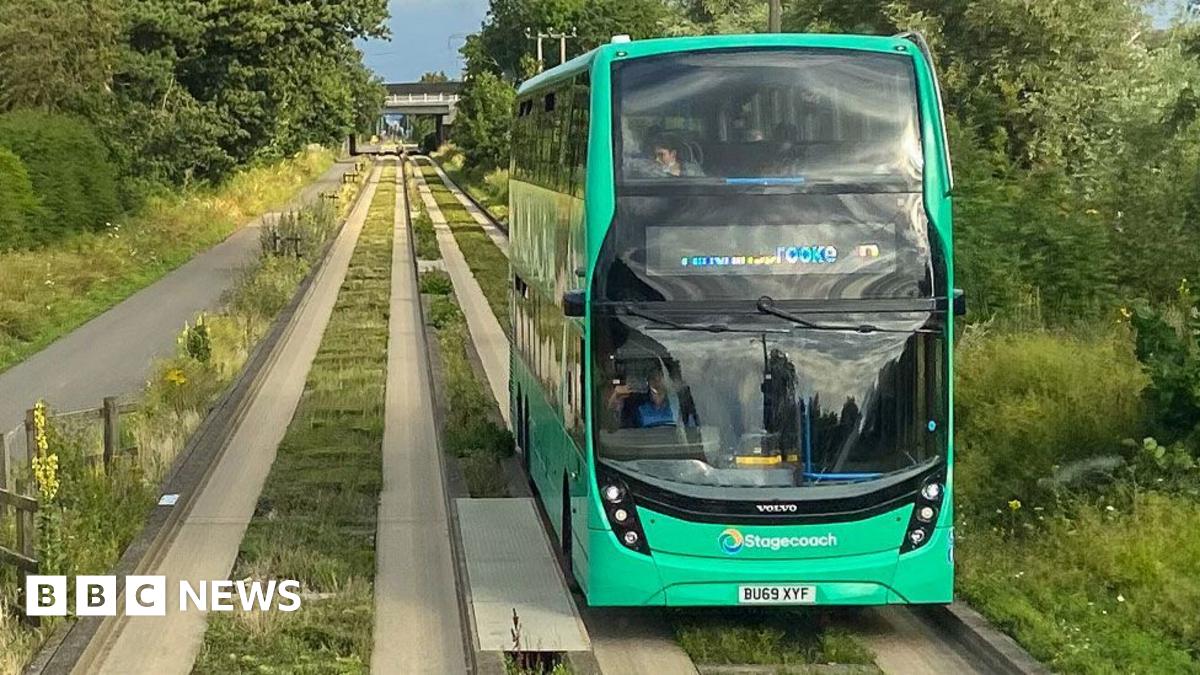
In particular, the north bound track of the Trumpington section is going to be closed again from 12 October while the fence is installed.

Mr Roe said passengers should also be aware of "further disruption" from 12 October when a section of the busway, from Trumpington to the station, would be closed to two-way bus traffic.
 

johncrossley

Established Member
Joined
30 Mar 2021
Messages
4,417
Location
London
Is the route really not wide enough for a tarmac road? I was a big advocate for guided busways 20 years ago but now I think they were a mistake. No other country in Europe apart from Germany has them and Germany have removed most of them.
 

Megafuss

Member
Joined
5 May 2018
Messages
889
Location
Spalding
Is the route really not wide enough for a tarmac road? I was a big advocate for guided busways 20 years ago but now I think they were a mistake. No other country in Europe apart from Germany has them and Germany have removed most of them.
Some sections would require incursion in to the bridleway. I think we all know what CamCycle and others would say about that ...
 

Magdalia

Established Member
Joined
1 Jan 2022
Messages
7,389
Location
The Fens
Is the route really not wide enough for a tarmac road?
For St Ives and Trumpington the concrete guideway is what we have. It would be hideously expensive and disruptive to remove it. Better to make it safe and make good use of it.

Not to a fast enough specification.
One of the key features of the original busway specification was the 90kph/56mph maximum speed. That matters on the St Ives section.

I was a big advocate for guided busways 20 years ago but now I think they were a mistake.

It needs rails and OHLE
That's what I thought 20 years ago.

But rails would not have included a cycleway, and would have worked for St Ives but not Trumpington.
 

johncrossley

Established Member
Joined
30 Mar 2021
Messages
4,417
Location
London
There are other areas with guided busways where there are problems which could be solved by removal. In Leeds and Bradford some routes don't have guide wheels so they need two stops at some locations. In Crawley some buses don't use the guided busway because they are too narrow. Later extensions just use bus lanes. Just like Cambridgeshire, none of them should have been built and probably should be removed.
 

Magdalia

Established Member
Joined
1 Jan 2022
Messages
7,389
Location
The Fens
The first stage of the busway fence work, between Long Road and the Addenbrookes spur, has been completed. Work has now started on the Addenbrookes spur to Trumpington section.

There is a BBC report here on how the reduced speed limit on the busway, and the work to install the fence, have had an impact on usage.


Fewer passengers have been using a guided busway since speed limits were lowered as part of a raft of new safety measures.

The limit on Cambridgeshire's network - where three people have died - was reduced to a blanket 30mph (48km/h) in October while permanent fencing works were carried out.

Meeting documents sent to Cambridgeshire County Council's highways and transport committee stated passenger numbers were "down due to the increased journey time".

David Boden, commercial director of Stagecoach East, said: "We are fully supportive of works to ensure safety, but, in delivering these works, every effort needs to be made to minimise as far as possible the impact on busway customers.

"At our most recent data, we are down 6.8% year-on-year on Busway A customers and 8.6% on Busway B customers. This is a result of the significantly increased journey times caused by the works.

"This increase in journey time, of between 40 and 50 minutes, has seen us introduce three extra buses, and our team put in huge efforts, to try and offer a guaranteed frequency where we can, and also to ensure that Trumpington Park & Ride to the Biomedical Campus has sufficient buses."
 

Trainbike46

Established Member
Joined
18 Sep 2021
Messages
4,374
Location
belfast
The first stage of the busway fence work, between Long Road and the Addenbrookes spur, has been completed. Work has now started on the Addenbrookes spur to Trumpington section.

There is a BBC report here on how the reduced speed limit on the busway, and the work to install the fence, have had an impact on usage.

The fence is only being installed on the station-addenbrookes-trumpington section, right?

So why is there a speed limit on the rest of the busiest, that doesn't have the main safety concern (somewhat narrow footpath right next to busway)?
 

Top