Our new ticketing site is now live! Using either this or the original site (both powered by TrainSplit) helps support the running of the forum with every ticket purchase! Find out more and ask any questions/give us feedback in this thread!
Work to add a fence southwards from Long Road starts on 6 October. The cycleway next to the section from Long Road to Biomedical Campus Junction (I made that name up) is expected to be closed for 5 weeks.
I haven't seen anything on whether the northbound carriageway of the busway will remain open.
New speed limits are to be introduced after three deaths a fine of £6m for a council.
www.bbc.co.uk
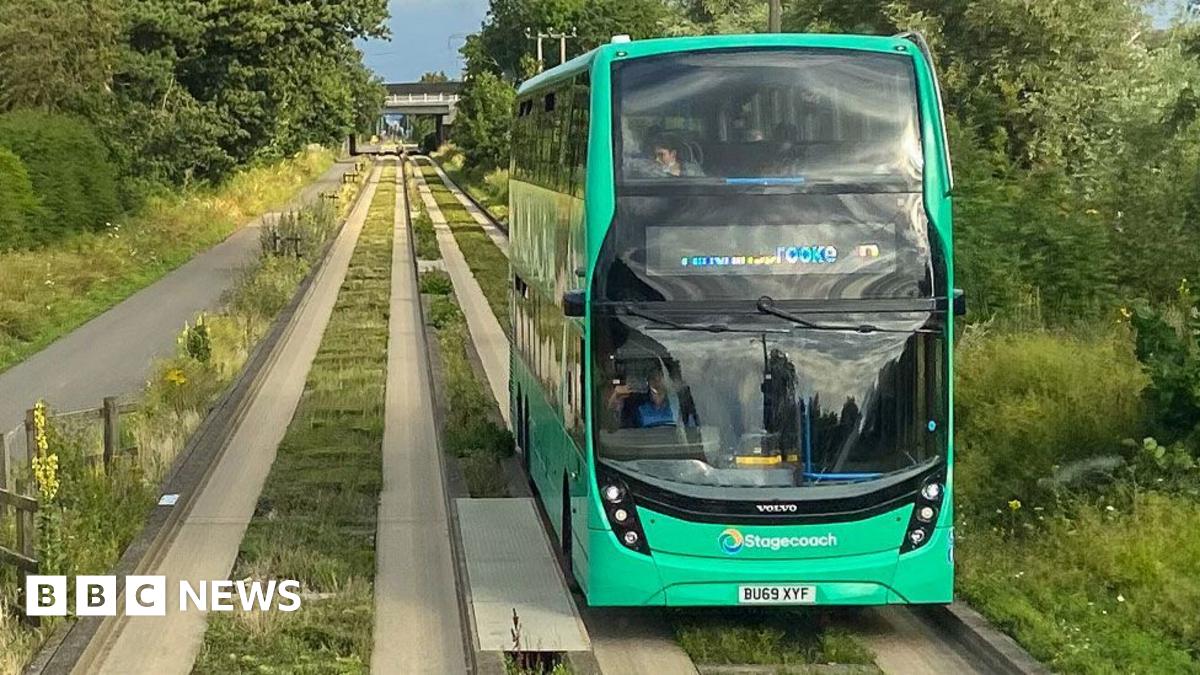
The speed limit on a busway network where three people have died has been reduced to a blanket 30mph (48km/h) for safety reasons.
Jennifer Taylor, Steve Moir and Kathleen Pitts were killed in collisions on the Cambridgeshire Busway between 2015 and 2021.
The county council was fined £6m earlier this year after the deaths and a judge criticised the authority for its "rigid and blinkered response" to the fatalities.
The speed was 56mph (90 km/h) in some places, and it will also be reduced to 20mph at crossing points as part of what the council said was its "ongoing commitment to ensure its safe operation".
Further reductions in maximum speeds are being introduced on the guided busway. Apparently this also includes a 15mph maximum on the maintenance track.
A speed limit of 15mph (24km/h) would also be introduced on the maintenance track that runs alongside the busway, used by pedestrians and cyclists, and motorcycles would be banned.
New speed limits are to be introduced after three deaths a fine of £6m for a council.
www.bbc.co.uk
Further reductions in maximum speeds are being introduced on the guided busway. Apparently this also includes a 15mph maximum on the maintenance track.
It seems the above report is a bit misleading. The 30 limit is on the unfenced bit and will be revised (up, presumably) after the fences are installed.
Temporary speed reduction on the Guided Busway
01 October 2025
The speed limit will be temporarily reduced along the whole Guided Busway as part of the county council’s ongoing commitment to ensure its safe operation.
From Monday (6 October), the speed limit will be lowered to 30mph along the busway and 20mph at crossing points. This is temporary until permanent fencing and barriers have been installed across the whole Guided Busway, which is expected to be completed by the end of 2026. The speed limit will be revised as each section of fencing is completed.
The speed limit reduction will enable potential risks we have identified with pedestrians crossing to be further reduced, in advance of installing new safety fencing and signage.
The bus operators have been engaged on the new temporary speed limit and are working hard to maintain a reliable service. People should prepare their journeys accordingly and allow extra time.
At the same time, a 15mph speed limit will be introduced on the maintenance track, the path which runs alongside the busway. Motorcycles will also be banned from the maintenance track and electric bikes that exceed 15mph will no longer be allowed. These restrictions are being implemented in partnership with the police.
In June, the Highways and Transport Committee agreed to further safety improvements on the Guided Busway. These additional measures build on the County Council’s commitment to health and safety on the Guided Busway.
We’d like to remind people they must not trespass on the busway, and they must keep to the maintenance track or formal crossing points for their own safety.
I think the Council are a bit off with ebikes though given that they are all capable of 15.5mph. I think a 20mph limit would be closer to the mark. I would agree some people cycle too fast on it and often close pass pedestrians - Strava segments are a scourge!
There isn't a legal speed limit for people on (traditional push) bicycles to enforce. Same with horses. Speed limits only apply to motorised vehicles. However you would have to be extremely fit to cycle above 30mph. I'm a medium-fast cyclist, and I track all my bike rides using an app. The fastest I have ever gone is 47km/h - aka 29mph. And that was because I was going down a steep hill. My average speed is 15-20km/h on flat ground - 9-12 mph. A really good road cyclist can go faster than me, definitely. But one that can keep up with 30mph road traffic? That's extremely rare.
A 30mph limit for buses on a guided busway, when they can go faster on normal roads, is frankly ridiculous.
It is perfectly possible (though a bit silly) to apply one. It isn't something that regular speed limits can be applied to, but a Byelaw limiting cycle speeds is perfectly possible and one assumes is how this is to be enforced, particularly given that 15mph is not a regular speed limit, they come in 10s.
However you would have to be extremely fit to cycle above 30mph. I'm a medium-fast cyclist, and I track all my bike rides using an app. The fastest I have ever gone is 47km/h - aka 29mph. And that was because I was going down a steep hill. My average speed is 15-20km/h on flat ground - 9-12 mph. A really good road cyclist can go faster than me, definitely. But one that can keep up with 30mph road traffic? That's extremely rare. E-bikes? Well they're legally capped at 15mph without pedalling.
If you were going to put a limit on the cycle path with a Byelaw applying it to cyclists, 20 makes more sense. Cycling above 20mph for a sustained period is (as you say) considerable effort and anybody doing it knows full well that they are, speedo or no. I'd be quite happy with legislation effectively preventing Strava segments on shared paths to be honest because they encourage dangerous cycling, and it's mostly people looking for these that are cycling fast on this shared path (and places like MK Redways for that matter which are very similar).
It seems the above report is a bit misleading. The 30 limit is on the unfenced bit and will be revised (up, presumably) after the fences are installed.
I ride my ebike on the busway maintenance track. The only place where I exceed 15mph by any significant amount is descending the bridge over the railway. The rest is ex railway so doesn't have any significant gradients from a cycling perspective, and my ebike doesn't get anywhere near 20mph, except when descending the bridge. A 15 mph limit is sensible if sensibly interpreted so as not to catch ebikes going at 15.5 mph/25 kph.
cycling above 20mph for a sustained period is (as you say) considerable effort and anybody doing it knows full well that they are, speedo or no. I'd be quite happy with legislation effectively preventing Strava segments on shared paths to be honest because they encourage dangerous cycling
Cambridge probably has more than its fair share of these, and I do get overtaken sometimes when riding my ebike. Cycling speeds above 15 mph are dangerous when the maintenance track is congested, particularly as Cambridge has a wide variety of cargo bikes and bikes with contraptions for conveying small children.
The bit that is unclear is how it can be enforced.
I don't believe anyone "walked out in front of a bus", rather on a particularly narrow section they were involved in an accident on the cycle path that caused them to fall on the busway, and unlike a normal road the bus couldn't swerve to avoid them and couldn't stop in time.
The busway is a bit like a railway in that sense really. Do we accept unfenced railways in the UK? I don't think we do.
The bit south of the station is particularly bad for this - the rest of it, bar a few sections like the bridge near St Ives, has plenty of room to move the track away from the busway itself or it is already away from it sufficiently that such an accident wouldn't happen.
The first death was an 81-year-old lady who walked out in front of a bus. She'd missed her stop, got off the bus, and was crossing at an unlit crossing point to get the next bus back when she was hit by a bus going in the other direction.
The other two deaths were a cyclist who clipped a kerb and fell in front of a bus, and another pedestrian. Details about the latter death seem sketchy, Google tells me the inquest is later this year. I think these two were on the narrower bit south of the station which, in fairness, probably should have been fenced from the beginning.
I don't believe anyone "walked out in front of a bus", rather on a particularly narrow section they were involved in an accident on the cycle path that caused them to fall on the busway, and unlike a normal road the bus couldn't swerve to avoid them and couldn't stop in time.
As Tetchtyke said at least one was just a passenger crossing the busway at a crossing. If there wasn't time to stop you do wonder if there would have been time to swerve anyway in reality. The issue with this at its heart appears to be that it seems to be applying rail rules to something without taking into account the different dynamic features of a bus - though this does depend on whether it applies to the whole Busway (most of which has the track seperated by several feet from the busway) where the 30mph limit seems over the top or just the largely urban sections, particularly around Cambridge, where the track is next to the Busway where a 30mph limit is more in line with the parallel roads.
Trams have track brakes which can stop them on a sixpence - so quickly that the driver has to check nobody was hurt. Buses can't actually stop quite as quickly - road vehicles usually rely on being able to swerve.
Also are there any tramways where there's a path right next to the tramway, unfenced and undivided, with a running speed of over 30mph? I can't think of one.
Trams have track brakes which can stop them on a sixpence - so quickly that the driver has to check nobody was hurt. Buses can't actually stop quite as quickly - road vehicles usually rely on being able to swerve.
Also are there any tramways where there's a path right next to the tramway, unfenced and undivided, with a running speed of over 30mph? I can't think of one.
Does it need to be guided in this section? Can they remove the guideway and put in a slightly tarmac road? Maybe technology has moved on sufficiently so that we can have optical guided buses that can pass each other sufficiently close meaning that kerb guidance is no longer required when the road is narrow.
Which of course doesn't work if any vehicles are coming the other way.
As someone else has said, they're applying rail like rules it seems i.e. any collision is the councils fault.
On roads of course most collisions never result in anything because for some reason no one seems to have any accountability for them
Which of course doesn't work if any vehicles are coming the other way.
As someone else has said, they're applying rail like rules it seems i.e. any collision is the councils fault.
On roads of course most collisions never result in anything because for some reason no one seems to have any accountability for them
Does it need to be guided in this section? Can they remove the guideway and put in a slightly tarmac road? Maybe technology has moved on sufficiently so that we can have optical guided buses that can pass each other sufficiently close meaning that kerb guidance is no longer required when the road is narrow.
Other forms of guidance have been around for at least 30 years. There was a system based on buried wires, initially used for the Channel Tunnel service vehicles and was going to be introduced around the Millennium Dome but I don't think it ever opened. There was also the Phileas system using buried magnets, and more recently purely optical systems. A vehicle can now follow a course purely by GPS with no physical infrastructure except perhaps a differential GPS setup, and this is done in agriculture to ensure that each part of a field is treated or seeded exactly once.
All these systems could allow a driver (assuming there is one) to override and swerve the vehicle away from its defined path, but are also reliant on the integrity of the guidance and the ability of the vehicle to steer correctly. Factors such as snow, ice, dirt, or GPS interference could compromise these systems, but not a simple mechanical kerb guidance.
True, but most of the time there opposite side of the road will be clear. The "headway" on something like the Cambridgeshire route is probably around 2min, governed by dwell time at the stops, so if a vehicle has to swerve there is a fairly small chance of an oncoming vehicle being within about 5s travel time when it might not be able to stop.
The court ruled that the fatalities were the council's fault, resulting from breaches of Health and Safety legislation. It is nothing to do with railway safety. Particularly damning was that, until after the first fatality, they had not done any risk assessments at all.
Maybe technology has moved on sufficiently so that we can have optical guided buses that can pass each other sufficiently close meaning that kerb guidance is no longer required when the road is narrow.
Other forms of guidance have been around for at least 30 years. There was a system based on buried wires, initially used for the Channel Tunnel service vehicles and was going to be introduced around the Millennium Dome but I don't think it ever opened. There was also the Phileas system using buried magnets, and more recently purely optical systems. A vehicle can now follow a course purely by GPS with no physical infrastructure except perhaps a differential GPS setup, and this is done in agriculture to ensure that each part of a field is treated or seeded exactly once.
Technology has moved on and any new guided busways will use different methods of guidance. But new busways do have to be guided in order to use the Transport and Works Act Order planning process. As it happens, the Transport and Works Act inquiry on the proposed Cambourne busway is currently in progress, though, as far as I'm aware, it has not addressed safety issues yet. I'm also not aware of any clear (I was tempted to say concrete there) statement on the method of guidance to be used for Cambourne.
The "headway" on something like the Cambridgeshire route is probably around 2min, governed by dwell time at the stops, so if a vehicle has to swerve there is a fairly small chance of an oncoming vehicle being within about 5s travel time when it might not be able to stop.
The headways can be very close, like two buses following each other on any road. Dwell time at stops only has limited effect on headways because there are not many stops that are actually on the guided sections. The southern section, where two of the fatalities occurred, only has one stop that is actually on the guideway.
But surely that is just red tape that can be removed by the government, which is already talking a lot about speeding up the planning process. The vast majority of dedicated busways in Europe and indeed the rest of the world don't use any form of guidance. Presumably the Fareham to Gosport busway was built without Transport and Works Act as it isn't guided.
But surely that is just red tape that can be removed by the government, which is already talking a lot about speeding up the planning process. The vast majority of dedicated busways in Europe and indeed the rest of the world don't use any form of guidance. Presumably the Fareham to Gosport busway was built without Transport and Works Act as it isn't guided.
An unguided busway is a road, and has to go through the planning process for roads.
You are right that the government can change the planning framework. It is already doing that, but things that require primary legislation are not "just red tape that can be removed".
One option could be for the government to designate any busways in Cambridge as Nationally Significant Infrastructure Projects, which use the Development Consent Order process.
But surely that is just red tape that can be removed by the government, which is already talking a lot about speeding up the planning process. The vast majority of dedicated busways in Europe and indeed the rest of the world don't use any form of guidance. Presumably the Fareham to Gosport busway was built without Transport and Works Act as it isn't guided.
I believe this use of TWA is to do with limiting use of the alignment to specific operators, otherwise it would be a normal road and under bus deregulation any operator could use it - also true if guided provided their vehicles had the necessary equipment. Hopefully one of the beneficial effects of dismantling bus deregulation will be to eliminate this particular piece of red tape.
I believe this use of TWA is to do with limiting use of the alignment to specific operators, otherwise it would be a normal road and under bus deregulation any operator could use it - also true if guided provided their vehicles had the necessary equipment. Hopefully one of the beneficial effects of dismantling bus deregulation will be to eliminate this particular piece of red tape.
The court ruled that the fatalities were the council's fault, resulting from breaches of Health and Safety legislation. It is nothing to do with railway safety. Particularly damning was that, until after the first fatality, they had not done any risk assessments at all.
It seems that the council eventually acquiesced and pleaded guilty, presumably just to get it out of their hair. But for years they had pushed back against the HSE. I think they were right to.
They wouldn't have had to do risk assessments for a road.
If a cyclist hits a kerb and crashes in front of a bus on a normal road then it is treated as what it is- distressing for all concerned, but simple bad luck. Same if someone walks out in front of a bus at an unlit crossing where they have, presumably, either not seen the bus or misjudged the distance in the dark/
The fundamental issue appears to be that the council treated the busway as a road and the HSE seem to want to treat the busway as a railway. Which is why we have the situation now where the health and safety lot are mandating a 30mph speed limit be put on the entire busway until fences are put up, even though the 40mph road right next to it has no fences at all.
== Doublepost prevention - post automatically merged: ==
The new mayor doesn't want franchising either. It's been a big source of conflict between different arms of the different authorities.
I also wonder whether this ongoing tension is why the council, after several years of firmly pushing back against the HSE, suddenly decided to acquiesce.
It seems that the council eventually acquiesced and pleaded guilty, presumably just to get it out of their hair. But for years they had pushed back against the HSE. I think they were right to.
They wouldn't have had to do risk assessments for a road.
If a cyclist hits a kerb and crashes in front of a bus on a normal road then it is treated as what it is- distressing for all concerned, but simple bad luck. Same if someone walks out in front of a bus at an unlit crossing where they have, presumably, either not seen the bus or misjudged the distance in the dark/
The fundamental issue appears to be that the council treated the busway as a road and the HSE seem to want to treat the busway as a railway. Which is why we have the situation now where the health and safety lot are mandating a 30mph speed limit be put on the entire busway until fences are put up, even though the 40mph road right next to it has no fences at all.
If the inquest into a death on a normal road identified the road design as a contributing factor, then it could also lead to a health and safety investigation and possible prosecution.
I use the section where two of the fatalities occurred, both on buses and on my ebike. Before the fence was installed it was unsafe, and, until the second death, the council did nothing about it. I did my own risk assessment and didn't cycle that way, except on Sundays, Hills Road was safer.
In a parallel example, the Addenbrookes roundabout has been redesigned following the death of a cyclist there in 2021.
Two highly experienced transport leaders have been appointed to support the Combined Authority’s ambition for better connectivity and Mayor Paul Bristow’s priority ‘to get the region moving.’ Peter Cushing has been named Light Rail Commissioner, and Leon Daniels OBE has been appointed as...
cambridgeshirepeterborough-ca.gov.uk
Two highly experienced transport leaders have been appointed to support the Combined Authority’s ambition for better connectivity and Mayor Paul Bristow’s priority ‘to get the region moving.’
Mayor of Cambridgeshire and Peterborough, Paul Bristow, said: “To finally deliver the modern, joined-up transport system this region needs, we need the right people. Peter and Leon bring exceptional expertise and a cast iron track record of delivery. I want this region to be the country’s fastest growing local economy. To do that, we need to show ambition. I’m serious about delivering light rail and bringing in a bus franchising system that is affordable and works for passengers. These appointments will help us get there.”
In the Cambridge area it is worse than that, with the mayor and the Greater Cambridge Partnership too. Unitary authorities are coming but not in the first round. At the moment we are part way through the usual bunfight on how to do the reorganisation, but a unitary authority comprising Cambridge City and South Cambridgeshire districts is likely in most scenarios.
== Doublepost prevention - post automatically merged: ==
I have now remembered an example where a road speed limit was reduced after a fatal accident.
Five-month-old Louis Thorold's father says the reduction is a step in the right direction.
www.bbc.co.uk
The speed limit on a road where a baby in a pram was killed has been reduced following a campaign by his family.
Five-month-old Louis Thorold died when a van mounted the pavement after it was in a collision with a car on the A10 in Waterbeach, Cambridgeshire, in January.
The county council confirmed the limit on a 1.3-mile (2.1km) stretch of the A10 will be reduced to 40mph (64km/h).
If the inquest into a death on a normal road identified the road design as a contributing factor, then it could also lead to a health and safety investigation and possible prosecution.
All roads where there there is a pedestrian footpath right next to it, or a cycle path right next to it, or worse, bikes having to share the road with general traffic have a chance of accidents. Therefore the design is at fault and so the pedestrian footpath or bike path needs to be completely fenced off from the road.
== Doublepost prevention - post automatically merged: ==
I believe this use of TWA is to do with limiting use of the alignment to specific operators, otherwise it would be a normal road and under bus deregulation any operator could use it - also true if guided provided their vehicles had the necessary equipment. Hopefully one of the beneficial effects of dismantling bus deregulation will be to eliminate this particular piece of red tape.
All roads where there there is a pedestrian footpath right next to it, or a cycle path right next to it, or worse, bikes having to share the road with general traffic have a chance of accidents. Therefore the design is at fault and so the pedestrian footpath or bike path needs to be completely fenced off from the road.
Your second sentence does not follow from the first, because the objective of safety management is not complete elimination of risk. The objective is to make the risks as low as reasonably practical (ALARP).
Various roads do have fences to segregate pedestrians and cycles from motor traffic. The fences are installed where the risks are high, for example, at busy junctions. Roads without fences do not have faulty design if the risk is as low as reasonably practical.
Your second sentence does not follow from the first, because the objective of safety management is not complete elimination of risk. The objective is to make the risks as low as reasonably practical (ALARP).
Various roads do have fences to segregate pedestrians and cycles from motor traffic. The fences are installed where the risks are high, for example, at busy junctions. Roads without fences do not have faulty design if the risk is as low as reasonably practical.
The risks we are talking about on normal roads is magnitudes more severe than anything to do with guided busways. The risk of an accident on a normal road with zero segregation between bike and car is obviously vastly higher than on a physically segregated cycle path next to a road/busway with almost zero traffic. On the Cambridgeshire busway there are fewer than 20 vehicles per hour each way. By contrast, the flow on many normal roads is hundreds of vehicles per hour, and they are allowed to continue operating without any segregation whatsoever, never mind fencing.
We are aware of an issue with emails from the Forum to Microsoft-based email accounts (hotmail/outlook/live.com email addresses). This is being looked into currently, thanks for your patience meanwhile.