• Our new ticketing site is now live! Using either this or the original site (both powered by TrainSplit) helps support the running of the forum with every ticket purchase! Find out more and ask any questions/give us feedback in this thread!

How many UK operators have so far moved towards Electric fleets ?

Status
Not open for further replies.

Wyrleybart

Established Member
Joined
29 Mar 2020
Messages
2,596
Location
South Staffordshire
I am in Staffordshire but work in Birmngham city centre so am only really familiar with Birmingham, and Walsall and South Staffordshire fleets. I am conscious though of the development of electric buses. Lat time I was at Birmingham airport I saw a couple of elewctric vehicles and thier inverted pantograph charging in operation outside the terminal.

NXWM introduced the ADL "Zenobe" buses to the Coventry fleet, then brought a load more into use in Birmingham, so the "E" fleet is expanding, especially with the delivery of the first few Wright Electroliners tyo NXWM.

As I understand it Stagecoach have introduced some electric ADLs to their fleet at Leamington, and I have seen the green electric Streetdecks in Leicester - presumably similar to the fl;eet that NXWM are taking. So my question and purpose of his thread is how is the electrification of UK buss services going ? I imagine the main towns and cities including London will have fleets.

Presume there hasn't been an incidence of a bus running out of charge - are thye too sophisticated for that ?

Welcome any thoughts and info
 
Sponsor Post - registered members do not see these adverts; click here to register, or click here to log in
R

RailUK Forums

stevieinselby

Established Member
Joined
6 Jan 2013
Messages
1,658
Location
Selby
Out of the Big Four, First and Stagecoach have been pushing hard on roll-out of electric buses, although they are generally concentrated in pockets rather than spread around the country (which makes sense in terms of infrastructure). Go-Ahead have got some deployment outside franchised areas but not much. Arriva have done nothing I can see outside London and a couple of partnership areas like Leicester and Merseyside.

Beyond that, it varies! There are some independents, smaller groups and municipals like McGills, Transdev and Cardiff Bus that have rolled out extensive electric fleets, some have a handful only, some (including most smaller operators) don't have any.
 

duncombec

Member
Joined
3 Sep 2014
Messages
1,147
The two biggest issues facing any operator are the cost of electric vehicles (there remains a significant price premium on electric - possibly 50%?) to begin with, rendering them out of reach for a lot of smaller operators without financial support (and frankly, larger operators too - look how many of the existing number have been funded or part funded by ZEBRA, partnership, etc.).

Secondly, that of getting the charge to the depot. London vehicles have been delayed entering service awaiting electrification - I seem to recall hearing that the electricity companies won't put you on the list for a supply upgrade until you've ordered the vehicles, then take longer to get the supply upgraded than it takes to build the vehicles. McGills noted one of their depots was relatively easy because there was essentially a "main main" along the road outside, but it would be much harder if they were in a more rural area, or at the back of an industrial estate.

A smaller problem may be the extra space needed for chargers. They take up a bit of space themselves, and it renders it fairly impossible for the sort of tight "can just about get the shunter out of the bus" parking that some operators - big and small - use.
 

TheGrandWazoo

Veteran Member
Joined
18 Feb 2013
Messages
22,842
Location
Somerset with international travel (e.g. across th
Out of the Big Four, First and Stagecoach have been pushing hard on roll-out of electric buses, although they are generally concentrated in pockets rather than spread around the country (which makes sense in terms of infrastructure). Go-Ahead have got some deployment outside franchised areas but not much. Arriva have done nothing I can see outside London and a couple of partnership areas like Leicester and Merseyside.

Beyond that, it varies! There are some independents, smaller groups and municipals like McGills, Transdev and Cardiff Bus that have rolled out extensive electric fleets, some have a handful only, some (including most smaller operators) don't have any.
The two biggest issues facing any operator are the cost of electric vehicles (there remains a significant price premium on electric - possibly 50%?) to begin with, rendering them out of reach for a lot of smaller operators without financial support (and frankly, larger operators too - look how many of the existing number have been funded or part funded by ZEBRA, partnership, etc.).

Secondly, that of getting the charge to the depot. London vehicles have been delayed entering service awaiting electrification - I seem to recall hearing that the electricity companies won't put you on the list for a supply upgrade until you've ordered the vehicles, then take longer to get the supply upgraded than it takes to build the vehicles. McGills noted one of their depots was relatively easy because there was essentially a "main main" along the road outside, but it would be much harder if they were in a more rural area, or at the back of an industrial estate.

A smaller problem may be the extra space needed for chargers. They take up a bit of space themselves, and it renders it fairly impossible for the sort of tight "can just about get the shunter out of the bus" parking that some operators - big and small - use.
Lot of accurate facts here. Fact is that EV's do have a massive upfront premium and that's aside from the charging infrastructure. ZEBRA funding and other schemes do help but remember, they only provide a proportion of the funding for new vehicles. Companies still need to invest themselves. Hence when Arriva was owned by DB and didn't have much available capital for fleet replacement, they pulled out of a plan to convert Stevenage to EV as they didn't have the money for their "share". Also, the problems of electrical connectivity are well known. I know some posters took great glee with Transdev's first EVs in Harrogate relying on a diesel generator to provide power but that was because the local provider simply could not meet the timescale.

First are probably the UK leader (in sheer numbers) with large fleets in Glasgow, York, Norwich, Leeds, Leicester, Portsmouth and increasingly so in Bristol. They have even got them in Taunton, just a mere 16 years after the last new vehicles for that fleet* arrived. I would say that Greater Manchester might have the most EVs but not certain.

Stagecoach has been busy in the provinces with new vehicles in a number of interesting spots such as Chesterfield and Warwick too, plus in the North East with Sunderland and Stockton. A couple of photos from May when I was in Teesside showing the works being done at Stockton depot. Since then, most of the vehicles seen here have been cascaded out of the area, replaced by a fleet of Yutong E12s (and very nice they are too). Also, the site will be open to third party businesses, I believe, so firms like Royal Mail, DPD etc will be able to charge their vehicles on a commercial basis.

1754570029710.png1754570097524.png

* excludes loans.
 

zwk500

Veteran Member
Joined
20 Jan 2020
Messages
18,401
Location
Northampton
First are probably the UK leader (in sheer numbers) with large fleets in Glasgow, York, Norwich, Leeds, Leicester, Portsmouth and increasingly so in Bristol

Indeed, Bristol has recently started introducing the new electric buses: https://www.bbc.co.uk/news/articles/clyzjrky1nyo
A total of 98 new buses will soon be operating across nine services in Bristol and North Somerset following the installation of rapid chargers at depots in Hengrove and Weston-super-Mare.

The buses can travel up to 230 miles on one charge, and can be fully charged in just one hour and 15 minutes.
The first 24 new electric buses are already operating from the Weston-super-Mayor depot, while the Hengrove depot in Bristol is set to get 74.

Over the next year, 258 new electric buses are set to be delivered across the West, with Bath routes being electrified in 2026.
They are increasingly visible around the city. interestingly, First put up a pretty big chunk of the cash for the vehicles.
First Bus, one of the UK's largest bus operators, provided £50m of the funding, while the remaining £9m came from central government.
 

londonteacher

Member
Joined
10 Aug 2018
Messages
800
Location
Chatham
Arriva Merseyside have a fleet of 12 67 plate BYD D9UR ADL Enviro200EV. But that appears to be all they have. They are very much still purchasing diesel buses.
 

Strathtay 260

Member
Joined
25 Jul 2024
Messages
260
Location
Scotland
The only fully electric coach operator, which started operating services in October 2020, Ember has 78 coaches at the moment (24 Yutong TCe12s and 54 Yutong GTe14s) with 60 more GTe14s to come.
 

londonteacher

Member
Joined
10 Aug 2018
Messages
800
Location
Chatham
Lothian Buses also appear to have many buses in the form of Volvo BZL DD. Warrington's Own Buses is a mainly electric fleet consisting of Volvo BZL and Volvo BZL DD.
 

padbus

Member
Joined
23 Feb 2015
Messages
287
Don't forget Oxford where the entire city service fleet (including the open toppers) has been converted to electric buses. Most are Go-Ahead (Wrightbus) with some from Stagecoach (ADL).
 

Dwarfer1979

Member
Joined
24 Feb 2025
Messages
437
Location
Leicester
The two biggest issues facing any operator are the cost of electric vehicles (there remains a significant price premium on electric - possibly 50%?) to begin with, rendering them out of reach for a lot of smaller operators without financial support (and frankly, larger operators too - look how many of the existing number have been funded or part funded by ZEBRA, partnership, etc.).

Secondly, that of getting the charge to the depot. London vehicles have been delayed entering service awaiting electrification - I seem to recall hearing that the electricity companies won't put you on the list for a supply upgrade until you've ordered the vehicles, then take longer to get the supply upgraded than it takes to build the vehicles. McGills noted one of their depots was relatively easy because there was essentially a "main main" along the road outside, but it would be much harder if they were in a more rural area, or at the back of an industrial estate.

A smaller problem may be the extra space needed for chargers. They take up a bit of space themselves, and it renders it fairly impossible for the sort of tight "can just about get the shunter out of the bus" parking that some operators - big and small - use.
The cost issue is really batteries, the base vehicle is no more expensive than a diesel, so if you can find a way to finance the batteries it becomes a commercial proposition. Talking to our directors it has been suggested that the maintenance and running cost savings over the life of the batteries do equal the cost of a battery pack so it does balance out but the issue is the finding that funding up front to cover the additional purchase price that you can amortise over the life. There are proposals from battery companies like Zenobe to lease the batteries (as they have uses for old bus batteries in power farms and the like) and that looks like a long term solution once the details are clarified.

Our depot had a "main main" outside it and our electric buses were still ready 6 months before the chargers were ready. There is an additional problem in that there is normally a need to install a transformer and the power companies demand a very long lease (I think 99 years) which affects where you can site it (to prevent blocking future development it tends to need to be on the edge of the site) and if the operator doesn't own the site can cause delays in agreements to allow installation.

Chargers will affect space and in some depots that is a real issue, this is why some of the bigger operators (First in Leicester have done this) have used gantries that mean the connectors drop down from above, more expensive to fit but less space take overall.
 

Energy

Established Member
Joined
29 Dec 2018
Messages
5,135
NXWM introduced the ADL "Zenobe" buses to the Coventry fleet, then brought a load more into use in Birmingham, so the "E" fleet is expanding, especially with the delivery of the first few Wright Electroliners tyo NXWM.
NX Coventry is up to 147 BYD/ADL E400EVs, with only the single-decker buses (currently 28 of those) being diesel. NX has trialed a few single-deckers in Coventry but has yet to make an order.

NXWM has a load of BYD/ADL E400EVs and is now having Electroliners delivered.
As I understand it Stagecoach have introduced some electric ADLs to their fleet at Leamington
Correct.

Coventry and Oxford have funding to become all-electric bus cities. Stagecoach Midlands has some funds from that, as well as a ZEBRA bid for Warwickshire, for a load of E400 EV integrals and single-deck Yutongs across the Leamington Spa, Rugby, and Nuneaton depots.
Out of the Big Four, First and Stagecoach have been pushing hard on roll-out of electric buses, although they are generally concentrated in pockets rather than spread around the country (which makes sense in terms of infrastructure). Go-Ahead have got some deployment outside franchised areas but not much.
First isn't buying any more diesels and has gone all in on electric. Notably, First York depot is entirely electric, with the diesel tank having been removed.

Stagecoach has been buying quite a few, though it has also purchased new diesel Optare Solos and E400s. Stagecoach originally ordered integral E200EVs, but ADL couldn't meet the required delivery times so those single-deck orders have been switched to Yutongs. Stagecoach has also bought some Volvo BZLs and a few Electroliners for London.
Arriva Merseyside have a fleet of 12 67 plate BYD D9UR ADL Enviro200EV. But that appears to be all they have. They are very much still purchasing diesel buses.
Indeed, Arriva Merseyside also just purchased a load of diesel Enviro200s and some B8RLEs.

Liverpool City Region Combined Authority has purchased 58 integral E400EVs, and 50 additional unspecified electric double deckers.
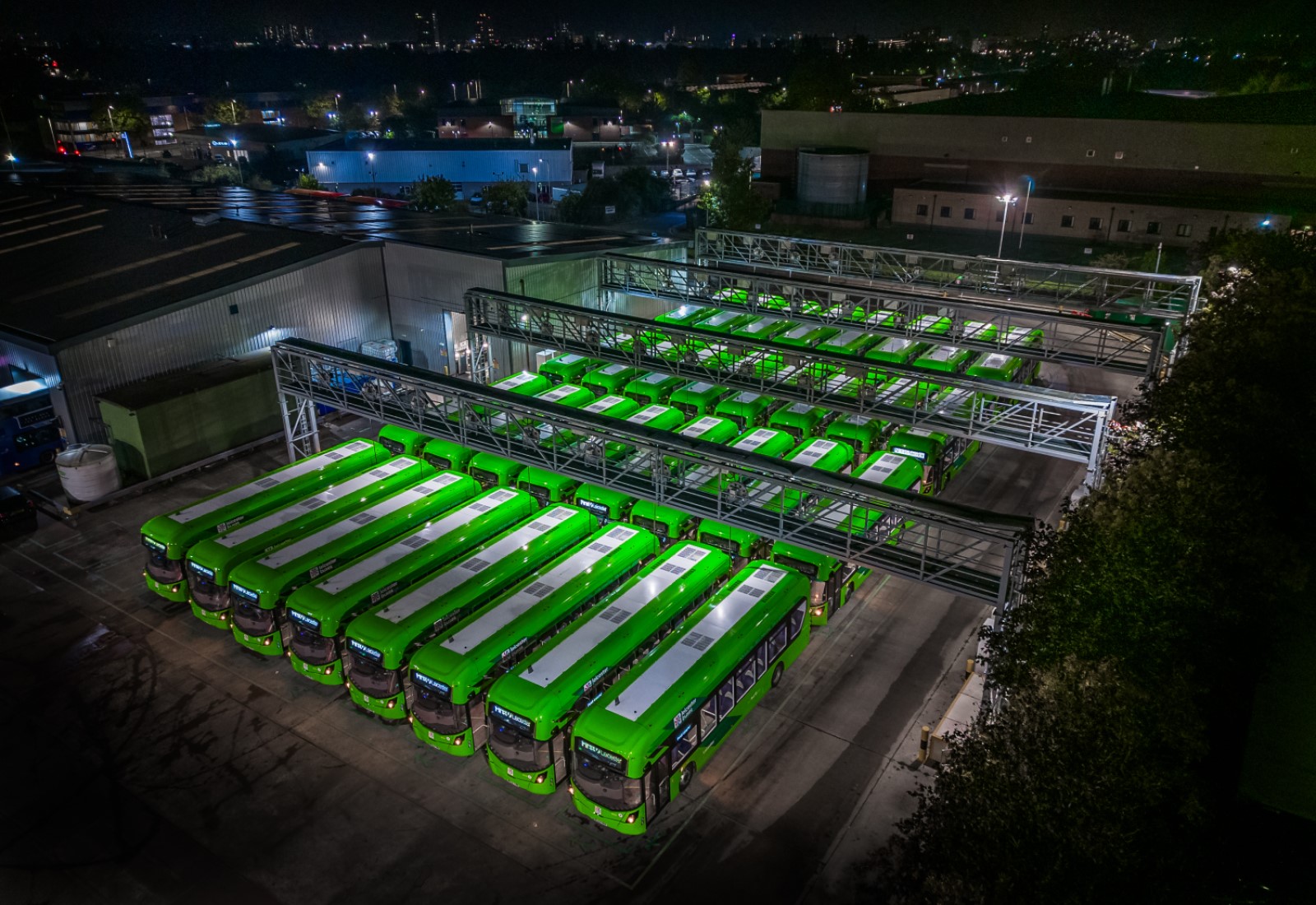
Chargers will affect space and in some depots that is a real issue, this is why some of the bigger operators (First in Leicester have done this) have used gantries that mean the connectors drop down from above, more expensive to fit but less space take overall
Yep, the gantries have retractable connectors. Here's the setup at First Leicester.
First-EV-Night.jpg
 
Last edited:

Magdalia

Established Member
Joined
1 Jan 2022
Messages
7,296
Location
The Fens
Cambridge Park and Ride, operated by Stagecoach, had a new fleet of electric vehicles about 2 years ago.

This was closely followed by Whippet getting electric vehicles for the U1 and U2 routes.

My impression, from press coverage at the time, was buses being able to run all day without recharging was a significant factor in the switch to electric vehicles.

I recall that the Stagecoach Park and Ride vehicles had some ZEBRA funding, and that the Whippet U1/U2 vehicles had some financial support from Cambridge University.
 

matt

Forum Staff
Staff Member
Global Moderator
Joined
30 Jun 2005
Messages
8,832
Location
Rugby
Stagecoach in Rugby have got some electric buses now.
 

JD2168

Established Member
Joined
11 Jul 2022
Messages
1,707
Location
Sheffield
South Yorkshire electric buses are:

South Pennine - 4 BYD Enviro 200 EV’s used on the Sheffield Connect services SC1 & SC2 funded by SYMCA

Stagecoach - Yutong E12’s numbered 73001-73023 in a special livery mainly on 22x & 221 - all based at Rawmarsh depot.

Stagecoach Chesterfield - large number of Yutong E10’s & E12’s & Enviro 400 EV’s.
 

stevieinselby

Established Member
Joined
6 Jan 2013
Messages
1,658
Location
Selby
Stagecoach has been buying quite a few, though it has also purchased new diesel Optare Solos and E400s. Stagecoach originally ordered integral E200EVs, but ADL couldn't meet the required delivery times so those single-deck orders have been switched to Yutongs. Stagecoach has also bought some Volvo BZLs and a few Electroliners for London.
Stagecoach have got a bunch of Enviro 100EVs in London, and another load scattered across various depots in Scotland. They've also got Enviro 400EVs, BYD Enviro 200s and 400s, Yutong E10s and E12s, Volvo BZLs and some 7900Es, Wright Electroliners and Switch miniMetroCities. Overall it looks like they've gone heavier with electric in Scotland than England, but again it tends to be concentrated in a small number of depots.
 

Great_Western

Member
Joined
18 May 2016
Messages
203
The only thing holding back faster adoption of electric buses now is acquisition and infrastructure cost.

It's obvious that once operational, electric fleets are so much cheaper to operate and maintain than diesel buses. Even medium size operators are now starting to grasp that and Newport Bus actually bought a batch of Yutongs commercially without any government subsidy.

The technology has got good enough now that even range isn't an issue. You can realistically get 150 miles of in service range in a day on the Yutongs and that's without any mid-day stops for a top up. This means that with a bit of sensible planning you can pretty much run any even long distance interurban run with them.

It's now possible to get from Barry Town to Hereford or Weston Super Mare by only using electric buses, and I'd imagine in a few years a lot more electric corridors like that will open up.
 

gka472l

Member
Joined
29 Apr 2016
Messages
659
Location
Merseyside
Liverpool City Region Combined Authority has purchased 100+ integral E400EVs.

I know of the 58 that have been built for Gillmoss depot (currently Stagecoach) but not aware of any more, although there are Electroliners in build at Wrightbus, also in 'METRO' livery, amount unknown at this time.....
 

stevieinselby

Established Member
Joined
6 Jan 2013
Messages
1,658
Location
Selby
It's obvious that once operational, electric fleets are so much cheaper to operate and maintain than diesel buses. Even medium size operators are now starting to grasp that and Newport Bus actually bought a batch of Yutongs commercially without any government subsidy.
I wonder at what point the improved reliability and lower maintenance needed for electric buses means operators can get away with a smaller fleet of electric buses than diesel buses. Then it becomes more of a commercially viable proposition than if you're replacing buses on a 1-for-1 basis.
 

Energy

Established Member
Joined
29 Dec 2018
Messages
5,135
Stagecoach have got a bunch of Enviro 100EVs in London, and another load scattered across various depots in Scotland. They've also got Enviro 400EVs, BYD Enviro 200s and 400s, Yutong E10s and E12s, Volvo BZLs and some 7900Es, Wright Electroliners and Switch miniMetroCities. Overall it looks like they've gone heavier with electric in Scotland than England, but again it tends to be concentrated in a small number of depots.
Indeed. A lot of the non-ADL orders occurred when BYD & ADL parted ways but ADL didn’t have its integral electric range ready.
I know of the 58 that have been built for Gillmoss depot (currently Stagecoach) but not aware of any more, although there are Electroliners in build at Wrightbus, also in 'METRO' livery, amount unknown at this time.....
58 integral E400EVs were ordered through ZEBRA2 funding. Another 50 electric double-deckers, through transport settlement funding, were ordered but it wasn't specified which depot or what model.

The electroliner order hasn’t been announced so I’d imagine it’ll be the 50 additional buses.
 

WM Bus

Member
Joined
28 Jul 2018
Messages
296
NX Coventry is up to 147 BYD/ADL E400EVs, with only the single-decker buses (currently 28 of those) being diesel. NX has trialed a few single-deckers in Coventry but has yet to make an order.

NXWM has a load of BYD/ADL E400EVs and is now having Electroliners delivered.
it was said Perry Barr are going to get electroliners eventually & BYDs will move over to Coventry to replace B7RLE. Coventry likely to go fully double deck like Birmingham Central.

Rotala have some custom dennings 1 at Tividale, 3 temporarily operating out of Kidderminster on the 242 & will join the others at Burton eventually. So not sure if they will ever operate any other services out of there even the peak 294 board would be interesting.
& 40725 which has been converted too.
 
Last edited:

Dai Corner

Established Member
Joined
20 Jul 2015
Messages
6,989
41 out of the 53 Newport Transport buses currently out are electric. They are Yutong E9Ls, E10s, E12s and U11DDs and I think a significant number were financed by UK or Welsh Government grants.

The ratio is not as good during the school term as they have a fleet of elderly diesel 'deckers for schools work, some of which also work normal services before, between or afterwards.
 

Wyrleybart

Established Member
Joined
29 Mar 2020
Messages
2,596
Location
South Staffordshire
41 out of the 53 Newport Transport buses currently out are electric. They are Yutong E9Ls, E10s, E12s and U11DDs and I think a significant number were financed by UK or Welsh Government grants.

The ratio is not as good during the school term as they have a fleet of elderly diesel 'deckers for schools work, some of which also work normal services before, between or afterwards.
Thanks Dai - and to be fair, I would expect older vehicles to cover the limited mileage and limited hours duties of school work. A couple of week ago I saw a 54 plate NXWM Trident on a schools duty around Bloxwich, which was surprising to me as most schools jobs I have seen in the past have been 15 plate Platinum ADLs.

Your post reminds me that the routes from South Wales to Aberystwyth have been converted to electric operation. Just looked at the T1 service on Bustimes and the five buses on the map are 72 plate Yutongs. further looking towards North Wales around Bangor and Arriva seem to be operating older diesel vehicles.
 

ac6000cw

Established Member
Joined
10 May 2014
Messages
3,884
Location
Cambridge, UK
Cambridge Park and Ride, operated by Stagecoach, had a new fleet of electric vehicles about 2 years ago.

This was closely followed by Whippet getting electric vehicles for the U1 and U2 routes.

My impression, from press coverage at the time, was buses being able to run all day without recharging was a significant factor in the switch to electric vehicles.

I recall that the Stagecoach Park and Ride vehicles had some ZEBRA funding, and that the Whippet U1/U2 vehicles had some financial support from Cambridge University.
According to bustimes.org, currently 30 x Volvo BZL and 2 x BYD/ADL Enviro400EV double-deckers with Stagecoach (about 25% of the total Cambridge depot allocated fleet), and 9 x Mellor Sigma 12 single-deckers with Whippet. So still a way to go before the fleet is majority electric (and currently almost all the buses used on The Busway are diesel).
 

TheGrandWazoo

Veteran Member
Joined
18 Feb 2013
Messages
22,842
Location
Somerset with international travel (e.g. across th
Your post reminds me that the routes from South Wales to Aberystwyth have been converted to electric operation. Just looked at the T1 service on Bustimes and the five buses on the map are 72 plate Yutongs. further looking towards North Wales around Bangor and Arriva seem to be operating older diesel vehicles.
It is the contradiction with TfW in that you have electric buses in Lampeter and Blaenau Ffestiniog but not in Wrexham or Swansea AFAIK
 

stevieinselby

Established Member
Joined
6 Jan 2013
Messages
1,658
Location
Selby
It is the contradiction with TfW in that you have electric buses in Lampeter and Blaenau Ffestiniog but not in Wrexham or Swansea AFAIK
Before the T1 was upgraded to Yutong E12s, it was using a mix of elderly Volvos and older Enviro 200s that really weren't up to the job of running a long interurban route, so it absolutely was right for the route to be given new buses, and as First are keen to move towards electric it made sense for them to be electric buses. None of their Swansea fleet looks like it needs replacing any time soon, so no point in junking buses that still have years of life left in them. Wrexham is predominantly an Arriva town, so don't expect to see any electric buses there while they are running the shop – I suspect that Lloyds got Volvos for the T3 rather than electrics because some buses overnight in Dolgellau and so wouldn't be able to be charged up at the depot.
 

Dai Corner

Established Member
Joined
20 Jul 2015
Messages
6,989
Before the T1 was upgraded to Yutong E12s, it was using a mix of elderly Volvos and older Enviro 200s that really weren't up to the job of running a long interurban route, so it absolutely was right for the route to be given new buses, and as First are keen to move towards electric it made sense for them to be electric buses. None of their Swansea fleet looks like it needs replacing any time soon, so no point in junking buses that still have years of life left in them. Wrexham is predominantly an Arriva town, so don't expect to see any electric buses there while they are running the shop – I suspect that Lloyds got Volvos for the T3 rather than electrics because some buses overnight in Dolgellau and so wouldn't be able to be charged up at the depot.
For completeness, TfW provided two Yutong E12s to Newport Transport for the T7 Chepstow-Bristol. NT already had charging facilities, of course.
 

kevjs

Member
Joined
4 Sep 2013
Messages
469
Nottingham city transport seem to be changing their single decker fleet to electric quickly
Their entire single decker fleet is due to be all electric in early 2026 - a total of 62 buses. After the first 24 buses were introduced Nottingham had the 5th largest battery-electric fleet outside of London.

They are advertising on the buses that their fleet will be "diesel free" by 2030, but have also just ordered some new diesel buses to serve the Pathfinder route towards Southwall.

Most of the double decker fleet is already CNG.
 
Status
Not open for further replies.

Top