
• Our new ticketing site is now live! Using either this or the original site (both powered by TrainSplit) helps support the running of the forum with every ticket purchase! Find out more and ask any questions/give us feedback in this thread!

Should the Island Line be Automated?

Status
Not open for further replies.

BerkshireRails

On Moderation
Joined
4 Apr 2021
Messages
889
Location
United Kingdom
Island Line is an 8 1/2 mile line running from Ryde Pier Head to Shanklin with stops at Ryde Esplanade, Ryde St Johns Road, Smallbrook Junction, Brading, Sandown and Lake. The line is fully electrified with the 750V DC third rail, and the route is a mixture of double and single track. It is double-tracked from Ryde Pier Head to Smallbrook Junction, although only one track is used between Ryde Pier Head and Ryde Esplanade. The route beyond Smallbrook Junction to Shanklin is single track apart from Passing Loops at Brading and Sandown. The Island Line is fully grade-separated apart from some footcrossings.

There are five different levels of Automation, these are;
Grade of Automation Level 0 (On Sight),
Grade of Automation Level 1 (Manual),
Grade of Automation Level 2 (Semi-Automatic),
Grade of Automation Level 3 (Driverless),
Grade of Automation Level 4 (Unattended)

I would go for Driverless, like what the DLR uses, so that you only need one member of staff to operate the train, check tickets and assist passengers. Both drivers and guards would become passenger service assistants, as they are on the DLR. The line would have all footcrossings replaced by Access for All footbridges and Subways, which would make the route completely grade-separated. The Line speed would be increased to 60mph to enable a train every 10 minutes during the summer with a reduced service of every 20 minutes during the winter, and the route between Lake and Ryde Esplanade would be a double track with the section between Ryde Esplande and Ryde Pier Head being operated as two separte single lines to remove a need to have S&C on the pier. The Class 484s would be replaced by new units, which would be designed around Driverless operations. The third rail will be converted from Top contact to bottom contact third rail for improved safety, with the section across the pier being heated to reduce the risk of it freezing in cold weather. Extensions to Ventnor and Newport via Sandown could be done during the conversion to enable this upgrade to affect more of the Isle of Wight. There would be a grant given to the Isle of Wight Steam Railway as well to allow them to extend to Whippingham.
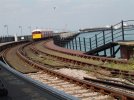
DSC02141.JPG
Ryde Esplanade Station with the out of use track being on the right hand side and the in use track being on the Left hand side with a British Rail Class 483 EMU on a Ryde Pier Head to Shanklin service.
 
Sponsor Post - registered members do not see these adverts; click here to register, or click here to log in
R

RailUK Forums

Zomboid

Established Member
Joined
2 Apr 2025
Messages
2,299
Location
Oxford
I don't see it ever justifying that kind of investment. It's always survived on second hand trains being nursed along on a shoestring (even before most of the island lines were closed), and what you'd save in staffing costs for a year would be used in the first 3 days of the project to automate the line.
 

BerkshireRails

On Moderation
Joined
4 Apr 2021
Messages
889
Location
United Kingdom
I don't see it ever justifying that kind of investment. It's always survived on second hand trains being nursed along on a shoestring (even before most of the island lines were closed), and what you'd save in staffing costs for a year would be used in the first 3 days of the project to automate the line.
The 484s are unable to operate the line with the originally planned half hourly service so they running roughly every 40 minutes. This upgrade would provide a step change in service on the Island Line. Although it would cost a fair amount of money it would give the Island Line a world class railway, which would bring more tourists as they will be able to sit up front, which will make the train more popular as well as having an improved journey time from the Line Speed increase.
 

The Planner

Veteran Member
Joined
15 Apr 2008
Messages
19,695
The 484s are unable to operate the line with the originally planned half hourly service so they running roughly every 40 minutes. This upgrade would provide a step change in service on the Island Line. Although it would cost a fair amount of money it would give the Island Line a world class railway, which would bring more tourists as they will be able to sit up front, which will make the train more popular as well as having an improved journey time from the Line Speed increase.
You could build brand new stock that could deliver a more frequent service for a fraction of automation.
 

dosxuk

Established Member
Joined
2 Jan 2011
Messages
2,439
The 484s are unable to operate the line with the originally planned half hourly service so they running roughly every 40 minutes. This upgrade would provide a step change in service on the Island Line. Although it would cost a fair amount of money it would give the Island Line a world class railway, which would bring more tourists as they will be able to sit up front, which will make the train more popular as well as having an improved journey time from the Line Speed increase.

Have you been to the Isle of Wight? Travelled on the Island Line?

Frankly, it doesn't want or need a "world class railway" - it just needs one that doesn't close for 3 months maintenance every couple of years and that has rolling stock that does as it's expected.

You're not going to attract tourists to the Isle of Wight because they can sit up the front on the train. You'll attract more passengers though by providing a reliable, dependable service - and you don't need expensive complicated automation to deliver that.
 

Gloster

Veteran Member
Joined
4 Sep 2020
Messages
13,005
Location
Up the creek
Have you been to the Isle of Wight? Travelled on the Island Line?

Frankly, it doesn't want or need a "world class railway" - it just needs one that doesn't close for 3 months maintenance every couple of years and that has rolling stock that does as it's expected.

You're not going to attract tourists to the Isle of Wight because they can sit up the front on the train. You'll attract more passengers though by providing a reliable, dependable service - and you don't need expensive complicated automation to deliver that.

Quite right. Just get the trains to run reliably and meet each FastCat.
 

BerkshireRails

On Moderation
Joined
4 Apr 2021
Messages
889
Location
United Kingdom
Have you been to the Isle of Wight? Travelled on the Island Line?

Frankly, it doesn't want or need a "world class railway" - it just needs one that doesn't close for 3 months maintenance every couple of years and that has rolling stock that does as it's expected.

You're not going to attract tourists to the Isle of Wight because they can sit up the front on the train. You'll attract more passengers though by providing a reliable, dependable service - and you don't need expensive complicated automation to deliver that.
I have been to the Isle of Wight Multiple Times.

Tourists will be attracted to the Island Line from. Being able to look out the front. Some tourists ride the DLR so they can see out the front.

The D-Trains are doing around 1,500 Miles between failures. D-Train failure rate. You're looking at new build custom-designed units for the Island Line, as it will be easier to get spare parts as well as doing future extensions to Newport and Ventnor.
 

Bletchleyite

Veteran Member
Joined
20 Oct 2014
Messages
113,486
Location
"Marston Vale mafia"
I think it would be a good candidate for a train based ATO type system based around self driving car tech, allowing for guard only operation, but I don't think given the slow development of this tech that any current drivers (one of whom I know) need worry about their jobs. Perhaps within 30-50 years or thereabouts.

I don't think implementing ETCS ATO would be economic.
 

BerkshireRails

On Moderation
Joined
4 Apr 2021
Messages
889
Location
United Kingdom
I think it would be a good candidate for a train based ATO type system based around self driving car tech, allowing for guard only operation, but I don't think given the slow development of this tech that any current drivers (one of whom I know) need worry about their jobs. Perhaps within 30-50 years or thereabouts.

I don't think implementing ETCS ATO would be economic.
My idea is that there would be no redundancies from this ATO project to make it more attractive to the unions. Why not just fit ETCS ATO, as the signalling would need to be renewed anyway, since there are still semaphores at Ryde St John's Road? Also, ETCS makes sense as it allows for higher line speeds than is currently allowed because of the constant speed supervision. It also provides known movement authority to the trains, which prevents misreading by the cameras during unfavourable lighting conditions. Plus, during the conversion stage, the trains can be manually driven light on the Northern City Line when it had both ETCS and Colour light signals. I do think LIDAR would be useful for monitoring stuff on or about the line, and if it isn't happy, then the guard can manually drive it through the section.
 

stadler

Established Member
Joined
5 Jun 2023
Messages
3,304
Location
Horsley
If you are going to do automated operation then you might as well just do proper full automation with no staff like the Copenhagen Metro and some Paris Metro lines etc. If you are going to do partial automation and require a guard onboard like the DLR then you might as well save costs and just introduce DOO instead of partial automation. So if it got automated i would favour full staffless automation with no staff onboard.
 

BerkshireRails

On Moderation
Joined
4 Apr 2021
Messages
889
Location
United Kingdom
If you are going to do automated operation then you might as well just do proper full automation with no staff like the Copenhagen Metro and some Paris Metro lines etc. If you are going to do partial automation and require a guard onboard like the DLR then you might as well save costs and just introduce DOO instead of partial automation. So if it got automated i would favour full staffless automation with no staff onboard.
I would rather keep the guard than the driver so that revenue protection is being done. Unattended operations could be a good option for Island Line, since it is an isolated network.
 

The Planner

Veteran Member
Joined
15 Apr 2008
Messages
19,695
My idea is that there would be no redundancies from this ATO project to make it more attractive to the unions. Why not just fit ETCS ATO, as the signalling would need to be renewed anyway, since there are still semaphores at Ryde St John's Road? Also, ETCS makes sense as it allows for higher line speeds than is currently allowed because of the constant speed supervision. It also provides known movement authority to the trains, which prevents misreading by the cameras during unfavourable lighting conditions. Plus, during the conversion stage, the trains can be manually driven light on the Northern City Line when it had both ETCS and Colour light signals. I do think LIDAR would be useful for monitoring stuff on or about the line, and if it isn't happy, then the guard can manually drive it through the section.
It doesn't automatically allow you to raise line speeds.
 

BerkshireRails

On Moderation
Joined
4 Apr 2021
Messages
889
Location
United Kingdom
It doesn't automatically allow you to raise line speeds.
It makes it much easier to raise line speeds as you no longer have the braking distance to worry about since the train will come up with that on its own. Alignment, Track form and other stuff are still issues however braking distance between signals is no longer one of them. Trains in ATO mode on Thameslink core can do 32mph and the Northern City Line will be raised to 45mph at some point.
 

The Planner

Veteran Member
Joined
15 Apr 2008
Messages
19,695
It makes it much easier to raise line speeds as you no longer have the braking distance to worry about since the train will come up with that on its own. Alignment, Track form and other stuff are still issues however braking distance between signals is no longer one of them. Trains in ATO mode on Thameslink core can do 32mph and the Northern City Line will be raised to 45mph at some point.
Thats just one small part of it, the others you note are much more difficult amd expensive as well as others. There are tens of schemes that would be more beneficial that this, even the open access down to Marchwood.
 

BerkshireRails

On Moderation
Joined
4 Apr 2021
Messages
889
Location
United Kingdom
Thats just one small part of it, the others you note are much more difficult amd expensive as well as others. There are tens of schemes that would be more beneficial that this, even the open access down to Marchwood.
Based on reports of units do 80mph on the Island Line, I think it is safe to assume the alignment would be safe for 60mph. The 769s are an interesting idea for Marchwood.
 

The Planner

Veteran Member
Joined
15 Apr 2008
Messages
19,695
Based on reports of units do 80mph on the Island Line, I think it is safe to assume the alignment would be safe for 60mph. The 769s are an interesting idea for Marchwood.
How are they doing 80mph when the max speed of the units are 60?
 

zwk500

Veteran Member
Joined
20 Jan 2020
Messages
18,565
Location
Northampton
I think it would be a good candidate for a train based ATO type system based around self driving car tech, allowing for guard only operation, but I don't think given the slow development of this tech that any current drivers (one of whom I know) need worry about their jobs. Perhaps within 30-50 years or thereabouts.

I don't think implementing ETCS ATO would be economic.
If you're spending any sort of capital money on the line, converting it to an off-the-shelf tram-train with battery operation for on-street sections is the obvious way to go. Use tram standard track, signals, vehicles, etc. Operating on-street would allow the vehicles to get much closer to the towns, and keeping it as an independent light-rail system means construction costs for an extension to Bembridge or Newport would be far more conscionable.
Tourists will be attracted to the Island Line from. Being able to look out the front. Some tourists ride the DLR so they can see out the front.
The number of tourists who will come specifically because they can look out of the front of the train will be in single figures. the ability to see out of the front will be a qualitative improvement for the users, not a demand driver in itself.
It makes it much easier to raise line speeds as you no longer have the braking distance to worry about since the train will come up with that on its own. Alignment, Track form and other stuff are still issues however braking distance between signals is no longer one of them. Trains in ATO mode on Thameslink core can do 32mph and the Northern City Line will be raised to 45mph at some point.
You've removed just 1 consideration (that isn't really a problem on single lines as the signals will simply be placed the appropriate distance apart at the approach to any conflicts), and I believe @Bald Rick has stated before there are over 70 considerations for line speed.
 
Last edited:

43096

On Moderation
Joined
23 Nov 2015
Messages
18,836
My idea is that there would be no redundancies from this ATO project to make it more attractive to the unions. Why not just fit ETCS ATO, as the signalling would need to be renewed anyway, since there are still semaphores at Ryde St John's Road? Also, ETCS makes sense as it allows for higher line speeds than is currently allowed because of the constant speed supervision. It also provides known movement authority to the trains, which prevents misreading by the cameras during unfavourable lighting conditions. Plus, during the conversion stage, the trains can be manually driven light on the Northern City Line when it had both ETCS and Colour light signals. I do think LIDAR would be useful for monitoring stuff on or about the line, and if it isn't happy, then the guard can manually drive it through the section.
Brilliant idea. Spend lots of money on automation and take none of the cost benefits.
:rolleyes:

We really need to get away from this malaise of not upsetting the unions. If there are savings to be had they need to be taken, no matter how hard the change might be.
 

BerkshireRails

On Moderation
Joined
4 Apr 2021
Messages
889
Location
United Kingdom
How are they doing 80mph when the max speed of the units are 60?
This was with the previous units on a downhill grade.
If you're spending any sort of capital money on the line, converting it to an off-the-shelf tram-train with battery operation for on-street sections is the obvious way to go. Use tram standard track, signals, vehicles, etc. Operating on-street would allow the vehicles to get much closer to the towns, and keeping it as an independent light-rail system means construction costs for an extension to Bembridge or Newport would be far more conscionable.
A Tram-Train might actually not fit in the Island Line's loading gauge, for example, the class 484s are 3.63m tall, and the class 399 tram-trains are 3.72m tall. The class 03 shuttles on the Island Line had to be cut down due to getting stuck under multiple road bridges. You may also have to upgrade the line from RA1 to allow for tram-train operation.
The number of tourists who will come specifically because they can look out of the front of the train will be in single figures. the ability to see out of the front will be a qualitative improvement for the users, not a demand driver in itself.
Although it may be small, a group of people would still be interested in sitting up front. Just look at how often the front seat is taken on the DLR.
You've removed just 1 consideration (that isn't really a problem on single lines as the signals will simply be placed the appropriate distance apart at the approach to any conflicts), and I believe @Bald Rick has stated before there are over 70 considerations for line speed.
Some signalling is from the steam era when the maximum speed was 40mph. So by renewing Rye St John's Road to Shanklin with enough braking distance for 60mph operations it will allow for 60mph operations once the other upgrades are done.
 

Brubulus

Member
Joined
13 Oct 2022
Messages
974
Location
Cambridge
You could build brand new stock that could deliver a more frequent service for a fraction of automation.
In the Czech Republic, there is an ongoing automation trial in the Kopidlno-Dolni Bousov line, using some form of ATO over ETCS. This is using 30+ year old railcars, but not sure how this could be applied to the 484s and the UK context.
 

zwk500

Veteran Member
Joined
20 Jan 2020
Messages
18,565
Location
Northampton
This was with the previous units on a downhill grade.

A Tram-Train might actually not fit in the Island Line's loading gauge, for example, the class 484s are 3.63m tall, and the class 399 tram-trains are 3.72m tall. The class 03 shuttles on the Island Line had to be cut down due to getting stuck under multiple road bridges. You may also have to upgrade the line from RA1 to allow for tram-train operation.
You've presumably missed the point about rebuilding the line to fit a standard project. Including abandoning Ryde Tunnel in favour of street running, if necessary.
Although it may be small, a group of people would still be interested in sitting up front. Just look at how often the front seat is taken on the DLR.
Again, this is irrelevant to any case for investment. Unless you're going to be charging a premium for sitting up front.
Some signalling is from the steam era when the maximum speed was 40mph. So by renewing Rye St John's Road to Shanklin with enough braking distance for 60mph operations it will allow for 60mph operations once the other upgrades are done.
So signal it conventionally for 60mph, doesn't require the expense of ETCS L2 + ATO. Trams run at 60mph in Manchester.
 

BerkshireRails

On Moderation
Joined
4 Apr 2021
Messages
889
Location
United Kingdom
You've presumably missed the point about rebuilding the line to fit a standard project. Including abandoning Ryde Tunnel in favour of street running, if necessary.
Ryde Tunnel isn't the issue as from from rail level to bottom of arch is 3.2 metres and then from bottom of arch to the crown of the tunnel is an extra 1.5-1.6 metres, so in the centre of the tunnel there is 4.7-4.8 metres of clearance in the tunnel. Also it will have to be a high floor system unless you can find a way around that because of all of the listed structures.
Again, this is irrelevant to any case for investment. Unless you're going to be charging a premium for sitting up front.
If you want you could make that First Class.
So signal it conventionally for 60mph, doesn't require the expense of ETCS L2 + ATO. Trams run at 60mph in Manchester.
Last time I checked the M5000 Trams in Manchester only did 50mph.
 

zwk500

Veteran Member
Joined
20 Jan 2020
Messages
18,565
Location
Northampton
Ryde Tunnel isn't the issue as from from rail level to bottom of arch is 3.2 metres and then from bottom of arch to the crown of the tunnel is an extra 1.5-1.6 metres, so in the centre of the tunnel there is 4.7-4.8 metres of clearance in the tunnel. Also it will have to be a high floor system unless you can find a way around that because of all of the listed structures.
A high floor system is not a massive problem
If you want you could make that First Class.
OK but this just seems a bizzare throwback.
Last time I checked the M5000 Trams in Manchester only did 50mph.
Fair, I had thought previous conversations on another thread had said 60mph was capable on the Bury route but double-checking the vehicle max speed is 50mph. However Sheffield Class 399 and Cardiff Class 398s are rated to 60mph.
 

Russel

Established Member
Joined
30 Jun 2022
Messages
5,506
Location
Lichfield
We're talking very small numbers here though, mostly enthusiasts.

Trains, weather you can see out of the front or not are just another form of public transport to most people, with, lets be honest, a poor reputation, if you own a car, you'll almost certainly drive to the Isle of Wight because it's cheaper and more practical, especially in a family group, if you don't have a car, you'll use the train...

Tourists will be attracted to the Island Line from. Being able to look out the front. Some tourists ride the DLR so they can see out the front.
 

Zomboid

Established Member
Joined
2 Apr 2025
Messages
2,299
Location
Oxford
We're talking very small numbers here though, mostly enthusiasts.

Trains, weather you can see out of the front or not are just another form of public transport to most people, with, lets be honest, a poor reputation, if you own a car, you'll almost certainly drive to the Isle of Wight because it's cheaper and more practical, especially in a family group, if you don't have a car, you'll use the train...
The front seat is popular on the DLR (and T&W metro and various airport people mover things in my experience), but only on an opportunity basis. The number of people who make journeys specifically to sit there will be so tiny as to be not measurable.
 

whoosh

Established Member
Joined
3 Sep 2008
Messages
1,892
Likely that putting in just one of the footbridges to replace a foot crossing will cost multiple years of driver and guard wages for the whole system on the island.

"We can save £1million of wages every year."

"Great, how do we do it?"

"By spending £XXmillions."

"Erm...okay...."

"Oh and then we don't really save any wages, because we keep the staff anyway."

"Not really worth it then?"

"But people can ride at the front, like the DLR!"

"Those four seats guaranteed to be filled, just might sway it then, economically?! - Have a day off!!"
 

DelW

Established Member
Joined
15 Jan 2015
Messages
6,004
Based on reports of units do 80mph on the Island Line, I think it is safe to assume the alignment would be safe for 60mph. The 769s are an interesting idea for Marchwood.

This was with the previous units on a downhill grade.
I can't believe that 483s ever did anything like 80mph. They were 50 years old before they moved to the island, and being tube stock they had small wheels as well.

In their latter days the track was so uneven that even 40mph was nearly enough to bounce you off your seat.

Platform 5's stock-lists quote them as having a maximum speed of 45mph.

Ryde Tunnel isn't the issue as from from rail level to bottom of arch is 3.2 metres and then from bottom of arch to the crown of the tunnel is an extra 1.5-1.6 metres, so in the centre of the tunnel there is 4.7-4.8 metres of clearance in the tunnel. Also it will have to be a high floor system unless you can find a way around that because of all of the listed structures.
Ryde tunnel has reverse curves, which limit the length of the vehicles as well as the height. 484s are full size cross section but short by comparison with mainline vehicles (about 18m long).
 

BerkshireRails

On Moderation
Joined
4 Apr 2021
Messages
889
Location
United Kingdom
Ryde tunnel has reverse curves, which limit the length of the vehicles as well as the height. 484s are full size cross section but short by comparison with mainline vehicles (about 18m long).
The height limit comes from an overbridge at Ryde St Johns Road, which a class 03 got stuck under having passed through Ryde Tunnel in both directions.
I can't believe that 483s ever did anything like 80mph. They were 50 years old before they moved to the island, and being tube stock they had small wheels as well.

In their latter days the track was so uneven that even 40mph was nearly enough to bounce you off your seat.

Platform 5's stock-lists quote them as having a maximum speed of 45mph.
It was the 485s & 486s which were reported to have done 80mph, as you had less stations so you gain more speed on the downhill grades towards Ryde Pier Head from Shanklin. That is the rumours I have heard and seen.
 
Status
Not open for further replies.

Top