• Our new ticketing site is now live! Using either this or the original site (both powered by TrainSplit) helps support the running of the forum with every ticket purchase! Find out more and ask any questions/give us feedback in this thread!

What was train travel like between Surrey and London in 1993?

Status
Not open for further replies.

writerdruid

New Member
Joined
28 Jun 2025
Messages
4
Location
Philippines
Hi! This is my first time on this forum.

I’m writing a fictional story set in the UK in 1993 and would really appreciate some help understanding what train travel would have been like during that time, particularly for a journey from Surrey (Woking, specifically) to London (ideally Waterloo, though anywhere in Central London would work).

Would it have been possible to travel from Surrey to London by train in 1993? If so, what kind of trains or stations would have been involved?

I’m also curious about how a passenger would have paid for that fare—would they typically use cash at a manned ticket booth, a machine, or purchase in some other way?

And finally, if anyone is willing, I’d be very grateful for a general walk-through of what a passenger in 1993 might do from buying a ticket in a station in Surrey to arriving in London.

Thank you so much in advance!
 
Sponsor Post - registered members do not see these adverts; click here to register, or click here to log in
R

RailUK Forums

Gloster

Veteran Member
Joined
4 Sep 2020
Messages
13,040
Location
Up the creek
A couple of thoughts:

From Woking Waterloo is and was the only station. Many trains are non-stop. If the passenger is a regular traveller they would probably have a season ticket: a piece of card that they would show at the barriers as they went on to the platform at Woking and off at Waterloo, and at any on-train inspections. For a once-off journey they would buy a ticket at a booking office before going through the barrier and should give the ticket up at the other end. Normally they would pay cash for a relatively small transaction such as this, but they might use a card.

It is check your platform number, go through the barrier and, if need be, over the footbridge, check the destination indicator on the platform again in case the platform has changed. When the train comes in you open the door (if someone else doesn’t), which will probably be a push button for a sliding door, but (I think) might still be a handle on an outward swinging door on an older train. Get in, sit down on the nearest seat that is free, travel for around half-an-hour to Waterloo, and when the train stops, get up, step down to the platform and walk past the front of the train and through the ticket check at the barrier. People in a hurry would be crowding by the doors to to get out.

Have a look at a short film called The Waterloo Bridge Handicap from 1978 which starts with a journey into Waterloo from a station nearer to London than Woking. It does show the older trains.
 

CyrusWuff

Established Member
Joined
20 May 2013
Messages
5,475
Location
London
If it was indeed 1993, the passenger would have bought their ticket either from the Ticket Office - where staff would be selling tickets from an APTIS machine - or from a QuickFare self-service machine. Both would be similar to tickets sold today.

Trains would mostly still be various classes of slamdoor electric units, such as the Class 421 (aka 4CIG), though Express services to Southampton and beyond would be power door Class 442s (aka 5WES) and Class 159 diesel units on trains to Salisbury and beyond.

As now, there would be around 10 to 12 trains per hour between Woking and Waterloo for much of the day, with a journey time of 25 to 40 minutes depending on how many stations they stopped at along the way.
 

Rescars

Established Member
Joined
25 May 2021
Messages
2,579
Location
Surrey
And finally, if anyone is willing, I’d be very grateful for a general walk-through of what a passenger in 1993 might do from buying a ticket in a station in Surrey to arriving in London.

Thank you so much in advance!
Do you mean what would they be doing whilst on the train? 1993, so v few analogue mobile phones, no tablets, no Kindles, no laptops. Looking out of the window, reading a book or a magazine or newspaper perhaps. Or doing some work - lots of paper in briefcases! Early trains might carry a fair number of financial services staff into the City - with quite a few studying texts for professional exams. One thing they certainly wouldn't be doing would be talking to fellow passengers - travelling in silence being the unwritten golden rule for London commuters!!
 

PG

Established Member
Joined
12 Oct 2010
Messages
3,470
Location
at the end of the high and low roads
I’d be very grateful for a general walk-through of what a passenger in 1993 might do from buying a ticket in a station in Surrey to arriving in London.
Further to what @Rescars has said, some passengers would be smoking either while waiting on the platform or on the train if they were in (the dwindling number of) smoking permitted coaches.
 

mike57

Established Member
Joined
13 Mar 2015
Messages
2,403
Location
East coast of Yorkshire
Another thought, peak hour trains would be rammed, getting on at Woking to a train into London during the morning rush hour it would already probably be full and standing.

In terms of the peak, my daily London commuting ended in 1980, but my perception is that the peak was much more concentrated back then. Not sure when that changed, but it was pretty much the rush HOUR...
 

The exile

Established Member
Joined
31 Mar 2010
Messages
9,462
Location
Somerset
And finally, if anyone is willing, I’d be very grateful for a general walk-through of what a passenger in 1993 might do from buying a ticket in a station in Surrey to arriving in London.

Thank you so much in advance!
If a regular, possibly swapping gossip with the other regulars who habitually sat in the same bit of the same carriage of the same train day after day (including moaning about the railways). If not a regular probably studiously avoiding eye contact with everyone and definitely not talking to them. Other than that, anything you might do on a train now as long as it doesn’t involve an electronic device.
If a regular, they’d be very unlikely to have bought a ticket (that morning) as they’d have a season. If they had bought a ticket, it would most likely have been in cash from a person at a ticket window. Primitive ticket machines did exist but were (IIRC) coin only. Paying by debit card would have been very new at that stage and credit card would have been unlikely for a small amount like a ticket from Woking to London. Also unlikely to grab a coffee - though possible, the widespread proliferation of take-away coffee outlets was only really just getting going and those at stations tended to be distress purchases!! (Maybe leafy Surrey was a bit more advanced in this respect)

== Doublepost prevention - post automatically merged: ==

and Class 159 diesel units on trains to Salisbury and beyond.
Though 1993 was the year they were introduced - so until May (at least) trains from Salisbury and Exeter would have been “proper trains” (!) with a diesel locomotive hauling carriages with slam doors.
 
Last edited:

Magdalia

Established Member
Joined
1 Jan 2022
Messages
7,415
Location
The Fens
I’m writing a fictional story set in the UK in 1993 and would really appreciate some help understanding what train travel would have been like during that time, particularly for a journey from Surrey (Woking, specifically) to London (ideally Waterloo, though anywhere in Central London would work).
I was a London commuter in 1993, though not on this route.

The distinction between whether this is a commuting journey at peak time, or a non-commuting journey off peak, is critical, both in terms of ticketing and the travelling experience.

It is also important to know what happens next after the train arrives at Waterloo. Unless the final destination is within walking distance, then the traveller will almost certainly have a zones 1-6 travelcard. If they are an annual season ticket holder that will be the Network SouthEast Gold Card. There might be a special case with regard to going on to the City via the Waterloo and City Line. In those days commuters did do some fairly long walks at the London end, for example many Whitehall civil servants walked from Waterloo via Hungerford Bridge or Westminster Bridge. Anther key feature for onward journeys from Waterloo were the Red Arrow buses via Waterloo Bridge and Lambeth Bridge.

By 1993 the ticket would be thin card with a magnetic stripe that could be read by a machine. My last old style card season ticket expired in 1988. I wouldn't be able to say whether Woking or Waterloo had barriers in 1993, or whether Woking had automatic ticket vending.

Commuters had ways of occupying the time on the train. Lots read newspapers, including doing the crossword. Morning papers would usually be bought at the station before getting on the train: most men read one of the broadsheets, most women read either the Mail or the Express. Waterloo was unusual in having a mix of City and Whitehall commuters so the choice of broadsheet would be more varied than on a route that primarily served one or the other. The main market for the London Evening Standard was homeward commuters and it was sold by street vendors on the main walking routes to the station. Reading could also be books and magazines, and some listened to music on a Sony Walkman. In the morning some women with a steady hand did their make up.

Most did not buy food or drink for the journey, they would have had breakfast before leaving home, and would have their evening meal when they got home.

Also bear in mind that on a winter day commuting journeys will be in the dark so there will be nothing to see out of the window.

Unless they knew each other, commuters didn't talk much, except when the service was disrupted. Off peak journeys had a very different atmosphere, with families and friends travelling together with a lot more talking, and more food and drink.
 

CyrusWuff

Established Member
Joined
20 May 2013
Messages
5,475
Location
London
By 1993 the ticket would be thin card with a magnetic stripe that could be read by a machine. My last old style card season ticket expired in 1988. I wouldn't be able to say whether Woking or Waterloo had barriers in 1993, or whether Woking had automatic ticket vending.
Automatic ticket gates were only found at London Underground stations in the early 90s, and were the P (for Pneumatic) type that connect to the same air main that powers points and tripcocks.

British Rail would still have been reliant on manual inspection, with the first E1 (E for electric) gates being installed at Marylebone after privatisation. (Still in use today, with the logo of what was then Westinghouse Cubic Ltd on the gate "lids.")
 

Snow1964

Established Member
Joined
7 Oct 2019
Messages
11,221
Location
West Wiltshire
Waterloo would have been different in 1993, the peak hour was lot more concentrated so trains would usually be rammed from last couple of pick up stops.

At Waterloo, commuters knew exactly where they were going, and unless they needed to stop at a shop like tie rack would head for one of the exits. There was none of the modern dressing down, nearly everyone wore business suits (the Friday dress down day was just starting around that time), but it was still frowned upon in most professional companies.

Those going to Waterloo and City and Bakerloo would head down the stairs about 2 coach lengths from buffers on each platform, those heading for Northern line tended to use the main concourse and escalators to avoid congestion on the stairs. Some would head out through Victory Arch (for Southbank area), or past the hoardings for still being finished Eurostar terminal.

At the other end of the Concourse were steps down to the colonnade where red arrow buses every couple of minutes whisked commuters to the Fleet Street and Holborn area (mainly lawyers and accountants in that area then). This area is now a Jubilee ticket hall and has escalators. Back in 1993 commuters accepted walking up and down stairs.

Fairly sure there wasn't ticket barriers at Waterloo in 1993, might still have had the sliding metal gates (and the enlargement of the ticket hall for Eurostar terminal meant temporary ticket booths were in use for underground too). In those days if there were barriers it was a credit card size ticket with magnetic stripe on back, no oyster, or contactless etc.

Those working in West End seemed to start bit later and would pass through Waterloo nearer 9am, with shop workers tending to be bit later as big West End stores tended to have later starts. whereas City workers would be more dominant at 8 - 8:30 as working 9- 5:30 was norm then in days before flexible working. (There was no Canary Wharf at Docklands then)

In the evening everyone stood watching the big Solari flap destination displays until platform was shown
 

Magdalia

Established Member
Joined
1 Jan 2022
Messages
7,415
Location
The Fens
Automatic ticket gates were only found at London Underground stations in the early 90s
Thanks for the clarification!

Those working in West End seemed to start bit later and would pass through Waterloo nearer 9am, with shop workers tending to be bit later as big West End stores tended to have later starts. whereas City workers would be more dominant at 8 - 8:30 as working 9- 5:30 was norm then in days before flexible working. (There was no Canary Wharf at Docklands then)
The civil service, and other public sector bodies, were already on flexitime in 1993. Core hours were 1000-1200 and 1400-1600, with minimum 30 minutes lunch. Workers could arrive Waterloo up to 0930 and still be in the office for 1000, and workers leaving at 1600 could be on the train home at 1630.
 

Belperpete

Established Member
Joined
17 Aug 2018
Messages
3,690
When referring to "the barriers", in 1993 this would have been a man, either standing or seated on a high stool in a wooden hut, who checked the tickets. In practice, this was usually little more than a quick glance, particularly at somewhere like Waterloo.

If you were reasonably well off, the newspaper would likely have been delivered to your house by a newspaper boy, and taken with you to the station. Otherwise bought from a kiosk near the station. Again, if you were well to do, you would buy one of the large broadsheet newspapers, such as the Times or Telegraph, and likely do the crossword on the train, and take it with you into work. Workmen would buy one of the tabloids, such as the Sun, Star or Mirror, and many would discard them on the train floor at the end of the journey.

As a previous poster noted, the experience would have been very different if travelling to Waterloo during the morning rush hour. During the rush hour, the trains would be packed and standing. Regular commuters would have their usual spot on the platform. If on the older stock with manually opened swing doors, the passengers nearest the doors would have them opened and be jumping off the train before it had even come to a stand, so as to save a few seconds and get a head start on everyone else for the queue to get through the barriers.

Travelling after the rush hour would be more relaxed. It would be nowhere near as crowded, and you would be able to get a seat. However, the train floor would likely be dirty and covered in discarded newspapers and cigarette butts, as the trains weren't cleaned between journeys.

The BBC made a film in 1953 "London to Brighton in 4 minutes", and again in 1983 and 2013. While not the same route, it might be worth watching the 1983 version on YouTube for the station scenes at the start and end of the journey to get a feel for travel on the Southern in that era. I don't think too much changed between 1983 and 1993. The trains would have received the brighter red, white and blue "Network Southeast" livery, compared to the somewhat drab corporate BR livery of blue and grey seen in that film. Likewise the stations would have all got painted in red. But they were essentially the same trains and stations.
 

Magdalia

Established Member
Joined
1 Jan 2022
Messages
7,415
Location
The Fens
If you were reasonably well off, the newspaper would likely have been delivered to your house by a newspaper boy, and taken with you to the station.
This didn't work for many London commuters, because they needed to leave home for the train before the newspaper would arrive.

I delivered morning newspapers and there were strict rules, enforced by the local council. Children had to be over 14 years old, and the hours were restricted to 0700-0800 Monday-Friday and 0800-0900 Saturday and Sunday.

Anyone needing to leave home before 0800 could not rely on home delivery.
 

Gloster

Veteran Member
Joined
4 Sep 2020
Messages
13,040
Location
Up the creek
If the OP’s character is a regular, or even fairly frequent, traveller then a lot of what they did would be done confidently. They know where the barriers are, where the departure indicators are to check the platform, where best to wait on the platform, are confident about quickly opening the doors, etc.

If they are a rare traveller they will take a few seconds to see where the booking office is, take longer there as the booking clerk checks what ticket they want, look around for the barrier and then the departure boards, work out where their platforms is and where the stairs are before standing around on the platform. When the train comes in they may be indecisive and walk alongside the train looking in to find a seat, before hurriedly jumping in when the station staff start shouting. (Regular travellers know where best to wait for the chance of getting a seat and when it is best to just get in and be prepared to stand.) At Waterloo they may start looking around them for the exit while all the regular travellers just stream past them.

If they have luggage they will probably be carrying it: suitcases with extending handles were rare then and ones with wheels on the bottom meant bending sideways to move them. Blocking other travellers gangways would be unpopular and the sensible traveller would let the stream pass before joining the rear of it.
 
Joined
23 Nov 2023
Messages
776
Location
Grimsby
I have the September 1992 to May 1993 BR timetable; it shows a service of around nine trains per hour from Woking to Waterloo off-peak, and around eleven at peak times. Older units displayed a two-digit route code on the front and this was also noted in the public timetable. To give you an idea of the service, here are the departures between 11 and 12 departing Woking for Waterloo:

1100 fast to Waterloo (ran from 22nd March 1993 only)- from Yeovil Junction, no route code.
1107 calling at Surbiton and Clapham Junction, from Southampton route 93.
1110 calling at West Byfleet, Weybridge, Walton-on- Thames and Surbiton, from Aldershot route 52.
1114 fast to Waterloo, from Exeter St Davids, no route code.
1116 calling all stations (West Byfleet, Byfleet and New Haw, Weybridge, Walton-on- Thames, Hersham, Esher, Surbiton, Wimbledon, Clapham Junction, Vauxhall), from Guildford route 75.
1120 calling at Clapham Junction, from Portsmouth Harbour route 80.
1131 calling at Clapham Junction, from Guildford route 82.
1137 calling at Surbiton and Clapham Junction, from Basingstoke route 63.
1138 calling at Clapham Junction, from Poole route 92.
1145 calling at Clapham Junction, from Alton route 51.
1146 all stops as per the 1116, from Guildford route 75.

The 1100 was an extra for this hour, the next train after 1146 was 1207.
All are shown as having first class available apart from the 1116 and 1146 stoppers. At a guess the 16 and 46 would be class 455 units; as mentioned up thread the 1100 and 1114 would be locomotive hauled in early 1993 and class 159s later in the year. I'll leave it to someone more knowledgeable to state the units on the other services!
The 1114, 1120 and 1138 are noted as "Network Express" services with the 1138 additionally noted as having a buffet counter service available.
 

Belperpete

Established Member
Joined
17 Aug 2018
Messages
3,690
If the OP’s character is a regular, or even fairly frequent, traveller then a lot of what they did would be done confidently. They know where the barriers are, where the departure indicators are to check the platform, where best to wait on the platform, are confident about quickly opening the doors, etc.
Regular commuters soon get into a set routine. They know to the minute what time they have to leave home, how long the walk to the station takes, the time of their train, and likely the time of the next train too, just in case. As you say, they know where best to wait on the platform. Then as now, trains going into the London termini are packed at the front, because is closest to the exit barrier, whereas there are likely empty seats at the back of the train, even at the height of the peak. Passengers for intermediate stations like Clapham Junction travel in the part of the train closest to the exit at those stations. They know exactly which way to go when they get off the train.

And thinking of entrances and exits, Waterloo has side exits to York Road, Lower Marsh and the cab rank, as well as the impressive if little used front entrance. Also the exit to the tube and Waterloo and City, and the exit to the adjoining Waterloo Eastern station. Whereas a regular traveller would know exactly which exit to use, depending on their walking route or mode of onward travel, it can all be a bit confusing to someone unfamiliar with the station. I can remember feeling hopelessly lost the first time I went there. I was looking for the tube, but somehow found myself in Lower Marsh!

I vaguely recall the entrance to the underground being significantly improved at some stage? It is not exactly obvious nowadays, as having exited the platform onto the concourse, it is behind you, but I seem to recall that at one time it was quite missable.

Didn't Waterloo used to have a subway down into the tube station, accessed by stairs down direct off the platforms? In which case, passengers making an onward journey by the tube would have gone that way, rather than through the barriers. Or was that subway just to the Waterloo and City line? I seem to recall it only being open in peak hours?

Thinking about it, the Waterloo and City line would have been part of the Southern in 1993, only coming under TfL control in 1994 in the run up to privatisation. Passengers changing onto the Underground have to have their tickets checked twice, once at the platform exit on the mainline station, and again in the underground station. However, this was not necessary when changing to the W&C, as it was a Southern service. I seem to recall commuters making a big fuss when this changed, as it increased their commute time. Was this when that direct subway link was closed?

1993 is an interesting year to choose, the last days of British Rail, the year that the railway privatisation act was passed, but before it had had any impact.
 
Last edited:

WesternLancer

Veteran Member
Joined
12 Apr 2019
Messages
15,325
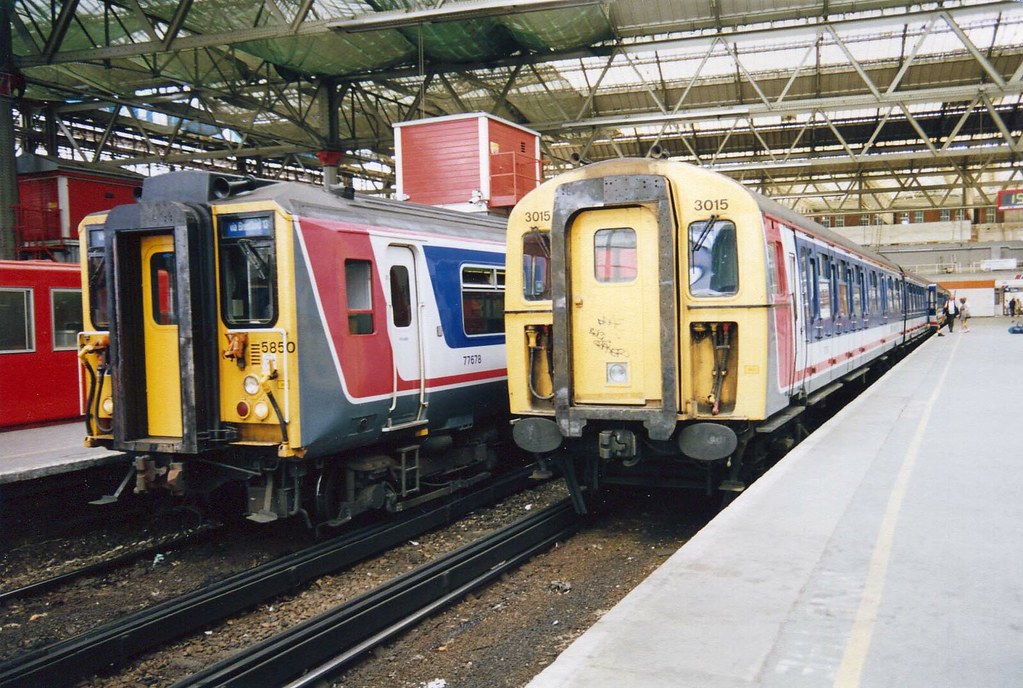
Plenty of pictures on F;ickr of Waaterloo station in 1993 - this one showing typical types of trains


The one on the right is one with manually opening hinged doors for passengers (all doors closed in the picture so not obvious), such train have all now been withdrawn - the train on the left is one that you could still travel on from Waterloo today - though unsure if that type would have served the route to Woking.

My picture search reminded me that in 1993 the new Eurostar terminal part of the station at Waterloo would have been in an advanced state of construction which some travellers might have taken an interest in - ahead of trains running direct to Paris and Brussels from Waterloo

This arched roof part of the station as per this pic

A train ticket would have looked like this example:


I would be fairly confident in saying that today you could go to Woking station, go o the ticket office, buy a ticket in cash from the member of staff at the ticket counter and the ticket would look like this, albeit without the words 'British Rail' on it.
 

swt_passenger

Veteran Member
Joined
7 Apr 2010
Messages
34,308
Didn't Waterloo used to have a subway down into the tube station, accessed by stairs down direct off the platforms? In which case, passengers making an onward journey by the tube would have gone that way, rather than through the barriers. Or was that subway just to the Waterloo and City line? I seem to recall it only being open in peak hours?

Thinking about it, the Waterloo and City line would have been part of the Southern in 1993, only coming under TfL control in 1994 in the run up to privatisation. Passengers changing onto the Underground have to have their tickets checked twice, once at the platform exit on the mainline station, and again in the underground station. However, this was not necessary when changing to the W&C, as it was a Southern service. I seem to recall commuters making a big fuss when this changed, as it increased their commute time. Was this when that direct subway link was closed?
The subway link off the platforms is still there and has always been in normal use in peak hours, but there are now added barrier lines to exit from it at its far end, ie by the Bakerloo/Northern concourse. It always provided peak time access to or from both those existing LU lines, as well as the Waterloo and City. It’s not that long since some of the steps down to the subway were rearranged to improve passenger flows, around P1-6 ish, I think that was done about the same time as the 10 car platform lengthening?

To my mind the only major difference to LU facilities since 1993 came with the addition of the Jubilee Line street level concourse.

There is still no gateline to enter the Waterloo and City, I believe there is not enough room, so once out of the NR paid area your entry to the W&C does not cause delays if you’re on a through ticket, but to start a journey there you need to touch in on a stand alone validator.
 

WesternLancer

Veteran Member
Joined
12 Apr 2019
Messages
15,325
As for devices, I'm pretty sure I had a Walkman in 1993. The joy of cassettes.
Indeed - I used a walkman from about 1985, and some people might even have had a discman by 1993 I suspect, to play CDs on the move
 

The exile

Established Member
Joined
31 Mar 2010
Messages
9,462
Location
Somerset
Plenty of pictures on F;ickr of Waaterloo station in 1993 - this one showing typical types of trains


The one on the right is one with manually opening hinged doors for passengers (all doors closed in the picture so not obvious), such train have all now been withdrawn - the train on the left is one that you could still travel on from Waterloo today - though unsure if that type would have served the route to Woking.

My picture search reminded me that in 1993 the new Eurostar terminal part of the station at Waterloo would have been in an advanced state of construction which some travellers might have taken an interest in - ahead of trains running direct to Paris and Brussels from Waterloo

This arched roof part of the station as per this pic

A train ticket would have looked like this example:


I would be fairly confident in saying that today you could go to Woking station, go o the ticket office, buy a ticket in cash from the member of staff at the ticket counter and the ticket would look like this, albeit without the words 'British Rail' on it.
In 1993 it would still have had British Rail on it (the ticket, that is).
 

Snow1964

Established Member
Joined
7 Oct 2019
Messages
11,221
Location
West Wiltshire
Another thing I remember from the early 1990s was every few months, journeys somewhere in London would be seriously disrupted by an IRA bomb.

As for travel at that time, commuters tended to carry a briefcase or satchel, not backpacks, and very rarely would drinks be seen in the morning (coffee shops at suburban stations didn't really exist then), and the modern fad of carrying a water bottle didn't exist either.

Reading the newspaper, or documents from a briefcase was the norm then, common use of mobile phones wasn't until around 1999-2000, and getting emails on phones or doing work on train tended to limited to annotations of notes from a briefcase. Back in 1993 work was limited to when you arrived in office until closed down desktop computer in the evening, none of modern being on call and stressed out at home.

Many of the trains from Woking in 1993 were open saloons with 2+2 or 2+3 seating either side of an aisle, and looking out of the windows was an option as they all lined up with the seats. There were generally not any tables. First class was then generally in compartments of 6 with 3 seats either side and a gangway at one side of train (with the exception of the then new diesel trains from Salisbury and Exeter which had open First Class saloons)

Finally journeys tended to be faster than today, and the motion was more pronounced (if there had been open cup of coffee it would have been slopping out when trains went over the jolts in the track).
 

WesternLancer

Veteran Member
Joined
12 Apr 2019
Messages
15,325
In 1993 it would still have had British Rail on it (the ticket, that is).
Yes, exactly - that picture is of a 1993 ticket, but my point was that if bought today the ticket would look largely the same albeit without the words British Rail on the ticket
 

Magdalia

Established Member
Joined
1 Jan 2022
Messages
7,415
Location
The Fens
Technically Network SouthEast at that time.
My 1993 annual season ticket only has the NSE logo and Gold Card on the front, British Railways Board is only in the small print on the back.

By 1993 NSE was an established brand that had been around for 7 years, many younger travellers would have known nothing else.
 

nw1

Established Member
Joined
9 Aug 2013
Messages
9,430
At Waterloo, commuters knew exactly where they were going, and unless they needed to stop at a shop like tie rack would head for one of the exits. There was none of the modern dressing down, nearly everyone wore business suits (the Friday dress down day was just starting around that time), but it was still frowned upon in most professional companies.

I remember visiting a small specialist software development company (not London, a provincial location) in 1995 and seeing the workforce all in suits, which seemed a bit strange particularly as they were not customer-facing. Many of them were also pretty young, twenty-something, so they weren't people just following norms from their youth.

I had not entered the world of work by then but looking back it seems a bit strange for software developers to have been wearing suits as recently as the mid-90s.
 
Status
Not open for further replies.

Top