I've heard the track sections can be lifted out, effectively making it easier to access than a regular road and making overnight repairs more feasible. However not sure if this is true or hyperbole.From what I remember of viewing the construction of parts of the Nottingham tramway, track laying involved a lot of depth, rebar and poured concrete and various layers. The VLR track is a lot shallower, less complex and less intrusive in construction, so it should be possible to remove and replace it a lot quicker. Of course fixing the utility would take the same time but the total elapsed time should be less.
But if it's a cable or a gas pipe they should be able to repair via side access from both ends; water mains and sewage might be more difficult though.

-
Our new ticketing site is now live! Using either this or the original site (both powered by TrainSplit) helps support the running of the forum with every ticket purchase! Find out more and ask any questions/give us feedback in this thread!
You are using an out of date browser. It may not display this or other websites correctly.
You should upgrade or use an alternative browser.
You should upgrade or use an alternative browser.
Coventry Very Light Rail - Awarded to RailAdventure
- Thread starter Steddenm
- Start date
- Status
- Not open for further replies.
Sponsor Post - registered members do not see these adverts; click here to register, or click here to log in
R
RailUK Forums

duffield
Established Member
I don't think it is hype, the article below on a construction website seems to bear it out in reality, in fact it sounds better than I remembered.I've heard the track sections can be lifted out, effectively making it easier to access than a regular road and making overnight repairs more feasible. However not sure if this is true or hyperbole.
Milestone reached on Coventry VLR
Colas Rail UK has completed the first phase of construction of a test bed for the Coventry Very Light Rail project.
 www.theconstructionindex.co.uk
Quote:
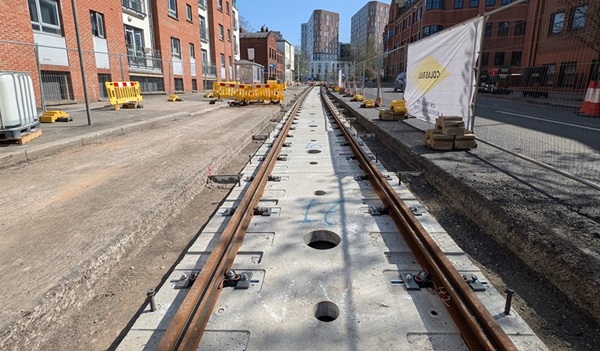
And also:A 220-metre single-track demonstrator for the Coventry Very Light Rail (CVLR) project has been built, along Greyfriars Road and Queen Victoria Road in Coventry city centre.
The trial represents the first time CVLR’s innovative modular track form has been embedded within a live urban corridor.
Colas Rail UK began work on 4th February 2025 in and has progressed swiftly to the completion of laying and aligning all ultra-high-performance concrete (UHPC) slabs and the alignment, welding, and fastening of the grooved rails. With full slab bedding now also complete, the result is a structurally sound and installation-complete track form, ready to accept the CVLR vehicle, the city council said.
Over the coming weeks, the team will finalise the installation of the structural health monitoring system, rail drainage, and rail-to-pavement interface components before embedding rails in asphalt pavement. The team targets completion of the construction phase by early May 2025.
Construction was undertaken within a strictly constrained corridor, maintaining continuous access across an active junction. Crucially, no full road closures or traffic diversions were required — a key goal in demonstrating CVLR’s ‘LITE footprint’ on the public realm.
The route also interfaces with all primary below-ground services, including water (clean and foul), gas, electricity and telecommunications. The track form’s shallow 300mm excavation depth and integrated utility access chambers enabled installation without major service relocation — unlike traditional tram systems.
ShadowKnight
Member
The VLR track does look like a trainset. I think that's the point
duffield
Established Member
This could be a game changer for the viability of new tram systems, but of course it has to stand the test of real life wear and tear etc. first - and that's why this demo track is important. The article goes on to say that monitoring systems for this purpose are built into the track.
Further quote from above linked article:
What I can't find out but would be interested to know is how long the trial of the demo track is intended to last before there is enough data to properly evaluate its performance.
Further quote from above linked article:
The track section has a high-frequency structural health monitoring system, with strain gauges embedded within the concrete slabs, asphalt strain gauges, accelerometers, pressure sensors, relative movement sensors and AI-enabled camera systems.
What I can't find out but would be interested to know is how long the trial of the demo track is intended to last before there is enough data to properly evaluate its performance.
Last edited:
Teds
Member
I don't think the in town test track is the main source of track performance data. There is a test track at the Dudley Innovation Centre and a section of track without any trams in a council depot to test how it responds to refuse trucks continually passing back and forth. That track was installed in March and it is intended to remain there for a year.What I can't find out but would be interested to know is how long the trial of the demo track is intended to last before there is enough data to properly evaluate its performance.

Coventry Very Light Rail’s ultra-thin track installed at Whitley Depot for testing – Coventry City Council
Coventry Very Light Rail takes a significant step forward today as construction of a test site for its unique track system is completed at the Council’s Whitley Depot facility, where it will be stress-tested by heavy goods vehicles (HGVs).
 www.coventry.gov.uk
By installing a short section of track at Whitley Depot, the team will be able to measure its performance under extreme conditions. Vibration sensors that take measurements 10 times a second have been installed at locations along the track, and weight-in-motion sensors will weigh vehicles while they move across the track.
This data will be collected for a year and fed into a ‘digital twin’ computer model, allowing the Council’s innovation partners, WMG at the University of Warwick, to evaluate the performance of the track over time.
Smethwickian
Member
March 2023, according to the press release you have linked to.That track was installed in March and it is intended to remain there for a year.
Probably as long as it would take if something like that broke underneath a conventional tramway
A lot longer than for a bus to go around the construction ...
ShadowKnight
Member
Seems like you would prefer if there were no trams anywhereA lot longer than for a bus to go around the construction ...
When the concept was first drawn up part of the potential novelty was that the vehicles would be battery electric, to save on catenary, yet another fairly large expense for a conventional tram route. Battery powered vehicles are now regarded as part of everyday life, so that part of the VLR concept is no longer thought of as experimental.
As for disruption for maintenance of underground utilities, many systems in Europe deal with that by providing temporary supports for the track and imposing severe local speed restrictions. As the VLR is to be "very light" that's something that should be possible for their system too.
As for disruption for maintenance of underground utilities, many systems in Europe deal with that by providing temporary supports for the track and imposing severe local speed restrictions. As the VLR is to be "very light" that's something that should be possible for their system too.
DavidGrain
Established Member
- Joined
- 29 Dec 2017
- Messages
- 1,488
This morning I went to Coventry to see the Very Light Rail prototype tram car being tested on the street. I had seen the vehicle on a couple of visits to the VLR Resource Centre in Dudley but I had never seen it running. We never expected to ride in the tram but we were surprised and pleased to be offered a ride. I did take some photos but I think this Geoff Marshall videos shows it better.

TT-ONR-NRN
Veteran Member
They look silly on their own but if they build the full thing and run them in say, coupled trios, it could be very successful.

Turtle
Member
- Joined
- 18 Mar 2013
- Messages
- 469
Just watched Geoff Marshall's video on YouTube. Quite interesting.They look silly on their own but if they build the full thing and run them in say, coupled trios, it could be very successful.

jfowkes
Established Member
- Joined
- 20 Jul 2017
- Messages
- 1,271
Not sure if "battery powered" and "very light" are compatible concepts.When the concept was first drawn up part of the potential novelty was that the vehicles would be battery electric, to save on catenary, yet another fairly large expense for a conventional tram route. Battery powered vehicles are now regarded as part of everyday life, so that part of the VLR concept is no longer thought of as experimental.
As for disruption for maintenance of underground utilities, many systems in Europe deal with that by providing temporary supports for the track and imposing severe local speed restrictions. As the VLR is to be "very light" that's something that should be possible for their system too.
ShadowKnight
Member
Depends how big the battery isNot sure if "battery powered" and "very light" are compatible concepts.
jfowkes
Established Member
- Joined
- 20 Jul 2017
- Messages
- 1,271
I mean, yes, but I don't think they're just going to stick a couple of AAs in there. If it's at all workable as a concept it's going to basically be a tram in terms of vehicle capacity and service patterns. That's a still-fairly-heavy vehicle with a lot of acceleration/deceleration cycles with not much scope for pausing to charge during the day.Depends how big the battery is

bluegoblin7
Established Member
The ‘Very Light’ is relative to heavy rail and light rail - by that standard they fit the definition.
But it also refers to the infrastructure standards - particularly the bit about not having to move utilities etc. IMO this is where most of the innovation comes from, and reduces the costs of construction, but comes at a price of a shorter life and being at the whims of disruption for utility work.
As a cheaper way to prove a business case this deserves to succeed, but beyond that… just do it properly.
Most modern (I.e. current products) light rail vehicles would meet the relevant restrictions for VLR infrastructure, dependent on the exact specification.
But it also refers to the infrastructure standards - particularly the bit about not having to move utilities etc. IMO this is where most of the innovation comes from, and reduces the costs of construction, but comes at a price of a shorter life and being at the whims of disruption for utility work.
As a cheaper way to prove a business case this deserves to succeed, but beyond that… just do it properly.
Most modern (I.e. current products) light rail vehicles would meet the relevant restrictions for VLR infrastructure, dependent on the exact specification.
duffield
Established Member
Shorter lifespan for the track might be a reasonable trade-off against "doing it properly" if the track can be replaced more quickly and cheaply when it does need doing, which should be the case with this modular design. A one-week closure of a section every ten years seems as good as a three-week closure every twenty or thirty years (figures for illustrative purposes only!). I suppose it depends a lot on just how modular "modular" is, i.e. how quickly sections can actually be replaced in practice, and also just how short a "shorter life" is.The ‘Very Light’ is relative to heavy rail and light rail - by that standard they fit the definition.
But it also refers to the infrastructure standards - particularly the bit about not having to move utilities etc. IMO this is where most of the innovation comes from, and reduces the costs of construction, but comes at a price of a shorter life and being at the whims of disruption for utility work.
As a cheaper way to prove a business case this deserves to succeed, but beyond that… just do it properly.
Most modern (I.e. current products) light rail vehicles would meet the relevant restrictions for VLR infrastructure, dependent on the exact specification.
The vehicle doesn't really matter, the "innovation" is the track. From what I've heard, the rest of the world isn't as aggressive when it comes to utility diversions as the UK, but this enables the number of diversions to be reduced to effectively zero, revolutionising the business case. The vehicle and it's battery powered nature is a bit of a red herring in my opinion, it's the track technology that matters, which I believe should be able to be rolled out on some conventional light rail systems.The ‘Very Light’ is relative to heavy rail and light rail - by that standard they fit the definition.
But it also refers to the infrastructure standards - particularly the bit about not having to move utilities etc. IMO this is where most of the innovation comes from, and reduces the costs of construction, but comes at a price of a shorter life and being at the whims of disruption for utility work.
As a cheaper way to prove a business case this deserves to succeed, but beyond that… just do it properly.
Most modern (I.e. current products) light rail vehicles would meet the relevant restrictions for VLR infrastructure, dependent on the exact specification.
bluegoblin7
Established Member
The shorter lifespan could indeed be a benefit - like I say, get it built, prove the business case then renew it 'properly'. The challenges come when Britain's ageing utility network does what it does best: fail, spectacularly. Europe doesn't have the same level of beyond-end-of-life Victorian engineering, and generally (especially on older networks) has diversionary routes available if there are blockages.Shorter lifespan for the track might be a reasonable trade-off against "doing it properly" if the track can be replaced more quickly and cheaply when it does need doing, which should be the case with this modular design. A one-week closure of a section every ten years seems as good as a three-week closure every twenty or thirty years (figures for illustrative purposes only!). I suppose it depends a lot on just how modular "modular" is, i.e. how quickly sections can actually be replaced in practice, and also just how short a "shorter life" is.
The proof will be in the pudding, but I suspect any meaningful VLR network will see a lot more short-notice closures than the equivalent 'traditional'(!) modern tramway.
There have been a lot of reasonable arguments as to why the VLR isn't significantly better than a bus. But watching this video, I would certainly be happier with a VLR connection from station to city centre than a bus connection. The passenger experience looks much much better than a bus, even those irizar 'tram' buses.This morning I went to Coventry to see the Very Light Rail prototype tram car being tested on the street. I had seen the vehicle on a couple of visits to the VLR Resource Centre in Dudley but I had never seen it running. We never expected to ride in the tram but we were surprised and pleased to be offered a ride. I did take some photos but I think this Geoff Marshall videos shows it better.
I hadn't read this before, thanks to everyone who has contributed so far.
Some of the arguments were depressingly familiar from 20 years ago when the Cambridgeshire Guided Busway was proposed.
The big difference between Coventry Very Light Rail and the Cambridgeshire Guided Busway is the utilities. The Cambridgeshire Guided Busway is built on old railway trackbeds, so does not have the utilities issue. But in Cambridge we see the utilities issue every day on the local roads, many of which are key bus routes.
Councils don't dig up roads, though they may occasionally do resurfacing and filling potholes. Digging up roads is almost always utilities: gas, water, sewage, electricity and telecoms. I don't know about Coventry, but here in Cambridge one or other of the utilities are digging up roads almost all of the time. Take Hills Road as an example, this is the main arterial route from the old city to the hospitals/biomedical campus, and passes over the railway at the south end of the main station. There is utilities work going on there nearly all the time and we are currently bracing ourselves for 10 months of disruption for replacement of a gas main.
Some of the arguments were depressingly familiar from 20 years ago when the Cambridgeshire Guided Busway was proposed.
The big difference between Coventry Very Light Rail and the Cambridgeshire Guided Busway is the utilities. The Cambridgeshire Guided Busway is built on old railway trackbeds, so does not have the utilities issue. But in Cambridge we see the utilities issue every day on the local roads, many of which are key bus routes.
Councils don't dig up roads, though they may occasionally do resurfacing and filling potholes. Digging up roads is almost always utilities: gas, water, sewage, electricity and telecoms. I don't know about Coventry, but here in Cambridge one or other of the utilities are digging up roads almost all of the time. Take Hills Road as an example, this is the main arterial route from the old city to the hospitals/biomedical campus, and passes over the railway at the south end of the main station. There is utilities work going on there nearly all the time and we are currently bracing ourselves for 10 months of disruption for replacement of a gas main.
If anything, the VLR system should simplify utilities work, by enabling track sections to be lifted out, instead of digging up the road surface. This also means I suspect track replacement will be an easy job, likely doable relatively quickly as sections can be lifted out and replaced.I hadn't read this before, thanks to everyone who has contributed so far.
Some of the arguments were depressingly familiar from 20 years ago when the Cambridgeshire Guided Busway was proposed.
The big difference between Coventry Very Light Rail and the Cambridgeshire Guided Busway is the utilities. The Cambridgeshire Guided Busway is built on old railway trackbeds, so does not have the utilities issue. But in Cambridge we see the utilities issue every day on the local roads, many of which are key bus routes.
Councils don't dig up roads, though they may occasionally do resurfacing and filling potholes. Digging up roads is almost always utilities: gas, water, sewage, electricity and telecoms. I don't know about Coventry, but here in Cambridge one or other of the utilities are digging up roads almost all of the time. Take Hills Road as an example, this is the main arterial route from the old city to the hospitals/biomedical campus, and passes over the railway at the south end of the main station. There is utilities work going on there nearly all the time and we are currently bracing ourselves for 10 months of disruption for replacement of a gas main.
In my opinion, the guided busway is a lot more of a gadgetbahn than the Coventry VLR, since this is simply a new track design for a tram route, which lowers installation costs.
jfowkes
Established Member
- Joined
- 20 Jul 2017
- Messages
- 1,271
But that still means you're stopping your tram service whenever there's utility works to do. It might make those works faster, which is great for the utility company, but means nothing to passengers.If anything, the VLR system should simplify utilities work, by enabling track sections to be lifted out, instead of digging up the road surface. This also means I suspect track replacement will be an easy job, likely doable relatively quickly as sections can be lifted out and replaced.
Whereas a tram network that isn't built over utility routes won't be disrupted by them at all. They can take as long as they like.

Skymonster
Established Member
- Joined
- 7 Feb 2012
- Messages
- 2,070
What now for the Coventry VLR

 www.railadvent.co.uk
Very Light Rail Innovation Centre operators fall into administration
Black Country Innovative Manufacturing Organisation, who operate the Very Light Rail National Innovation Centre in Dudley, has fallen into administration. RSM UK Restructuring Advisory LLP were appointed administrators on the 1st July 2025. The Very Light Rail centre was home to the Coventry VLR...
www.railadvent.co.uk
Black Country Innovative Manufacturing Organisation, who operate the Very Light Rail National Innovation Centre in Dudley, has fallen into administration.
RSM UK Restructuring Advisory LLP were appointed administrators on the 1st July 2025.
The Very Light Rail centre was home to the Coventry VLR vehicle until it left recently to start testing in Coventry itself.

silexa
Member
This doesnt really affect Coventry VLR that much, they only really used the centre in Dudley as a workshop/testing place. The vehicle never returned to Dudley after it's testing phase in Coventry.What now for the Coventry VLR
Very Light Rail Innovation Centre operators fall into administration
Black Country Innovative Manufacturing Organisation, who operate the Very Light Rail National Innovation Centre in Dudley, has fallen into administration. RSM UK Restructuring Advisory LLP were appointed administrators on the 1st July 2025. The Very Light Rail centre was home to the Coventry VLR...

All it needs is a bit of regulation (I know that seems anathema to some in the UK). Track panel lifted out overnight to dig hole and install some clever kind of “bridge track panel” over it meaning trams can continue to pass at walking pace. Work continues underneath. Any large scale renewal to involve diversion away from the trackbed so a)problem doesn’t recur and b) the new can be laid without disturbing tge old, which only needs to be disrupted to “plumb the join in”.But that still means you're stopping your tram service whenever there's utility works to do. It might make those works faster, which is great for the utility company, but means nothing to passengers.
Whereas a tram network that isn't built over utility routes won't be disrupted by them at all. They can take as long as they like.
DavidGrain
Established Member
- Joined
- 29 Dec 2017
- Messages
- 1,488
Information available is that Coventry City Council own the intellectual Property to the VLR and the prototype was developed before the Dudley operation became involved.This doesnt really affect Coventry VLR that much, they only really used the centre in Dudley as a workshop/testing place. The vehicle never returned to Dudley after it's testing phase in Coventry.
silexa
Member
Yeah, Dudley was more just a useful thing for them to use whilst it was thereInformation available is that Coventry City Council own the intellectual Property to the VLR and the prototype was developed before the Dudley operation became involved.

DJ_K666
Member
Personally I'd love to see tram rails added into the Cambridge misguided buswayI hadn't read this before, thanks to everyone who has contributed so far.
Some of the arguments were depressingly familiar from 20 years ago when the Cambridgeshire Guided Busway was proposed.
The big difference between Coventry Very Light Rail and the Cambridgeshire Guided Busway is the utilities. The Cambridgeshire Guided Busway is built on old railway trackbeds, so does not have the utilities issue. But in Cambridge we see the utilities issue every day on the local roads, many of which are key bus routes.
Councils don't dig up roads, though they may occasionally do resurfacing and filling potholes. Digging up roads is almost always utilities: gas, water, sewage, electricity and telecoms. I don't know about Coventry, but here in Cambridge one or other of the utilities are digging up roads almost all of the time. Take Hills Road as an example, this is the main arterial route from the old city to the hospitals/biomedical campus, and passes over the railway at the south end of the main station. There is utilities work going on there nearly all the time and we are currently bracing ourselves for 10 months of disruption for replacement of a gas main.
The guided buses can run along them in between the trams, Essen style! Using the Coventry system of tramcars would avoid catenary being put up (although I definitely think aligning street lamps and putting the wire up attached to those would be preferable where there are historic buildings).
Essen's O-bahn

simple simon
Member
Its worth bearing in mind that what I filmed (as seen in that YouTube, above) when in Essen was still experimental - the next stage was to use concrete bus tracks. But because of German reunification the funding was diverted to elsewhere and this did not happen. Also, the buses shared with metre gauge trams - for Cambridge the tracks would be standard gauge.
That all said, yes it would be welcomed if metal rails were added to the Cambridge kerb guided busway, but the big question would be "exactly how this could be done without digging it all up and laying new, combined train / tram tracks and bus tracks as one package"?
In a country where the funds for infrastructure projects are very hard to come by I cannot imagine this being done - unless a non-governmental body found viable access to funding it all.
That all said, yes it would be welcomed if metal rails were added to the Cambridge kerb guided busway, but the big question would be "exactly how this could be done without digging it all up and laying new, combined train / tram tracks and bus tracks as one package"?
In a country where the funds for infrastructure projects are very hard to come by I cannot imagine this being done - unless a non-governmental body found viable access to funding it all.
- Status
- Not open for further replies.