• Our new ticketing site is now live! Using either this or the original site (both powered by TrainSplit) helps support the running of the forum with every ticket purchase! Find out more and ask any questions/give us feedback in this thread!

Acton Main Line to Acton Wells Jct electrification

3973EXL

Established Member
Joined
2 Feb 2017
Messages
2,741
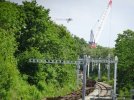
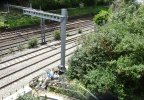
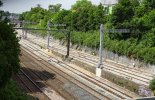
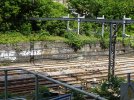
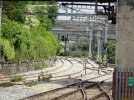
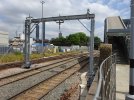
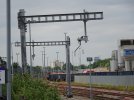
19/05/25 Poplars Acton Wells to Horn Lane bridge.

DSC02671.JPGDSC02674.JPGDSC02675.JPGDSC02676.JPGDSC02677.JPGDSC02679.JPGDSC02682.JPGDSC02684.JPG

== Doublepost prevention - post automatically merged: ==

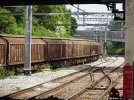
Bank viewed from Down Relief through Horn Lane bridge.
DSC02693.JPGDSC02694.JPGDSC02696.JPG

Poplars adjacent to Acton Main Line

DSC02685.JPGDSC02686.JPGDSC02687.JPGDSC02688.JPGDSC02691.JPG
 
Last edited:
Sponsor Post - registered members do not see these adverts; click here to register, or click here to log in
R

RailUK Forums

Meerkat

Established Member
Joined
14 Jul 2018
Messages
9,276
It’s great to see it getting done but……did they say
”here’s the spec, make it as ugly as possible!”
 

Benjwri

Established Member
Joined
16 Jan 2022
Messages
3,264
Location
Bath
It’s great to see it getting done but……did they say
”here’s the spec, make it as ugly as possible!”
I’d rather it got done than money was spent on designing ‘pretty’ OHLE. There isn’t the money to make it look good’s and even if there was imo it shouldn’t be wasted here.
 

WAO

Established Member
Joined
10 Mar 2019
Messages
1,216
Good design is both functional and economic. This isn't that bad; what could be improved is the horizontal beams having a lighter, trussed, lattice construction rather than the crude, heavier (probably weaker) rectangular form. A further improvement would be a latticed bracket rather than the heavy clamp on the side of a too-tall post, which would have the installation benefit of a single operation to erect a mast/beam. The mast heights are quite uniform here, so neater than the chaotic, random installations of the GWEP. The above suggestions are only based on what is being done elsewhere.

Good design usually looks good.

WAO
 

londonmidland

Established Member
Joined
22 Dec 2009
Messages
2,347
Location
Leicester
I’m surprised Series 2 or another less ‘heavy looking’ OLE installation wasn’t used here, seeing as high speed, high frequency working isn’t the focus here?
 

zwk500

Veteran Member
Joined
20 Jan 2020
Messages
18,401
Location
Northampton
I’m surprised Series 2 or another less ‘heavy looking’ OLE installation wasn’t used here, seeing as high speed, high frequency working isn’t the focus here?
Presumably the advantages for inspection, maintenance, and repair of having one design for the entire area was judged to be worth it.
 

59CosG95

Established Member
Joined
18 Aug 2013
Messages
6,853
Location
Beeston (Notts)
Good design is both functional and economic. This isn't that bad; what could be improved is the horizontal beams having a lighter, trussed, lattice construction rather than the crude, heavier (probably weaker) rectangular form. A further improvement would be a latticed bracket rather than the heavy clamp on the side of a too-tall post, which would have the installation benefit of a single operation to erect a mast/beam. The mast heights are quite uniform here, so neater than the chaotic, random installations of the GWEP. The above suggestions are only based on what is being done elsewhere.

Good design usually looks good.

WAO
A big drawback with lattice designs is the increased likelihood of finding a poor-quality weld.
 

WAO

Established Member
Joined
10 Mar 2019
Messages
1,216
A big drawback with lattice designs is the increased likelihood of finding a poor-quality weld.
Reactangular grids have shorter weld lengths. Are there any instances of lattices falling apart? Why are they still used?

WAO
 

59CosG95

Established Member
Joined
18 Aug 2013
Messages
6,853
Location
Beeston (Notts)
Reactangular grids have shorter weld lengths. Are there any instances of lattices falling apart? Why are they still used?

WAO
No instances of collapse AFAIK, but I believe they probably aren't considered for coastal environments due to the corrosion risk from salt water.
(This has mainly been with Mk1 installations from what I've heard, and a lot of those are in coastal areas (out of Fenchurch St & Liverpool St, Merseyside, Strathclyde as well))
 

WiredUp

Member
Joined
17 May 2021
Messages
97
Location
Bedford
It's pretty bog-standard Series 1 like everything else west of Airport Jn.
The design uses UKMS100 with F+F SICs and RESICs. Some steelwork and foundations are from Series 1.

== Doublepost prevention - post automatically merged: ==

Presumably the advantages for inspection, maintenance, and repair of having one design for the entire area was judged to be worth it.
Commonality with the equipment presently used on the GWML.

== Doublepost prevention - post automatically merged: ==

I’m surprised Series 2 or another less ‘heavy looking’ OLE installation wasn’t used here, seeing as high speed, high frequency working isn’t the focus here?
Series 2 is not a OLE Basic Design Range which is approved for new electrification schemes - UKMS is.

== Doublepost prevention - post automatically merged: ==

Good design is both functional and economic. This isn't that bad; what could be improved is the horizontal beams having a lighter, trussed, lattice construction rather than the crude, heavier (probably weaker) rectangular form. A further improvement would be a latticed bracket rather than the heavy clamp on the side of a too-tall post, which would have the installation benefit of a single operation to erect a mast/beam. The mast heights are quite uniform here, so neater than the chaotic, random installations of the GWEP. The above suggestions are only based on what is being done elsewhere.

Good design usually looks good.

WAO
It's a very efficient and elegant design that maximises standardisation and constructability. No one will be in a hurry to use welded angle masts and booms.
 

WAO

Established Member
Joined
10 Mar 2019
Messages
1,216

Curious to know what's wrong with the above images. Sorry to labour the point.

WAO
 

59CosG95

Established Member
Joined
18 Aug 2013
Messages
6,853
Location
Beeston (Notts)

Curious to know what's wrong with the above images. Sorry to labour the point.

WAO
Nothing wrong with the above - there are at least some solid steel sections there. It's more the Mk1 welded 4-angle TTC & portal sections that suffer, along with (and to a lesser extent) the Mk3 4-angle TTCs and portals.
Mk3 4-angle portal masts do exist, true enough, but they leave very, very little room for adjustment compared to their 300x90 Prefabricated Double Channel (PF DC) (as used over Welwyn Viaduct) and their 645x100 PF DC (as used at Leeds) cousins. These 3 portal types are all in the UKMS range, and were in the Mk3 and Series 2 ranges before that.
 

Class15

Established Member
Joined
30 Dec 2021
Messages
4,099
Location
North London or Mildmay line
According to: https://www.railforums.co.uk/threads/class-93-tri-mode-loco.210779/page-48#post-7300956

The curve may see electric freight action after all.

== Doublepost prevention - post automatically merged: ==

A little birdy told me this...

You know that silly piece of track between Acton Main Line and Acton Wells Junction that's currently being electrified, which should have *really* been done at the very beginning of the GWML project (don't go there).

Apparently ROG 93s are being assessed for use on the Hanwell Bridge 'trip' stone trains to Dagenham, Purfleet and Harlow.

A 59/66 will bring the huge 4,000t jumbo trains to Hanwell, where they are split into 2 or 3 smaller trains and a 93 will 'trip' the rakes to Essex.

Hanwell Bridge Loop - GWML - Acton Wells - NLL - GOBLIN - LTS.

Whole route from West London to Essex will be electrified except Hanwell Bridge Loop and Stone Terminals where diesel mode is only required at low speeds.
 

PLY2AYS

Member
Joined
26 Mar 2024
Messages
518
Location
Montserrat
Can someone please explain the difference between traditional pulleys and tensorex drums to me?
Guessing it’s a more modern (more efficient and safer?) way of tensioning the OLE… but what’s the actual mechanism behind it?
 

swt_passenger

Veteran Member
Joined
7 Apr 2010
Messages
34,227
Can someone please explain the difference between traditional pulleys and tensorex drums to me?
Guessing it’s a more modern (more efficient and safer?) way of tensioning the OLE… but what’s the actual mechanism behind it?
The Tensorex drums contain a flat coil spring. The best explanation of what goes on internally is probably by watching a manufacturer’s video. One of the major advantages is that the two units, one for the catenary and one for the contact wire, can usually be mounted vertically above the track. So there’s no need for the wire runs to head off at an angle to a weight system mounted away from the track, this also has a greater benefit on four track sections:

(Video includes animations of Tensorex unit operation.)
 
Last edited:

PLY2AYS

Member
Joined
26 Mar 2024
Messages
518
Location
Montserrat
The Tensorex drums contain a flat coil spring. The best explanation of what goes on internally is probably by watching a manufacturer’s video. One of the major advantages is that the two units, one for the catenary and one for the contact wire, can usually be mounted vertically above the track. So there’s no need for the wire runs to head off at an angle to a weight system mounted away from the track, this also has a greater benefit on four track sections:

(Video includes animations of Tensorex unit operation.)
Superb link. Greatly appreciated.
 

hwl

Established Member
Joined
5 Feb 2012
Messages
8,235
The Tensorex drums contain a flat coil spring. The best explanation of what goes on internally is probably by watching a manufacturer’s video. One of the major advantages is that the two units, one for the catenary and one for the contact wire, can usually be mounted vertically above the track. So there’s no need for the wire runs to head off at an angle to a weight system mounted away from the track, this also has a greater benefit on four track sections:

(Video includes animations of Tensorex unit operation.)
And you end up with fewer wire runs overall because the "used" section of each run is longer.
 

The Planner

Veteran Member
Joined
15 Apr 2008
Messages
19,628
And you end up with fewer wire runs overall because the "used" section of each run is longer.
Which is great until you need to replace the contact wire and the wire run extends over a junction :D
 

rower40

Member
Joined
1 Jan 2008
Messages
577
Did we get an answer to why these lines are called the "Poplar" lines? (What with Poplar being on the other side of London.) I've skim-read the last 7 pages, and have drawn a blank.
 

zwk500

Veteran Member
Joined
20 Jan 2020
Messages
18,401
Location
Northampton
Did we get an answer to why these lines are called the "Poplar" lines? (What with Poplar being on the other side of London.) I've skim-read the last 7 pages, and have drawn a blank.
Possibly because they were the GWR's connection to the Poplar area (London Docks) via the North London Railway?
 

Dr Hoo

Established Member
Joined
10 Nov 2015
Messages
5,604
Location
Hope Valley
Did we get an answer to why these lines are called the "Poplar" lines? (What with Poplar being on the other side of London.) I've skim-read the last 7 pages, and have drawn a blank.
Poplar was the first properly railway-connected London Dock. It was also owned by the North London Railway, which had started out as a ‘railway and dock’ company. It isn’t appropriate to go into all the historical ownership and re-naming issues on a modern electrification thread.

The lines were built to connect with Poplar.
 

Snow1964

Established Member
Joined
7 Oct 2019
Messages
11,015
Location
West Wiltshire
Possibly because they were the GWR's connection to the Poplar area (London Docks) via the North London Railway?
GWR had a depot in poplar, it was alongside a now filled in dock under Trafalgar Way on (new) Billingsgate market side (there is still one old square brick building there, which marks the area). The spur of water from Dock now know as Poplar dock marina towards Boardwalk Place was the entrance to the dock served by GWR

Access was North London Railway, then a reversing spur (approx where Castor Lane is today), then on bridge across line to Fenchurch Street (bridge was approx where Williamsburg Plz is today)
 
Last edited:

59CosG95

Established Member
Joined
18 Aug 2013
Messages
6,853
Location
Beeston (Notts)
I passed there the other day when I was going to Richmond - it looked like it was really making progress but still quite a bit left to do.
As far as I could make out from a recent AIVR video, most/all the structures seem to be in, but the wiring has yet to commence.
 

76020

Member
Joined
1 Nov 2012
Messages
198
Anyone have an update by any chance on actual electrification progress please?
I will be travelling past the Poplars Lines on this coming Friday, I am really busy for the rest of Friday and also all day Saturday, so I will post an update this coming Sunday.
 

Top