
• Our new ticketing site is now live! Using either this or the original site (both powered by TrainSplit) helps support the running of the forum with every ticket purchase! Find out more and ask any questions/give us feedback in this thread!

One Water Column Supplying Another Question

Status
Not open for further replies.

Andy873

Established Member
Joined
23 Mar 2017
Messages
1,421
I've been working on a mystery of what happened to a water column at a particular station, it was labelled by the L&Y as Number 178 which was in the sidings at the Up end. Next to it on the Up platform was No. 177. These two water columns were erected / nearly finished in July 1885.

A reporter for the Haslingden Gazette describes the water column (note single wording not plural) is nearing completion and not only can it supply engines standing by the platform but also engines in the sidings too.

However, I've been able to confirm there were actually two water columns, not one. I by accident came across a large scale town map from 1890 and it clearly shows both columns.

Question:

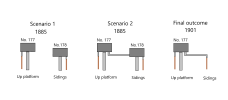
Could or did water columns feed each other with water? one having the water supply, the other being topped up from the first?

Please see attached scenarios.

I'm trying to understand why the reporter seems to only be describing one water column, and yet describes it as being able to also supply the sidings as well as the platform side.

Could it be that one fed the other by means of an outlet pipe, and the author's limited understanding saw both of them as being one of the same thing, that is, a single column "device"?

By 1901, water column 178 had gone, it had too to make room for the steps of the new passenger footbridge connecting the two platforms. At this time, No. 177 definitely has an L shaped outlet pipe extending into the sidings - maybe by then it had been realised that two columns was a bit OTT?

The sidings by the way were carriage shed sidings, mainly worked in the summer months, town holidays and bank holidays etc.

Thanks,
Andy.
 

Attachments

  • Water.png
    Water.png
    68.1 KB · Views: 22
Sponsor Post - registered members do not see these adverts; click here to register, or click here to log in
R

RailUK Forums

Rescars

Established Member
Joined
25 May 2021
Messages
2,587
Location
Surrey
Do you have details about the design of the columns? Was there a header tank on one or other column, or were these fed directly at mains pressure or from a separate storage tank? If there was a separate tank, perhaps the journalist used the term "water column" to describe the entire installation. Could a single "L" shaped water crane have been used to reach both the platform line and the siding perhaps (though this wouldn't explain why the two columns were numbered separately)?
 

Andy873

Established Member
Joined
23 Mar 2017
Messages
1,421
Do you have details about the design of the columns? Was there a header tank on one or other column, or were these fed directly at mains pressure or from a separate storage tank? If there was a separate tank, perhaps the journalist used the term "water column" to describe the entire installation. Could a single "L" shaped water crane have been used to reach both the platform line and the siding perhaps (though this wouldn't explain why the two columns were numbered separately)?
@Rescars, this is why I do like your input, you do ask some great questions.

The water columns were standard ones with a support column and a cylindrical tank on top, there are several photos showing No. 177.

Regarding the consecutive numbers, there's only really two options, 1. Erected at the same time, 2. The L&Y at a later date renumbered all the columns. Personally I think option 1 is the likeliest.

The L&Y in the 1880's invited tenders twice for batches of columns. one in 1886 for 40, and in Feb 1885 for 20. It's probably from this batch of 20 came the two for this station, but of course I can't prove that.

What I can prove - No. 178 did exist, and had to go as the space was needed for the steps of the footbridge at the Up platform. A fact that, up until now was never written about. What happened to it is anyone's guess, it would seem a waste of money if it was scrapped as it was only here for 16 years.
 

John Webb

Established Member
Joined
5 Jun 2010
Messages
3,787
Location
St Albans
I suspect the tanks were individually supplied, either direct from the mains or from another storage tank elsewhere on site. (Any possible trace on the old map you found?) Feeding one tank column from another means that a fault with one could scupper both, so feeding both separately gives a degree of protection if one fails.
 

Gloster

Veteran Member
Joined
4 Sep 2020
Messages
13,049
Location
Up the creek
One vague thought. Could a single storage tank be adjacent to one of the columns, but feeding both separately. The journalist misunderstood and thought that the storage tank was part of the adjacent column and the other subsidiary was fed off it. Scenario 2 strikes me as unlikely, but not impossible.
 

Rescars

Established Member
Joined
25 May 2021
Messages
2,587
Location
Surrey
What I can prove - No. 178 did exist, and had to go as the space was needed for the steps of the footbridge at the Up platform. A fact that, up until now was never written about. What happened to it is anyone's guess, it would seem a waste of money if it was scrapped as it was only here for 16 years.
I doubt 178 would have been scrapped. Water columns can't have been cheap. More likely to have been put into storage pending installation elsewhere. Bit of a win for the Outdoor Plant and Machinery budget!
 

edwin_m

Veteran Member
Joined
21 Apr 2013
Messages
28,760
Location
Nottingham
I suspect the tanks were individually supplied, either direct from the mains or from another storage tank elsewhere on site. (Any possible trace on the old map you found?) Feeding one tank column from another means that a fault with one could scupper both, so feeding both separately gives a degree of protection if one fails.
Also, unless one column was much taller than the other, the two tanks would be at the same level so a pump would be needed to transfer water between them. Far easier just to fill them separately, possibly from the same water supply.
 

Andy873

Established Member
Joined
23 Mar 2017
Messages
1,421
What date was this report, please?
Saturday, 18 July 1885.

One vague thought. Could a single storage tank be adjacent to one of the columns, but feeding both separately. The journalist misunderstood and thought that the storage tank was part of the adjacent column and the other subsidiary was fed off it. Scenario 2 strikes me as unlikely, but not impossible.

Also, unless one column was much taller than the other, the two tanks would be at the same level so a pump would be needed to transfer water between them. Far easier just to fill them separately, possibly from the same water supply.
I think we are all in agreement here, two separate columns looks to be the simplest and easiest solution. I know the water was town water supplied from a reservoir high up on the hills, so gravity gave it the force to flow downhill.

No 177 was on the platform's ramp which would have involved digging up part of the ramp, and if you're doing that you might as well continue into the sidings for No 178.

I doubt 178 would have been scrapped. Water columns can't have been cheap. More likely to have been put into storage pending installation elsewhere. Bit of a win for the Outdoor Plant and Machinery budget!
Me too, I've come across instances where signal boxes have been disassembled and reassembled at different locations, so there's no reason why an expensive column wouldn't be used elsewhere that's suitable.

I think the real answer is that when No. 178 was removed, they modified 177 as a duel outlet type, with the second outlet flowing from the L shaped pipe, which by the way was above your head as you came down the footbridge steps.

Thanks all!
 

Nottingham59

Established Member
Joined
10 Dec 2019
Messages
3,353
Location
Nottingham
A reporter for the Haslingden Gazette describes the water column (note single wording not plural) is nearing completion and not only can it supply engines standing by the platform but also engines in the sidings too.

However, I've been able to confirm there were actually two water columns, not one. I by accident came across a large scale town map from 1890 and it clearly shows both columns.
We all know that newspapers get details wrong. The simplest explanation might be the reporter never actually visited the site and wrote up a story he had been told in the pub.
 

Andy873

Established Member
Joined
23 Mar 2017
Messages
1,421
We all know that newspapers get details wrong. The simplest explanation might be the reporter never actually visited the site and wrote up a story he had been told in the pub.
Yes, and the thought had crossed my mind too! Especially as he only mentions one water column not two. Maybe he spotted something as he passed through the station, perhaps he asked a member of staff there, or as you say, heard it in the pub!
 

edwin_m

Veteran Member
Joined
21 Apr 2013
Messages
28,760
Location
Nottingham
The more usual arrangement would probably have been a single water column or tower feeding one or more water cranes at the places where tanks were filled. However, these would have to be connected by large diameter pipework to handle the flows needed to complete the task in a reasonable time. A separate tank can be "trickle charged" by a small diameter pipe but discharged rapidly when needed, on roughly the same principle as a flush toilet.
 
Status
Not open for further replies.

Top