Our new ticketing site is now live! Using either this or the original site (both powered by TrainSplit) helps support the running of the forum with every ticket purchase! Find out more and ask any questions/give us feedback in this thread!
They are pushing politicians into stupid populist decisions that are irrelevant to climate change - target date for getting rid of diesel trains for example
That’s nice if it’s only us relying on it. Except that multiple countries will be following the policy of relying on the same lump of spare power. And if everyone goes for battery etc storage then that spare capacity won’t be as spare it is used to be.
They are pushing politicians into stupid populist decisions that are irrelevant to climate change - target date for getting rid of diesel trains for example
Poor winter weather is a hypothetical edge case? And widespread power shortages are a huge impact event.
On a financially reasonable basis they are - we are committing to needing multiples of the power capacity we actually use.
That’s nice if it’s only us relying on it. Except that multiple countries will be following the policy of relying on the same lump of spare power. And if everyone goes for battery etc storage then that spare capacity won’t be as spare it is used to be.
As a decarbonisation researcher, I must admit I have some issues with NESO's projections - mostly inherited from when it was an arm of National Grid.
The long term scenarios also have some rather interesting choices - for example modelling the system as having CCGTs that operate at around 1% capacity factor. That is not an economical way to provide backup power, especially considering the age of the standing CCGT fleet.
As a decarbonisation researcher, I must admit I have some issues with NESO's projections - mostly inherited from when it was an arm of National Grid.
The long term scenarios also have some rather interesting choices - for example modelling the system as having CCGTs that operate at around 1% capacity factor. That is not an economical way to provide backup power, especially considering the age of the standing CCGT fleet.
I don't disagree that there are some choices in the scenarios that are, up for debate, shall we say?
I was replying to a poster who seems completely convinced we'll have multiple (rolling) blackouts every winter due to insufficient generation- and that is something that is quite clearly disproven by the planning and modelling that has been done.
While I agree that gas power generators of any type that spent very little time actually generating power will be expensive, can I ask how the age of the standing CCGT fleet impacts this?
The long term scenarios also have some rather interesting choices - for example modelling the system as having CCGTs that operate at around 1% capacity factor. That is not an economical way to provide backup power, especially considering the age of the standing CCGT fleet.
To be fair, that's why they had called them Future Energy Scenarios. They are not forecasts of what the energy system will look like, but a representation of what it could look like, should certain choices be made or circumstances come to pass. So to worry about some 1% utilised gas turbines in any of the pathways is - to me - missing the point of the work. It's also not about picking a winning/preferred scenario, tempting as that might be (it's something I have to work to resist). The real value is looking that the similarities and differences between the scenarios, and the big factors that influence them.
So where all the scenarios/pathways agree in terms of timescale or deployment, it's telling us some probable no-regrets choices. Re-reading the summary doc, a couple that spring out are
- 2 GW clean hydrogen by 2035
- 50 GW offshore wind by 2035
So we probably ought to crack on with these.
But then when the pathways diverge, that tells you about choices and alternatives. So one of the differences between pathways is around nuclear deployment, and we can get a feel of what happens to other parts of the energy system if the nuclear industry broke the habit of a lifetime and delivered significant cost reductions/economies of scale in new build.
Agree, and any kind of short-term CO2 targets will go out of the window to keep the lights on. The other point being that you might use very carbon intensive generation to keep the lights on, but if it's only running a few hours a year it's not contributing much CO2 overall, so you can perhaps deprioritise that and instead pay attention to getting rid of other big pools of carbon emissions, such as domestic gas use.
While I agree that gas power generators of any type that spent very little time actually generating power will be expensive, can I ask how the age of the standing CCGT fleet impacts this?
Britain has piles of first generation CCGTs, that are of little higher efficiency than modern open cycle gas turbines.
So if we are keeping those around we will suffer hugely in terms of operating costs compared to jettisoning them for OCGTs or gas engines of similar efficiency and much lower maintenance requirements.
And if we replace them with new CCGTs we will be paying hugely over the odds for capital equipment we will almost never use.
In the sort of envisaged backup role I doubt the steam plant will add much to the real world efficiency of the station - and it requires lots of maintenance people be kept around ot keep it in order.
As a society we would be better off discarding the CCGTs and buying a bunch of General Electric's 9HA.02s, which are ~44% efficient in simple cycle mode.
Britain has piles of first generation CCGTs, that are of little higher efficiency than modern open cycle gas turbines.
So if we are keeping those around we will suffer hugely in terms of operating costs compared to jettisoning them for OCGTs or gas engines of similar efficiency and much lower maintenance requirements.
And if we replace them with new CCGTs we will be paying hugely over the odds for capital equipment we will almost never use.
In the sort of envisaged backup role I doubt the steam plant will add much to the real world efficiency of the station - and it requires lots of maintenance people be kept around ot keep it in order.
As a society we would be better off discarding the CCGTs and buying a bunch of General Electric's 9HA.02s, which are ~44% efficient in simple cycle mode.
Thank you for explaining - that makes sense, and probably is why I've seen some proposals for OCGTs, an example is this one by SSE Thermal, being made.
EDIT: I now realise I linked an Irish Open Cycle Gas Turbine, instead of one in GB. I left the link above as is, but there are also multiple OCGT proposals for GB, such as this one by drax
== Doublepost prevention - post automatically merged: ==
I thought it was 10%, but the principle is the same. Last year it was 26% Gas. 6 years ago it was 39%. All we need is a slightly higher rate of renewables growth for the next 5 years and we’re there (and the plan is a higher level of renewables growth, mush of which is under construction already). If Hinckley Point comes on line by then we’ll smash it.
I started to doubt myself so I went and checked this. The NESO report on clean power 2030 states that unabated gas should produce no more than 5% of the generation by 2030 (among other requirements).
The scenarios in this report suggest it is possible to achieve the government's goal while maintaining current reliability standards.
I started to doubt myself so I went and checked this. The NESO report on clean power 2030 states that unabated gas should produce no more than 5% of the generation by 2030 (among other requirements).
I’ve checked the separate Government policy document, and it is indeed 5% “unabated“ gas, ie gas without Carbon Capture. In addition, within the 95% net zero share there is gas with Carbon capture, biomass, and energy to waste.
I’ve checked the separate Government policy document, and it is indeed 5% “unabated“ gas, ie gas without Carbon Capture. In addition, within the 95% net zero share there is gas with Carbon capture, biomass, and energy to waste.
In case of conflict (or they just want to be awkward) with the soviet union or china, the interconnector cables to the continent might well be severed. If the sun doesn't shine and the wind doesn't blow, what then?
In case of conflict (or they just want to be awkward) with the soviet union or china, the interconnector cables to the continent might well be severed. If the sun doesn't shine and the wind doesn't blow, what then?
In case of conflict (or they just want to be awkward) with the soviet union or china, the interconnector cables to the continent might well be severed. If the sun doesn't shine and the wind doesn't blow, what then?
All of which applies in a fossil fuel system. What if oil and gas pipelines were destroyed or LNG ships prevented from reaching UK? Multiple interconnectors, multiple offshore and on shore wind sites and Solar PV provide a more diverse generation mix making targeting it harder for an adversary.
In terms of cost of back up gas powered generation it will have a high unit cost but will be offset by very low unit costs for renewables for large periods of the year. Forecasted amortized cost over the year in the 2030's is for a lower unit cost relative to now and crucially for unit prices to be much more stable allowing companies and households more certainty.
In terms of blackout risk we were a lot further away from this than many news articles suggest when the price of the last few generators was extremely high. Additional industrial back up generators and other demand side responses were still available to be called upon as was additional interconnector capacity.
Going forwards the rapidly increasing BESS capacity will help cut 2-3GW of the peaks providing a massive increase in headroom in cold conditions and also making it harder for generators to game the system for high profits.
Back in November and interconnector tripped offline suddenly removing 1.5GW from.the grid. Within 2 minutes BESS were replacing all this capacity and only minor brownouts occured for less than 2 minutes.
And yes we will over build renewable capacity as their will be a financial sweat spot between the level of overcapacity versus the cost of long duration storage/ back up gas generation capacity.
The scenarios in the NESO document have less biomass than today in 2030, and so little gas CCS that you might as well not have any, so I'm not too worried about that personally.
Waste to Energy is really a waste management strategy that happens to produce a little energy on the side
The scenarios in the NESO document have less biomass than today in 2030, and so little gas CCS that you might as well not have any, so I'm not too worried about that personally.
Waste to Energy is really a waste management strategy that happens to produce a little energy on the side
There's people making a fuss about biomass at the moment, but there's not genuinely likely to be any massive progress towards waste reduction in the next 10 years, and we're still sending a large proportion of the current waste to landfill. Burning is clearly more sustainable than landfill from a non-carbon perspective, is probably better than landfill methane emissions from a pure carbon point of view.
Unless we do something really dramatic on waste, which we won't, it's likely in the round to be a better form of long-term baseload power than retaining the equivalent amount of gas capability.
There's people making a fuss about biomass at the moment, but there's not genuinely likely to be any massive progress towards waste reduction in the next 10 years, and we're still sending a large proportion of the current waste to landfill. Burning is clearly more sustainable than landfill from a non-carbon perspective, is probably better than landfill methane emissions from a pure carbon point of view.
There's people making a fuss about biomass at the moment, but there's not genuinely likely to be any massive progress towards waste reduction in the next 10 years, and we're still sending a large proportion of the current waste to landfill. Burning is clearly more sustainable than landfill from a non-carbon perspective, is probably better than landfill methane emissions from a pure carbon point of view.
Unless we do something really dramatic on waste, which we won't, it's likely in the round to be a better form of long-term baseload power than retaining the equivalent amount of gas capability.
Biomass and Waste-to-Energy are completely separate things.
The former is the use of organic material to produce energy. It includes things that are generally good, such as using real organic waste streams for energy, but also things like the burning of complete trees that may or may not be replanted or have the ecosystem restored afterwards.
An example of the first type of biomass is the production of biogas from Anaerobic digestors fed with food waste collected from households. An example of the second is what the Drax power station is doing - importing trees from North America, at least sometimes from places where forestry management isn't what it should be. In my view, we should be expanding the first, and reducing the second. Things like the second is what makes biomass dicey from a carbon perspective.
Waste-to-Energy is the burning of household general waste (and similar wastestreams) in specific facilities. This is clearly better than landfill, even just from the methane landfill produces, which is usually enough that the carbon impact of incineration is lower than that of landfilling. As you point out, it is also better from a land use and pollution point of view, among others.
The reason I say it is a waste management strategy primarily, is because the amount of general waste we produce is what should be driving the incineration policy, not the energy strategy. In the grand scheme of things, Waste-to-Energy facilities produce very little electricity, though they do occasionally feed district heating networks as well.
I do think we need to get better at waste management in this country in general, and that is across the chain. Post-collection sorting of at least some recyclables, especially metals and maybe certain plastics, should be universal. No waste should be going to landfill. Food waste should always be collected separately, because it has a negative impact on both post-collection sorting and on incineration.
== Doublepost prevention - post automatically merged: ==
That doesn't work because of the methane produced by the compostable materials (food waste, paper, wood, etc.) that inevitably end up in that stream as well!
That doesn't work because of the methane produced by the compostable materials (food waste, paper, wood, etc.) that inevitably end up in that stream as well!
You can deal with organics in your plastic stream by autoclaving the waste prior to burying it, which causes all those sorts of materials to disintegrate into an organic rich aqueous phase that can go for digestion.
It also causes all the plastics to agglomerate and compact, making it easier to bury.
This isn't practical for recycling due to contamination and mixing of plastics, but those aren't problems in this case.
You can deal with organics in your plastic stream by autoclaving the waste prior to burying it, which causes all those sorts of materials to disintegrate into an organic rich aqueous phase that can go for digestion.
It also causes all the plastics to agglomerate and compact, making it easier to bury.
I'm not aware of anyone doing so, no. Certainly not for this purpose.
Currently incineration is in vogue, but with the falling belief in recycling and increasing opposition to incinerators, I don't really know what will happen long term.
Recycling isn't doing so well in the public conciousness after all the scandals and all that.
In any case, as you noted, incineration will never produce a nationally important supply of electricity.
Biomass and Waste-to-Energy are completely separate things.
The former is the use of organic material to produce energy. It includes things that are generally good, such as using real organic waste streams for energy, but also things like the burning of complete trees that may or may not be replanted or have the ecosystem restored afterwards.
An example of the first type of biomass is the production of biogas from Anaerobic digestors fed with food waste collected from households. An example of the second is what the Drax power station is doing - importing trees from North America, at least sometimes from places where forestry management isn't what it should be. In my view, we should be expanding the first, and reducing the second. Things like the second is what makes biomass dicey from a carbon perspective.
Drax is green washing pure and simple. We need to move away from this model of biofuels.
On the other hand converting human and animal manure into biogas turns a methane producing product into a sustainable biofuel helping to fill any gaps in renewable power generation.
On the other hand converting human and animal manure into biogas turns a methane producing product into a sustainable biofuel helping to fill any gaps in renewable power generation.
and it's good to know that lots of "waste water" treatment works do this already... Somebody here or on another forum has said that moving the sludge from smaller works to the digesters is a significant part of their lorry mileage.
Sewage sludge is the leftover material from the wastewater treatment process, United Utilities collect this and send it to one of their 13 digestion sites which are located at waste water treatment facilities around the region. It is put into an anaerobic digester to generate renewable biogas which is then used in a combined heat and power unit to produce electricity and heat to power the wastewater treatment facility.
The Stockport Sludge Treatment facility is located at Stockport Wastewater Treatment Works and processes sludge from other wastewater treatment facilities in the area. Just over 600 cubic metres of sludge are processed every day – enough to fill an Olympic sized swimming pool every four days.
The combined heat and power unit at Stockport currently generates more than 9,700 kilowatt-hours of renewable energy every day, the equivalent of the power used by 1,230 homes each year.
Boosting the amount of gas generated by 20% supports United Utilities’ Net Zero commitment and will bring Stockport Wastewater Treatment Works closer to achieving energy neutrality as well as reducing greenhouse gas emissions.
Today saw solar power peak at 6.25GW. While it was sunny across the board, that still looks impressive for late-January, so it will be interesting to see what peaks we see in June, when the sun is of course both higher and up for longer.
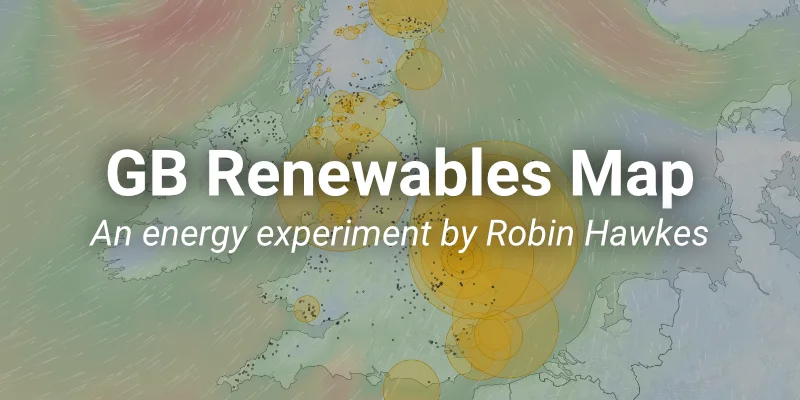
I discovered this excellent map the other day, showing how much each windfarm is generating in real time overlaid with current wind conditions. It really brings home the point that 99% of the time it’s windy somewhere.
I have no idea how accurate it is - for example Dogger Bank has been showing as not generating every time I have looked, yet it generated its first power 15 months ago. Perhaps it is off line (they have had some issues, and full completion won’t be for another 6 months at least) or perhaps the data isn’t flowing.
I discovered this excellent map the other day, showing how much each windfarm is generating in real time overlaid with current wind conditions. It really brings home the point that 99% of the time it’s windy somewhere.
I have no idea how accurate it is - for example Dogger Bank has been showing as not generating every time I have looked, yet it generated its first power 15 months ago. Perhaps it is off line (they have had some issues, and full completion won’t be for another 6 months at least) or perhaps the data isn’t flowing.
Thank you for sharing this. On another note looking at it, what would it take to actually put some wind farms in the Bristol channel/southeast Irish sea area? This is the frontline for prevailing SW winds so should have huge potential. I know depth is a problem off Cornwall to the south, though hopefully floating wind farm tech will sort this out.
Thank you for sharing this. On another note looking at it, what would it take to actually put some wind farms in the Bristol channel/southeast Irish sea area? This is the frontline for prevailing SW winds so should have huge potential. I know depth is a problem off Cornwall to the south, though hopefully floating wind farm tech will sort this out.
Tidal forces in the Bristol channel will be severe enough to make actually working on a wind turbine site, and maintaining it, a lot more expensive than in the North Sea or Northern Irish Sea.
I'm not sure the depth issue is a real problem if it came down to it, gravity base structures can be built to much greater depths than found there if necessary
Thank you for sharing this. On another note looking at it, what would it take to actually put some wind farms in the Bristol channel/southeast Irish sea area? This is the frontline for prevailing SW winds so should have huge potential. I know depth is a problem off Cornwall to the south, though hopefully floating wind farm tech will sort this out.
I’m no expert here, but for reasons I don’t know the SW approaches actually aren’t that windy compared to the North Sea and the NW approaches off the Hebrides. The former is filling up with turbines quickly, and the latter is going to be the area of interest for offshore floating wind.
There was a piece on Radio 4 this morning about a trial site in Devon for underground pumped storage using water with an additive that makes it much denser. Claimed it would greatly reduce the cost of pumped storage and/or make it viable on much lower hills than previously.
We are aware of an issue with emails from the Forum to Microsoft-based email accounts (hotmail/outlook/live.com email addresses). This is being looked into currently, thanks for your patience meanwhile.