Just checking notes from past trips, in June 2004 while visiting Glasgow I did a quick return trip to Wishaw as I needed to red-pen the line from Holytown and my recollection is that the regular service on it had started with the May timetable change that year.Holytown was electrified in 1974: I don’t recall when it eventually got a timetabled electric passenger service, but it was decades later.

-
Our new ticketing site is now live! Using either this or the original site (both powered by TrainSplit) helps support the running of the forum with every ticket purchase! Find out more and ask any questions/give us feedback in this thread!
You are using an out of date browser. It may not display this or other websites correctly.
You should upgrade or use an alternative browser.
You should upgrade or use an alternative browser.
British electrification OHL dates (mainly 25kV plus the most significant 1.5KV DC)
- Thread starter Justin Smith
- Start date
Sponsor Post - registered members do not see these adverts; click here to register, or click here to log in
R
RailUK Forums

GraphitProjekt
Member
The first electric trains on the Ockenden branch were in 18/06/1963 according to Garry Keenor's book.Bow Jn to Fenchurch St was electrified as part of the LNE/GE 1500v DC scheme. Presumably 1949? It only did 2/4 roads between Stepney East (Limehouse) and Fenchurch St. 1961 LTS electrification completed the other two roads and all four became 6.25kv. Converted to 25Kv in 198x. Ockenden needs including.
1960 - Delete Lea Valley (1969?)
Graham Road Curve was presumably electrified when built?
1994 HS1
Camden Road to Primrose Hill electrified 199x.
Ripple Lane and Tilbury Container Terminal circa 1990?
When LTS was electrified in 1961, it was 6.25kv from Fenchurch Street until Barking Feeder Station. The neutral sections that separated the two voltages were at Upney on the main line and somewhere before Ripple Lane yard on the Tilbury Loop. Then both lines (and Ockenden branch) were 25kv all the way to Leigh-on-Sea neutral section and then it was 6.25kv to Shoeburyness. At this time, Bow Curve and Forest Gate Jnc to Barking were also 6.25kv
Ripple Lane yard was wired and the route to it from Forest Gate Jnc via Barking was upgraded to 25kv in 1988. When the rest of LTS was upgraded is a mystery to me.
Graham Rd curve is a bit confusing because the wiring (in 1986) was originally from Reading Lane Jnc on WAML to Dalston Kingsland station where class 313s then switched voltage if they were going to Liverpool Street. Dalston Western Junction to North Woolwich had been electrified with third rail in 1985. (And for context, Broad Street to Willesden Junction had been electrified with 3rd rail in 1917).
And for some pedantry, the "North London Incline" that connects Camden Road (East Jnc) to the ECML (Copenhagen Jnc) was also electrified overhead in 1986 so that those class 313s could get back to their home depot at Hornsey after running the Liverpool Street to Watford Junction trains all day.
As others have said, Camden Road to Stratford AC wiring was in 1988 (it was actually part of the same scheme that brought you Ripple Lane yard and the associated 6.25kv upgrade - all to do with electric freight)
While we're at it, the freightliner terminal in the Kings Cross area (aka "York Way" or "Maiden Lane") to the WCML (Camden Jnc) via Camden Road and Primrose Hill was wired at 25kv in 1965 as a part of the original WCML work, In fact, not in the 1990s.
But you are right that a lot of NNL wiring did occur in the 1990s: mainly Acton Central to Camden Road via Willesden Junction High Level and Gospel Oak on 29/09/1996. And then a short stretch of WLL: Mitre Bridge Jnc to Willesden Junction H.L. in 1997.
== Doublepost prevention - post automatically merged: ==
Tbf, Tottenham South Curve and Seven Sisters Chord still has mark 3 OLE on it, only the quite short stretch through South Tottenham was replaced with Series 2 (look at this cabrideDid we get (I can't see it) the S-curve from the Lea Valley line, through South Tottenham station on the Goblin, then round to Seven Sisters. Some years there was one train a day that way, other times not at all. In the recent Goblin electrification it was all torn down and then done again. South Tottenham station became like Newton-le-Willows long after 1974, fully electrified but with no, or hardly any, electric services.
== Doublepost prevention - post automatically merged: ==
I might question you on this. I have it that South Tottenham was wired in 1989 a year before Coppermill Jnc to Stratford. This is from Garry Keenor's book and Anglia East by John Glover (2003). I think that date comes from railcodes.org which I believe is just wrong on this front. (it's right on most things though, still a very good source).It says Seven Sisters Junction - Tottenham South Junction was electrified as infill 5 May 1969, the same day as lines from Hackney Downs to Cheshunt and Chingford, but used by passenger diversions. The line to Stratford was for some reason not done until 1989, but had no passenger service.
The 1 train a week is 2U00 05:30 Liverpool St - Enfield Town via South Tottenham on Saturdays only, operated by London Overground. Unlike Newton-le-Willows which supposedly didn’t have a single electric passenger service run through it until the wires had been extended to Lime Street.
Last edited:
Further pedantry, it was actually 4th rail, giving compatibility with the Bakerloo and District Underground lines. Third railed in the 1970s I believe.(And for context, Broad Street to Willesden Junction had been electrified with 3rd rail in 1917).
It was in the 1990s that the Richmond to North Woolwich service was converted from its initial 2-EPB trains, DC all the way, to 313s, which used two separate 25kV sections on the way, changing voltage four times each journey. Some of this was driven by electrical interference problems with stray currents from the initial 1980s DC third rail extension. The near-explosion noise every few minutes from the air-driven pantograph being extended or retracted at the various changeover points was a regular amusement for those seated directly underneath.
== Doublepost prevention - post automatically merged: ==
Then it must have been put back up as it was. I went along there shortly after the Goblin reopened for the mainstream works project, which actually finished very little, and commented here about, with so little wired up, and the Seven Sisters and South Tottenham sections visibly removed, the length of wiring installed actually looked like it had gone backwards (written here at the time):Tbf, Tottenham South Curve and Seven Sisters Chord still has mark 3 OLE on it, only the quite short stretch through South Tottenham was replaced with Series 2 (look at this cabride ...)
Gospel Oak to Barking Line (GOBLIN) electrification
An item in RAIL magazine 820 (Feb 15-28) reports the B-GO Rail User Group as saying the civil engineering (as distinct from actual electrification works) mostly went well during the blockade. However it mentions breaches of sewers at Walthamstow while driving piles, and the discovery of...
 www.railforums.co.uk
Last edited:
GraphitProjekt
Member
I also like to seek out a seat under the pantograph just to hear the circuit breaker at neutral sections, modern trains can be quite quiet about it though.
Right you are on the pedantry - I had forgotten that the centre rail was bonded in 1970, sometimes they sit resting on the sleepers in 4' for many more years unused (still on the northern city line).
Where were the changeovers in the 1990s? Acton Central, Camden Rd and Dalston Kingsland are my guesses but what's the other one?
Right you are on the pedantry - I had forgotten that the centre rail was bonded in 1970, sometimes they sit resting on the sleepers in 4' for many more years unused (still on the northern city line).
Where were the changeovers in the 1990s? Acton Central, Camden Rd and Dalston Kingsland are my guesses but what's the other one?
Did we get (I can't see it) the S-curve from the Lea Valley line, through South Tottenham station on the Goblin, then round to Seven Sisters. Some years there was one train a day that way, other times not at all. In the recent Goblin electrification it was all torn down and then done again. South Tottenham station became like Newton-le-Willows long after 1974, fully electrified but with no, or hardly any, electric services.
It says Seven Sisters Junction - Tottenham South Junction was electrified as infill 5 May 1969, the same day as lines from Hackney Downs to Cheshunt and Chingford, but used by passenger diversions.
Railway Observer June 1989 has the following:I have it that South Tottenham was wired in 1989 a year before Coppermill Jnc to Stratford.
South Tottenham. On 15th April it was noted that the connection from Seven Sisters through South Tottenham station and down to the Lea Valley line was in the course of electrification.
On 15th April it was noted that the connection from Seven Sisters through South Tottenham station and down to the Lea Valley line was in the course of electrification.
Whatever was the purpose of this? Surely not even as a diversion route for Liverpool Street trains; these would just go direct from Hackney Downs to Seven Sisters.
I occasionally used it on the last leg of its journey from Leyland to Preston. It was one of the very few electric trains to stop at Leyland at that timeI believe Newton-le-Willows did have a passenger service for the first couple of years after the WCML extension wiring was completed in 1974. This was a 304 emu, which left Crewe at about 0930, and stopped everywhere to Preston, including Newton-le-Willows by going round the loop. It returned in the afternoon.
A decidedly leisurely diagram, it was described as being given to the Crewe driver nearest retirement. Probably ran near-empty, and was given up after a couple of years. Thereafter no passenger electric service at Newton for more than 30 years.
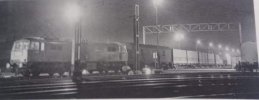
I've mentioned this before in the forum but electrification of the York Way/Maiden Lane terminal was something of a mystery to me for a number of years because although I'd found several photos of it in use in the late 60s, none of them showed any sign of electrification. Did the wiring stop short of the depot, maybe to allow the use of cranes?While we're at it, the freightliner terminal in the Kings Cross area (aka "York Way" or "Maiden Lane") to the WCML (Camden Jnc) via Camden Road and Primrose Hill was wired at 25kv in 1965 as a part of the original WCML work, In fact, not in the 1990s.
Finally at long last I've found the answer on the Facebook Group BR: Lost Goods Yards: UK and Ireland - and yes it did stop short! I've attached the photo posted by a member called Mike Townsend and as can be seen there's a wiring termination gantry at the entrance to the terminal.
Attachments
GraphitProjekt
Member
I have updated it to Clapton Jct but I am sure (when I was originally researching that entry) that the source I used said Coppermill Jct !
Just so we're all clear on this kinda messy subject, I thought I'd put together a quick graphic to show the junctions here (and around South Tottenham)View attachment NE london junction names-03.jpgI did wonder about that.
Clapton junction and Copper Mill junction are only just over half a mile apart.
== Doublepost prevention - post automatically merged: ==
damn! I can never get my pictures to show up (even as thumbnails) when I post on this site. Never understood this honestly
== Doublepost prevention - post automatically merged: ==
That's good to see, we like a primary source. I suppose it operates similarly to Garston terminal in Liverpool which is still operated (occasionally) with class 90s carefully propelling into the crane area.I've mentioned this before in the forum but electrification of the York Way/Maiden Lane terminal was something of a mystery to me for a number of years because although I'd found several photos of it in use in the late 60s, none of them showed any sign of electrification. Did the wiring stop short of the depot, maybe to allow the use of cranes?
Finally at long last I've found the answer on the Facebook Group BR: Lost Goods Yards: UK and Ireland - and yes it did stop short! I've attached the photo posted by a member called Mike Townsend and as can be seen there's a wiring termination gantry at the entrance to the terminal.
Interestingly, some sources say that Camden Junction to Maiden Lane terminal OLE was unused between 1968 and 1988
Attachments
Last edited:

Justin Smith
Established Member
That's really good that map !Just so we're all clear on this kinda messy subject, I thought I'd put together a quick graphic to show the junctions here (and around South Tottenham)View attachment 170880
== Doublepost prevention - post automatically merged: ==
damn! I can never get my pictures to show up (even as thumbnails) when I post on this site. Never understood this honestly
== Doublepost prevention - post automatically merged: ==
That's good to see, we like a primary source. I suppose it operates similarly to Garston terminal in Liverpool which is still operated (occasionally) with class 90s carefully propelling into the crane area.
Interestingly, some sources say that Camden Junction to Maiden Lane terminal OLE was unused between 1968 and 1988

D6130
Established Member
A wee bit of pedantry on that otherwise very good and clear map....shouldn't Coppermills Junction be Coppermill Junction?That's really good that map !
Snow1964
Established Member
My gran used to live in Walthamstow, and we walked in the Lea valley in 1970s, and there were mast bases along some of the lifted Hall Farm curve (South East curve) towards Lea Bridge, so I assume the Hall Farm curve was electrified for at least part of its length from Hall Farm Junction.I did wonder about that.
Clapton junction and Copper Mill junction are only just over half a mile apart.
Clapton curve was also part electrified, when Chingford line was done, which is why style of masts is different at Clapton end to the later Lea Valley electrification
The Copper Mill curve (North East curve) by water treatment works which was closed earlier was never electrified
GraphitProjekt
Member
That's really good that map !
Thankyou all!A wee bit of pedantry on that otherwise very good and clear map....shouldn't Coppermills Junction be Coppermill Junction?
I've also just realised I forgot to mention the Lea Valley Reversible line!
Neither. Copper Mill Junction is correct.A wee bit of pedantry on that otherwise very good and clear map....shouldn't Coppermills Junction be Coppermill Junction?
GraphitProjekt
Member
I had no idea there were past connections!My gran used to live in Walthamstow, and we walked in the Lea valley in 1970s, and there were mast bases along some of the lifted Hall Farm curve (South East curve) towards Lea Bridge, so I assume the Hall Farm curve was electrified for at least part of its length from Hall Farm Junction.
Clapton curve was also part electrified, when Chingford line was done, which is why style of masts is different at Clapton end to the later Lea Valley electrification
The Copper Mill curve (North East curve) by water treatment works which was closed earlier was never electrified
Correct me if (when) I'm wrong but is it:
"Hall Farm Curve" (aka "Lea Bridge Curve") is Temple Mills line (Downwards) to Chingford Line (Downwards) (Copper Mill South Junction to Hall Farm Junction)
"Copper Mill Curve" (aka "Walthamstow Curve") is Chingford Line (Upwards) to Lea Valley Line (Downwards) (Hall Farm Junction to Copper Mill North Junction)
"Clapton Curve" is Chingford Line (Downwards) to Lea Valley Line (Downwards) (Clapton Junction to Copper Mill North Junction)
was there a Lea Bridge to Clapton connection?
== Doublepost prevention - post automatically merged: ==
I blame quailmap for that one! I have seen it shortened elsewhere but it's probably because of their error.Neither. Copper Mill Junction is correct.
== Doublepost prevention - post automatically merged: ==
Also thankyou for mentioning my thread, I do implore anyone who has anything to say about Anglia region substations and feeding arrangements (past & present), and especially 6.25kV upgrades to add anything you have to that thread and hopefully we can reach a full pictureAll of these schemes were at least partly 6.25kV. There is an incomplete discussion of 6.25kV to 25kV conversion dates here:
Anglia region electrification: conversion to 25kv in 1970s/1980s
Hello all, I've been trying to investigate the history of electrification systems on GEML, LT&S and the Lea Valley routes. I have found pretty thorough sources for how these systems started out in 1960/1961 (and for the earlier DC system) and this includes feeder stations, TSCs and neutral...
If anyone can fill in the missing bits that would be good.
Shenfield-Chelmsford was converted direct from 1.5kV DC to 25kV AC in 1961.
Last edited:
Justin Smith
Established Member
Latest colour coded version, in two parts to enable printing out on two sheets of (landscape) A4. I have dropped the font size to 8 to enable it to fit on A4 sheets and give some spare lines for the next few years !
If anyone wants the original file (Microsoft Works Spreadsheet) POM me and I'll send it you. :


If anyone wants the original file (Microsoft Works Spreadsheet) POM me and I'll send it you. :
Last edited:

Railsigns
Established Member
- Joined
- 15 Feb 2010
- Messages
- 2,754
"Finneston" should be "Finnieston".
The 1956 entry for 'Shenfield to Chelmsford and Southend Victoria' is partly incorrect. The stretch between Shenfield and Chelmsford was electrified at 25kV in 1961, just before the mainline from Chemsford to Colchester in 1962. There were no clearance problems on that section in meeting the then 25kV requirements, so the line had new 25kV OLE insulators from '61, rather than retaining the single disc insulators originally installed for 1500VDC and pressed into service for 6.25kV when the original Liverpool St to Shenfield conversion took place in 1960, (ref. post #107 in this thread).Latest colour coded version, in two parts to enable printing out on two sheets of (landscape) A4 :
View attachment 173517
View attachment 173518

DanNCL
Established Member
A couple to add:
Heathrow Central to Heathrow T5 opened in 2008 and was electrified 25kV AC from opening.
Pelaw Junction to Sunderland was electrified 1500V DC in 2002. Even though the wires are for Metro it’s probably still worth having on the list as it is a wired part of the national network.
Heathrow Central to Heathrow T5 opened in 2008 and was electrified 25kV AC from opening.
Pelaw Junction to Sunderland was electrified 1500V DC in 2002. Even though the wires are for Metro it’s probably still worth having on the list as it is a wired part of the national network.
GraphitProjekt
Member
I saw it was said earlier that the various dual voltage and/or converted railways were going to be ignored for simplicity. It really depends on what your focus is - first OLE installation or how the system has operated for the majority of its existence. Fenchurch street p1&2 to bow junction wasn't used in regular service in the DC era (or since then tbf). I understand if OP wants to put a limit on detail of this nature and then be consistent with it
== Doublepost prevention - post automatically merged: ==
Similarly, if kettering to wigston is included, then lostock junction to wigan northwestern as that was energised this new years.
== Doublepost prevention - post automatically merged: ==
Similarly, if kettering to wigston is included, then lostock junction to wigan northwestern as that was energised this new years.
Last edited:
Justin Smith
Established Member
Was that 2024 ?I saw it was said earlier that the various dual voltage and/or converted railways were going to be ignored for simplicity. It really depends on what your focus is - first OLE installation or how the system has operated for the majority of its existence. Fenchurch street p1&2 to bow junction wasn't used in regular service in the DC era (or since then tbf). I understand if OP wants to put a limit on detail of this nature and then be consistent with it
== Doublepost prevention - post automatically merged: ==
Similarly, if kettering to wigston is included, then lostock junction to wigan northwestern as that was energised this new years.
== Doublepost prevention - post automatically merged: ==
Thanks I'll correct it.Just a nit, but it’s “Valleys” not ”Vallys”
== Doublepost prevention - post automatically merged: ==
Will try to add that.1949 Should be Liv St and Fenchurch Street to Shenfield.
1961 Fenchurch Street needs no change as it added wiring to two running lines (of the 4 track railway) excluded in 1949.
GraphitProjekt
Member
01/01/2025 as far as I'm aware. Only for energisation - testing is going on at the moment and entry into service won't be for some time.Was that 2024 ?
== Doublepost prevention - post automatically merged: ==
That's really good that map !
Completely forgot to add, but I extended that map to show the Stratford area.A wee bit of pedantry on that otherwise very good and clear map....shouldn't Coppermills Junction be Coppermill Junction?
View attachment 1738006347592.jpeg
contrex
Established Member
Am I missing why the Holcombe Brook and LBSCR overhead schemes aren't included on that list?
Sir Felix Pole
Established Member
Manchester Piccadilly (London Road) to Oxford Road became 25kV AC (converted from 1500V DC) in 1960, earlier than the Oxford Road to Altrincham section in 1971.
Justin Smith
Established Member
I thought Fenchurch St was electrified in 1961(and is on the list as that date) ? See this post, and Wiki page for Fenchurch St.1949 Should be Liv St and Fenchurch Street to Shenfield.
1961 Fenchurch Street needs no change as it added wiring to two running lines (of the 4 track railway) excluded in 1949.
== Doublepost prevention - post automatically merged: ==
I think you are right, but I am trying to keep it relatively concise and there is no room on that line for any more info !Manchester Piccadilly (London Road) to Oxford Road became 25kV AC (converted from 1500V DC) in 1960, earlier than the Oxford Road to Altrincham section in 1971.
== Doublepost prevention - post automatically merged: ==
Was that London Bridge and Victoria via Peckham Rye and (to ?) Battersea Park (at 6.6kV) ?Am I missing why the Holcombe Brook and LBSCR overhead schemes aren't included on that list?
Have you got the date it went live and the date it was switched off ?
If it's simple enough to fit on one line I will add it.
Last edited:
contrex
Established Member
Was that London Bridge and Victoria via Peckham Rye and (to ?) Battersea Park (at 6.6kV) ?
Have you got the date it went live and the date it was switched off ?
If it's simple enough to fit on one line I will add it.
Lancashire and Yorkshire Railway:
First date: 3,500 volts DC overhead, second date: changed to 1200 volt DC side-contact third rail.
Bury Bolton Street - Holcombe Brook, 29 July 1913, 29 March 1918
London, Brighton and South Coast Railway (Southern Railway from 1st January 1923):
First date: 6,700 volts AC 25 Hz overhead, second date: changed to 660 volts DC third rail.
Victoria - London Bridge, 10 December 1909, 16 June 1928
Victoria - Streatham Hill - Crystal Palace Low Level, 12 May 1911, 2 March 1929
Crystal Palace - Norwood Junction - Selhurst depot, 1 June 1912, 29 September 1929
Peckham Rye - Tulse Hill - Crystal Palace/Streatham Hill, 1 June 1912, 16 June 1928
Balham - Selhurst - East Croydon - Coulsdon North, 1 April 1925, 22 September 1929
Selhurst - West Croydon - Sutton, 1 April 1925, 22 September 1929
Tulse Hill - Streatham Common, 1 April 1925, 22 September 1929
Last edited:
Bow Junction - Gas Factory - Fenchurch Street was electrified at 1500 DC as part of the 1949 Liverpool Street to Shenfield scheme. Between Fenchurch Street and Stepney East (Limehouse today) only two of four running lines (the slows) were wired.I thought Fenchurch St was electrified in 1961(and is on the list as that date) ? See this post, and Wiki page for Fenchurch St.
The LTS electrification in 1961 wired the two remaining lines from Fenchurch Street to Stepney East, and from Gas Factory Jn towards Plaistow & Barking.
I’d recommend ‘Fenchurch Street To Barking’ by J.E Connor (1998 Middleton Press) as an infinitely more reliable source than Wiki! It has several photos dating back to 1949 showing the LNE OHLE in place.
A bit more history……..
The LNER electrification was planned to provide a Fenchurch Street to Stratford service (a rump of the Ongar service) which never happened. The only electric passenger service at Fenchurch Street between 1949 & 1961 was a brief direct service from the GE during the East Coast floods of 1953 which cut off the LTS east of Benfleet. It was also (trivia alert) the only planned period of tender loco operation into Fenchurch Street working additional commuter services from Southend Victoria.
The rest of the 49-61 period, an ocassional wire cleaning EMU ran as ECS from the GE to Fenchurch Street. Photos of early 306 visits to Fenchurch Street record that, such as plate 18 of the Connor book above.
Last edited:
Justin Smith
Established Member
This is an odd one....Bow Junction - Gas Factory - Fenchurch Street was electrified at 1500 DC as part of the 1949 Liverpool Street to Shenfield scheme. Between Fenchurch Street and Stepney East (Limehouse today) only two of four running lines (the slows) were wired.
The LTS electrification in 1961 wired the two remaining lines from Fenchurch Street to Stepney East, and from Gas Factory Jn towards Plaistow & Barking.
I’d recommend ‘Fenchurch Street To Barking’ by J.E Connor (1998 Middleton Press) as an infinitely more reliable source than Wiki! It has several photos dating back to 1949 showing the LNE OHLE in place.
A bit more history……..
The LNER electrification was planned to provide a Fenchurch Street to Stratford service (a rump of the Ongar service) which never happened. The only electric passenger service at Fenchurch Street between 1949 & 1961 was a brief direct service from the GE during the East Coast floods of 1953 which cut off the LTS east of Benfleet. It was also (trivia alert) the only planned period of tender loco operation into Fenchurch Street working additional commuter services from Southend Victoria.
The rest of the 49-61 period, an occassional wire cleaning EMU ran as ECS from the GE to Fenchurch Street. Photos of early 306 visits to Fenchurch Street record that, such as plate 18 of the Connor book above.
If one puts Fenchurch St in twice it just seems wrong !
So, if we're talking a route being electrified, was it Liverpool St and Fenchurch Street to Shenfield in 1949 then Stepney East (Limehouse) to Southend in 1961 ?